• Link to X
  • Link to Facebook
  • Link to Instagram
  • Link to TikTok
  • Link to Youtube
  • About
    • About Us
      • President
      • Board of Directors
      • Board of Advisors
      • Financials
      • Our Methodology
      • Success Tracker
      • Contact
  • Act Now
    • 30 Ways to Help
      • Email Congress
      • Call Congress
      • Volunteer
      • Courses & Certificates
      • Be a Donor
    • Internships
      • In-Office Internships
      • Remote Internships
    • Legislation
      • Politics 101
  • The Blog
  • The Podcast
  • Magazine
  • Donate
  • Click to open the search input field Click to open the search input field Search
  • Menu Menu

Archive for category: Aid Effectiveness & Reform

Information and stories about aid effectiveness and reform

Aid, Aid Effectiveness & Reform, Global Poverty

Foreign Aid Investments Saved Over 30 Million Children’s Lives

foreign_aid
The Institute of Health Metrics and Evaluation (IHME), the top international agency for global health data collection and analysis, has provided a new report which scores the impact of foreign aid investments made over the past fifteen years.

The study, recently published in the Lancet Medical Journal, determined that between 2000 and 2014, low and middle-income nations invested $133 billion US into child health initiatives. These investments are estimated to have saved the lives of 20 million infants and children.

An additional $73.6 billion US of foreign aid investments provided by donors, both governmental and privatized, accounted for the saving of an additional 14 million infant and child lives, the IHME estimates.

In total, an estimated 34 million children’s lives have been saved in the past 15 years. The report estimates that US foreign aid investments saved the largest number of children under-five, with 3.3 million lives saved. The UK was also noted as a significant factor in this progress and is estimated to have saved 1.7 million lives through their own development funding. The Bill and Melinda Gates Foundation proved to be the largest privatized donor, having saved an estimated 1.5 million lives.

Ray Chambers, the UN Secretary General’s Special Envoy for Financing the Health Millennium Development Goals and Malaria, collaborated with the IHME to produce this report and hopes to use this form of analysis in the future to track the success of the Sustainable Development Goals.

Chambers said in an interview about the new score, “We know that despite the efforts of governments and donors to improve health in low-income and middle-income countries, too many children die before the age of five. Without a way to monitor and publicly share progress regularly, we will miss the opportunity to build on the momentum we have seen since the millennium declaration.”

The IHME estimates that within the most impoverished nations, the cost to save a child’s life is about $4,000 US. The organization stated in its report that within countries such as Tanzania and Haiti, the costs are $4,205. They estimate within nations such as Botswana and Thailand, where economies are more developed, that the costs to save a child’s life are above $10,000 US due to high health care costs.

The Director of the IHME, Dr. Christopher Murray, said in a recent interview, “You can spend $4,000 on many different things, but there are very few places where the money would deliver the kind of impact you get by investing it in child health.” He continued in reasoning, “If you invest in the poorest countries, you will see the biggest impact in child health because the costs of things like nutrition programmes, vaccines and primary care are lower.”

The report analyzed both governmental and privatized donors and included internationally renowned agencies such the Global Fund, World Bank, UNICEF, USAid and Gavi. The study concluded that the efforts and financial support of Gavi, a global non-profit organization focused on vaccination, has saved over 2.2 million lives.

Looking towards future development initiatives such as the Sustainable Development Goals, Dr. Murray said, “We have seen such incredible success in saving children’s lives over the past 15 years. We need to take what we have learned from that experience and push for more progress and more accountability as we enter the era of the Global Goals for Sustainable Development.”

The Sustainable Development Goals were developed at the UN Rio+20 Conference in 2012 and are designed to build upon the progress of the Millennium Development Goals in the coming years.

– James Thornton

Sources: The Guardian, News-Medical
Photo: The Guardian

July 24, 2015
https://borgenproject.org/wp-content/uploads/borgen-project-logo.svg 0 0 Borgen Project https://borgenproject.org/wp-content/uploads/borgen-project-logo.svg Borgen Project2015-07-24 18:23:102020-07-07 13:50:15Foreign Aid Investments Saved Over 30 Million Children’s Lives
Aid Effectiveness & Reform, Global Poverty

US Representative Introduces the Electrify Africa Act 2015

electrify_africa_act_2015
On June 23, 2015, California Representative Ed Royce introduced an updated version of his “Electrify Africa Act” in hopes that, after a year of gaining attention, the bill would have more traction in 2015.

First introduced nearly two years earlier, H.R. 2847 (2014 version, H.R. 2548), known as the Electrify Africa Act, seeks “to encourage African countries to provide first-time access to electricity and power services for at least 50,000,000 people in Sub-Saharan Africa.”

Though certain language has been rearranged and some bill descriptions altered between the years, both versions address the same goal: to have the U.S. Government establish policy to “partner, consult, and coordinate” with the governments of Sub-Saharan Africa and international agencies in order to provide reliable access to electricity.

Findings reported to Congress in the 2014 act showed that an estimated 68% of Sub-Saharan Africans lacked access to electricity as of 2010; with Africa’s rapid rate of population growth, this percentage is likely even higher today. At a minimum, first-time access to electricity must be provided to 50 million people in the region, some 10% of the estimated population lacking power.

Residents of Sub-Saharan Africa living without electricity are forced to use time-consuming and inefficient heating and cooking methods, such as using wood and dung for fuel. In addition to being time-consuming, the fuels utilized in these regions can produce toxic fumes, which, according to the report, cause nearly 3 million premature deaths due to respiratory disease each year.

The Electrify Africa Act of 2015 would establish a precedent in U.S. foreign policy to aid developing nations in creating and expanding their electrical infrastructure in a sustainable and effective way. Expansion of the electrical grid would reduce the prevalence of carbon-emitting and toxic materials being used for heating and cooking purposes, as well as reduce poverty by creating jobs, expanding entrepreneurial opportunities and lowering energy prices.

The bill further calls for a focus on expanding and promoting energy development strategies, including the use of renewable and cleaner energy sources as a way to build the overall economy by increasing investment across the region.

Electrify Africa 2014 (first introduced in June 2013) passed the U.S. House of Representatives with significant bipartisan support and a vote of 297 to 117. However, the bill stalled out once it hit the U.S. Senate floor, where it was read twice before being referred to the Committee on Foreign Relations, as documented on Congress.gov.

The Electrify Africa Act 2015 has since been referred to the House Committee on Foreign Affairs, where it awaits further action. Though the bill has garnered significant support in 2014, the 2015 version will need to raise the bar in order to make it all the way to the President in this legislative session.

– Gina Lehner

Sources: EAA 2014, EAA 2015
Photo: Huffington Post

July 19, 2015
https://borgenproject.org/wp-content/uploads/borgen-project-logo.svg 0 0 Borgen Project https://borgenproject.org/wp-content/uploads/borgen-project-logo.svg Borgen Project2015-07-19 11:36:172024-12-13 17:51:48US Representative Introduces the Electrify Africa Act 2015
Aid Effectiveness & Reform, Development, Global Poverty, Health

Financing Global Health

Financing_Global_Health

With the closing of the Millennium Development Goals window and various summits regarding foreign policy, international development and global health reform, the way that we fund many projects and initiatives is changing. The introduction of the Sustainable Development Goals, expected this fall, will redirect funds and call for new investment strategies.

The Development Goals outline specific targets for improving health worldwide, which facilitates investment for major donors. With the anticipated adoption of the lengthier Sustainable Development Goals, there is concern over whether or not the lack of a very specific, short list of aims could complicate and subsequently stall funding. The broader targets group things like communicable diseases together, where as in the past diseases had been separate goals. However, the past focus on specific individual diseases did give way for some unpredictability. For example, with such focus individual countries would oftentimes focus on specific diseases, so when a primary benefactor experienced some political or economic instability, so did the projects that they were funding. The introduction of the Sustainable Development Goals will shift funds from aims such as HIV/AIDS prevention, maternal mortality and child mortality, which typically receive the most aid, to new aims more focused on sustainability.

As we transition into more of a sustainability mindset, consideration of where the funds are coming from is increasingly important. In the past, the majority of funds in developing countries for development projects have come from foreign actors. If the aim of these goals, in the long-run, is sustainability, it would make sense that we would focus on helping these countries finance the projects domestically. This would involve continuing some financial aid, but also providing additional and extensive educational aid, to give people both the means and the tools to make sustainable changes to improve the health of their nations.

We will continue to see more collaboration on how to come at the new set of goals in terms of financing. One topic to be frequently discussed is how to use existing funds in more useful ways to minimize the additional capital needed to combat the updated list of health and development problems. Ways that can help include developing and disseminating tools, creating policies that minimize corruption and streamlining fund allocation specifically to targeted development projects. The new set of goals calls for in-depth analysis of past development financing and projects as well as development of new strategies and policies, so that the international development community can ease into the transition of alleviating the newly designated most pressing matters in the international community. Financing global health is truly a dynamic issue.

– Emma Dowd

Sources: Devex, Devex, Forbes, Humanosphere
Photo: World Affairs Council

July 14, 2015
https://borgenproject.org/wp-content/uploads/borgen-project-logo.svg 0 0 Borgen Project https://borgenproject.org/wp-content/uploads/borgen-project-logo.svg Borgen Project2015-07-14 09:38:332024-12-13 17:51:45Financing Global Health
Aid Effectiveness & Reform, Foreign Aid, Global Poverty, USAID

How USAID Is Falling Apart

USAID-Falling-Apart

The United States Agency for International Development, USAID, is the United States’ lead agency for international development and poverty reduction. The organization is credited with a multitude of successes, but in recent years it has faced organizational problems that have for the most part gone unnoticed by governmental higher-ups.

These organizational pitfalls threaten the agency’s ability to combat poverty and promote development worldwide. Recently, USAID has come under attack in the news for providing the wrong geographical coordinates for health centers that the agency funded in Afghanistan. A further look into the organization to find what internal problems are facilitating such mistakes revealed administrative and staffing discrepancies.

The USAID staff has become a major debilitating problem for the agency. There seems to be a rift between new and established staff members when there needs to be collaboration and unity among them. The veterans of the agency should be advising and teaching the newer members so that when they move on or retire, the staff remains steady and prepared. According to the U.S. Global Leadership Coalition, two-thirds of USAID’s professional staff has left. Over 50% of professionals still with the organization are over retirement age. As these older employees are gearing up to leave, the agency is left with a young, new workforce. Over 70% of USAID’s younger employees have less than five years of work experience.

Another problem USAID is facing is the lack of support from Obama’s administration. The slip up in Afghanistan was acknowledged but underscored by USAID, who defended the error with the fact that knowing the geographical coordinates for the center is not the first priority. However, the mistake undermines international credibility and domestic trust in the agency. USAID officials are also claiming that as the United States continues to prepare to fully leave Afghanistan, their own on-the-ground operations are threatened by a lack of firsthand protection. However, the avoidance and negation of blame that such statements allude to may come from a larger internal frustration with a lack of attention from the government and a lack of experienced staff.

Continued increases in spending on military and defense, despite widespread support of development as a better investment for long-term national security measures, undermines the work that USAID can do. Military-led humanitarian efforts rarely focus on the real core issues contributing to the problems and instead expend energy on the symptoms, which makes it unsustainable and often ineffective in the long-term.

The development sector of the government receives only a fraction of what the military receives. Development needs to be made a priority in order for it to receive the recognition and funding that it deserves so it can not only improve countries around the world, but our own country as well.

– Emma Dowd

Sources: Foreign Policy, Huffington Post, U.S. Global Leadership Coalition
Photo: Washington Post

July 11, 2015
https://borgenproject.org/wp-content/uploads/borgen-project-logo.svg 0 0 Borgen Project https://borgenproject.org/wp-content/uploads/borgen-project-logo.svg Borgen Project2015-07-11 09:44:192024-12-13 17:51:45How USAID Is Falling Apart
Aid Effectiveness & Reform, Children, Development, Education, Global Health, Global Poverty, United Nations

What Have the Millennium Development Goals Achieved?

What Have the Millennium Development Goals Achieved?

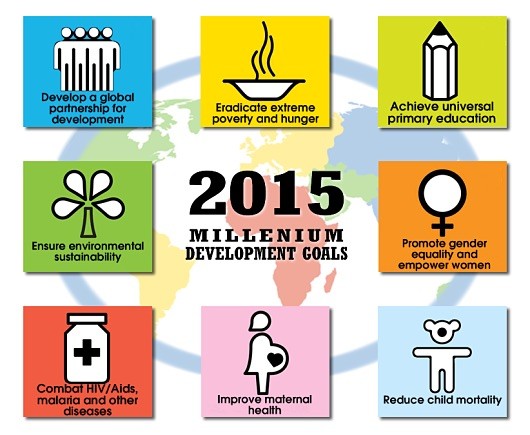
What Have the Millennium Development Goals Achieved? In 2000, the United Nations set out on a clearly defined mission to end global poverty by means of tackling eight core areas of need. Now we are looking back, 15 years later, and seeing how successful the UN was in meeting their goals-and where the new Sustainability Goals will need to take up the slack.

The Millennium Development Goals were designed as a framework for developing impoverished nations by addressing the most critical needs of the society, like reliable food sources, access to education, and adequate health care.
Each goal had specific targets which the United Nations hoped they would meet by 2015. Some goals had more success than others.

The UN’s goal of halving global poverty was met with resounding success, as the number of people living on less than one dollar and 25 cents a day dropped from one point nine billion in 1990, to 836 million in 2015. An estimated 14 percent of the global population are living in extreme poverty today, down from nearly half in 1990.

The reduction in the proportion of undernourished people globally narrowly missed its target, coming within two percent of the 50 percent reduction goal. Though narrowly missing their target, given the exponential human population growth over the last three two decades, it is still a considerable success.

The goals suffered two more near misses in their attempts to increase educational opportunities for all, including establishing gender equality in schools. An estimated 10 percent of children are not receiving any formal education, and only about two -thirds of developing countries have achieved gender equality in the classroom.

Goals four and five of the Millennium Goals, which addressed child and maternal mortality, respectively, both failed to meet their targets. While both the mortality rate of children under five and maternal deaths were reduced by over half, both failed to reach the two-thirds reduction target.

Goal six, stop and reverse the spread of HIV/AIDs, malaria, and other diseases was similarly not met in the given 15 year time frame. Although the rate of new HIV/AIDS infections has fallen by around 40 percent, an estimated two point one million people are still being infected annually. The fight against malaria and other diseases prevalent in developing areas has seen more success however, with an estimated six point two million malaria deaths averted between 2000 and 2015.

The final two goals of the 2000 Millennium Development Goals tackled strengthening infrastructure, sustainable development, and international partnership. While both goals are still on-going endeavors, over the last decade, two point six billion people have gained access to improved drinking water and official development assistance to developing nations has risen by nearly seven percent.

Overall, the United Nations has experienced great success in their struggle to address the needs of the poor around the world, but they are the first to admit that more work is needed. In the official Millennium Development Goals report, released earlier this month, Wu Hongbo Under-Secretary-General for Economic and Social Affairs admitted that success has been uneven across developing nations. “Millions of people are being left behind, especially the poorest and those disadvantaged because of their sex, age, disability, ethnicity or geographic location. Targeted efforts will be needed to reach the most vulnerable people,” said Hongbo.

The Quick and Dirty of Hits and Misses:
Goal #1: Target goal met and exceeded
Goal #2: Target goal nearly achieved
Goal #3: Not met
Goal #4: Not met
Goal #5: Not met
Goal #6: Not met
Goal #7: Target achieved ahead of schedule
Goal #8: No target specified, on-going action

The Sustainable Development Goals of 2015 will pick up where the Millennium Goals left off and continue to guide the United Nations as they work to eradicate global poverty.

– Gina Lehner

Sources: The Guardian, UN
Photo: Global Classrooms

July 9, 2015
https://borgenproject.org/wp-content/uploads/borgen-project-logo.svg 0 0 Borgen Project https://borgenproject.org/wp-content/uploads/borgen-project-logo.svg Borgen Project2015-07-09 15:02:462020-07-10 12:53:34What Have the Millennium Development Goals Achieved?
Aid, Aid Effectiveness & Reform, Food & Hunger, Food Aid, Global Poverty, Refugees and Displaced Persons

UN Scales Back Food Aid for Syrian Refugees

UN-Scales-Back-on-Food-Aid-for-Syrian-Refugees
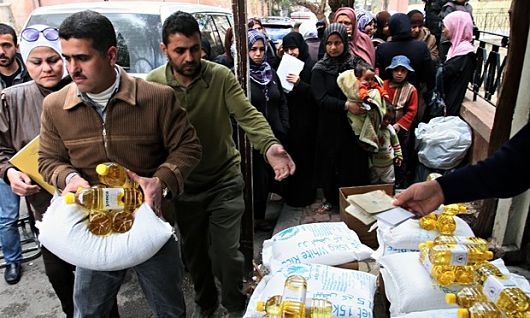
In the wake of large budget cuts and conflict with the Islamic State, or ISIS, the United Nations World Food Programme (WFP) is scaling back its food aid for more than 1.2 million Syrian refugees in Lebanon. These cuts will manifest themselves in the monthly food assistance vouchers that Syrian refugees receive. Normally valued at $19 per person, the vouchers will be reduced to $13.50 as of July.

Around 75% of Syrian refugee households in Lebanon are undergoing “some level of food insecurity,” according to a recent WFP survey. In addition, roughly 800,000 refugees in Lebanon qualify for food vouchers, and this scale-back is arriving right in the middle of Ramadan.

The WFP was banking on a ceasefire between ISIS and the Syrian government in order to let Syrian farmers harvest wheat stored in ISIS territory. No such ceasefire took place.

“That wheat that is harvested cannot be brought across lines of conflict into the area where it is needed most by people who are suffering now into a fifth year of this conflict,” WFP Executive Director Ertharin Cousin told the Associated Press.

A WFP press release issued earlier this month points out that the WFP’s refugee operations are currently 81% underfunded. The WFP is requesting $139 million in order to continue aiding refugees in Lebanon, Jordan, Egypt, Turkey and Iraq through the summer.

“We are extremely concerned about the impact these cuts will have on refugees and the countries that host them,” WFP Regional Director Muhammad Hadi told the U.N. News Centre. “Families are taking extreme measures to cope such as pulling their children out of school, skipping meals and getting into debt to survive. The long-term effects of this could be devastating.”

– Alexander Jones

Sources: McGuirk, UN, Wood
Photo: The Guardian

July 8, 2015
https://borgenproject.org/wp-content/uploads/borgen-project-logo.svg 0 0 Borgen Project https://borgenproject.org/wp-content/uploads/borgen-project-logo.svg Borgen Project2015-07-08 10:47:072024-06-11 02:48:08UN Scales Back Food Aid for Syrian Refugees
Aid Effectiveness & Reform, Global Poverty, Women

Women in Poverty: The Good, Bad and Ugly

women_in_poverty

If you have paid attention to any type of news recently, you likely know that women’s rights and equality have been a hot topic in the United States. These issues that women face—violence, employment issues, malnutrition and more—only multiple in developing and impoverished areas around the globe.

Among the tribulations women face are violence, malnutrition, lack of education, unemployment, less access to healthcare and family stress. All of these come in different forms, but with more than 3 billion people in the world living in poverty and 60 percent of those being women according to The Hunger Project, these factors influence billions of women and children every day.

Like in most poverty-based situations, there are positive aspects occurring as well as unpleasant and disturbing news.

The Ugly: Violence.

Domestic abuse, sex trafficking, childhood marriage and sexual exploitation all fall into the category of violence but are not limited to those forms of violence. Violence is one of the ugliest problems women around the world face, especially impoverished women.

UN Women reported that female children who are poor are “2.5 times more likely to marry in childhood than those living the wealthiest quintile.” If married as a child, girls’ likelihood to experience some form of sexual exploitation increases due to sexual encounters too early in life that are often forced relations.

On top of early marriage, sex trafficking is a widespread problem around the entire world. Sex trafficking occurs in places from the Mid-West of the United States to Central Europe, to highly impoverished areas of Africa.

This disheartening yet growing epidemic targets impoverished women and children specifically. UN Women classified them as being much more vulnerable to become victims of sex trafficking.

For these women and families living in poverty, changing their abusive reality is rarely an option. “Due to their lack of resources and income,” abusive households can provide some forms of security.

The Bad: Though just as ugly, there are numerous additonal troubles that women face while in poverty.

Malnutrition and a lack of healthcare are two of the largest and most threatening problems that women face. The Hunger Project found that “50 percent of pregnant women in developing countries lack proper maternal care,” which results in at least 240,000 deaths annually from pregnancies and childbirth.

The Hunger Project also reported that “1 out of 6 infants are born with a low birth weight in developing countries,” which is due to malnutrition and uncared for health issues in women.

In developing and impoverished areas, healthcare is scarce enough at it is. When healthcare is provided, males are often treated first because of their presumed ability to work more and hold more worth.

This often leaves women and children sickly and untreated. In most situations, men perform agricultural work to sell while women grow food for the family and tend to the children. If unwell, providing for and taking care of the family can become near impossible for these women.

Being uncared for and underfeed trickles down through the families. Nearly 45 percent of deaths in children the age of 5 are due to poor nutrition. With more than 3 million child deaths each year, an average of 8,500 children are dying each day due to malnutrition and a lack of healthcare. Most of these children, according to the Food and Agriculture Organization of the United Nations, are under the age of 5.

The difficulties of finding work and education as a women, can be added stressors. Again, work and education are luxuries in most developing countries, which when provided, often go to male prospects before women.

With such a disadvantage at hand, women face more obstacles in becoming educated and able to find a superior job that will allow them to take better care of their families.

The Good: Finally, there is good news for women in developing and impoverished areas.

More and more people around the globe are becoming informed about poverty and its difficulties especially for women and children. Poverty for any gender is a constant struggle, but the added stress for women is becoming increasingly apparent.

Through news outlets and by word of mouth, talk about poverty and ways to end it is spreading. Because of the work of organizations like The Hunger Project, UN Women, The Borgen Project and countless more, support and assistance is being sent to the most impoverished corners of the world.

A UN Women-supported project has begun to train families and women on how to become entrepreneurs of their own businesses and the economic ins and outs of it. The program has provided training for “more than 5,000 families in Kyrgyzstan and Tajikistan” so far and is equipping them with needed resources.

This is one example of the many organizations and projects that are working to improve the livelihood of people around the world and for women in poverty. Continuing to raise awareness regarding the overwhelming and frightening facts of our world is the first step to ending poverty for all genders and all ages.

– Katherine Wyant

Sources: UN Women, FAO, The Hunger Project
Photo: Grameen Foundation

July 1, 2015
https://borgenproject.org/wp-content/uploads/borgen-project-logo.svg 0 0 Borgen Project https://borgenproject.org/wp-content/uploads/borgen-project-logo.svg Borgen Project2015-07-01 08:29:442024-05-27 09:25:31Women in Poverty: The Good, Bad and Ugly
Aid Effectiveness & Reform, Development, Global Poverty, Women & Children

Poverty in Ahmedabad, India

Ahmedabad
With a population of around 8 million, the city of Ahmedabad is the largest in India’s western region of Gujarat. While India has long held a reputation for being one of the world’s least developed countries, it has steadily been shifting and is now one of the fastest growing developing countries. Poverty in India is starting to disappear; industry is thriving, literacy rates are increasing and the world community is beginning to see it as a real front-runner. There is no better example of this new shift in development than Ahmedabad.

Census information gathered in 2001 showed a literacy rate of around 79 percent. The next census, gathered in 2011, revealed a great increase, showing that around 85 percent of the population was literate. The first step in decreasing poverty is increasing education. For many years, India has faced issues with its large impoverished communities not allowing their children to attend school because they needed them to work in order to support the family. Now, with increased aid from various NGO’s and family structure organizations, Ahmedabad’s youth have been, for the most part, educated at least to an 8th grade level. This six percent gain is not the only leap that Ahmedabad has made.

When one imagines India, they might picture crowded streets, pollution, over-population, grand temples and the Taj Mahal, which would all suffice to describe it. However, recent census information has shown a 1.55 percent decrease in birthrates. While to some this may seem sad, it is quite the opposite. Many poor families will have upwards of 8 children in an attempt to have as many people working in order to support the family. Often, women are overwhelmed by the pressure to have kids, and with no safe methods of birth control available, many have more than ten in their lifetimes. While supporting 10 kids is hard enough, this amount of children can also be very detrimental to a woman’s health. Many women to die during childbirth. In the past few years, many women’s health organizations have gone to the slums of India to introduce birth control packs and condoms to the people. This decrease in birthrate is also accompanied by a 6 percent decrease in death rates of women during childbirth, as the amount of institutionalized deliveries has increased by 13 percent. While this may seem small, it marks a big change for the city of Ahmedabad and India as a whole.

As India continues to grow, poverty rates in Ahmedabad are decreasing. Occupying a large strip of the coastline, Gujarat is one of the best areas for businesses seeking to work overseas to take root. The business models in Gujarat and Ahmedabad have been described by UNICEF as “being a highly effective growth and private sector-driven model. In fact, the average growth rate of GDP in Gujarat over the past two decades has been higher than the national average, and more balanced than the other high growth-rate states.” This positive increase in GDP is primarily due to the agricultural and business sectors.

For now it looks like poverty is out and development is in for the great city of Ahmedabad, and this is a trend that the global community hopes to see a lot more of in the future.

— Sumita Tellakat

Sources: UNICEF India, Journal of Health Population and Nutrition, Ahmedabad Census 2011
Photo: Flickr

June 18, 2015
https://borgenproject.org/wp-content/uploads/borgen-project-logo.svg 0 0 Borgen Project https://borgenproject.org/wp-content/uploads/borgen-project-logo.svg Borgen Project2015-06-18 02:16:212024-05-27 09:24:15Poverty in Ahmedabad, India
Aid Effectiveness & Reform

AGOA’s Ticking Clock

ticking clockAs the expiration date for the African Growth and Opportunity Act (AGOA) of 2000 approaches in September, members of Congress are calling for a rapid-fire renewal process to protect the work that AGOA has accomplished so far.

Senate Finance Committee Chairman Orrin Hatch (R-Utah) and Ranking Member Senator Ron Wyden (D-Ore.), and House Ways and Means Committee Chairman Paul Ryan (R-Wisc.) and Sander Levin (D-Mich.) have introduced The AGOA Extension and Enhancement Act of 2015 that will renew the act for ten years.

Originally signed into law in May of 2000, the AGOA was a bipartisan initiative intended to strengthen economic relations between the United States and Africa. By creating trade preferences for African products that allowed for duty-free entry into the United States, the AGOA sought to provide an exclusive economic partnership with budding African industries and American consumers. The Brookings Institution, a Washington, DC-based think tank, estimates that the AGOA has created several hundred thousand direct s in Africa—particularly in textiles.

Under the agreement, eligible African nations would receive “unlimited duty free and quota free access to the U.S. market for apparel made in Africa from U.S. fabric and U.S. thread.” Several African nations saw unprecedented growth in exports to the United States. For example,  Kenya saw a 1,375% increase in exports to the U.S. between 2000 and 2001.

“The legislation [AGOA] has helped transform the economic landscape for Sub-Saharan Africa by stimulating new trade opportunities for African and Americans businesses, creating new jobs, and investments worth hundreds of millions of dollars,” wrote a U.S. Administration 2002 report.

The AGOA was initially set to expire in 2008 until a new round of legislation pushed the expiration date back to September 2015.

In addition to the African jobs created by the AGOA, there are many American jobs dependent on the trade network that this legislation has formed. The United States Trade Representative has estimated that exports to Africa are responsible for more than 120,000 American jobs. The AGOA has provided a level of security that have lead to a four-fold increase in exports to Africa—something that helped to pay thousands of salaries stateside.

“This legislation will promote American trade and strengthen our economic ties with important countries,” said Sen. Paul Ryan in April. “It will encourage our friends in Africa and Haiti to pursue free enterprise and solidify the rule of law. This legislation demonstrates that more trade can create opportunity at home and promote our economic values abroad.”

Brookings has argued that uncertainty over the act’s renewal could halt the progress made so far by the AGOA. Without the stability of the legislation, textile factories are less likely to receive orders in enough time to produce clothing for a new season of shopping. In the void left by the AGOA, competing manufacturers like China will be eager to step in and soak up the businesses that were once protected by the AGOA.

– Emma Betuel

Sources: WPI, IB Times, Brookings
Photo: Global Vison

June 1, 2015
https://borgenproject.org/wp-content/uploads/borgen-project-logo.svg 0 0 Borgen Project https://borgenproject.org/wp-content/uploads/borgen-project-logo.svg Borgen Project2015-06-01 01:55:552024-12-13 18:05:10AGOA’s Ticking Clock
Aid Effectiveness & Reform, Development, Global Poverty

Does Global Aid Really Work?

global_aid
People living in extreme poverty see an improvement in their living conditions when they earn just a little extra money from farming or raising livestock.

This is according to Dean Karlan, founder of Innovations for Poverty Action, or IPA. The nonprofit researches and evaluates different programs fighting world poverty so as to inform its own poverty-combating program initiatives.

Karlan studied economics in graduate school at the Massachusetts Institute of Technology and is now a professor at Yale. He began researching poverty and started IPA in order to answer the question, “Does global aid work?”

Prior to starting IPA, Karlan was displeased with how little research existed on global aid programs and their effects. It was impossible to know precisely how much people’s lives were improving due to aid.

This is an ongoing debate, and today, two polarizing views on global aid prevail. Some believe that the U.S. and other nations need to invest more, while others think that enough money has already been wasted on a fruitless cause. Through IPA, Karlan is working to produce tangible evidence about global aid to dispel the second view and, in turn, combat poverty.

Karlan and his colleagues ran a five-year-long experiment with the poorest families they could find in six developing countries. The team divided the families into two groups. The control group received nothing, while the other group was given a hefty aid package for up to two years. The package included livestock (for raising), livestock training, food or cash, a savings account and physical and mental health aid.

After observing both groups for the duration of the study, Karlan and his colleagues concluded that families who were given aid, made a little more money and had more food to eat than the control group. Moreover, families continued to generate more income a year after they stopped receiving aid.

Karlan reports, “We see mental health go up. Happiness go up. We even saw things like female power increase.”

The measured effect of aid was quite slim. Incomes and food consumption rates in the study increased only by about five percent in comparison to the control group. It is hard to forecast the long-term impact since the families were only observed for a year following the experiment.

Nonetheless, the aid package still has an impact in the short term for the participating families and appears to have promising long-term effects. Giving families an extra boost is exactly what may enable them to begin climbing out of extreme poverty, albeit slowly.

“Moving poverty is hard,” explains Sarah Baird, an economist at George Washington University. “[But] the fact that [Karlan and his colleagues] were able to move it, and it was sustainable after a year, I think is important.” The study supports the conclusion that aid from charities and governmental programs do have a positive impact.

A little bit of money can go a long way for those in extreme poverty. At the very least, it offers hope, and makes a difference for the families who receive it.

– Lillian Sickler

Sources: NPR, American Program Bureau, Innovations for Poverty Action
Photo: Flickr

May 29, 2015
https://borgenproject.org/wp-content/uploads/borgen-project-logo.svg 0 0 Borgen Project https://borgenproject.org/wp-content/uploads/borgen-project-logo.svg Borgen Project2015-05-29 04:00:552020-07-18 02:03:19Does Global Aid Really Work?
Page 5 of 16«‹34567›»

Get Smarter

  • Global Poverty 101
  • Global Poverty… The Good News
  • Global Poverty & U.S. Jobs
  • Global Poverty and National Security
  • Innovative Solutions to Poverty
  • Global Poverty & Aid FAQ’s
Search Search

Take Action

  • Call Congress
  • Email Congress
  • Donate
  • 30 Ways to Help
  • Volunteer Ops
  • Internships
  • Courses & Certificates
  • The Podcast
Borgen Project

“The Borgen Project is an incredible nonprofit organization that is addressing poverty and hunger and working towards ending them.”

-The Huffington Post

Inside The Borgen Project

  • Contact
  • About
  • Financials
  • President
  • Board of Directors
  • Board of Advisors

International Links

  • UK Email Parliament
  • UK Donate
  • Canada Email Parliament

Get Smarter

  • Global Poverty 101
  • Global Poverty… The Good News
  • Global Poverty & U.S. Jobs
  • Global Poverty and National Security
  • Innovative Solutions to Poverty
  • Global Poverty & Aid FAQ’s

Ways to Help

  • Call Congress
  • Email Congress
  • Donate
  • 30 Ways to Help
  • Volunteer Ops
  • Internships
  • Courses & Certificates
  • The Podcast
Scroll to top Scroll to top Scroll to top