• Link to X
  • Link to Facebook
  • Link to Instagram
  • Link to TikTok
  • Link to Youtube
  • About
    • About Us
      • President
      • Board of Directors
      • Board of Advisors
      • Financials
      • Our Methodology
      • Success Tracker
      • Contact
  • Act Now
    • 30 Ways to Help
      • Email Congress
      • Call Congress
      • Volunteer
      • Courses & Certificates
      • Be a Donor
    • Internships
      • In-Office Internships
      • Remote Internships
    • Legislation
      • Politics 101
  • The Blog
  • The Podcast
  • Magazine
  • Donate
  • Click to open the search input field Click to open the search input field Search
  • Menu Menu

Archive for category: Aid Effectiveness & Reform

Information and stories about aid effectiveness and reform

Aid, Aid Effectiveness & Reform, Global Poverty, Humanitarian Aid

Voucher Programs: Way to Transfer Humanitarian Dollars

Voucher Programs: A Better Way to Transfer Humanitarian Dollars?
When it comes to helping the world’s poor, sometimes questions come up that the average person might never have considered.

Once there is an organization or a group that is willing to provide help, how will they do it? What does “providing resources” mean? How are “resources” defined?

There’re a few different ways for aid to be brought in the direct transfer of goods, such as food, clothing and other necessities, from humanitarian groups to the people in need.

However, there are also the methods of providing the impoverished with cash so that they can purchase the goods they deem necessary for themselves.

As Owen Barder, chair of the High Level Panel on Humanitarian Cash Transfers puts out, “A good starting point for our work is the acknowledgment that people are a good judge of what they need, and we should always think twice before putting our judgment ahead of theirs.”

Providing cash-based aid also has the potential to stimulate local economies, as recipients spend the money at small businesses and help their communities to thrive.

According to a study in the Journal of Development Effectiveness published last year, direct provision of cash is the cheapest way to bring aid, with costs coming to $2.99 per transfer. To put this in perspective, providing food directly came out to $11.46 per transfer because of all of the costs to store, package and distribute the food.

To some, it might seem unnecessarily expensive to provide food and other materials directly to those in need. To others, the idea of giving destitute, uneducated people a set sum of cash to spend whatever way they would like doesn’t make much sense, either.voucher_programs

Even assuming every recipient is perfectly ethical, is it safe to assume all of those in need have enough knowledge of nutrition and savvy spending?

Voucher programs, theoretically, are sort of a happy medium between the benefits of cash transfer and direct resource provision. Only slightly more expensive than direct cash at $3.27 per transfer, in the study, vouchers are like certificates redeemable for specific items, usually food.

Vouchers have the benefit of stimulating local economies without the corruption and security risk present with cash transfers. Voucher programs allow those in need to receive the most nutritious food available without the expense associated with food aid.

Vouchers are not the ultimate, game-ending form of humanitarian aid. Different situations will call for different ways to provide aid. (For example, when providing immunizations, it makes far more sense to simply provide the immunizations themselves en masse, rather than money for each individual to get immunized.)

However, it seems that this form of help is relatively underrated when compared to food and cash aid.

They can be used locally, they are relatively cheap to provide and when they are used at events such as voucher fairs, they offer recipients freedom to spend the aid on what they choose, within a specific context of essential items. Fairs like these can even help to address issues like gender inequality.

Said one woman at a voucher fair held by UNICEF in the Democratic Republic of Congo, “Before we came here, my husband and I discussed what we need. In the past, he did what he wanted with our money, but here it’s me who takes the final decision.”

Paul Harvey and Sarah Bailey said it well in a brief for The Overseas Development Institute (ODI). “Humanitarian organizations provide assistance based on agreed principles and standards. At its heart is the principle of humanity – the universal impulse to seek assistance and to provide it to those in need.”

– Emily Dieckman

Sources: CGDEV, Europa , ODI, Research Gate, TUFTS, UNICEF
Photo: Flickr1, Flickr2
September 26, 2015
https://borgenproject.org/wp-content/uploads/borgen-project-logo.svg 0 0 Borgen Project https://borgenproject.org/wp-content/uploads/borgen-project-logo.svg Borgen Project2015-09-26 01:30:152024-12-13 18:05:05Voucher Programs: Way to Transfer Humanitarian Dollars
Aid Effectiveness & Reform, Global Poverty

Kabul City: On the Road to Improvement

Kabul City: On the Road to Improvement
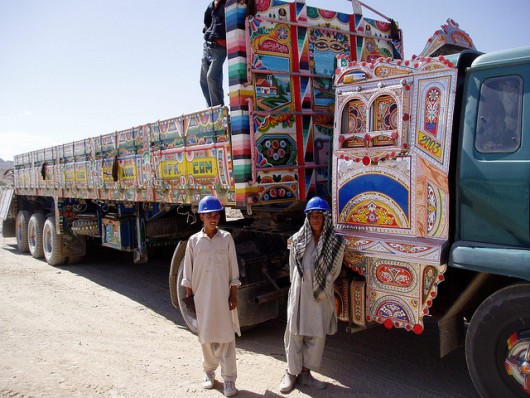
When we think of a “bad road,” often times we conjure an image of driving over narrow, uneven or pot-holed ridden paths, usually in the heart of a city or perhaps out in the middle of nowhere. But what if the main road we traversed in our walk to school every day or commute to work was in a state of even worse condition—unpaved and muddy, invisible beneath a cloud of dust?

For residents living in the Qala-e-Zaman Khan neighborhood in Kabul, traveling on roads which match this description was an everyday occurrence. A five minute walk to school became a 20 minute one, with students changing out of their mud-caked clothing several times a day, while also becoming more susceptible to illness as a result of breathing in the perpetual dust.

Left almost untouched for nearly half a century, the need for infrastructural improvements for roads in the neighborhood of Qala-e-Zaman Khan was dire. Fortunately, with the support of the Kabul Municipal Development Program (KMDP), implemented by the Kabul Municipality, a project to build and pave roads could finally begin.

This program was funded by a grant equaling $110 million from the Afghanistan Reconstruction Trust Fund (ARTF). Established in 2002, the ARTF provides a financial vehicle for the government of Afghanistan’s budget, allowing them to make a significant difference in areas such as education, health, agriculture, rural development, infrastructure and governance.

Aside from improving street conditions, an article from The World Bank states that the KMDP organization has more goals in store.

“KMDP’s objectives are to increase access to basic municipal services in selected residential areas of Kabul city; redesign Kabul Municipality’s Financial Management System to support better service delivery; and enable early response in the event of a relevant emergency.”

Since the creation of newly paved roads in this area of Kabul, the quality of living has improved for its people. Shopkeepers have seen their income double now that dust no longer settles on food. Children don’t dread the mud-splattered walks to school, taxi cabs have reduced their fares and those seeking hospitals save time on the newly constructed streets.

The KMDP plans to reach at least 770,000 people with their services throughout the 1,770 hectares of government-owned land. So far, at least 618 hectares have been improved.

The organization has also funded over 310,000 beneficiaries comprising over 100,000 from upgraded roads and more than 210,000 from trunk roads. At least 76,000 indirect beneficiaries have also benefited, including students and staff of schools and institutions of higher education.

With the construction of asphalt roads in neighborhoods that have only known dust and mud-covered paths, residents embrace the positive outcomes that continue to surface with each new step.

– Nikki Schaffer

Sources: World Bank, ARTF
Photo: Flickr

September 23, 2015
https://borgenproject.org/wp-content/uploads/borgen-project-logo.svg 0 0 Borgen Project https://borgenproject.org/wp-content/uploads/borgen-project-logo.svg Borgen Project2015-09-23 01:30:252020-06-26 12:59:10Kabul City: On the Road to Improvement
Aid Effectiveness & Reform, Global Poverty

Big Gains Seen in Socially Responsible Investments

New Report Reveals Dramatic Growth in Impact Investments
Socially Responsible Investments (SRI), those that pay attention to the environmental and social impacts of what they fund while still turning a profit, have ballooned. The Forum for Sustainable and Responsible Investment, an association for professionals and organizations engaged in sustainable, responsible, and impact investing, recently released a report detailing the growth of SRI in the United States, showing huge increases in funding.

Coming in at over $6.5 trillion in 2014, the Socially Responsible Investments market in the United States has shown a 76 percent increase since 2012 and has grown nearly tenfold from 1995. “These assets account for more than one out of every six dollars under professional management in the United States,” the report states. The dollar amount is over 200 times larger than the annual flow of Official Development Assistance from the United States.

The growth in SRI is not limited to the United States. The Global Sustainable Investment Alliance, a worldwide collaboration of sustainable investment organizations takes a broader view, looking at the amount of money invested in SRI around the world by region.

In 2014, $21.4 trillion was tied up in SRI around the globe, an increase of $8.1 trillion from two years previously. Europe leads the pack, with 63.7 percent of the total, more than doubling the amount held by the United States. Canada contributes 4.4 of the share, an impressive number considering its relatively small population. In fact, per capita SRI in Canada is higher than the United States. These three regions contribute 99 percent of the total, with Asia and Australia/New Zealand taking .2 and .8 percent respectively.

Europe also has the highest proportion of SRI to total managed assets, with 58.8 percent of all investments channeled towards socially beneficial growth. The global average is just over 30 percent and has grown nearly 50 percent in the last two years.

To be sure, foreign investment by governments to aid developing nations must also be strong. “The global challenges are so complex and the size of the funding that’s needed is so large, traditional funding sources like philanthropy are probably not going to be sufficient to meet it,” said Anna Kearney, associate director for corporate social responsibility at the Bank of New York Mellon (BNY Mellon), in July.

In addition, the issue of how much of SRI ends up aiding environmental and social development in the developing world is unclear.

However, the Global Impact Investing Network — a nonprofit working to scale up impact investing — sheds some light on the answer. The group surveyed 146 SRI firms around the globe and found that 48 percent of the $60 billion under management by these firms was invested in emerging markets. That may be a proxy for the ratio of the $21.4 trillion in SRI that is invested in developing economies.

The trajectory for SRI remains promising. As more consumers look to put their money toward helping the planet and the poor while earning a profit, a growth in investment options that offer this will follow.

– John Wachter

Sources: Forum for Sustainable and Responsible Investment 1, Forum for Sustainable and Responsible Investment 2, Global Impact Investing Network, Global Sustainable Investment Alliance, The Guardian, Organization for Economic Cooperation and Development
Photo: Flickr

September 20, 2015
https://borgenproject.org/wp-content/uploads/borgen-project-logo.svg 0 0 Borgen Project https://borgenproject.org/wp-content/uploads/borgen-project-logo.svg Borgen Project2015-09-20 01:50:512024-05-27 09:27:20Big Gains Seen in Socially Responsible Investments
Activism, Aid Effectiveness & Reform, Charity, Global Poverty, Nonprofit Organizations and NGOs

St. George’s Crypt Makes Progress to Help those in Need

St. George’s Crypt Makes Progress to Help those in Need
Founded in the 1930s, St. George’s Crypt became a charitable group that has helped local people for generations. In its beginnings, the small church began charitable functions and fundraising from local people, run by Reverend Percy Donald, known as the Don.

Throughout its existence the function of the organization has shifted to satisfy the needs of the people and the events occurring around the neighborhood, such as assistance for those affected by war, illness, and the impact of a devastating economic downturn.

As the group’s website states, one of the objectives of the organization is to assist in “the relief of poverty, hardship, sickness and distress among needy and destitute persons,” and recently St. George’s Crypt has taken their efforts to help people even further.

In 2011, The Crypt set up purchase shops that would benefit more people in the area. More recently, the organization has done even more as it has invested more money into building homes for struggling families in the area.

A development project recently gave the group £1.5 million to spend on infrastructure, and the building of 20 new homes for those in need. These properties will act as “halfway houses” to help individuals as well as families get back on their feet, and create more sustainable lifestyles, and smarter economic practices.

The outreach of support for those in need knows no limits, helping those that are homeless, ill, suffering the vulnerabilities of recent catastrophes, and even those suffering from addiction. One of these housing developments will include a hostel in Hyde Park, which will house a larger number of people at a time for a shorter period of time.

When small organizations such as these expand over the years, even over 85 years such as the St. George’s Crypt, it gives hope that there is potential for anyone to make a difference in their communities. To learn more about St. George’s Crypt and the work they continue to do for those in need in their community, go to their website.

– Alexandrea Jacinto

Sources: St. George’s Crypt, BBC
Photo: Flickr

September 18, 2015
https://borgenproject.org/wp-content/uploads/borgen-project-logo.svg 0 0 Borgen Project https://borgenproject.org/wp-content/uploads/borgen-project-logo.svg Borgen Project2015-09-18 01:30:402024-05-27 09:27:38St. George’s Crypt Makes Progress to Help those in Need
Aid, Aid Effectiveness & Reform, Global Poverty, Humanitarian Aid

Humanitarian Response Faces Increasing Pressure to Reform

Humanitarian_Response
The humanitarian system is facing increasing demand to reform its approach to crisis response. The demands are for the system to become more flexible and transparent in order to better meet needs, utilize resources more efficiently as well as improve local capacity. But, why now?

Our world is changing rapidly and there is an increasing demand to solve new problems in an ever-changing world of ongoing conflict. As a result, UN’s Secretary-General has initiated the World Humanitarian Summit to be held in Istanbul on May 23-24, 2016, where he seeks to challenge the ways humanitarian organizations work together to deliver aid and save lives.

In 2014, $23 billion was spent on crisis response. Yet, the international emergency aid system is still failing vulnerable regions such as Syria and Ukraine.

IRIN, an independent, nonprofit news organization, suggested various ways UN humanitarianism could change to Ertharin Cousin, head of the World Food Programme (WFP), and Kyung-wha Kang, Assistant Secretary-General of the UN’s humanitarian coordination body, OCHA.

Among the many ideas for reform is localizing the humanitarian response system. This not only involves having the local communities making crisis response decisions, but also changing the humanitarian funding methods. Currently, larger organizations such as OCHA and WFP receive the vast majority of the funding, while local organizations receive little funding.

Another important reform proposal, is making the top jobs available to everyone, not just permanent members of the Security Council. This is something the UN has been heavily criticized for.

Having only people on the inside of the organization and not bringing an outside perspective is definitely not conducive to change. It’s also not conducive to avoiding politicisation, one of the many causes of humanitarian problems.

Despite all of these ideas, the question still remains – is reform the answer to a more efficacious humanitarian response system or should we get rid of the system all together?

– Paula Acevedo

Sources: IRIN News, World Humanitarian Summit
Photo: Flickr

September 10, 2015
https://borgenproject.org/wp-content/uploads/borgen-project-logo.svg 0 0 Borgen Project https://borgenproject.org/wp-content/uploads/borgen-project-logo.svg Borgen Project2015-09-10 04:30:442024-05-27 09:27:44Humanitarian Response Faces Increasing Pressure to Reform
Aid Effectiveness & Reform, Education, Global Poverty, Sustainable Development Goals

Education and the Sustainable Development Goals

Education and the Sustainable Development GoalsLong idolized were the Millennium Development Goals, a set of eight targets created and adopted by the United Nations in 2000. Central to their aim was the eradication of global poverty by improving maternal health and access to clean water, food and education while reducing the number of people living on under $1.25 a day across the developing world.
However, the days of the Millennium Development Goals are over. They expired this year after 15 years mixed with success and failure. A new set of global development goals is now on the horizon: the Sustainable Development Goals. Once again, there will be a specific goal tailored to improve equal education access for all. But before delving into how that goal is currently shaping up, it is worth examining how education fared with the Millennium Development Goals.

Goal two of The Millennium Development Goals aimed to achieve universal primary education. The goal only had one target: “ensure that, by 2015, children everywhere, boys and girls alike, will be able to complete a full course of primary schooling.”

Unfortunately, this target was not met. On the bright side, the number of children globally that now attend primary school has risen dramatically since 1990. Enrollment in the developing world has risen to 91 percent, but the goal was for universal primary education, meaning all children everywhere. There is also still a fairly large gender gap in some areas. Of the 57 million kids out of school, 33 million are in Sub-Saharan Africa and 55 percent of those 33 million children are girls.

So where are the Sustainable Development Goals heading in terms of education development in the next 15 years? First off, education gets another specific goal for itself. The target this time is to “ensure inclusive and equitable quality education and promote lifelong learning opportunities for all,” not all that different from the Millennium Development Goal before it.

The Sustainable Development Goals’ “vision is to transform lives through education, recognizing the important role of education as a main driver of development.” Looking to continue with the progress created by the Millennium Development Goals, goal four of the Sustainable Development Goals will look to expand access to all by providing 12 years of free, publicly-funded, high-quality equal education. Nine of these years will be compulsory.

Particular emphasis is put on the quality of education going forward. By increasing quality of education, the 100-year education gap between the developed and developing has the potential to be reduced. Another benefit of an improvement in the quality of education is that it will improve learning outcomes. How can this be done? By “strengthening inputs, processes and evaluation of outcomes and mechanisms to measure progress.”

Another facet to quality education is ensuring that the teachers are well trained, empowered, motivated and supported. This ensures a higher level of quality when it comes to education.

Often seen as a gateway out of poverty, education is an extremely important issue when it comes to development in the developing world. It will be interesting to track the evolution of the Sustainable Development Goals’ development toward a fully-fledged goal. Hopefully, it can continue the inroads created by the Millennium Development Goals and improve education for the millions of children without it.

– Gregory Baker

Sources: UNDP, UNESCO UN Millennium Goals, UN Sustainable Development,
Photo: Flickr

September 3, 2015
https://borgenproject.org/wp-content/uploads/borgen-project-logo.svg 0 0 Borgen Project https://borgenproject.org/wp-content/uploads/borgen-project-logo.svg Borgen Project2015-09-03 09:41:122024-06-04 04:33:48Education and the Sustainable Development Goals
Aid Effectiveness & Reform, Food Aid, Global Poverty

Changes to US Food for Peace to Increase Sustainability

Changes to Food for Peace to Increase Sustainability
Sixty years after being put into effect, the Food for Peace program faces congressional reform that will lower costs and provide sustainable support for those living in conflict-ridden countries. Currently, law requires that food aid be grown in and shipped from the U.S. – a mandate that increases costs 25-50 percent more than they would be on the current market. Advocates for reform criticize the program for its inefficiency and helping American shipping and farming businesses profit from such programs.

Shipping firms, farms and some NGOs form an “iron triangle of special interests” that have benefited from international aid and attracted criticism from politicians in both parties. Between 2004 and 2013, 88 percent of USAID funding was used to harvest and ship food- a huge cost that decreased the amount of food the organization was able to provide by 64 percent.

A system designed this way is not only inefficient in properly allocating resources, but also counterproductive in affecting any kind of change in the countries that need it most. Daniel Maxwell, professor and research director at the Feinstein International Center at Tufts University, commented, “We need to support local agricultural producers and markets, or at a minimum, not undermine them.” Reformers advocate for changing the system to implement locally grown and shipped food resources rather than those from the U.S.

Senators Corker and Coons, who are cosponsoring the reform of the bill, have estimated that such changes could expand the program’s reach by 12 million people and free up $440 million through local, sustainable production. Providing support for local growers and shippers will strengthen local economies rather than keeping them reliant on international resources, empower and employ more people, and create a more sustainable rebuilding of communities.

Eric Munoz at Oxfam America says that a program created 60 years ago is not useful or appropriate for current times. Indeed, when 60 million people per year are in need of food aid, expansion of resources and lowering costs is more greatly needed than ever. Many farmers believe they have a right to profit from food aid programs and would suffer from reforms, but experts estimate such programs amount to only 1 percent of agribusiness profits.

For policy changes that would so greatly impact those in need, lessening the profits of huge farming businesses in the U.S. seems trivial. Worrying about this profit loss is “an inappropriate way of viewing the rationale of providing emergency assistance and foreign assistance, particularly assistance that is meant to address food insecurity in complex crises like Syria or South Sudan,” says Munoz.

Corker and Coon’s reform bill will see congressional debate in September.

– Jenny Wheeler

Sources: IRIN 1, IRIN 2
Photo: Flickr


August 29, 2015
https://borgenproject.org/wp-content/uploads/borgen-project-logo.svg 0 0 Borgen Project https://borgenproject.org/wp-content/uploads/borgen-project-logo.svg Borgen Project2015-08-29 01:30:392024-05-27 09:27:17Changes to US Food for Peace to Increase Sustainability
Aid, Aid Effectiveness & Reform, Global Poverty, Health

5 Ways to Ensure Effective Health Aid Dispersal

Health AidNot all aid is created equal. In the fight against global poverty, ensuring sufficient funds for aid programs is only half the battle. The other half is ensuring that aid is results-oriented, transparent, expedient and cost-effective.

During the second High-Level Forum on Aid Effectiveness in Paris in 2005, the Organization for Economic Cooperation and Development (OECD) countries formulated the Paris Declaration. This declaration was meant to set benchmarks for how to measure the five key categories of effective aid: ownership, alignment, harmonization, results and mutual accountability.

While these five categories are intended to measure the effectiveness of all kinds of aid, they are particularly pertinent to health aid. Developing public health infrastructure in poorer countries is the “gift that keeps on giving,” ideally continuing to serve local populations well after aid has ceased. Thus, a robust public health outcome is an ideal metric to judge the quality of aid using the five categories of the Paris Declaration.

1. Ownership

Ownership, according to the Paris Declaration, involves partner countries exercising “effective leadership over their development policies and strategies.” This category is a measurement of how much aid recipients are involved in developing and executing programs that actually take advantage of the aid they are receiving. Aid strategies have traditionally assumed that once a country reaches middle-income status, it will have sufficient resources and self-interest to invest in public health, but unfortunately, this is not always the case.

For example, Nigeria is technically a middle-income country, but it spends less on public health than Rwanda, which a low-income country. Health aid can really only be considered effective if countries take ownership of health programs that outlive donor support as the country transitions into middle-income status.

Ownership is especially important given a recent estimate by the World Health Organization that predicts that in the next few decades, there will be a global health workforce shortage of up to 12.9 million. Aid programs need to ensure that recipients are developing adequate long-term strategies, especially when it comes to investing in health training and education.

2. Alignment

The dimension of alignment measures how well aid matches up with recipient strategies for dispersal and development. Development experts often criticize “tied” aid. This is aid that is contingent on the recipient procuring health products from the donor country, using their distribution infrastructure, employing foreign personnel or involving some other condition which is often not the most cost-effective or desirable for the recipient. Alignment essentially means “untying” aid to make sure that it aligns closely with the national development strategy of the recipient country.

A topical example of the alignment of health aid in the Global Food Security Act of 2015. This bill, currently introduced to the House and awaiting consideration, encourages local procurement of food aid for U.S. aid programs (among other things). Traditionally, food aid dispersal from the U.S. has been tied, requiring that a certain percentage of that aid be procured from the U.S. and dispersed using the U.S. merchant marine.

However, this bill seeks to do away with those requirements and favors recipient-country producers. This encourages the growth of local agriculture and health aid infrastructure, rather than out-competing them. Additionally, local procurement is faster, and in the event of a humanitarian emergency, recipient populations would not have to wait as long for foreign aid to reach them.

3. Harmonization

Harmonization involves cutting down on the plurality of programs that may have the same goal yet interfere and undermine each other. An aid recipient country may be host to dozens of organizations or programs that target public health outcomes yet do not communicate with each other, thus creating redundancies or inefficiency.

Harmonization is especially critical to public health, more so in emergencies. Currently, there is no standard system whereby donors can track and share how much and to where health aid is going, making it difficult to determine where it is most needed. The recent Ebola epidemic was a particularly disastrous indication of the need for better logistics and donor coordination; it is difficult to tell if health aid has even reached a recipient population, much less if it is redundant, or necessary.

4. Results

Just as it is important to harmonize aid efforts, tracking the progress of health programs has also been an ongoing challenge for donors and recipients. Health aid, despite good intentions, can be totally ineffective when it isn’t results-oriented. Tracking public health outcomes generally involves better data collection and census practices, which can be incredibly difficult to implement in developing countries that lack basic infrastructure.

Very recently, the Girls Count Act passed the U.S. House of Representatives. This act directs the Secretary of State as well as the United States Agency for International Aid and Development (USAID) to work with developing countries to build adequate civil registration systems as well as create economic and social policies that are deliberately inclusive of women and girls. The idea is that better demographic data and inclusive policy can help traditionally marginalized populations (such as women) take advantage of existing social safety nets. Additionally, better demographic data would lead to more effective health aid, as donors often lack access to accurate census information and thus may be unaware of vulnerable populations, or unable to determine the impact of aid.

5. Mutual Accountability

The final category calls for recipients and donors to exercise “mutual accountability and transparency in the use of development resources.” This emphasis on accountability stems from a history of aid inefficiencies due to a lack of transparency, or even outright corruption in recipient countries. For example, millions of dollars in aid money were simply pocketed by corrupt dictator Mobutu Sese Seko of the Republic of Zaire (now the Democratic Republic of Congo) during the ’70s and ’80s.

Conversely, donor countries must be transparent about where aid flows are going in order to provide recipient countries (as well as other donors) with accurate information they can present to their citizens. In general, developing genuine partnerships between donors and recipients is crucial in ensuring that resulting health and development programs are effective and long-lasting.

– Derek Marion

Sources: Reuters, Devex, Partners in Health, OECD
Photo: OECD

August 8, 2015
https://borgenproject.org/wp-content/uploads/borgen-project-logo.svg 0 0 Borgen Project https://borgenproject.org/wp-content/uploads/borgen-project-logo.svg Borgen Project2015-08-08 01:30:292024-12-13 17:51:585 Ways to Ensure Effective Health Aid Dispersal
Activism, Advocacy, Aid Effectiveness & Reform, Global Poverty, United Nations

Action/2015 Progress by Month

action_2015
For Action/2015, “This is our year.” The coalition of more than 1,950 organizations worldwide is carving a brighter future in order to make 2015 the year of action and change. The agenda includes tackling climate change, poverty, and inequality, and so far, Action/2015 made substantial progress through key campaigning and advocacy events.

January
Action/2015 launch:
On January 15, 2015, Action/2015 launched campaigns all over the world from Mali, Mexico, Senegal, Sri Lanka, Uganda, and the UK to name a few. Twitter helped spread #Action2015 to millions of people.

March
International Women’s Day:
On March 8, 2015, the coalition held street marches and rallies around the work in support of women’s rights. They could be spotted from the UK, Nicaragua, Spain, Ecuador, New York City, Bangladesh, Spain, and South Africa.

April
Global Citizen 2015 Earth Day:
The coalition mobilized its campaign via Twitter, Instagram, and Facebook, in order to address the annual spring meeting of the World Bank held in Washington D.C. #Hero, addressed the world’s Finance Ministers to fund poverty reduction projects such as the Sustainable Development Goals and Climate Goals.

May
Throughout the month, Action/2015 campaigned to pressure world leaders attending the Post-2015 Sustainable Development Goal Summit in September and the COP21 climate negotiations in December. More than 22 million advocates in 150 countries held events to call for change. In Kenya, the President responsively agreed to a 12 percent pay increase for workers.

May’s Days of Actions guided support through various themes of change. May 1 was Yes to Labour Rights, No to Social Exclusion Day, and May 13 was Poverty is Sexist Day. Among more, these days calling for global action complemented other events like Citizen Heartings, community sports days, caravans, and concerts.

June
The G7 Summit was held on June 7-8 in Germany. The coalition played its part by taking to Twitter to stand #AgainstPoverty. Many participants were also a part of a free concert, United Against Poverty, also calling to the G7 leaders for greater attention to end poverty.

July
The Financing for Development was held on July 13-16 in Addis Ababa, Ethiopia. Just before the conference, 4.8 million coalition events in 150 countries rallied to demand that world leaders “meet outstanding sending commitments, fight structural injustices of unfair tax, and many other issues.”

August
International Youth Day unleashed #YouthPower. Sri Lanka, South Africa, Brazil, and Benin hosted marches, workshops, political meetings, flash mobs in honor of the movement. The coalition offered guidance through the options to download from their website, International Youth Day toolkits, YouthPower Workshop plans, and contact the team for direct consultation.

September
The United Nations General Assembly will take place on September 15-28. The world’s most influential leaders will meet to conclude the Millennium Development Goals and create a new set of Sustainable Development Goals. The coalition is scheduling September 24 as a Global Day of Action for global mobilization.

November-December
From November 20 to December 11, Paris will host the UN Climate Change Conference. Action/2015 advocates will join around the globe to pressure their world leaders for stronger leadership and progress in poverty reduction.

– Lin Sabones

Sources: Action/2015 1, Action/2015 2, Action/2015 3, Action/2015 4, Action/2015 5, Action/2015 6, Action/2015 7, Action/2015 8, Action/2015 9, World Bank
Photo: Restless Development

August 8, 2015
https://borgenproject.org/wp-content/uploads/borgen-project-logo.svg 0 0 Borgen Project https://borgenproject.org/wp-content/uploads/borgen-project-logo.svg Borgen Project2015-08-08 01:30:162024-05-27 09:27:18Action/2015 Progress by Month
Advocacy, Aid Effectiveness & Reform, Global Poverty

Charity Versus Chauvinism: Successful Working Methodology at BRAC

BRACAmidst the daily fight against global poverty levels, success stories arise from one of the world’s largest development charities. Recently awarded the World Food Prize for successfully pulling more than 150 million people in developing countries out of poor living conditions, Fazel Hasan Abed, founder of the Bangladeshi charity BRAC, seems to have stumbled upon a working methodology.

What makes this methodology different from other approaches can be found in the difference between chauvinism and charity. Chauvinistic approaches to world aid portray a very “hands-off” tactic, whereas charity clearly sets out to give direct help to those in need.

Many IGOs are now looking to out-source the BRAC method. This method utilizes a short amount of time, 24 months, and a high amount of pressure on developing communities in order to produce the greatest results.

The first step is to determine the target individuals of aid by looking at the “determinants of poverty” – little to no healthcare availability, no livelihood skills or capital, low self-esteem and illiteracy, as well as social exclusion. This is done through “participatory wealth ranking,” which directly engages the community.

Next, the individuals are provided with adequate resources and taught fundamentals through “asset grants.” Fundamentals include different livelihood skills and literacy abilities, such as being able to write his or her name for the first time.

The last tactic is monitoring. Arguably, this demonstrates the importance of such a hands-on approach and in fact is referred to as the “hand-holding” step. Progress is closely supervised. For two years the individuals receive direct assistance and have proven that these individuals are able to maintain a better quality of life over the next four years after they “graduate” the BRAC system.

While this methodology might seem a “brute force approach” concerning its direct and hands-on elements, it proves to be the most effective. BRAC is smart, efficient, and proven to work. It targets the “ultra-poor” specifically, sets goals and drives the ball home until the individuals have successfully been pulled out of poor living conditions.

– Felicia L. Warren

Sources: The Guardian
Photo: Flickr

July 27, 2015
https://borgenproject.org/wp-content/uploads/borgen-project-logo.svg 0 0 Borgen Project https://borgenproject.org/wp-content/uploads/borgen-project-logo.svg Borgen Project2015-07-27 12:58:232020-07-10 18:02:44Charity Versus Chauvinism: Successful Working Methodology at BRAC
Page 4 of 16«‹23456›»

Get Smarter

  • Global Poverty 101
  • Global Poverty… The Good News
  • Global Poverty & U.S. Jobs
  • Global Poverty and National Security
  • Innovative Solutions to Poverty
  • Global Poverty & Aid FAQ’s
Search Search

Take Action

  • Call Congress
  • Email Congress
  • Donate
  • 30 Ways to Help
  • Volunteer Ops
  • Internships
  • Courses & Certificates
  • The Podcast
Borgen Project

“The Borgen Project is an incredible nonprofit organization that is addressing poverty and hunger and working towards ending them.”

-The Huffington Post

Inside The Borgen Project

  • Contact
  • About
  • Financials
  • President
  • Board of Directors
  • Board of Advisors

International Links

  • UK Email Parliament
  • UK Donate
  • Canada Email Parliament

Get Smarter

  • Global Poverty 101
  • Global Poverty… The Good News
  • Global Poverty & U.S. Jobs
  • Global Poverty and National Security
  • Innovative Solutions to Poverty
  • Global Poverty & Aid FAQ’s

Ways to Help

  • Call Congress
  • Email Congress
  • Donate
  • 30 Ways to Help
  • Volunteer Ops
  • Internships
  • Courses & Certificates
  • The Podcast
Scroll to top Scroll to top Scroll to top