• Link to X
  • Link to Facebook
  • Link to Instagram
  • Link to TikTok
  • Link to Youtube
  • About
    • About Us
      • President
      • Board of Directors
      • Board of Advisors
      • Financials
      • Our Methodology
      • Success Tracker
      • Contact
  • Act Now
    • 30 Ways to Help
      • Email Congress
      • Call Congress
      • Volunteer
      • Courses & Certificates
      • Be a Donor
    • Internships
      • In-Office Internships
      • Remote Internships
    • Legislation
      • Politics 101
  • The Blog
  • The Podcast
  • Magazine
  • Donate
  • Click to open the search input field Click to open the search input field Search
  • Menu Menu

Tag Archive for: United States

Posts

Aid, Global Poverty, United Nations, USAID

10 Facts About the International Affairs Budget


International Affairs Budget

The Trump Administration recently released its federal budget proposal for Fiscal Year 2018 (FY18), proposing deep cuts for the International Affairs Budget. The proposal includes plans to cut State Department and USAID funding by 31 percent and the Treasury International Programs budget by 35 percent. The proposed $37.6 billion total budget cut for the State Department and USAID starkly contrasts the $54 billion increase proposed for the Department of Defense.

There has already been pushback to the proposal, including a letter signed by more than 120 retired generals and admirals against the cuts, and another opposition letter signed by more than 100 faith leaders.

Top 10 things you need to know about the International Affairs Budget

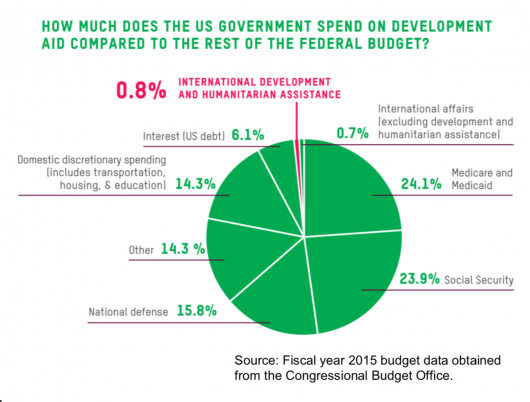
  1. It’s tiny. The International Affairs Budget accounts for less than one percent of the federal budget. The amount spent on foreign aid is often overestimated by the general public. A Kaiser Family Foundation poll published in 2015 asked respondents: “What percentage of the federal budget is spent on foreign aid?” — the average response was 28 percent.
  2. The International Affairs Budget is also referred to as the “150 account.” Foreign aid can be split into two functions: economic and development assistance (151), and security assistance (152). For FY17, the State Department requested $25.6 billion for the 151 account and $16.8 billion for the 152 account.
  3. Seven out of the top 10 recipients of economic and development assistance are African nations. Afghanistan is the largest recipient of economic and development assistance, as part of the ongoing reconstruction of the country after the U.S. military invasion in 2001.
  4. Money allocated to help alleviate global poverty is mutually exclusive from money allocated to help fund domestic poverty-reducing programs. In the overall federal budget, the International Affairs Budget is a completely separate account from the domestic expenditure. Therefore, spending money on global poverty does not have to compete with spending money on poverty here at home. Mattis Foreign Aid Quote
  5. The U.N. suggests that developed countries put 0.7 percent of their Gross National Income (GNI) toward overseas development and assistance. According to 2015 OECD statistics, the U.S. spends just 0.17 percent on overseas development and assistance — missing the U.N. target by 76 percent.
  6. The International Affairs Budget funds vital programs that have profound impacts on major global health threats. USAID assistance helped stall the recent Ebola outbreak in West Africa and continues to partner with local governments and organizations to ensure any further outbreaks are mitigated.
  7. USAID is the largest provider of food assistance in the world. Nearly 800 million people worldwide suffer from chronic hunger. Since its inception, around three billion people have benefited from USAID’s assistance programs.
  8. The International Affairs Budget has bipartisan support in Congress. U.S. Senator Ben Cardin (D-MD) led three of his bipartisan Foreign Relations Committee members in proclaiming that funding for the budget is “every bit as essential to ensuring America’s national security as funding for the Department of Defense, the Intelligence Community and law enforcement.”
  9. The soft power of foreign assistance and development is supplementary to the hard power of the military. In 2013, U.S. Secretary of Defense James Mattis, as Commander of U.S. Central Command, remarked to Congress, “If you don’t fully fund the State Department, then I need to buy more ammunition.” Foreign aid and development can undoubtedly play a role in fostering positive growth and warm feelings toward the U.S. in societies that are at risk of succumbing to terrorist groups.
  10. Spending money on international development is not just a moral decision. In an ever-connected world, funding the International Affairs Budget creates jobs for American workers and boosts the American economy. In 1996, 39 percent of exports went to developing countries. Now, more than half of U.S. exports go to developing economies. Through aid and development, people living in developing economies are becoming more wealthy and more capable of affording American products.

The International Affairs Budget is a tiny component of the overall federal budget, but its impact in myriad areas is enormous. American jobs, economic growth, national security, and global health are just a few areas that will be affected if the proposed cuts by the Trump Administration are implemented.


– Michael Farquharson

Photo: Oxfam

April 22, 2017
https://borgenproject.org/wp-content/uploads/borgen-project-logo.svg 0 0 Borgen Project https://borgenproject.org/wp-content/uploads/borgen-project-logo.svg Borgen Project2017-04-22 01:30:402024-12-13 17:57:4510 Facts About the International Affairs Budget
Foreign Aid, Global Poverty, USAID

“Power Africa” and the Return on Investment of USAID


On the surface, the term “foreign aid” indicates a government policy that is purely altruistic. The reality is that foreign aid is also an investment. Aid opens new opportunities for American businesses overseas and promotes domestic job growth by developing future trading partners. The Power Africa initiative is a prime example of the return on investment of USAID.

Two-thirds of people in sub-Saharan Africa do not have access to electricity. Established in 2013, Power Africa is a government-led partnership aiming to double access to electricity in sub-Saharan Africa. The initiative aims to establish 60 million new connections for homes and businesses by 2030. American firms, such as General Electric and SunEdison, sponsor and manage projects in conjunction with other international and local businesses.

Sen. David Perdue (R-GA) recently highlighted the return on investment of USAID and the Power Africa initiative. He elaborated, “USAID put $8 billion up and attracted more than $45 billion [in commitments].” According to USAID, $2.8 billion has been spent thus far and $14 billion guaranteed. That amounts to a return on investment ratio of one to five.

The return on investment of the Power Africa initiative should not solely be considered a short-term goal; USAID funding and assistance have fostered immediate short-term investments by U.S., African and other international businesses. However, the long-term ramifications of the development of the energy sector in sub-Saharan Africa have the potential for much larger returns.

Growing the energy sector and bringing more and more African citizens into the global marketplace creates new opportunities for American exports. Access to electricity boosts business growth in the local economy, improves medical care, encourages investment and creates a platform to further integrate Africa into the global economy.

Power Africa benefits current and future generations of Africans as it gives them the opportunity to become more self-reliant and less dependent on foreign subsidies. For example, South Korea received billions of dollars in U.S. foreign assistance from the 1940s through the 1970s. In 2013, South Korea was the sixth-largest trading partner of the U.S., with exports of $42 billion and imports of $62 billion.

The Marshall Plan is another notable success story of the return on investment of international development money. The Marshall Plan was a policy under President Truman in which the U.S. government spent just over $120 billion in today’s dollars to rebuild Western European economies after World War II. The policy was a resounding success. The U.S. now exports approximately $240 billion to the EU every year, and millions of Americans have jobs as a result.

Historical examples provide concrete evidence that both the recipient and donor benefit from foreign aid. Power Africa has the potential to transform the energy sector in sub-Saharan Africa and provide further evidence of the return on investment of USAID.

– Michael Farquharson

Photo: Flickr

April 13, 2017
https://borgenproject.org/wp-content/uploads/borgen-project-logo.svg 0 0 Borgen Project https://borgenproject.org/wp-content/uploads/borgen-project-logo.svg Borgen Project2017-04-13 01:30:172024-12-13 17:56:13“Power Africa” and the Return on Investment of USAID
Global Poverty, Refugees and Displaced Persons, War and Violence

15 Statistics on Refugees

refugee statistics
The refugee statistics are appalling. The last few years have seen the highest levels of refugees on record. The topic is everywhere — on television, online and on the minds of both those displaced and those trying to help. To grasp how big the world refugee crisis truly is, below are 15 statistics on refugees worth knowing.

Top Refugee Statistics

  1. Nearly one in 100 people worldwide have been pushed out of their homes due to war or political instability.
  2. Including 5.2 million Palestinian refugees, the total number of refugees in the world today is 21.3 million. This does not include internally displaced persons (IDPs) who have not left their country’s borders but were forcibly moved from their community. More than 65 million people are affected by war and power struggles, including IDPs.
  3. Fifty-three percent of refugees come from Somalia, Afghanistan and Syria. Respectively, 1.1 million, 2.7 million, and 4.8 million refugees are from these countries.
  4. The Middle East and North Africa host 39 percent of refugees. Africa hosts 29 percent, Europe and the Americas host 18 percent, while Asia and the Pacific host 14 percent. Turkey, Pakistan, Lebanon, Ethiopia, and Jordan rank as the top hosting countries.
  5. The number of people seeking asylum in Europe has also reached a record high of 1.3 million. Most of these refugees are from Syria, Afghanistan and Iraq.
  6. Germany, Hungary and Sweden have become the top destination countries in Europe for refugees.
  7. In the history of statistics on refugees, the last five years have seen the greatest rate of increase on record. The greatest rate of decrease occurred between the years 1994 to 1999. The lowest recorded number of refugees was in 1963.
  8. Nine out of 10 refugees head for neighboring countries. Most do not seek asylum in industrialized countries. About 86 percent are hosted in developing countries.
  9. Pakistan and Iran house nearly 95 percent of Afghan refugees.
  10. Turkey, Lebanon, Jordan, Iraq and Egypt house nearly 95 percent of Syrian refugees.
  11. The U.N. Refugee Agency was underfunded by $10.3 billion dollars in 2015. It is estimated that the annual cost of U.S. airstrikes against ISIS in Syria will be $10 billion.
  12. Several countries are doing their statistical “fair share” to assist in the latest refugee crisis. Canada is at the top of this list, receiving almost 250 percent of its estimated fair share of refugees. Norway is second, accepting 144 percent of its fair share, and Germany is not far behind, welcoming 118 percent.
  13. The countries that accept the least of their fair share include the U.S., Spain and France, all standing at 10 percent. Japan, Russia and South Korea rank last, having accepted zero percent of what would be considered fair.
  14. The largest refugee camps in the world include Kakuma Camp in Kenya, Zaatari in Jordan and Yida in South Sudan. Each of these camps hold more than 70,000 people, which is more than the population of Boston.
  15. Many case studies illustrate the need for clean water. In Kakuma camp, households that had access to 110 liters of water per day saw 11 cases of cholera; those who had access to 37 liters of water per day noted 163 cases.

These statistics on refugees show the extent to which this unprecedented crisis has affected the world. Certain regions are more affected than others, but affected most are the displaced persons themselves.

– Michael Ros

Photo: Flickr

April 9, 2017
https://borgenproject.org/wp-content/uploads/borgen-project-logo.svg 0 0 Borgen Project https://borgenproject.org/wp-content/uploads/borgen-project-logo.svg Borgen Project2017-04-09 01:30:152024-05-27 23:59:3215 Statistics on Refugees
Global Poverty, Slums

5 Facts About Mexican Slums

mexican slums mexico city shanty towns
It’s no secret that President Trump has some choice words associated with Mexico, “wall” being one of the most frequently used. The President’s plans to complicate American ties with Mexico could have devastating effects on Mexico’s poor. Cutting back on economic ties with our southern neighbor could mean speeding up the economic degradation of Mexico’s poorest communities, exacerbating the issue of Mexican slums.

Top 5 Facts About Mexican Slums

  1. Mexican slums become breeding grounds for drug dealing and gang activity. Despite being among the richest nations in the world, Mexico’s poorest citizens live on less than $13 a day. The economic degradation leads many who live in Mexican slums to turn to drug dealing to support themselves and their families.
  2. One of the most commonly dealt drugs in Mexican slums is methamphetamine, a highly addictive stimulant drug that produces a high when inhaled or smoked. Desperate and impoverished, many residents of Mexican slums turn to dealing meth because it is a synthetic drug that can be made cheaply and sold for a high profit. The ease with which someone could make more money dealing drugs than working a real job is a telltale symptom of the depth of poverty present.
  3. The striking difference between affluent members of Mexican society and those who live in Mexican slums is most pronounced in photographs of Mexico City. Photographer Johnny Miller’s aerial photographs of Mexico City include brand new middle-class homes built right next to a rundown “barrio.”
  4. Approximately eight million people around the world live in slums, and in Mexico, most of those people are concentrated on the outskirts of the Mexican capital. Many rural residents travel to Mexico City in search of a better life only to wind up in shanty towns bordering the capital. However, many residents still believe that they and their families stand a better chance at finding a more dignified lifestyle in Mexico City than elsewhere. Al Jazeera reports on the Garduno family, who moved into Mexico City and lived with extended family in a small hut. Now, the Gardunos have their own home and are preparing to open a taco shop.
  5. Nezo-Chalco-Itza is the world’s largest slum, with about four million impoverished people living in it. The residents of this Mexican slum account for almost 10 percent of the population of Mexico City.

– Mary Grace Costa

Photo: Flickr

April 4, 2017
https://borgenproject.org/wp-content/uploads/borgen-project-logo.svg 0 0 Borgen Project https://borgenproject.org/wp-content/uploads/borgen-project-logo.svg Borgen Project2017-04-04 01:30:572024-12-13 17:57:425 Facts About Mexican Slums
Global Poverty, Politics

How To Attend Town Hall Meetings


Although each shift in U.S. Presidential administrations inspires increases in civic participation by citizens, President Trump’s election in 2016 may prove to be one of the most inspirational of all. For the average citizen with no history of political advocacy, determining how and where to start can feel overwhelming, but knowing how to attend town hall meetings is as easy as following this step-by-step guide.

  1. Identify your political representatives. Your Congressional representatives comprise two Senators and one Representative. To find them, visit https://borgenproject.org/call-congress/ and plug your zip code into the box under step one to go straight to the Congressional directory.
  2. Find the next town hall meeting near you. From the directory, you can visit each Congressperson’s official website. Once there, look for a link labeled “Events,” “Meet your representative” or something similar. If you cannot find anything specific, scan the page for a “Contact Us” link and call or email the Congressperson’s staff for information on the next town hall meeting happening near you. Other third-party organizations such as Town Hall Project have streamlined many of these steps to make it even easier to determine how to attend town hall meetings.
  3. Prepare for the meeting. This step is vital to getting your point across and being taken seriously. Research your topic as well as your Congressperson, and be prepared to make an “elevator pitch” about your feelings on the issue. Your opinion is important, but to your Congressional representatives, your well-informed opinion that takes their position into account is unforgettable.
  4. Tell your personal story. Town hall meetings offer the chance to connect with your Congressperson in a human, immediate way. Explaining why you feel passionate about an issue because of its direct effects on you, your friends, or your family is a surefire way to make an impact.
  5. Be polite. There is a fine line between an impassioned plea and a Twitter-worthy rant. Rudeness, insults, or reminding your Congressperson that your tax dollars pay their salary will only damage your credibility and sever the lines of communication.
  6. Talk to the staffers. Staffers will always accompany members of Congress in meetings as part of their administrative duties. Take the time to seek them out. Introduce yourself by asking for their business card and explaining briefly why you chose to attend. Even if you do not get an opportunity to speak directly with your representative because of time constraints or a large volume of participants, talking to the staff can get your voice heard by your representative.
  7. Bring your friends. There is strength in numbers. Bringing a group of friends to the meeting will not only ease any anxiety you may feel, it will provide a visual demonstration to your representatives of how many other voters support your stance on an issue.
  8. Follow up afterward. Send additional emails and make follow-up phone calls to your Congressional representatives’ offices and state that you were in attendance at the recent town hall meeting. Better yet, put the next meeting on your calendar and repeat the whole process. This lets your Congressperson know you mean business, and you will continue to show up until your issue is resolved in a mutually satisfactory manner.

Using this guide to know how to attend town hall meetings will put you in a centuries-long tradition of civic involvement.

– Dan Krajewski

Photo: Flickr

April 4, 2017
https://borgenproject.org/wp-content/uploads/borgen-project-logo.svg 0 0 Borgen Project https://borgenproject.org/wp-content/uploads/borgen-project-logo.svg Borgen Project2017-04-04 01:30:042024-12-13 17:57:42How To Attend Town Hall Meetings
Global Poverty

Why is Poverty in the Spratly Islands Key to the US?


There are no indigenous people and no inhabitants of the Spratly Islands. However, the Spratly Islands represent the claim on areas of sea that contain oil, gas and rich fishing grounds. The islands prime location within busy international shipping lanes draws focus to the political sensitivity of the area.

The Claim to the Spratly Islands

Although rival countries have been quarreling over the Spratly Islands and neighboring territories for centuries, tensions are building. China’s long-term strategy to build and expand its own industries threatens the livelihood of rural populations.

Backed by geographical proximity to the Spratly Islands, the Filipino population, whose livelihood is dependent on the fishing grounds that surround the Spratly Islands, fear a violation of their sovereign rights.

Intimidated by China’s goliath presence and associated economic, military and global influence, the Philippines sought international arbitration in regard to the U.N. Convention on the Laws of the Sea in 2013.

In July 2016, the Philippines case was backed by the tribunal and their claims supported. China was found guilty of violating the Philippines’ sovereign rights, a ruling that China found to be illogical and unsubstantiated.

Why is the U.S. invested?

Bound by a mutual defense treaty ratified in 1951, the U.S. and Philippines preserve a historic relationship. “Sharing a common bond of sympathy, mutual ideals and regional security, the treaty stated that no potential aggressor could be under the illusion that either of them stands alone in the Pacific area.”

Former U.S. ambassador Max Baucus warns that if the U.S. strategy toward China is not strong, careful and considered, China will continue to build its economic force to the “detriment of other countries.”

In addition, if the U.S. turns a blind eye to political power plays and poverty in the Spratly Islands’ neighboring countries due to protectionist island ideals, the U.S. runs the risk of yielding crucial global space to China. This is an ocean space in which $1.2 trillion worth of U.S. traded goods passes through annually.

China’s right to the Spratly Islands

At odds with the Philippines’ shared rights to the Spratly Islands is China’s nine-dash line. Spreading hundreds of miles south and east of its border, China claims territory and sovereignty over the Spratly Islands and the Paracel Islands, including its surrounding ocean areas.

China argues that the Spratly Islands lies within Chinese territory that can be identified in maps issued in 1947. According to the map, both island groups in the South China Sea are marked within China’s territory. The aforementioned maps contain no coordinates and claim all of the territorial water within the line.

How can the Spratly Islands reduce poverty?

According to the international poverty line, 18.4 million Philippines live in extreme poverty; their livelihood is dependent on the fishing grounds surrounding the Spratly Islands. Keeping sea territory in the hands of the Philippines is crucial to the families who rely on the income and produce of Filipino fishermen.

Furthermore, estimates made by Chinese analysts suggest poverty in the Spratly Islands will become a past notion due to its rich resources. With extensive research and extrapolation of the mineral wealth that surrounds the Spratly Islands, oil deposits and gas fuel increase debates over ownership.

The U.S. Department of Energy estimates there are 11 billion barrels of oil and 190 trillion cubic feet of natural gas in the Spratly Island region.

Considering the economic climate of the Philippines, the rights to oil and natural gas resources in the Spratly Islands and the surrounding ocean area could drastically change the lives of millions of people. Poverty in the Spratly Islands and its neighboring nations remains a looming presence. The poorest provinces in the Philippines are in short supply of water sources, electricity and toilet facilities.

If the majority of wealth from these resources goes to the Filipino people, national capital will increase, new industries will be created and mass poverty could be eliminated. The economic infrastructure will also provide education, nutrition and healthcare.

For China the driving reason behind ownership of the Spratly Islands is territorial. Developing hydrocarbon resources in the South China Sea allows the Chinese ownership of regions and is of huge strategic value in the delineation of maritime boundaries.

For the Philippines, the U.S. and other associated nations, there is far more at stake.

– Emma Royce

Photo: Flickr

March 31, 2017
https://borgenproject.org/wp-content/uploads/borgen-project-logo.svg 0 0 Borgen Project https://borgenproject.org/wp-content/uploads/borgen-project-logo.svg Borgen Project2017-03-31 01:30:102024-05-27 09:33:23Why is Poverty in the Spratly Islands Key to the US?
Global Poverty, Sustainable Development Goals, United Nations

“Small Smurfs, Big Goals” and US Sustainable Development Goals

Sustainable Development Goals
“Smurfs: The Lost Village” and the U.N. are working together on the Small Smurfs, Big Goals campaign. The campaign aims to promote the United Nation’s Sustainable Development Goals for 2030. The International Day of Happiness, which the U.N. has celebrated since 2013 on March 20, was central to this campaign.

Demi Lovato, Joe Manganeilio and Mandy Patinkin, three of the main voice actors from the “Smurfs: The Lost Village” movie, came to the International Model U.N. Conference to honor a few students for their projects to help achieve the Sustainable Development Goals (SDGs).

Karan Jerath, a 20-year-old, created a device to protect marine life from oil spills. Sarina Davin, a 17-year-old, helped with a U.N. girl empowerment program. Noor Samee, also 17, blogs for UNICEF about social justice issues.

Patinkin, who plays Papa Smurf in the film, congratulated the students at the conference.

“On behalf of all Smurfdom,” he said, “thank you for your work in awakening everything, in your community, through your social media, all over the world, in the ways that you have chosen to encourage people everywhere to make this world a better place for those who are so vulnerable in every way imaginable.”

Each of the students received a symbolic key to Smurf Village.

The visit to the International Model U.N. Conference was one way the Small Smurfs, Big Goals campaign honored the International Day of Happiness and the SDGs. On March 20, the Smurf cast and the U.N. lit the Empire State building blue.

On the Small Smurfs, Big Goals website, visitors can take a quiz to find which Smurf they are most like based on the issues they care about. Then, they can share their smurfs and support or learn more about what they can do to support these issues.

The campaign also has a lesson plan for elementary school teachers to use “Smurfs: Lost Village” to teach children about SDGs.

World leaders in September 2015 adopted the SDGs for 2030 and implemented them in January 2016. The SDGs build on the Millennium Development Goals (MDGs.) The goals focus on education, equality, access to jobs and other key issues.

– Jennifer Taggart

Photo: Flickr

March 28, 2017
https://borgenproject.org/wp-content/uploads/borgen-project-logo.svg 0 0 Borgen Project https://borgenproject.org/wp-content/uploads/borgen-project-logo.svg Borgen Project2017-03-28 16:49:112024-12-13 17:57:43“Small Smurfs, Big Goals” and US Sustainable Development Goals
Foreign Aid, Global Poverty

Why Cutting Foreign Aid Won’t Reduce US Debt


President Trump is counting on cutting foreign aid to sustain his controversial new budget plan. He intends to introduce massive tax cuts while simultaneously pledging to increase defense spending. This plan would increase the already steep national debt of $600 billion per year. The president needs to slash other areas of the budget to prevent this.

Reducing foreign assistance is one of the major proposed solutions. The only problem? Foreign aid accounts for less than one percent of the federal budget. This year, the U.S. plans to spend $36.5 billion on foreign assistance. Even cutting that entire amount does not come close to offsetting the suggested $54 billion increase in defense spending.

Trump vows to boost annual defense spending by 10 percent. He needs to counterbalance this by reducing non-defense spending. Most federal spending is non-discretionary, going to entitlements like Social Security and Medicare. Therefore, cuts would have to come from discretionary spending, half of which goes to defense. Since Trump insists on increasing defense spending, reductions will be made to other categories.

Alongside foreign assistance, there are several other areas being considered for spending cuts. These categories include the Environmental Protection Agency and the National Endowment for the Arts, which have respective budgets of $8 billion and $148 million. Cutting these areas does not put a significant enough dent in the $54 billion minimum needed to cover the proposed increases.

President Trump is playing off the lack of public knowledge about these figures. Most Americans believe over 25 percent of the federal budget goes toward foreign aid. They also have similar misconceptions about the amount reserved for federal assistance programs. Consequently, many citizens support cuts in these areas because they think the budget emphasizes programs that only support very specific groups of Americans and foreigners. This confusion leads people to believe that budget plans like this make sense.

Even if the proposed numbers add up, it is highly unlikely that Trump will be able to cut large amounts of foreign assistance without significant pushback. Government officials have come out in protest of the proposal already. They maintain that cutting foreign aid will be harmful to global stability and conflict resolution.

Reducing the foreign aid budget will leave no solution to crisis other than war. By increasing defense spending and decreasing diplomatic tools, the budget would eliminate some of the most important and effective instruments used to combat extremism. Military operations work hand in hand with diplomatic resolutions to keep the U.S. and the world safe. Thus, cutting foreign aid is not the way to “Make America Great Again.”

– Lindsay Harris

Photo: Flickr

March 22, 2017
https://borgenproject.org/wp-content/uploads/borgen-project-logo.svg 0 0 Borgen Project https://borgenproject.org/wp-content/uploads/borgen-project-logo.svg Borgen Project2017-03-22 01:30:022024-12-13 17:57:35Why Cutting Foreign Aid Won’t Reduce US Debt
Developing Countries, Foreign Aid, Global Poverty, USAID

15 Foreign Aid Statistics


The following 15 foreign aid statistics help to understand the topic of foreign assistance. Most Americans don’t know much about U.S. foreign aid. There are many misconceptions about what foreign aid is and how much of the federal budget goes to it each year. Here are 15 foreign aid statistics.

  1. The U.S. government states, “Foreign assistance is aid given by the United States to other countries to support global peace, security, and development efforts and provide humanitarian relief during times of crisis. It is a strategic, economic and moral imperative for the U.S. and vital to U.S. national security.”
  2. The first U.S. aid program was created in the aftermath of World War II.
  3. In 1961 Kennedy signed the Foreign Assistance Act which created The United States Agency for International Development (USAID).
  4. The Kaiser Family Foundation conducted a study in 2015 and found that most Americans thought the U.S. spends too much on foreign aid. Twenty-six percent was the guess for how much of the total federal budget goes towards it.
  5. Out of the total $4.15 trillion proposed budget for 2017 by Obama, $42.4 billion was set aside for foreign assistance.
  6. $25.6 billion was set for economic and development assistance. The top three countries receiving this aid are Afghanistan, Jordan and Kenya.
  7. Economic and development assistance includes many programs, the largest being Global Health Programs, Economic Support Fund, Development Assistance and Migration and Refugee Assistance.
  8. Within Global Health Programs, most of what the U.S. gives goes towards fighting HIV/AIDS.
  9. Some of the smaller programs falling under economic and development assistance include International Disaster Assistance, Food for Peace, Millennium Challenge and The Peace Corps.
  10. About $16.8 billion was budgeted for U.S. security assistance in 2017. The top three countries receiving this aid are Afghanistan, Israel and Egypt.
  11. The main programs falling under U.S. security assistance include Foreign Military Financing, Afghanistan Security Forces Fund and Coalition Support Funds.
  12. The U.S. spent more than $14 billion from the foreign aid budget on deliveries of arms sales in 2015. According to The Washington Post, “in terms of arms sales, [the United States] controls at least half of the global market.” The top three countries receiving these deliveries were Saudi Arabia, Australia and Iraq.
  13.  Less than one percent of the entire U.S. annual budget is spent on International Development and Humanitarian Assistance.
  14.  Oxfam says three changes to U.S. foreign aid would help make it more effective: “Focus first and foremost on fighting poverty. Recognize that local citizens and governments are in charge of their countries’ futures. Put more U.S. aid resources in their hands. Continue to provide more useful information about U.S. aid.”
  15. In an interview with NPR, Phyllis Pomerantz (public policy professor at Duke University) said, “On the one hand, you can say that the U.S. is the most generous because it is one of the biggest donators to foreign aid, but on the other hand, we have one of the lowest percentages of gross national income donated to foreign aid.”

These 15 foreign aid statistics help to better understand what U.S. foreign aid is, how much money goes where and what needs to be reworked as we look towards the future.

– Shannon Elder

Photo: Flickr

March 19, 2017
https://borgenproject.org/wp-content/uploads/borgen-project-logo.svg 0 0 Borgen Project https://borgenproject.org/wp-content/uploads/borgen-project-logo.svg Borgen Project2017-03-19 01:30:172024-06-05 04:10:4415 Foreign Aid Statistics
Global Poverty

How Members of the House of Representatives are Elected

When the founding fathers of the United States sought independence from the British Empire, they were determined to create a government based on representation. Many settlers in the new world were not happy being taxed by a government in which they did not have a voice. The desire for a fair democracy that represented the interests of its citizens was manifested in the House of Representatives. The process for how members of the House of Representatives are elected was first laid out in the Constitution, but the process has evolved over time.

The legislative branch was first defined in Article I of the United States Constitution. It is comprised of two chambers, the upper chamber (the Senate) and the lower chamber (the House of Representatives). Article I Section II clarified that members of the house are to represent the interests of the people. Representatives do not have to be residents of the districts they seek to represent, but they are required to be residents of that district’s state. This rule was created to ensure that representatives worked in the interest of the state’s voters.

At the time of the Constitution’s inception, only a few states were part of the union. As states were admitted, the number of representatives was adjusted to ensure equal representation. The House would use the census every 10 years to determine or adjust representative districts. In 1929, the Permanent Apportion Act capped the number of house seats at 435, the same as the number of representatives at the time. This act sought to keep the House of Representatives from growing to an unmanageable number.

Members of the house each serve two-year terms, as opposed to the six-year terms of senators. While the Senate is split into three classes, with one class up for election every two years, the entire House of Representatives is up for election every two years.

Term length aside, the process for electing members of the House of Representatives follows the standard for presidential and senate elections. Party primaries are held first to determine who the individual political parties nominate as their candidate for the seat. The primary is the widest field of candidates for voters. Once parties choose their candidates, a general election is held in November of even calendar years. Whoever receives the popular vote within the specific house district is the declared winner of that House Seat. Since there are no specified term limits for any member in the House of Representatives, it is possible for a representative to hold their seat for the remainder of his or her life.

– Jeffery Silvey

Photo: Flickr

March 16, 2017
https://borgenproject.org/wp-content/uploads/borgen-project-logo.svg 0 0 Borgen Project https://borgenproject.org/wp-content/uploads/borgen-project-logo.svg Borgen Project2017-03-16 01:30:492020-05-13 14:48:52How Members of the House of Representatives are Elected
Page 9 of 17«‹7891011›»

Get Smarter

  • Global Poverty 101
  • Global Poverty… The Good News
  • Global Poverty & U.S. Jobs
  • Global Poverty and National Security
  • Innovative Solutions to Poverty
  • Global Poverty & Aid FAQ’s
Search Search

Take Action

  • Call Congress
  • Email Congress
  • Donate
  • 30 Ways to Help
  • Volunteer Ops
  • Internships
  • Courses & Certificates
  • The Podcast
Borgen Project

“The Borgen Project is an incredible nonprofit organization that is addressing poverty and hunger and working towards ending them.”

-The Huffington Post

Inside The Borgen Project

  • Contact
  • About
  • Financials
  • President
  • Board of Directors
  • Board of Advisors

International Links

  • UK Email Parliament
  • UK Donate
  • Canada Email Parliament

Get Smarter

  • Global Poverty 101
  • Global Poverty… The Good News
  • Global Poverty & U.S. Jobs
  • Global Poverty and National Security
  • Innovative Solutions to Poverty
  • Global Poverty & Aid FAQ’s

Ways to Help

  • Call Congress
  • Email Congress
  • Donate
  • 30 Ways to Help
  • Volunteer Ops
  • Internships
  • Courses & Certificates
  • The Podcast
Scroll to top Scroll to top Scroll to top