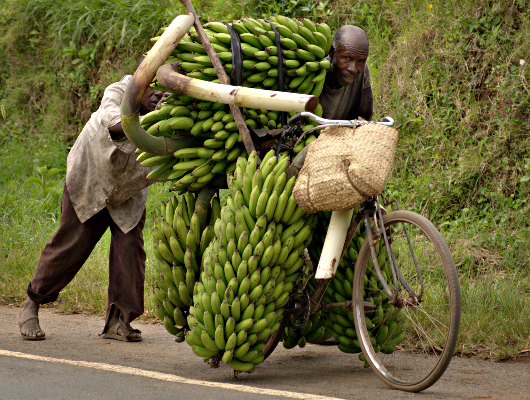
Mozambique entrepreneurs have created the award-winning social enterprise Mozambikes builds low-cost bicycles to improve the livelihoods of thousands of people in Mozambique. Affordable and efficient bicycle transportation can greatly impact the pace of development in a country with 54 percent of citizens living below the poverty line, especially in rural areas.
In addition to bringing economic opportunities, Mozambikes is committed to improving the lives of 50,000 Mozambicans by 2018. The company and affiliated non-profit Mozambikes Social Development intends to reach this goal through the sale and donation of affordable branded bicycles.
Mozambikes’ unique branding strategy has created three avenues of distribution. The first allows customers to brand and purchase bicycles for their own business needs, such as employee incentive programs. Other customers choose to brand bicycles sold to low-income markets.
Branding customers allow Mozambikes to sell the bicycles at a subsidized rate. For advertisers, it is an opportunity to tap into remote rural markets. Bicycles can also be donated through Mozambikes Social Development for about $100.
These bicycles are purchased at cost from Mozambikes and donated to those who still cannot afford a bicycle. Co-Founder and Chief Executive Officer Lauren Thomas said in an article published on The Guardian, “A bicycle may seem like such a small item to many, but it is quite literally life-changing in rural Africa.” 
The bicycles are specifically designed for use on the bumpy roads in Mozambique with large luggage racks for transporting goods. The design also accommodates traditional skirts with a diagonal crossbar. Local technicians assemble the bicycles and after-market maintenance has created a demand for more bicycle technicians.
In comparison with regional competitors, Mozambikes’ product is better quality and more affordable. The company hopes to improve the bicycle industry of Mozambique through these innovations.
Bicycles can have a significant impact in low-income communities and aid development. In Mozambique, two-thirds of people walk more than an hour to the closest health center. Bicycles provide increased access to education, health care and are a clean energy solution.
In five years, Mozambikes has sold or donated over 7,000 bicycles and plans to increase that number to 125,000 by 2020. In rural Africa, a bicycle is generally considered a household items aiding not only individuals but also entire families.
It is estimated that 70 percent of Mozambicans rely on income from what they can produce, largely through subsistence farming. Transportation is essential in this informal economy. Fetching water, maintaining crops and getting products to market are all made easier with access to bicycles.
As a Mozambique business, Mozambikes employs about 12 workers and pay salaries above minimum wage. The company also strives to empower women, provide training for bike technicians, and educate cyclists about safety.
Mozambikes hopes to benefit a million Mozambicans through low-cost, efficient transportation. Each bicycle improves another Mozambican’s livelihood.
Thomas affirms the company’s long-term vision: “Some people come and go, but we are really committed to making this an ongoing, sustainable business, and there is still so much more we can do.”
– Cara Kuhlman
Sources: The Guardian, How We Made It In Africa, Mail & Guardian, Mozambikes, Mozambikes YouTube Channel
Photo: Wikimedia, Flickr

Do You Know Enough About Antibiotic Resistance?
Antibiotic resistance poses one of the greatest threats to global health and so-called “superbug” infections continue to grow. The latest World Health Organization (WHO) survey shows widespread confusion surrounding antibiotic resistance in developing countries.
The WHO reveals that those most affected by and at risk for antibiotic-resistant infections are confused about them. This poses a challenge to the treatment and eradication of antibiotic-resistant infections, which are propagating all over the world.
“Antibiotic resistance is occurring everywhere in the world, compromising the treatment of infectious diseases and undermining many other advances in health and medicine,” says the WHO.
According to the Alliance for the Prudent Use of Antibiotics, bacteria become resistant either by a genetic mutation or by acquiring resistance from another bacterium.
The survey, carried out in September and October 2015, covered 12 countries including Barbados, China, Egypt and India. The statistics cover the countries’ use of antibiotics and knowledge of antibiotics and antibiotic resistance.
The results were below expectations. Although respondents acknowledged that antibiotic resistance is a threat to them and their families, they did not fully understand how it affects them or what they can do to protect themselves.
According to the findings, “64 percent of respondents believe antibiotics can be used to treat colds and flu, despite the fact that antibiotics have no impact on viruses.”
Almost one-third of respondents believe they should stop taking antibiotics when they feel better, rather than for the full course of the prescription, which is also incorrect.
This uncertainty is occurring at a time when the threat of antibiotic resistance is reaching a peak. Deaths caused by antibiotic-resistant infections, known as “superbugs,” are growing faster than we are able to respond to them. The death rate for patients with infections caused by common but resistant bacteria treated in hospitals can be about twice that of patients with infections caused by the same non-resistant bacteria, says the WHO.
With results as pronounced as these, the WHO has started a new campaign to increase global awareness and improve understanding of the problem of antibiotic resistance.
– Ashley Tressel
Sources: WHO 1, WHO 2, WHO 3, TUFTS
Photo: Joint Programming Initiative on Antimicrobial Resistance
Charitable Christmas Gift Giving Guide 2015
Compassion International is a Christian organization dedicated to helping children who are living in poverty. Below are some charitable Christmas gift options from the organization’s “Gift Catalog” that allows people to give to families living in poverty.
1. HIV/AIDS Care. A $25 donation can go a long way to providing much needed medical care to those suffering from HIV/AIDs. According to the World Health Organization (WHO), HIV/AIDS was responsible for an estimated 1.1 million deaths in 2013 and children are the most susceptible.
Compassion International estimates that 1,000 children are infected with HIV every day. Medical breakthroughs have helped curb the global killer, but the disease continues to rage on. This charitable Christmas gift donation would help…
2. Water Wells. According to Water.org, 663 million people do not have access to potable water, one in every ten people. A $34 donation can help provide clean and safe access to water for those that need it by allowing them to have:
3. Goats or Other Animals. What many people may think of as pets, people in developing countries think of as a life source. Having a goat, cow or chicken can mean milk, eggs, wool or food for people living in developing countries. A $100 donation for livestock would help those living in poverty to:
4. Mosquito Nets. According to WHO, 438,000 deaths were linked to malaria in 2015. Most of those were deaths of children under the age of five. However, nearly half of the world’s population, 3.2 million people, are at risk for the disease. An $18 charitable Christmas gift donation for a malaria net would help in the following ways:
5. Food for a Baby and a Mother. Malnutrition is something that is all too real for families living in developing countries. According to The Hunger Project, 98 percent of the world’s undernourished people inhabit developing nations.
It is also estimated that 795 million people in the world do not have enough to eat. Of those 795 million, 214 million live in Africa and 525.6 million live in Asia according to The Hunger Project. A $15 monthly donation can help mothers and children receive the nutrition they need to retain their strength. It can also:
The suggestions provided are only a handful of options. There are, of course, many other charitable options that can help people in need. For other charitable Christmas gift giving ideas, visit Compassion International.
– Alyson Atondo
Sources: WHO 1, Water.org, THP, WHO 2, WHO 3, Compassion 1, Compassion 2
Photo: Flickr, Pixabay
Compassion International Brings Experience
Compassion International, a Christian ministry organization, is highlighting the reality of global poverty through an interactive event hosted in the United States.
The exhibits are free to the public and seek to display true stories of children living in challenged developing countries such as Kenya, Uganda and the Dominican Republic. Through this forum, the organization gives visitors the opportunity to step into the lives of people living in developing countries without getting on a plane.
Visitors are guided through exhibits laid out over 2,000 square feet. Throughout the tour, people have the opportunity to experience the lives of three children who are sponsored by Compassion International. Each of the children featured narrates their own story.
“The tour took us through his life in the streets and eventually to the point where he became involved with Compassion International,” Joseph Hughes, who resonated with the story of Rueben, a child from the Dominican Republic, said. “It was a moving experience. I’ll admit, when Reuben finally became stable, had food and access to an education, I teared up a little.”
According to UNICEF, 1.9 million children are living in poverty today. The interactive tour started when Compassion International teamed up with local churches to provide child development programs and assist children living in poverty.
James Hays, a pastor who helps lead the event, said he wanted to give others the opportunity to experience life in different regions of the world that are impacted by global poverty.
“We thought it would be something not only our church would benefit from, but the community could as well,” he said.
Overall, the response from visitors has been positive. Jillian Kissell, a participant of one event in Searcy, Arkansas described the event as “enlightening”.
“I think it’s important to see how others are living and what their daily lives look like,” she said. “I like experiences that will get me out of my comfort zone and learn something new.”
Hays said this is the first time Compassion International has put on the event. According to information found on Compassion International’s website, the tour will visit 35 cities this year.
– Alyson Atondo
Sources: UNICEF, Harding, Access Atlanta, TCPalm, The Connection
Photo: Flickr
10 Ways to Prevent Global Health Crises
The Independent Panel on the Global Response to Ebola recently made recommendations to prevent future global health crises based on the outcomes of the West African Ebola outbreak last year.
The outbreak killed over 11,000 people in 2014, including health workers. Experts blame the slow response, lack of leadership and lack of proper training for a large number of deaths caused by Ebola.
The panel’s report was published online by The Lancet, a medical journal. Here are their recommendations:
Photo: Pixabay
The proposed changes to responding to global health crises were categorized into five themes: preventing disease outbreaks, responding to outbreaks, monitoring and sharing data, garnering knowledge and technology through research and, lastly, global coordination to prevent and respond to outbreaks.
– Marie Helene Ngom
Sources: STAT, The Lancet, BBC
Photo: World Affairs
Mozambique Entrepreneurs Change Lives with Bikes
Mozambique entrepreneurs have created the award-winning social enterprise Mozambikes builds low-cost bicycles to improve the livelihoods of thousands of people in Mozambique. Affordable and efficient bicycle transportation can greatly impact the pace of development in a country with 54 percent of citizens living below the poverty line, especially in rural areas.
In addition to bringing economic opportunities, Mozambikes is committed to improving the lives of 50,000 Mozambicans by 2018. The company and affiliated non-profit Mozambikes Social Development intends to reach this goal through the sale and donation of affordable branded bicycles.
Mozambikes’ unique branding strategy has created three avenues of distribution. The first allows customers to brand and purchase bicycles for their own business needs, such as employee incentive programs. Other customers choose to brand bicycles sold to low-income markets.
Branding customers allow Mozambikes to sell the bicycles at a subsidized rate. For advertisers, it is an opportunity to tap into remote rural markets. Bicycles can also be donated through Mozambikes Social Development for about $100.
These bicycles are purchased at cost from Mozambikes and donated to those who still cannot afford a bicycle. Co-Founder and Chief Executive Officer Lauren Thomas said in an article published on The Guardian, “A bicycle may seem like such a small item to many, but it is quite literally life-changing in rural Africa.”
The bicycles are specifically designed for use on the bumpy roads in Mozambique with large luggage racks for transporting goods. The design also accommodates traditional skirts with a diagonal crossbar. Local technicians assemble the bicycles and after-market maintenance has created a demand for more bicycle technicians.
In comparison with regional competitors, Mozambikes’ product is better quality and more affordable. The company hopes to improve the bicycle industry of Mozambique through these innovations.
Bicycles can have a significant impact in low-income communities and aid development. In Mozambique, two-thirds of people walk more than an hour to the closest health center. Bicycles provide increased access to education, health care and are a clean energy solution.
In five years, Mozambikes has sold or donated over 7,000 bicycles and plans to increase that number to 125,000 by 2020. In rural Africa, a bicycle is generally considered a household items aiding not only individuals but also entire families.
It is estimated that 70 percent of Mozambicans rely on income from what they can produce, largely through subsistence farming. Transportation is essential in this informal economy. Fetching water, maintaining crops and getting products to market are all made easier with access to bicycles.
As a Mozambique business, Mozambikes employs about 12 workers and pay salaries above minimum wage. The company also strives to empower women, provide training for bike technicians, and educate cyclists about safety.
Mozambikes hopes to benefit a million Mozambicans through low-cost, efficient transportation. Each bicycle improves another Mozambican’s livelihood.
Thomas affirms the company’s long-term vision: “Some people come and go, but we are really committed to making this an ongoing, sustainable business, and there is still so much more we can do.”
– Cara Kuhlman
Sources: The Guardian, How We Made It In Africa, Mail & Guardian, Mozambikes, Mozambikes YouTube Channel
Photo: Wikimedia, Flickr
House Passes Foreign Aid Transparency and Accountability Act
The Foreign Aid Transparency and Accountability Act has passed a full vote in the House of Representatives – a move that was welcomed by aid advocacy organizations including The Borgen Project.
In a statement released after the vote, the Modernizing Foreign Assistance Network (MFAN) commended Representatives Ted Poe (R-TX) and Gerry Connolly (D-VA) for sponsoring the bill and thanked house leadership for moving swiftly to bring it to the floor. “At a time when the U.S. is facing an unprecedented number of humanitarian and development challenges around the globe, efforts to ensure our foreign assistance is being spent effectively, like this legislation, must be prioritized,” MFAN said.
The legislation, which received bipartisan support, would strengthen the government’s commitment to maximizing aid transparency and effectiveness in a few ways. It would require the President to develop uniform interagency guidelines for measurable goals and performance metrics. And, it would ensure that U.S. foreign aid agencies use these guidelines to consistently monitor and evaluate their programs and provide comprehensive aid data to the public. By doing so, legislators hope to better track and allocate scarce aid resources.
Despite public perception, less than one percent of the federal budget is allocated for foreign aid – around $54 billion compared to over $600 billion in military spending. This money funds 110 missions undertaken by USAID in over 100 developing countries including health and education initiatives, security and peacekeeping missions, economic development and disaster relief.
At a time when Congress is seeking across-the-board spending reductions, the FY2016 budget includes $6 billion less in foreign assistance than last year. It is, therefore, vital that development agencies use every dollar as efficiently as possible.
“Foreign assistance plays an important role in advancing American national security interests in the world, creating new markets for American businesses and helping improve the lives of millions of people living in poverty. However, we must also always demand the highest standards of transparency and accountability to ensure that our foreign assistance efforts are making the most meaningful impact possible in the communities we assist,” said Tim Nelson, Congressional Relations Manager at The Borgen Project.
A companion version of the bill sponsored by Senators Marco Rubio (R-FL) and Ben Cardin (D-MD) passed the Senate Foreign Relations Committee in November and must now pass a full vote before being sent to the President for signing.
– Ron Minard
Sources: The Borgen Project, Congress.gov, MFAN
Photo: Flickr
UNDP Broadens Youth Career Opportunities
In Guatemala, young people are more likely to join a gang than to graduate upper secondary school. According to UNICEF, only 54.2 percent of youth ages 10-19 are enrolled in upper secondary schools.
On the other hand, a World Bank report states there are an estimated 14,000 young gang members. The report goes on to explain that “youth unemployment is associated with a higher probability of youth engaging in risky behavior, including crime and violence. Youth inactivity rates are often much higher than youth unemployment rates.”
To counteract this trend of violence, several organizations are working with youth to help them stay focused on educational opportunities. In fact, USAID found that “Long-term, sustainable development and improved equity in Guatemala will only be possible if [the] education of children and youth continues to improve.”
One of the most successful programs to date has been the United Nations Developing Programme’s (UNDP) Munijoven project. The Municipality of Guatemala City, with the support and funding of the UNDP and the Italian Government, leads the project.
In total, it is estimated that by April 10, 323 youth had taken part in the project’s training opportunities. “The Munijoven project aims to create academic opportunities for those underprivileged youth and to help them into employment,” UNDP said.
With programs focused on English, IT, tourism, gardening, arts, cooking and customer service training, the project hopes to provide job opportunities that these youth would not have under normal circumstances.
“With UNDP’s support, an employment strategy is currently being developed within the city’s youth policy, to create better economic, training, health and recreational opportunities through public-private partnerships,” UNDP said.
Businesses like Pizza Hut, local banks, furniture retailers and bakeries have joined the initiative. These businesses are vital to the project’s goals.
In fact, Ana Gabriela De León, UNDP’s Programme Officer for Poverty Reduction and Social Investment, stated, “Business participation is a key part of this process, since the main goal at the end of the training is to integrate young people into the labor market [as soon as] they have successfully completed the Munijoven programme.”
An estimated 60 percent of the participants, or 6,000 young people, were able to sign employment contracts at the end of the project.
– Katherine Martin
Sources: UNICEF, World Bank, USAID, IZA, UNDP
Photo: Flickr
Girl Up Campaign Volunteers: Addressing Global Poverty
Sydney Faler and Molly Foulkes of Dundee-Crown High School in Illinois started the Girl Up Dundee student club at their school with the hope of helping girls in need across the globe.
The club is a member of the U.N.’s Girl Up campaign which aims to help girls have access to education, health care, safe living conditions as well as social and economic opportunities. The U.N.’s program helps girls in Guatemala, India, Malawi, Liberia and Ethiopia, which are among the toughest places for girls to live.
In the beginning, Faler and Foulkes wanted to do something positive, but they were not sure how to make a difference. Inspired by Emma Watson’s U.N. speech on gender equality, they decided to start the club as a way to collect support and resources for girls.
Foulkes said, “It’s a way for me as a high school student, where I don’t really have that voice, to be able to impact something globally.”
Their sentiment proved to be a common one, as the club started with 35 members and has more people joining every week. In the digital age, students seem more aware of problems in the world and they wish to have a positive impact.
Foulkes said that “we’re becoming a more globalized nation and world. It’s important to realize there are so many more people out there than just our community.” With the planet becoming smaller due to everyone connecting through the internet and social media, issues that were previously unknown are now being brought to the forefront.
People everywhere are coming together to help each other, as evidenced by the growing popularity of the Girl Up student club, which is just one of 1,000 registered Girl Up clubs in the United States. The U.N.’s Girl Up club is also represented in 51 countries around the world.
So far this year, the Dundee-Crown chapter of the Girl Up student club has raised over $300 for girls in Guatemala. The funds will provide bicycles for girls in Guatemala, so they can get to school safely. With access to education, the girls will likely be healthier, more financially responsible and better qualified for good jobs.
Most Guatemalan girls in the Girl Up-supported regions only receive about three years of schooling. This lack of education means that most girls never learn to read and write. In addition, without access to education, girls are more at risk for early marriage and childbearing, thus continuing the cycle of poverty.
In order to help break the cycle, Faler and Foulkes also plan to host a gala event with local community members so they can spread their message. Foulkes said that “a lot of people don’t really understand what we’re doing.”
They believe that once they inform others, they will reach their goal of raising $500 to help more girls in need. These two high school students’ actions are having positive impacts for girls who desperately need it.
– Andrew Wildes
Sources: Daily Herald, Girl Up
Photo: Cloud Front
Africa Climate Plan: Addressing Extreme Poverty
The World Bank has created the Africa Climate Plan to alleviate extreme poverty caused by climate change. Titled “Accelerating Climate-Resilient and Low-Carbon Development”, the plan was presented at COP21, the global climate talks in Paris, on November 30. According to The World Bank, the plan hopes to boost renewable energy options and strengthen early warning systems, so as to better equip countries to deal with the destructive effects of climate change.
According to The World Bank, the Africa Climate Plan hopes to boost renewable energy options and strengthen early warning systems, so as to better equip countries to deal with the destructive effects of climate change.
These effects include higher temperatures, changes in precipitation patterns, rising sea levels and weather-related disasters, all of which pose a threat to agriculture, water sources and more.
“Sub-Saharan Africa is highly vulnerable to climate shocks, and our research shows that could have far-ranging impact — on everything from child stunting and malaria to food price increases and droughts,” said World Bank Group President Jim Yong Kim.
In regards to climate change and its effects on developing countries, the World Bank Group and partners have created the Vulnerable Twenty Group (V20), which includes twenty nations whose future development may be stunted by climate change.
The list of V20 members: Afghanistan, Bangladesh, Barbados, Bhutan, Costa Rica, Ethiopia, Ghana, Kenya, Kiribati, Madagascar, Maldives, Nepal, Philippines, Rwanda, Saint Lucia, Tanzania, Timor-Leste, Tuvalu, Vanuatu and Vietnam.
In addition to Africa, The World Bank has announced a funding plan for South Asia regarding climate change. The recently released initiative will attempt to raise $3.8 million for the prevention of natural disasters in Bhutan and South Asia through a new weather and disaster improvement project.
– Ashley Tressel
Sources: World Bank 1, World Bank 2, V-20, World Bank 3
Photo: Flickr
Eradicating Extreme Poverty: The 10 Percent Mark
As the world turns its focus toward the home stretch of ending the likes of world hunger and preventable diseases, eradicating extreme poverty also lands on the agenda. According to the World Bank, extreme poverty will reach an all-time low of less than 10 percent by the end of this year.
However, as great as this news is, millions are still suffering, and it is important to remember the end goal of completely eradicating extreme poverty, both through what has been proven to work and new innovations.
Jim Yong Kim of the World Bank said that “this is the best story in the world today, these projections show us that we are the first generation in human history that can end extreme poverty.”
Knowing this, it is so important to take these findings and act on the opportunity; now is not the time to relax. According to the World Bank, 702 million people (or 9.6 percent of the world) will still be living below the poverty line. Most of these people currently live in sub-Saharan Africa and Asia.
But the progress can be clearly seen when compared with past numbers. In 2012, 902 million people (or 13 percent) still lived in poverty, and that number was higher still at 29 percent in 1999. Since the pledge made by the leaders of the world 15 years ago, more than one billion people have been lifted out of poverty.
Kim believes this steady decline has occurred thanks to a combination of economic growth in developing countries as well as more countries investing in their health and education systems. Resiliency among communities has also been increased through societal safety nets, which help to prevent people from falling back into poverty.
As mentioned above, the work is not over as long as one person still lives in poverty. The world and organizations focused on poverty need to continue to be proactive if they want to be able to completely eradicate extreme poverty.
As Kim says, “This new forecast of poverty falling into the single digits should give us new momentum and help us focus even more clearly on the most effective strategies to end extreme poverty.”
– Drusilla Gibbs
Sources: Al Jazeera 1, Al Jazeera 2, World Bank
Photo: Christianity Today