The recent announcement of the Sustainable Development Goals (SDGs) in September creates a shift in the mentality towards foreign aid and international development.
While the previous United Nations (U.N.) initiative for development, the Millennium Development Goals (MDGs) focused strictly on improving the conditions for those in developing countries, the SDGs apply to every country.
The SDGs include 17 target goals on various issues such as climate change, economic growth, women’s rights, equality and health. This is an expansion from the MDGs, which included eight goals.
Furthermore, by making SDGs relevant to every country that ratifies them, the SDGs blur binaries such as developing/developed, global north/global south and first world/third world.
As Professor Heinrietta Moore, director of the UCL Global Prosperity Institute, said in an op-ed published in The Guardian, “we are all developing countries from now on.”
The U.N. is hopeful that this shift in mentality will promote teamwork, collaboration and partnerships between countries across boundaries. Furthermore, the SDGs create a list of goals that all countries must work towards. No country has already completed the SDGs.
While all countries must strive to complete the SDGs, some countries are more equipped to do this than others. Funding will be critical to achieving the SDGs. Currently, it costs $30 billion per year to eradicate global hunger and another $66 billion per year to provide a social safety net to help those in extreme poverty.
However, the most critical goal is implementing long-term positive change to meet the SDGs. According to Dr. Kohona, a former chief of the U.N. Treaty Section, building and maintaining the infrastructure required will come at an astronomical price.
He roughly estimates that annual investments to infrastructure will cost $7 trillion per year. These investments will be crucial to meeting SDGs targets on water, electricity, agriculture and transportation.
Naturally, this $7 trillion cost must be shared, but how it will be shared has yet to be fully determined. The development assistance commitment made by developed countries to share 0.7 percent of their GNP with developing countries would be a great start.
Presently, this commitment is not fulfilled by all countries. The U.S., for example, invests less than 0.2 percent. On average, countries who have agreed to share 0.7 percent of their GNP send about 0.3 percent.
Funding this investment in infrastructure could also be supported through other initiatives on a national level. U.S. legislation, such as the Electrify Africa Act and the Reach Every Mother and Child Act, if ratified, would fit under this category.
In a recent letter received by the author from President Obama regarding foreign policy states “ultimately, we will brighten America’s future and the lives of countless women and men by growing the ranks of prosperous, capable, and democratic states that can work with us in the decades ahead.”
Hopefully, our intentions are matched by our actions, and this is done on a global level. While incredibly ambitious, every bit of progress made towards the SDGs indicates an improvement in someone’s livelihood.
– Priscilla McCelvey
Sources: The Borgen Project, The Guardian, IPS News, Personal letter from the President
Photo: Flickr, Wikipedia

Democratic Growth in Burkina Faso
Burkina Faso’s recent presidential election marks a turning point for the West African country, which has been locked in a power struggle for decades.
November 29 marked the first truly democratic election in Burkina Faso in 30 years. Roch Marc Christian Kabore won the presidential election in a significant statement of democratic promise for the long-suffering country.
However, the election did not go off without a hitch. Presidential guard forces, led by General Gilbert Diendéré, staged a coup in September by taking the transitional president and prime minister hostage, pushing the election back two months. Fortunately, the popular movement successfully shut down the attempt according to U.N. Dispatch.
Newly elected President Kabore founded the Movement of People for Progress (MPP), a social democratic party that opposes former president Compaore’s Congress for Democracy and Progress party (CDP).
This election brings much-needed change that will lift Burkina Faso out of its period of civil strife. Between power struggles and economic downfall, this country has seen it all in the past few decades.
“A poor country even by West African standards, landlocked Burkina Faso has suffered from recurring droughts and military coups,” the BBC said.
Poor, indeed, Burkina Faso ranks 181 out of 187 in the United Nations Development Programme’s (UNDP) 2014 Human Development Index.
The election not only brings the promise of democratic growth, but also socio-economic growth in the country. Ethiopia is another country which is benefitting from socio-economic and democratic transformation, as Sudanese government officials reportedly commended its federal system for guaranteeing sustainable peace and economic development.
“The Sudanese delegates said the Ethiopian federal system was the foundation for stability and socio-economic development achieved following the constitutional-based introduction of the system,” the Sudan Tribune said.
Now that democratic rule has been established in Burkina Faso, President Kabore can focus on building the country’s economy and a sustainable future.
– Ashley Tressel
Sources: UN Dispatch 1, UNDP, UN Dispatch 2, Reuters, BBC, Sudan Tribune
Photo: Flickr
USAID Ramping up Fight Against Food Insecurity in Ethiopia
Over the next five months, the El Niño weather system is expected to continue dropping torrential rains in East Africa and causing severe droughts in Ethiopia, which is facing conditions not seen in three decades.
According to the USAID, the number of people facing food insecurity in Ethiopia will likely increase from 2.9 million to over 8 million by the beginning of 2016. But officials say they are ready and confident that systems are in place to mitigate the worst effects of this annual meteorological phenomenon.
“Improved early warning, the establishment of the Productive Safety Net Program (PSNP), as well as serious engagement from the government of Ethiopia means that we are not likely to see the kind of famine conditions witnessed in Ethiopia in earlier decades,” said USAID Director of Food for Peace, Dina Esposito.
Her remarks accompanied the announcement that USAID will commit an additional $97 million to bolster PSNP for at-risk communities in the region.
The Productive Safety Net Program was launched in 2005 by the government of Ethiopia with support from the World Food Programme (WFP) to provide immediate relief from low crop yield and create agricultural sustainability moving forward.
PSNP provides regular food and income transfers to food insecure households over six-month periods during dry seasons, and it obligates aid recipients to participate in training programs on sustainable farming, land rehabilitation and water management.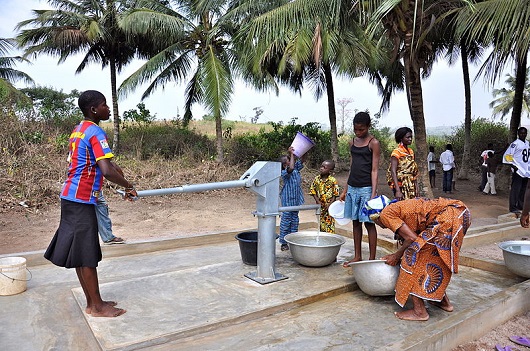
Katana Kusiya, a participant of PSNP in 2009, said that the aid was enough to feed her family of 11 for one month. In exchange, she received training on building wells and capturing rainwater efficiently. This training will hopefully result in communities like Katana’s relying less on sustenance farming and moving toward productive farming.
By investing in the safety net, development partners are hopeful that rural communities will develop an ability to resist the shock of unfavorable weather patterns, like El Niño, and become less food insecure in the long term. In its first three years, the program reached 7.5 million people and delivered 78,000 tons of food.
This newest commitment by USAID will include 154,000 tons of direct food assistance and a $58 million donation to the Catholic Relief Services for the transfer of an additional 105,700 tons of food.
The organizations are acting quickly to provide these transfers in order to ensure that 3.5 million vulnerable households, including refugees from neighboring Somalia, Eritrea and South Sudan receive aid in a timely manner.
For UNICEF Executive Director Anthony Lake, El Niño also presents an opportunity to re-engage the conversation about linkages between climate change and food insecurity in countries like Ethiopia during the upcoming climate conference in France.
Severe weather patterns regularly devastate agricultural productivity in developing countries, leading to famine and loss of life. “[El Niño’s] intensity and potential destructiveness should be a wake-up call as world leaders gather in Paris,” he said.
In the meantime, USAID is working quickly to provide the government of Ethiopia with all the support it needs to prevent loss of life this season. $600 million in aid, they estimate, will be required to effectively deal with the emergency.
– Ron Minard
Sources: AllAfrica, BBC, IB Times, WFP
Photo: UN Multimedia, Wikipedia
Eliminating Poverty in India Through Volunteer “Techies”
A group of “techies” are working to build a community of volunteers who will use technology to alleviate poverty throughout India.
Code for India is an initiative to eliminate poverty in India through technological advancements and solutions. The organization is aligned with Prime Minister Modi’s vision of Digital India.
Digital India aims to expand growth in electronic services, products, manufacturing and job opportunities. The program hopes to provide broadband highways, universal access to mobile connectivity and public Internet access.
Code for India is a nonprofit organization and was founded in Silicone Valley. It is one of the fastest growing tech communities in the world. The organization has helped build technology solutions for elections, city governance, women’s safety and education.
Code for India currently has more than 5,000 software engineers of Indian origin working in all different parts of the world. These engineers are donating their time free of cost to work on projects that will benefit those in poverty in India.
Karl Mehta is one of the engineers who helped start Code for India and make it into a successful organization. Mehta believes that technology can be leveraged to completely eliminate poverty in India.
Mehta said that Code for India is helping in the development of India from a digital standpoint towards a bigger goal of nation building. The techies who donate their time and talent do so out of the kindness of their hearts.
Code for India’s mission statement is, “to build scalable technology solutions for non-profits and social causes that will enable them to have a greater impact on society.”
One of Code for India’s most recent projects is ‘Skill Up India,’ which is a global open-source platform used to train millions of people across India to prepare them for the 21st century labor force needs. There are 350 million youth under the age of 35 in India, which provides a great asset to India’s workforce once they are properly trained.
Code for India is currently working on 37 projects and 25 non-government organizations.
Code for India will continue to work with Prime Minister Modi’s Digital India initiative to create successful tech programs, which will help to alleviate poverty throughout India.
– Jordan Connell
Sources: Code For India, YourStory 1, YourStory 2
Photo: Flickr
Solar Backpacks for the Students of the Future
Today more than 700 people are impoverished because of a lack of meeting basic needs and human rights. Innovative solutions provide different routes to solving the issue of global poverty.
Canadian student, Salima Visram, set out to revolutionize the way of life for those who live in deteriorated conditions with an ingenious solution that literally sheds light on the lives of students. Her invention: new solar backpacks equipped with a source of light that will charge all day and can be activated at night in order for students to study.
Instead of using toxic kerosene lamps, alternative technology allows for clean energy to be used. Not only is this a green solution, but also an economic one, as households can grab a backpack as their energy source instead of constantly replenishing their kerosene supply.
These solar backpacks have the potential to positively impact states that struggle with poverty, especially Kenya, where 92 percent of households utilize kerosene lamps.
The first to receive Visram’s backpacks were the residents of Kikambala village, where she raised enough money to produce 2,000 solar backpacks. Each backpack consists of a solar panel, battery pack and light.
This occurred in January after she raised money via crowdfunding site, Indiegogo. Since then, Visram has said she wishes to “expand the project to a hundred schools in the county within the next year and a half.”
Sticking to her own agenda, in September, Visram delivered 500 backpacks to the students of Kikambala Primary School, marking her business’ first official order. This is not the only milestone Visram wishes to achieve, however, as her goals go hand in hand with Masomo Bora—Kenya’s mission to provide education to all children.
Visram’s dream began as a public funding project on Indiegogo, but continues today in hopes of bringing as many students “into the light” as possible.
Fortunately, the costs of production are cheap, and in two months alone an additional $50,000 has been raised—more than doubling the initial capital of $40,000 required to manufacture the first 2,000 solar backpacks.
The backpacks are able to provide between seven and eight hours of light using only three to four hours of sunlight. As more and more solar backpacks become available, the hope is that the 4,000 deaths that occur daily due to kerosene-induced illness will be significantly reduced.
– Emilio Rivera
Sources: Indiegogo, IT News Africa, Compassion International
Photo: Conscious Living TV
Room to Read: 10 Keys to Improving Global Education
Room to Read set out to change the lives of children around the world by focusing on literacy and gender equality. Fifteen years later, the non-profit has educated almost 10 million children.
Their other accomplishments include publishing more than 1,000 books in local languages, building more than 1,900 schools, establishing more than 17,000 libraries and providing more than 31,000 girls with education and life skills.
Room to Read facilitates education programs in Bangladesh, Cambodia, India, Laos, Nepal, South Africa, Sri Lanka, Tanzania, Vietnam and Zambia. Through monitoring and evaluating their programs, Room to Read has revealed 10 keys to their success:
“Achieving our milestone of 10 million children impacted through Room to Read’s programs is a time to celebrate and further our mission,” said Erin Ganju, Room to Read’s CEO and co-founder. “By sharing our findings on what works in global education, we hope to deliver a quality education to every child in every corner of the globe.”
– Marie Helene Ngom
Sources: Roomtoread, PRNewswire, AnnualReport
Photo: Flickr
Why Foreign Aid is Important for the SDGs
The recent announcement of the Sustainable Development Goals (SDGs) in September creates a shift in the mentality towards foreign aid and international development.
While the previous United Nations (U.N.) initiative for development, the Millennium Development Goals (MDGs) focused strictly on improving the conditions for those in developing countries, the SDGs apply to every country.
The SDGs include 17 target goals on various issues such as climate change, economic growth, women’s rights, equality and health. This is an expansion from the MDGs, which included eight goals.
Furthermore, by making SDGs relevant to every country that ratifies them, the SDGs blur binaries such as developing/developed, global north/global south and first world/third world.
As Professor Heinrietta Moore, director of the UCL Global Prosperity Institute, said in an op-ed published in The Guardian, “we are all developing countries from now on.”
The U.N. is hopeful that this shift in mentality will promote teamwork, collaboration and partnerships between countries across boundaries. Furthermore, the SDGs create a list of goals that all countries must work towards. No country has already completed the SDGs.
While all countries must strive to complete the SDGs, some countries are more equipped to do this than others. Funding will be critical to achieving the SDGs. Currently, it costs $30 billion per year to eradicate global hunger and another $66 billion per year to provide a social safety net to help those in extreme poverty.
However, the most critical goal is implementing long-term positive change to meet the SDGs. According to Dr. Kohona, a former chief of the U.N. Treaty Section, building and maintaining the infrastructure required will come at an astronomical price.
He roughly estimates that annual investments to infrastructure will cost $7 trillion per year. These investments will be crucial to meeting SDGs targets on water, electricity, agriculture and transportation.
Naturally, this $7 trillion cost must be shared, but how it will be shared has yet to be fully determined. The development assistance commitment made by developed countries to share 0.7 percent of their GNP with developing countries would be a great start.
Presently, this commitment is not fulfilled by all countries. The U.S., for example, invests less than 0.2 percent. On average, countries who have agreed to share 0.7 percent of their GNP send about 0.3 percent.
Funding this investment in infrastructure could also be supported through other initiatives on a national level. U.S. legislation, such as the Electrify Africa Act and the Reach Every Mother and Child Act, if ratified, would fit under this category.
In a recent letter received by the author from President Obama regarding foreign policy states “ultimately, we will brighten America’s future and the lives of countless women and men by growing the ranks of prosperous, capable, and democratic states that can work with us in the decades ahead.”
Hopefully, our intentions are matched by our actions, and this is done on a global level. While incredibly ambitious, every bit of progress made towards the SDGs indicates an improvement in someone’s livelihood.
– Priscilla McCelvey
Sources: The Borgen Project, The Guardian, IPS News, Personal letter from the President
Photo: Flickr, Wikipedia
Ending World Hunger: Understanding Causes and Effects
The causes of world hunger are directly related to those of poverty. Close to 795 million, or one in nine, people living in the world today do not have enough food. Ending world hunger requires an understanding of the causes and effects.
Poverty and hunger more often than not go hand in hand. Poor people just do not have the resources such as tools, money, land and even physical energy to combat hunger.
World hunger itself causes roughly 146 million children to be underweight while one in three children in a developing country have their growth stunted. Approximately 66 million primary school age children go hungry every day and between 2 to 3.5 billion people have micronutrient deficiencies. Over nine million people die worldwide from hunger and malnutrition. Five million of those people are children.
In the world right now there is enough food to feed every human being on the planet. Yet according to globalissues.org, concernusa.org and many other organizations and sources, a shocking amount of food is wasted in first-world countries and even in third-world countries.
– Drusilla Gibbs
Sources: Concern USA, Freedom from Hunger, WFP, Global Issues
Photo: Flickr
Saving Millions: Reach Every Mother and Child Act
On the African continent, women are 47 times more likely to die from preventable complications during childbirth than they are in the United States. That amounts to approximately 800 women dying a day in developing nations. Mothers are not the only vulnerable ones. Each day, an estimated 17,000 children under the age of five will also die from treatable conditions.
Delaware’s Senator Chris Coons and Maine’s Senator Susan Collins hope to dramatically shrink and ultimately eliminate these statistics. In July 2015, the senators introduced the Reach Every Mother and Child Act of 2015 in order to increase the amount of U.S. aid being directed toward ending these tragic and preventable deaths. The bill establishes a framework to implement the existing tools and focus necessary for winning the battle against preventable mother and child deaths.
The bill calls for a strategic and attainable 10-year plan to succeed in ending preventable maternal, newborn and child deaths by 2035. This includes the creation of a permanent Maternal and Child Survival Coordinator at the United States Agency for International Development (USAID) who will be responsible for implementing the 10-year plan and to confirm that resources and interventions are being effectively utilized in target nations.
The U.S. government will also create a financing framework that will allow the use of U.S. funds to leverage additional funds from nongovernmental organizations, partner countries and international organizations.
While introducing the bill in their floor speeches, Senators Coons and Collins both stressed that the Reach Every Mother and Child Act is not a bolt-from-the-blue or a handout.
“Investing in maternal and child health in developing countries is an investment in the future, and I look forward to working with my colleagues to help all mothers and children around the globe get the health care they deserve,” said Senator Coons.
Acting USAID Administrator Alfonso Lenhardt echoed Coons’ sentiment. “As children survive and thrive, parents are choosing to have smaller families,” said Lenhardt, “unleashing a virtuous cycle of progress and prosperity.”
USAID recently released a new report showing that previous efforts to improve the survival rates of mothers, newborns and children under the age of five have already saved 2.5 million children and 200,000 mothers since 2008. This demonstrates substantial evidence that the new act will be successful.
“There are simple, proven and cost-effective interventions that we know will work if we can reach the mothers and children who need them to survive,” said Senator Collins. The Reach Every Mother and Child Act, if passed, is anticipated to improve the health of millions of impoverished and at-risk mothers and children.
World Vision’s Director of Government Relations Lisa Bos is particularly excited about the bill, praising Senators Collins and Coons for championing the bill. “The goal of ending preventable maternal and child deaths is achievable, but it will take renewed commitment, coordination and resources,” said Bos. “This bill builds on the progress we’ve made and is critical for ensuring we reach every mother and child. We hope every Member of the Senate will support this legislation.”
– Claire Colby
Sources: Senate, USAID, World Vision
Why is Transparency in Foreign Aid Important?
When a free society is established, the government needs to be held accountable and inform the people of how taxpayers’ money is spent and where. This occurs through transparency.
At the end of October, many organizations and individuals applauded the reintroduction of Bill H.R. 3766, or the Foreign Aid Transparency and Accountability Act of 2015.
“By strengthening its commitment to monitoring and evaluation and transparency, the U.S. government can better allocate aid resources and be held accountable by a range of stakeholders,” according to Modernize Aid. This means that those with influence are able to put the money where it is most needed and most effective.
Former attempts to pass the bill were largely successful and moved quickly through the Senate and the House. However, the Senate stopped progress in both instances.
Modernizing Foreign Assistance Network and the Professional Services Council (PSC) are two of many organizations that are enthusiastic about the bill.
PSC’s CEO, Stan Soloway, has stated that “Congress should increase aid transparency and accountability and provide USAID and other agencies with the necessary acquisition and other resources to effectively plan, award and oversee development implementation by international development companies.”
As United States citizens, there are certain responsibilities to the government. The National Center for Constitutional Studies notes that “the success of the American Republic as a political structure has been the consequence…of the voluntary participation of citizens in public affairs – enlisting in the army in time of war; taking part unpaid in political campaigns; petitioning legislatures; and in a hundred other great ways, or small-assuming responsibility for the common good.”
The key goal in foreign aid transparency is the petitioning for legislation. This process is the people’s opportunity to let government officials know what is most important to them. It also gives the leaders an idea of what bills to pass.
Transparency in Foreign Aid allows a country to see exactly where tax money is going. It is a bill that holds promise for a more accountable government.
OXFAM America has expressed its desire for the legislation to be passed. “Now’s the time for effective aid supporters from both sides of the aisle in Congress to rally behind the House and Senate sponsors and push this bill over the finish line. It’s fun to cheer positive action in Congress! Let’s make sure we have the opportunity to do more of it.”
In order to do this, constituents are able to write, email or call their government leader’s offices. Each time a citizen does this, a tally is made on the issue the individual expresses interest in.
These tallies add up each week and are then considered when it comes time for voting on various bills and legislation. The more tallies from people, the more likely the piece of legislation has for success.
– Katherine Martin
Sources: Ballotpedia, Modernize Aid, Professional Services Council, NCCS, Politics of Poverty
Photo: Google Images
Lights, Camera, Global Health Film Festival
The Global Health Film initiative held its first festival last month to use film and media as a catalyst for discussion and change on global health issues. The festival included film production workshops, in-depth panel discussions and pitching opportunities.
The inaugural event was held in London this year on Oct. 30-31. The festival – Films to Inspire Change, began a new era of global health discussion, incorporating art and expression into the previously science-only forum.
According to the Global Health Film initiative, workshops at the festival included:
One of the films featured at the festival, “Body Team 12,” follows the first female member of the Ebola response teams in Liberia. Another, “Fire in the Blood,” documents the battle to make AIDS drugs cheap enough for poor countries to afford them (Sci Dev Net). “TB Unmasked” and “TB Silent Killer” cover tuberculosis, while “Outbreak” exposes the “hidden” beginning of the Ebola outbreak in West Africa.
In order to facilitate discussions such as those sparked at the festival, the Global Health Film initiative also developed two labs this year to support global health advocates and produce films that highlight critical global health issues. The Global Health Film Lab houses nine fellows and gives them the training and tools they need to produce their own change-inspiring films.
The initiative also holds screenings for new films that present new ideas in the global health field. Past screenings include “Girl Rising,” which promotes the education of girls in developing countries, and “Open Heart,” which tells the story of Rwandan children with rheumatic heart disease.
These films continue to raise awareness and present otherwise widely-ignored information in a way that evokes an emotional response.
– Ashley Tressel
Sources: SciDev, Global Health Film 1, Global Health Film 2
Photo: Pixabay