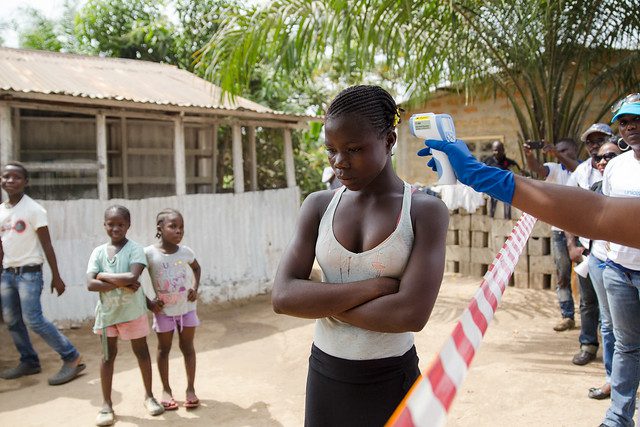
In July 2019, there were 750 reported cases of Ebola among children. This is in comparison to 20 percent dating back to prior epidemics. Children are particularly vulnerable to contracting Ebola and require special care to treat the disease. Also in July 2019, about one-third of children have accounted for the nearly 1,700 people who lost their lives to Ebola since August 2018 in The Democratic Republic of Congo. Additionally this month, over 2,500 individuals have been diagnosed with the illness. The nation has begun working with the World Health Organization (WHO) along with other health advocacy organizations such as UNICEF to help cure Ebola.
Children and Ebola: The Numbers
Children under age five are at the highest risk and often suffer the worst symptoms. Out of the 750 cases reported, 40 percent of children under age five were diagnosed with Ebola. Young children are also most likely to die from this disease, as their fatality rate is 77 percent. This is in comparison to 67 percent for other age groups.
Symptoms and Treatments
Manifestations of Ebola encompass fever, headache, diarrhea, and sometimes blood vessel discharges. Prompt detection and sufficient medication are effective in curing the disease.
Because children are more susceptible to contracting Ebola and due to the difference in symptoms in comparison to adults, children with Ebola require differentiated medical care.
Medical personnel has articulated that special treatments are necessary for children suffering from Ebola. They require different and exclusive treatments to focus on children’s individual psychological and social requirements.
Treatments for children with Ebola consist of the same drugs that are used to treat other age groups. Of course, distinct quantities differ. Young children also receive zinc to cure diarrhea and intestinal parasite infections as well. Undernourished children must receive different medication. For example, they are given food that is precisely manufactured for their needs.
Orphaned and Abandoned Children
Hundreds of children are either orphaned or abandoned due to their parents becoming infected with Ebola. UNICEF has organized nursery settings in conjunction with treatment centers. Survivors even serve as caregivers.
Children whose parents have been diagnosed or die from Ebola are at an increased risk of being condemned and forsaken, as their chances are much higher of contracting the disease. Within the treatment centers, all patients undergo examinations on a daily basis.
For orphan children, The Democratic Republic of Congo works to set up arrangements with other family members for the child to live. Additionally, the country is providing nutrient guidelines and covering the cost of fees to allow children to attend school.
Specialized Care for Children
Pediatricians work with children within the Ebola Treatment Centers to deliver focused treatments for children with Ebola. Treatment is based on the patients’ individual needs. Every child that has lost parents to Ebola, or has been separated as a result of their illness, receives specialized care. They are cared for by Ebola survivors who provide comfort. They also transport the child to visit their parents receiving medical care at the Ebola Treatment Centers. In addition, counselors are also present to provide support to families throughout the duration of their treatment.
Nutritionists are also present in the treatment centers to deliver personalized nutrient guidelines to those who are likely to have the disease, as well as those who have been diagnosed already. As a result of these health innovations, these types of care have proven to improve sufferers’ conditions.
International Intervention to Eliminate Ebola
Save the Children is a nonprofit organization that began in the United Kingdom in 1919. Their goal is to advance children’s lives in various aspects, such as education, healthcare and employment. Additionally, the organization supplies relief in response to natural disasters and war.
WHO, in conjunction with Save the Children has declared the current Ebola epidemic in the Democratic Republic of Congo to be a public health emergency of international concern. Due to the outbreak duration of nearly one year, further actions are being implemented to eliminate further cases of Ebola and to provide treatment for children with Ebola. It is predicted that if the outbreak of Ebola continues, the surrounding countries will be affected as well.
Several hundreds of government officials and health personnel are working to cure those infected by the disease and prevent further cases. Save the Children is promoting advocacy efforts in curing Ebola through communal action and informational sessions. These efforts are to ensure that all age groups are informed of prevention practices.
Since the beginning of the current epidemic, Save the Children has provided one million individuals with advice relating to symptom detection and how to prevent the spread of Ebola. Health workers receive training on how to treat those infected with Ebola. Patients are separated and the disease is then traced. Save the Children also educates the public about the disease.
Save the Children has also delivered various supplies to health practices and border crossings in addition to establishing sanitation facilities in order to decrease further infections and to provide treatments for children with Ebola.
Bringing Hope to Children in the Democratic Republic of the Congo
Thanks to international intervention and specialized care, children in the Democratic Republic of the Congo are receiving the treatment they need to fight against Ebola. There is still much to be done, but as long as aid efforts continue, there is hope for these children’s futures.
– Diana Dopheide
Photo: Flickr

10 Facts About Corruption in Brazil
As the largest nation in South America with a population of over 200 million, Brazil’s importance on the global stage is clear; however, corruption charges and convictions have riddled the country’s reputation. In 2014, one of the worst economic recessions in Brazil’s history hit it and left it in a state of political and economic instability along with ongoing corruption investigations. It is just beginning to recover. These 10 facts about corruption in Brazil serve to better understand one of the world’s most influential, and most corrupt, global players.
10 Facts About Corruption in Brazil
Above are 10 facts about corruption in Brazil, but the problem and potential solutions are much more vast. While these 10 facts about corruption in Brazil paint a picture of the extent of the problem, one cannot overstate corruption’s tangible impact on the lives of everyday Brazilians. With each new election comes renewed fears of corrupt activities; nevertheless, innovative preventative and corrective initiatives are flowing freely, and a corruption-free future for Brazil is more likely than ever.
– Erin Jenkins
Photo: Flickr
Top 10 Facts about Living Conditions in Guinea-Bissau
Once considered as a possible model for African development, Guinea-Bissau is now one of the poorest nations in the world. The nation has struggled to recover from instability created by a string of military coups in the 1980s. Now, the population is crippled with human trafficking, poverty and low literacy rates. Here are the top 10 facts about living conditions in Guinea-Bissau.
Top 10 Facts about Living Conditions in Guinea-Bissau
These top 10 facts about living conditions in Guinea-Bissau reveal that its citizens are struggling. However, international organizations are taking notice and are striving to institute positive change in this small, West African country.
– Andrew Edwards
Photo: Flickr
Care for Children with Ebola in the Democratic Republic of the Congo
In July 2019, there were 750 reported cases of Ebola among children. This is in comparison to 20 percent dating back to prior epidemics. Children are particularly vulnerable to contracting Ebola and require special care to treat the disease. Also in July 2019, about one-third of children have accounted for the nearly 1,700 people who lost their lives to Ebola since August 2018 in The Democratic Republic of Congo. Additionally this month, over 2,500 individuals have been diagnosed with the illness. The nation has begun working with the World Health Organization (WHO) along with other health advocacy organizations such as UNICEF to help cure Ebola.
Children and Ebola: The Numbers
Children under age five are at the highest risk and often suffer the worst symptoms. Out of the 750 cases reported, 40 percent of children under age five were diagnosed with Ebola. Young children are also most likely to die from this disease, as their fatality rate is 77 percent. This is in comparison to 67 percent for other age groups.
Symptoms and Treatments
Manifestations of Ebola encompass fever, headache, diarrhea, and sometimes blood vessel discharges. Prompt detection and sufficient medication are effective in curing the disease.
Because children are more susceptible to contracting Ebola and due to the difference in symptoms in comparison to adults, children with Ebola require differentiated medical care.
Medical personnel has articulated that special treatments are necessary for children suffering from Ebola. They require different and exclusive treatments to focus on children’s individual psychological and social requirements.
Treatments for children with Ebola consist of the same drugs that are used to treat other age groups. Of course, distinct quantities differ. Young children also receive zinc to cure diarrhea and intestinal parasite infections as well. Undernourished children must receive different medication. For example, they are given food that is precisely manufactured for their needs.
Orphaned and Abandoned Children
Hundreds of children are either orphaned or abandoned due to their parents becoming infected with Ebola. UNICEF has organized nursery settings in conjunction with treatment centers. Survivors even serve as caregivers.
Children whose parents have been diagnosed or die from Ebola are at an increased risk of being condemned and forsaken, as their chances are much higher of contracting the disease. Within the treatment centers, all patients undergo examinations on a daily basis.
For orphan children, The Democratic Republic of Congo works to set up arrangements with other family members for the child to live. Additionally, the country is providing nutrient guidelines and covering the cost of fees to allow children to attend school.
Specialized Care for Children
Pediatricians work with children within the Ebola Treatment Centers to deliver focused treatments for children with Ebola. Treatment is based on the patients’ individual needs. Every child that has lost parents to Ebola, or has been separated as a result of their illness, receives specialized care. They are cared for by Ebola survivors who provide comfort. They also transport the child to visit their parents receiving medical care at the Ebola Treatment Centers. In addition, counselors are also present to provide support to families throughout the duration of their treatment.
Nutritionists are also present in the treatment centers to deliver personalized nutrient guidelines to those who are likely to have the disease, as well as those who have been diagnosed already. As a result of these health innovations, these types of care have proven to improve sufferers’ conditions.
International Intervention to Eliminate Ebola
Save the Children is a nonprofit organization that began in the United Kingdom in 1919. Their goal is to advance children’s lives in various aspects, such as education, healthcare and employment. Additionally, the organization supplies relief in response to natural disasters and war.
WHO, in conjunction with Save the Children has declared the current Ebola epidemic in the Democratic Republic of Congo to be a public health emergency of international concern. Due to the outbreak duration of nearly one year, further actions are being implemented to eliminate further cases of Ebola and to provide treatment for children with Ebola. It is predicted that if the outbreak of Ebola continues, the surrounding countries will be affected as well.
Several hundreds of government officials and health personnel are working to cure those infected by the disease and prevent further cases. Save the Children is promoting advocacy efforts in curing Ebola through communal action and informational sessions. These efforts are to ensure that all age groups are informed of prevention practices.
Since the beginning of the current epidemic, Save the Children has provided one million individuals with advice relating to symptom detection and how to prevent the spread of Ebola. Health workers receive training on how to treat those infected with Ebola. Patients are separated and the disease is then traced. Save the Children also educates the public about the disease.
Save the Children has also delivered various supplies to health practices and border crossings in addition to establishing sanitation facilities in order to decrease further infections and to provide treatments for children with Ebola.
Bringing Hope to Children in the Democratic Republic of the Congo
Thanks to international intervention and specialized care, children in the Democratic Republic of the Congo are receiving the treatment they need to fight against Ebola. There is still much to be done, but as long as aid efforts continue, there is hope for these children’s futures.
– Diana Dopheide
Photo: Flickr
The New Frontier: China’s Investment in Africa
For those seeking investment, look no further than the continent of Africa. While the continent has had a tumultuous couple of decades, plagued by health crises such as Ebola, and political unrest is it also gushing with economic, diplomatic, and political potential – and China is taking notice.
Government Involvement
Just last year (August 2018), President Xi of China, speaking at the Forum on China-Africa Cooperation, has pledged to invest a major sum of $60 billion in commercial loans to the African continent. This investment in Africa, as well as a plethora of other nations scattered across the Middle East, Eastern Europe and Asia, are all apart of China’s overall global strategy – what they are calling the Belt Road Initiative (BRI). Under this daring economic, political and diplomatic strategy, China is investing large sums of money to mainly developing nations as a way to not only benefit China’s economic interests but to cement its role in the world as a dominating global superpower.
A Welcoming Environment
Also, when it comes to large Chinese investments, Africa is more than welcoming. In addition to the overall loans that China is dedicating to forming some friendships, these investments, especially in infrastructure, may be a godsend. At the time of this writing, Africa has a $900 billion infrastructure deficit. The much-needed cash flow from China will not only allow many African nations to lay the groundwork for basic infrastructure projects, but it will also afford children the opportunities required to gain an education and for local businesses to trade.
In addition to the major pillars of the BRI, China is also establishing what it is calling a “Maritime Silk Road” – a chain of seaports from the South China Sea to Africa. With the construction of these ports will come: oil refineries, industrial parks, and fiber optic networks, all designed to make a trade with China easier and mutually beneficial – and thus far it seems to be accomplishing China’s goal of breathing new life into its infamous ancient Silk Road.
And while these projects are beneficial to the recipient countries, China does add that part of the developments will be helped by Chinese labor and companies, thus allowing China to take a slice of the economic cake as it were. But while many Chinese companies are profiting off BRI contracts, the projects being funded are benefiting local communities and provide steady work and cash flow to otherwise struggling areas of Africa. Economic benefits aside, this partnership is allowing many African nations to forge diplomatic relations with a world power as well.
Economic and Political Ramifications
China’s investment in Africa does, however, come with a few pitfalls. While Chinese companies become more prominent in Africa, so will “Made in China” products. This will come with some obvious knock-on effects, for example, for the last couple of decades these products have had a devastating effect on what was once a thriving South African textile industry. But, the pendulum does swing the other way as well. Ethiopia has seen positive outcomes from Chinese investments.
Investment in Africa began as an opening of windows of opportunity around the globe for China. The United States has been the worlds primary loan superpower for the last several decades – investing billions of dollars in foreign aid and development projects through USAID and starting working establishment programs in various nations. But with loans from the West coming with strings attached – mainly strict ethical standards – China saw a chance to offer billions in loans with fewer conditions.
Due to China’s willingness to loan large sums of money to nations torn apart by conflict and instability, the global community has raised concerns. These nations will eventually need to pay back these loans, and the worlds less than reliable recipients could threaten global economic stability if they default.
However, China isn’t necessarily concerned if these countries can’t pay them back, in the literal sense. In exchange for the economic clout that comes with Chinese investments, nations such as South Africa’s Djibouti are lending naval ports as a means of reciprocation – forming a “String of Pearls” which gives China a foothold in the naval Indian ocean. But while some of these loans may be risky investments on the continent of Africa, China understands the cost-benefit analysis and is treating Africa as a new frontier.
A Positive Outcome
China’s investment in Africa, while risky, may end up paying off. With Africa’s willingness to accept loans from China, and listening with open ears to China’s overtures for stronger diplomatic relations, Africa is in a good position to begin funding its own economic and development programs. Programs that will address issues of poverty, inequality, and education.
– Connor Dobson
Photo: Flickr
Team Nelson Aiding Orphans in Tanzania
Team Nelson is a nonprofit organization based out of Atlanta, GA that works to send orphans in Tanzania to school. In 2017, there was a 79 percent net enrollment rate in primary school but only a 23 percent net enrollment rate in secondary school. After primary school, many teenagers have to find work to help provide for their families, so retention is a huge issue in secondary school. Many of the orphanages in Arusha, Tanzania lack the funds to send their children to school, so McCrea O’Haire and her board began to raise money to send the first boy she met, Nelson, to school. From there, it grew.
Team Nelson has been successfully raising money and awareness in order to send more Tanzanian orphans to school. The organization also encourages kids to prioritize their education and reap the greater benefits of completing their education instead of leaving to find work. The Borgen Project had the opportunity to interview McCrea O’Haire about Team Nelson about sending orphans to school in Tanzania.
Who is Nelson?
Nelson is one of the first kids that O’Haire met in Tanzania and the inspiration behind Team Nelson. Upon first meeting him, she recalls him having a reserved and shy nature, as he was just trying to blend in with the other children. It was not until she learned of his situation that she saw him for who he really was and “realized how important it is to help the invisible children that people might not notice.” She eventually decided to transform Team Nelson into much more than just one child. Originally, she did not intend to do anything other than sending Nelson to school, but she received an outpour of support from family and friends which snowballed her intentions. Once she felt the support around her, she had the inspiration to do more.
The Future of Team Nelson
In running this nonprofit, O’Haire cites two main challenges. Firstly, everyone in the organization also works full-time jobs and have careers, so there are many difficult compromises that it must make. Secondly, there are always language barriers and cultural differences her team encounters when they visit Arusha. She cites their desire “to help people living across the world while not interrupting their cultural flow or offending anyone,” noting that this is not always easy.
Within the next five years, O’Haire hopes the organization continues its current trajectory. In the past year and a half, it has been able to send 18 children to school, so in five years, it would like to send around 50 or more kids. One of her favorite things about Team Nelson is the “one to one love” that they currently have. She wants to help as many kids as possible but also does not want the program to include thousands of kids that members of the organization have never met.
Addressing Systemic Issues in Tanzania
AIDS killed Nelson’s mother and alcoholism afflicted his father. His family alone represents a larger, systematic issue resulting in the death of many parents and caretakers in Tanzania, which has left about 3.1 million orphans in Tanzania. O’Haire cites this problem as one of the main reasons she and her team decided to create Team Nelson; “A lot of the problems in Tanzania revolve around offering more opportunities for education and helping the children further their lives with increased resources and tools.” She emphasizes the importance of sexual health education that children receive in school and the need for recurring doctor’s appointments.
If the government continues to receive pressure to employ more top-down approaches, she says, there will be drastic improvements in health and education. Fortunately, the Tanzanian government recently decided to make all lower-secondary education free in order to retain more students, as there are currently 1.5 million adolescents that are not in school.
Although it is quite difficult to live in rural Tanzania right now, O’Haire underscores the positivity of everyone she has met there. Prior to her trips there, she prepares herself to be the beacon of hope and energy that they may need but quickly reminds herself that Tanzanians are a happy group. In hard times, she reminds herself of the objectives of Team Nelson, which is sending children to school. She must often turn down requests but notes the importance of staying focused on her organization’s goals and trust in that impact.
If you would like to help Team Nelson and the orphans in Tanzania, O’Haire encourages a monthly donation of just $10, which directly contributes to getting children an education. In the case that providing a financial contribution is not possible, she hopes that “people will spread the word about this cause and really care about the problems our world is facing.”
To learn more, please visit https://www.weareteamnelson.com/.
– Jessica Haidet
Photo: Flickr
10 Facts About Life Expectancy in North Korea
Korea was divided into the Democratic People’s Republic of Korea in the north and the Republic of Korea in the south due to opposing political ideologies. Before the 1990s, the World Bank estimated that the life expectancy of North Korea was similar to that of South Korea. Men were expected to live to 65.9 years, and women 73 years. Here are 10 facts about life expectancy in North Korea that will list what factors have had the largest impact on the growth or decline or this rate.
10 Facts About Life Expectancy in North Korea
North Korea’s reclusive and secretive nature means that there is still a lot that remains unknown. However, these 10 facts about life expectancy in North Korea provide some insight into what areas may need more attention from the country’s government and international human rights organizations.
– Jordan Melinda Washington
Photo: Unsplash
Inequality in South Africa Continues
Despite the institution of racially inclusive democracy, inequality in South Africa persists decades after the end of apartheid. According to a 2018 report by The World Bank, South Africa is one of the most economically unequal countries in the world. Inequality has gone up since the end of Apartheid in 1994 and remains high.
The Situation
In 2015, South Africa had a Gini coefficient of 0.63, the highest in the world. Also in 2015, the top 10 percent of earners controlled 70 percent of the wealth in South Africa, while the bottom 60 percent had 7 percent of the wealth. Fifty percent of South Africans earn $5 per day. Despite the official end to apartheid and the holding of multiracial elections, inequality in South Africa continues to operate on racial lines. Black South Africans mostly make up the lower class.
A significant wage gap also exists between segments of the population. There is a very small middle class with workers in either very high paying jobs or very low paying jobs. The high paying jobs earn on average five times the amount of lower-paying jobs. Therefore, a small segment of the population has similar income to those in developed countries, while low-wage laborers have wages comparable to ones in low-income developing countries.
Inequality in South Africa
High unemployment and low economic mobility mark inequality in South Africa. Unemployment reached 27 percent in 2017.
Poverty is high for a middle-income country and is a particular problem for black South Africans, the uneducated, the unemployed, female-led households, large families and children. Poverty also has a significant geographic indicator, a relic of the apartheid era. Poverty runs high in regions that people oppressed during apartheid, particularly the homelands, land set aside for black South Africans. Although the likelihood of living in poverty depends, to some extent, on race and gender, research indicates that skills and labor market factors play a significant role, which indicates that public policy has the potential to reduce poverty.
South Africa’s poor public education system means that skilled and professional labor is in short supply. Reforming the education system to make students better prepared to join the workforce could reduce poverty significantly.
Land Rights
Inequality in South Africa continues to connect to land rights even after the end of official segregation. Many black South Africans live in slums, which numbered 300 in 1994 but 2,700 in 2019. These underfunded living quarters stem from the 1960s when the apartheid region uprooted many black residents from their homes and sent them to live in isolated townships. The forced relocations meant many had to spend the bulk of their income on transportation and had to go to underfunded schools which did little to prepare students for the job market, contributing to the cycle of poverty.
Most relocated families have never been able to return home even after the end of apartheid, as prohibitively high costs keep them out of the big cities and in impoverished outskirts. Many have to commute from the outskirts of the town to jobs in the city; the commute can cost $3 a day out of an average wage of $10 a day for a service worker. Sending a child to a school in the city to avoid the poorly performing township schools also incurs costs.
Efforts to Eliminate Poverty in South Africa
Many tracts of public land lay empty, presenting opportunities for building housing. Reclaim the City has been working to stop the privatization of empty government land. It has moved over 1,000 people into abandoned government property such as hospitals, utilizing a law that says people cannot evict citizens if they lack a better alternative. Additionally, groups like the Social Justice Coalition are working to improve informal settlements where people already live by building amenities and securing formal occupation rights.
Additionally, the South African government has taken steps to reduce inequality with the implementation of the National Development Plan 2030 (NDP). The NDP seeks to end poverty within the country by 2030. The policy focuses on “drawing on the energies of its people, growing an inclusive economy, building capabilities, enhancing the capacity of the state, and promoting leadership and partnerships throughout society,” according to the National Planning Commission’s NDP Executive Summary.
– Clarissa Cooney
Photo: Wikimedia Commons
Irene’s School in Uganda Supports Girls’ Education
Education outcomes, a lack of funding, rapid expansion and inadequate management have led to low and declining education outcomes for girls and boys in Uganda. Since 2000, initial primary enrollment and attendance rates have increased; however, only one-third of students will finish their primary education.
The Problem
Only 20 percent of students reach O-level, which is four years of lower secondary education, and only 10 percent reach A-level, which is finishing secondary education and two years of upper secondary education. Furthermore, less than half of primary students meet the minimum level of literacy and numeracy in the National Assessments of Performance in Education.
Girls living in sub-Saharan Africa face some of the greatest disadvantages when it comes to gaps in education. Globally, over half of the out-of-school children live in this region, and nearly 40 percent of adolescent girls are out of school.
The reasons for this vary, however one of the most tenacious reasons is harassment from men. There is a lack of private bathroom facilities and it is very common for boys at school to target girls for consensual or forced sexual encounters which can harm the girl’s reputation. If she becomes pregnant, she’s forced out, while the father of the baby can continue with school.
Irene’s Story
Irene’s school in Uganda is a success story that stands above the rest and gives girls in sub-Saharan Africa hope. Irene Kamyuka, the youngest of four kids, was forced to drop out of her sixth year of primary school in 2012 because her father ran short of money. Kamyuka’s father told her that she could go back to school when her siblings were finished and he had saved up enough money.
However, because of her dedication and the generosity of others such as the Plan International Program, the 15-year-old is now in her first year at Kamuli Progressive College and stands as an inspiration to girls aspiring to stay in school. The international development charity is paying her term fees, which work out to about 20 U.S. dollars every three months.
Stories like Irene’s are not uncommon. Ugandans who live in rural areas, like in Kamyuka’s town Kamuli, make their living as subsistence farmers and run into difficulties paying for their children’s schooling. Though this East African nation’s government-run schools are free, parents who cannot afford to pay for uniforms, books and supplies cannot send their child to school.
According to preliminary statistics from Uganda’s Ministry of Education for the 2012 school year, the number of girls who qualify to attend secondary school stood at 343,000 in contrast to 408,000 boys. As in Kamyuka’s case, the outcome of their education is often interrupted or canceled completely.
How is the world helping?
Despite it being unusual for girls to attend school as far as the seventh grade in Uganda, the country is receiving support. UNICEF has been supporting Irene’s school in Uganda since 2015 by providing school supplies, as well as training teachers and building a new classroom block and latrines.
Similarly, the Plan International Program continues to help those in need to pay dues for school, and the Irene Children’s Support Organization (LICSOU) was formed in 2012. They work to respond to the overwhelming number of children who are dropping out of schools within rural communities like Irene’s school in Uganda. In order to accomplish their goals and help the greatest number of children, they plan on lobbying, advocating and improving community networking and collaboration.
– Grace Arnold
Photo: Unsplash
The History of USAID Providing Aid
Foreign aid refers to any donation that one country makes to help another. The United States has proven itself to be a leading figure in foreign aid projects through the work of the United States Agency of International Development (USAID). This article focuses on the history of USAID.
USAID is the United States’ foreign aid branch which is responsible for diminishing poverty, innovating development and ideological progress around the world. The organization harbors an interesting history scattered with different approaches and methods. Each decade has acted as an era to test new theories on how to best assuage purveying poverty.
A Quick Historical View
On November 3, 1961, President John F. Kennedy signed an executive order that created the first U.S. agency that would take on global development challenges. USAID emerged “with a spirit of progress and innovation.”
The need for a specific agency to handle global development projects became clear after World War II. The Marshall Plan, active from 1945 to 1949, focused on rebuilding European nations after the damaging war. This demonstrated to U.S. lawmakers that providing assistance to stabilize countries is an effective way of initiating positive change. The 1960s was the decade of development. International powers united under the belief that poverty was a moral blot in the world. Groups like UNICEF and UNDP formed to strengthen infrastructure and industrialization in third-world countries.
Since its early stages, USAID has morphed and shifted focuses. The 1970s had a humanitarian ideal, the 1980s a market-based one and the 1990s saw an effort to stabilize democracy. The 2000s have thus far been reminiscent of USAID’s original purpose. The all too numerous episodes of violence and war have caused much of USAID’s efforts to go towards rebuilding destroyed neighborhoods and governments.
How Does USAID Implement Aid?
The history of USAID shows that while the organization has taken on multiple approaches, funding methods have remained stagnant. USAID sometimes gives donations to governments and predominantly channels them through NGOs that use the money for very specific purposes.
Many NGOs use their budget to directly affect the lives of individuals and families. Communities receive humanitarian aid in the aftermath of natural disasters. Events like these are particularly harmful to impoverished individuals, as many of them rely on agriculture as the sole means of income. Education and health services are also a primary focus of NGO groups as these are both methods to bring third-world countries onto the modern development stage.
Which Countries Receive the Most Aid?
There are over 100 countries that receive foreign aid assistance from USAID. The history of USAID shows that countries riddled with violence are often the highest receivers.
To date, USAID has given Afghanistan the most foreign aid from the United States. The country has received a considerable $4.89 billion in total. About 73 percent of this aid has gone directly to military projects. Counter-terrorist projects are particularly important in Afghanistan, as USAID attempts to stabilize legal and judicial systems that work to hinder the threat of violent groups. This not only protects the domestic Afghan population but also works to improve U.S. national security.
Iraq, Israel and Jordan are the next three countries that receive the most foreign aid assistance from USAID. The purpose of these donations is similar to that of Afghanistan.
Ethiopia, South Sudan and Kenya are also big receivers but for different reasons as economic aid is the primary concern. These programs are diverse and unique to the concerns of each country. Many, however, focus on relieving the spread of disease and allocating food security to suffering populations.
A Recent Project
When reviewing the history of USAID, it is difficult to pick just one outstanding success. The record has shown that it has integrated democracy, erected countless schools and brought the miracles of modern-day science to neglected regions.
One of its recent projects that focuses on agriculture shows that USAID plans for the future and is also pragmatic. The Avansa Agrikultura Project from April 2015 to March 2020 focuses on farming in East Timor. At its completion, the project should help 5,500 individuals in earning more income and benefitting from a nutritious diet. USAID hopes to improve the daily goings of farm life in East Timor in addition to opening international trade markets to recipients.
A glance at the history of USAID personifies it as an organization dedicated to eradicating worldwide poverty through appropriate methods. With its record, it is no secret that this U.S. foreign aid branch poses as an international leader and will more than likely continue to be so in the future.
– Annie O’Connell
Photo: Flickr
Digital Education Improves Literacy in Bangladesh
Education Overview
Bangladesh’s school system is broken down into four categories: pre-primary, primary, secondary and tertiary. The country currently has five years of compulsory education from age six to age ten. The country has been working to decrease the number of out of school children throughout the past ten years, with only 753 children not in school as of 2017. The number of out of school adolescents has also decreased, dropping from 2,776 children in 2010 to 995 children in 2017.
Impact of Digital Education
With these decreases in out-of-school children, Bangladesh has been working to increase the literacy levels throughout the country. Digital education is making access to reading materials and textbooks easier throughout all regions, which helps to improve literacy in Bangladesh. Using digital materials to increase the level of education in schools is helping children to understand the tools available through the internet and infuse a larger amount of knowledge into the current school systems in place. Many schools have adopted the use of technology to aid education throughout the country, incorporating digital white boards, tablet devices and learning apps to infuse more learning materials into classrooms.
JAAGO Foundation
One group working to improve literacy rates in Bangladesh is the JAAGO Foundation, which has helped through the creation of a digital school. This school helps to teach information and communications technology (ICT) to students, which was accredited by UNESCO in 2017 as an innovative, new method for ICT education. The school is set up into parts: a headquarters for teachers located in Dhaka, and classrooms in remote areas with video-streaming technology to broadcast lessons from the headquarters. JAAGO’s school also includes interactive calls between the students and the teachers in Dhaka so that these students have opportunities to ask questions and get individual learning time.
JAAGO has also partnered with Bangladesh’s government through the A2i project, which provides an e-learning platform for students looking for an online education. This platform, named Muktopaath, features both videos and educational lessons to supplement traditional education forms and help to increase the literacy rates throughout the country.
Literacy Rates on the Rise
Because of institutions like the digital school from the JAAGO Foundation, literacy in Bangladesh is currently at an all-time high, with 72.76 percent of the population being literate in 2016. This number has increased by 26.1 percent from 2007, where literacy rates were measured at 46.66 percent. The literacy rate for people between 15 to 24 has also increased drastically, from 61.87 percent in 2007 to 92.24 percent in 2016. These figures show how Bangladesh is working to break out of the Least Developed Country (LDC) designation and improve overall quality of education throughout the regions.
Bangladesh’s government has also been increasing funding to local schools to benefit the quality of literacy and education throughout the country. Government spending toward education was over $4.3 billion in 2016, which is more than double what the government spent in 2008. The National Education Policy of 2010 helped to make education accessible for everyone, and over 26,000 primary schools have been accredited by the government as national schools to ensure that a primary school is in every region of the country.
Literacy in Bangladesh has been steadily increasing by infusing technology into local schools. Through increasing government funding for schools and with the help of outside programs like the JAAGO Foundation, educational systems throughout the country are beginning to rise to meet international education standards. As more technology is added into school systems, Bangladesh will continue to improve in international standings and surpass LDC status within the next few years.
– Kristen Bastin
Photo: Flickr