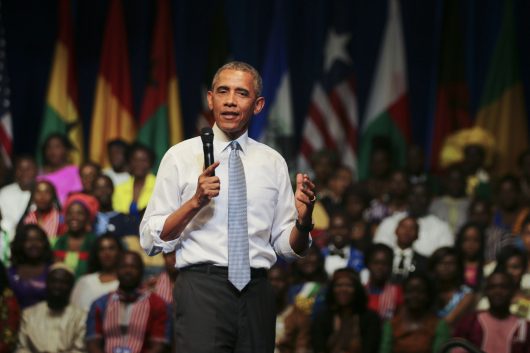
President Obama spoke about the importance of advancing global development at the White House Summit on Global Development this past July. He focused his speech on development as a “key pillar” of his foreign policy and reassured that it would remain so for the next president.
The Obama Administration has funded global projects such as reducing poverty and encouraging global economic growth and stability. These programs add to former President George W. Bush’s efforts to focus on fighting global disease through the President’s Emergency Plan for AIDS Relief (PEPFAR).
According to the official White House website, Obama’s U.S. Global Development Policy that he issued in 2010 was the first time that “global development was elevated, on par with diplomacy and defense as a core pillar” of U. S. policy. Following Bush, Obama and his administration have continued to focus on solving global issues throughout his time in office.
The Washington Post cites the Obama Administration’s Feed the Future program as one of its successes. The agriculture-based program supported 9 million farmers and increased their sales by more than $800 million. The Global Food Security Act will systematize the program so that its impact extends long past the Obama Administration.
Susan Rice, the National Security Advisor, wrote in a Huffington Post article about why it is so important that Obama is dedicated to development. “Development is not a charity – it is a prudent investment in the security and prosperity of us all,” she wrote. Development is an investment that helps to stabilize global conditions and to create opportunities.
Rice wrote that Obama’s White House Summit on Global Development will help to support global economic growth, to improve food security and nutrition, to improve global health, and to invest in leadership. The programs already supporting these causes, like the United Nations’ Sustainable Development Goals and Feed the Future, will all help to eradicate poverty and secure a prosperous future through the continued support of global leaders and organizations.
Obama’s White House Summit on Global Development will hopefully mobilize already existing aid and development programs of all kinds. With goals to advance development in a variety of ways, the Summit will hopefully help to expedite poverty reduction efforts and stabilize global conditions.
– Addie Pazzynski
Photo: Flickr


 In recent years, Colombia has successfully taken measures to reduce the issues that contribute to poverty, particularly in the worse urban areas. However, land displacement due to violent conflict still causes a significant portion of the population to be affected by
  The European Union, or EU, is the world’s largest development aid donor with