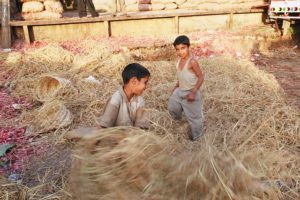
Malnutrition claims the lives of more than 3.1 million children a year. Those who survive face mental impairment as well as a heightened risk of disease or disability.

Yet the rising gross domestic product (GDP) of low-income to mid-income countries fails to correlate with a decline in stunted, under-weighted or wasted children. In field of development, many presume economic growth and improved standards of living lead to greater food security. S.V. Subramanian, a social epidemiologist at Harvard, reports an “insignificant decline in stunting” during times of economic expansion. He and his associates researched 36 of these countries, collecting data on children from 1990 to 2011. The Journal Lancet Global Health published the results this month.

With every 5 percent gain in GDP, less than 1 percent of decrease in stunting results. This results in a “zero effect” of GDP on child malnutrition, according to Subramanian.

Derek Heady of the International Food Policy Research Institute objects to this conclusion. “Income growth is a necessary condition for increased spending on food, health, education, sanitation and so on,” he asserts.

Subramanian, however, attributes this “zero effect” to disparities in income distribution and the inefficient delivery of health services. A rising GDP, he remarks, may not benefit every individual, region, or sector. For instance, these countries often invest money into sectors that initially led to the this growth. Such investments, however, often fail to improve child health.

India highlights this tendency. Its GDP has grown rapidly in recent decades, reaching an estimated 5 percent increase per year. This growth far surpasses that of most Western countries. Yet nearly half of children appear stunted and an additional two-fifths underweight. This limited food security among children has persisted as early as 1990.

Rather than investing in nutrition efforts in schools or clinics, the government focused on highway construction. A large population currently lacks basic sanitation. Child malnourishment endures without interventions in safe water, breastfeeding practices and food aid. Economic growth alone cannot resolve this health threat.

Lawrence Haddad heads the Institute for Development Studies in England. He highlights Ghana, Vietnam and Brazil as success cases; in these countries, malnutrition declined as a result of both economic growth and investments in water, sanitation, health services and nutrition programs.

“Unfortunately, with malnutrition, there is no silver bullet,” he elaborates. “It’s like a series of links in a chain, and if any one of those links is weak, it undermines everything else.”

Understanding the driving factors in malnutrition, though, promises reform in government spending. These growing economies hold the potential to combat this health crisis. First, though, strategic investment in the fields of nutrition and sanitation must occur.

– Ellery Spahr

Sources: NPR, Voice of America
Photo: United Nations Photo via photopin

Derrick Walton knows what it feels like to be homeless, sleep in abandoned cars and not have enough, if anything, to eat. Therefore, when he established Chef D’s Rock Power Pizza in January 2014 in Des Moines, Iowa, he pledged to shut down his restaurant once a week to help in feeding the homeless.
“I made a promise that if I ever got in a position where I could help somebody, I would give something back,” Walton told Yahoo’s Good News blog.

Although Walton can’t really afford to close his restaurant one night a week, he continues to do so to make sure anyone who needs food can get it – for free.

On April 2, 2014, Walton was invited on the Ellen Degeneres Show and she gave him $10,000 for his cause. Ellen has been partnering with Bank of America to highlight people who give back to their communities. When she heard of Walton, she was touched by his story and wanted to help him get the word out about his restaurant.

Walton grew up in Detroit in a household of eight kids and he learned to cook from his mother. After going to culinary school, Walton said he made some bad choices that landed him homeless.

“It put me in a position where I needed help from others, but the doors were always closed,” he recalls. “I made a promise that if I ever got in a position where I could help somebody, I would give something back.”

After saving up money from a dish washing job and later a line cook, Walton was able to open Chef D’s Pizza. And now, the $10,000 check from Ellen will help him continue to be able to keep his doors open for the homeless on Monday nights.

Iowa is home to almost 3,000 homeless people. The state has a poverty rate of 12.7%. With poverty often comes food insecurity and Walton is doing a small part to alleviate hunger in the homeless population of Des Moines.

– Haley Sklut

Sources: Ellen, The Huffington Post, Yahoo, Spotlight on Poverty
Photo: LiftBump

MasterCard_selfie_selfless
Last month, we talked about the #SelfiePolice project started by young college students who found an innovative way to turn the traditionally selflish “selfie” into a force for social good. Turning selfishness into selflessness has now also been embraced as a strategy by MasterCard and the World Food Programme (WFP), through the “Selfless Selfie Campaign.”

The Selfless Selfie Campaign was unleashed this year at the Mobile World Congress, where attendees were encouraged to stop by the MasterCard booth, take a selfie and tweet about it. For each selfie taken, MasterCard pledged to donate a month of school meals for a hungry child through the WFP.

The campaign did not end there. It found itself this week taking on “one of the hottest and most well-known festivals in the world,” South by South West (SXSW) in Austin, Texas. MasterCard donated $5 for every selfie taken at the festival and tweeted with the hashtag #dogood. Again, for each selfie tagged, MasterCard pledged to donate $5 to provide a month of school meals for a hungry child through a WFP program.

MasterCard and the WFP formed a global partnership in 2012, with the goal of delivering “ground-breaking technology to meet the needs of the world’s hungry and vulnerable populations in order to help end world hunger.” According to Hunter Biden, the Board Chair of the WFP USA, “66 million students across the developing world go to school hungry every day.” MasterCard and the WFP believe that a new approach to help these children lies in the power of technology to unlock innovation in food assistance.

One way to utilize the power of technology is through social media platforms. “Leveraging technology to do good is important to us at MasterCard,” said Ann Cairns, MasterCard President International Markets.

Twitter, in particular, has some staggering statistics that make it a valuable tool for corporations, non-profits, and activists worldwide to spread their message to millions:

  1.  There are now at least 230 million active users on Twitter globally, with over 100 million daily active users
  2. More than 5,000 tweets are tweeted every second
  3.  3 million websites integrate with Twitter.

Twitter and other social media sites offer a unique platform that connect millions of people, affording them opportunities to influence change and spark social justice movements in ways that were unimaginable before.

– Rifk Ebeid

Photo: Mastercard
Sources:
Amazon, Stay Classy, News Room

Thailand is known for having one of the best nutritional programs in Asia. According to the World Food Programme (WFP), Thailand has successfully dropped child malnutrition from 36% to approximately 8.42% within 30 years.

Thailand’s success stemmed from an in-depth look at growth rates, nutritional education, supplementation of iron and vitamins, as well as a focus on health coverage. It was also one of the primary countries to reach out to the community as a basis for promoting an end to malnutrition – specifically in children.

One method for reducing malnutrition in Thailand among school-aged children is the School Lunch Program, which supplies lunch at no cost to children struggling to maintain a healthy weight, or students who are unable to afford lunch. These lunches also aim to “educate students about desirable eating habits, values, and social manners.”

Students from rural areas have specifically been the victims of malnutrition in Thailand. Although rice is a staple food, the large amount of production does not necessarily correlate with balanced meals or eating a satisfactory amount required for healthy growth, both physically and mentally. Since diet is mainly based on rice, a lack of protein in diets are a large contributor to malnutrition in Thailand; also among the nutrients lacking in diets are iron, iodine and vitamin A.

SLP is currently providing all kindergarten and elementary public schools, reaching about 30,000 schools and 700,000 preschoolers. School Lunch Program currently provides meals for students for 200 days during the school year. The program started off by focusing merely on the amount of meals that were able to reach students. Now the meals are geared around the nutritional value.

With the help from the School Lunch Program many students whose diets are lacking in balance, or worse nonexistent, now receive meals at school that they may not have been able to receive at home.

The meals that Thailand is able to provide to children not only helps their struggle with malnutrition, but also helps with their ability to focus, gain weight, and grow cognitively.

– Rebecca Felcon

Sources: Rappler, Right To Food Campaign, World Food
Photo: IIRR

julia roberts
When people think of the needs of the hungry in the developing world, their supply of proper cookware is not always the first thing that comes to mind. More common are thoughts of the need for immediate food supplies and ways to promote agriculture. However, there is a definite need in the developing world for proper cookware. Estimates say three billion people around the world rely on open-air stoves, an inefficient and sometimes dangerous way of cooking food.

The Global Alliance for Clean Cookstoves was organized in 2010 by then-Secretary of State Hilary Clinton and the United Nations Foundation to raise awareness about the challenges that so many face in cooking their food from open-air flames. In 2011, Julia Roberts joined the Alliance as a global ambassador and became a key spokesperson for the group. In a statement soon after her decision, she said, “I was inspired to join the Global Alliance for Clean Cookstoves because its core mission is saving lives – especially children’s lives.”

It is believed that two million people a year are killed due to the smoke coming from the cooking done on unclean cookstoves. Up to a million of those killed are children. In the necessity for parents to provide for their children they inadvertently put them at risk. This shows the necessity for governments in the developed world to step in, and shows the necessity of groups like the Borgen Project to encourage this type of support.

Fires cooked over open-air flames take the terrible human toll that have resulted in the millions of deaths around the world. They also take a toll on the environment, raising concerns about the future of humans on this planet. In order to supply these open-air flames, the people using them are contributing to the global deforestation problem. The flames from the stoves, just as they release carcinogens that can harm the cooks, can also release dangerous greenhouse gases that harm the environment. Studies have shown that fires contribute to emissions of methane, carbon monoxide and black carbon.

The goal of the Global Alliance for Clean Cookstoves is to change the landscape of cooking in the developing world by 2020. Goals have been set to establish 100 million clean stoves by that year. Julia Roberts describes the “effective solutions, which can save lives, improve livelihoods… and combat climate change.”

This is a fight worth taking up, one that could have large impacts on the global stage. With more efficient stoves, the health costs spent combating smoke-related diseases could be used towards the upkeep of a productive family. As more families have these funds freed up, a significant impact on the global economy could follow.

Human lives being lost in the search for a good meal should not be the case anywhere in the world. The meals people cook everyday at home are an unheralded luxury we enjoy. If citizens take the time at every meal to think of how they can make it easier for those abroad to healthily enjoy their meals, it may contribute to a global effort to save lives.

Eric Gustafsson

Sources: Kiva, Clean Cookstoves, Guardian, PBS
Photo: TV Guide

poverty in armenia
Landlocked between Azerbaijan, Turkey, Georgia and Pakistan, the country of Armenia has faced economic hardships since the collapse of the Soviet Union in 1991. Between 1989 and 1999, warfare with Azerbaijan and tensions with Turkey have led both countries to impose economic blockades against Armenia; an international settlement has yet to happen. The country’s main source of trade occurs across the border shared with Georgia and into Russia.

Despite some growth and improvements from bilateral humanitarian efforts, Armenia faces several economic and food security challenges. Though Armenia’s gross domestic product growth rates have reached double digits in recent years, this is largely attributed to the widening of the poor-rich gap and the uneven distribution of wealth. Areas of poverty in Armenia are concentrated in rural areas and the country’s borders. Harsh winters, infertile and highly elevated lands and a lack of agricultural diversity have hampered Armenia’s goal of achieving economic sustainability.

The United Nations Development Programme (UNDP) reports that levels of poverty in Armenia have halved from 56.1 percent in 1999 to 23.5 percent in 2008. Though promising, the hard fact is that about 48 percent of the country’s population was below the poverty line of $2 per day in 2008. In 2006, a severe lack of funding forced the World Food Programme to cease its food aid operations in Armenia. Already dire conditions for the country’s most vulnerable people worsened.

Several organizations have since taken up the task of aiding Armenia’s long-term development. USAID is the leading donor agency in Armenia, focusing operations on diversifying Armenia’s economy and agriculture, rebuilding infrastructures, fueling education and bolstering Armenia’s economic competitiveness.

In addition, USAID has partnered with several inter-World Bank and IFC Armenian initiatives to provide extensive technical assistance as well as monetary aid to the bolstering of water safety, road construction and the modernization of healthcare and the public sector.

The International Finance Corporation (IFC) has focused on increasing investments by $2.5 million to improving food safety measures of Armenian meat factories; improving food safety practices to international standards would bolster future international trade potentialities and competitiveness. The IFC has invested $271.5 million in the country over 44 projects spanning several diverse sectors.

The United Nations Food and Agriculture Organization is also supporting the Armenian Government in the improvement of food safety; methods involving training government assessment personal and educating rural farmers. The World Bank has invested $1.746 million to dozens of projects in Armenia, focusing on job creation and again economical competitiveness. The World Bank has since renewed its partnership with the Republic of Armenia for 2014 to 2017, paying particular attention to rapidly reducing both urban and rural poverty.

Armenia is one of the international success stories of multi-lateral humanitarianism. The country that crumbled economically two decades ago has seen vast improvements and is on its way to economical sustainability and independence, but only as a result of international collaboration and investments.

– Malika Gumpangkum

Sources: Action Against Hunger, World Food Programme, World Bank, The Armenian Weekly, World Bank, World Food Programme, World Bank, United Nations Development Programme, USAID, USAID
Photo: Ararat Magazine

hunger_rwanda
The Republic of Rwanda is a small sovereign state in the Eastern part of Central Africa. Rwanda ranked at 166 of 187 countries on the UNDP Human Development Index in 2011. Rwanda also has the highest population density in the region with 416 people per square kilometer.

Low income, limited natural resources, and food and water insecurity pose a problem for citizens in Rwanda every day. In the years following the Rwandan Genocide in 1994, international rebuilding efforts have been on the ground trying to make sustainable changes to alleviate some of the hunger and water issues.

Here are five facts that explain the state of hunger in Rwanda and how it may change in the coming years:

  1. The 1994 Rwandan Genocide marked the end of the ceasefire signed the year before that stopped the fighting of the Rwandan Civil War. The war began between two ethnic groups the Hutu and Tutsi. The Genocide began when the plane carrying the Hutu supported president Juvenal Habyarimana was shot down and he, along with several other members of the government, were killed. The genocide lasted 100 days and an estimated 800,000 to 1,000,000 people were killed. The fallout from the Rwandan Genocide is the cause for much of the instability in the region that lasts today.
  2. Secondary school attendance in Rwanda is one of the lowest in the world and the literacy rate is 55%.
  3. Approximately 65% of the population has access to safe, clean drinking water
  4. 45% of children under 5 years of age are malnourished.
  5. Over 67,000 refugees from neighboring countries currently reside in Rwanda.

Even though there is a lot of strain on the country today, organizations have been working with the government to address one of Rwanda’s major problems: food insecurity. Agriculture was the country’s main sector before the genocide, and since then, major efforts have been made to make it profitable one more.

Updating the agricultural practices is what the World Food Programme credits with directly reducing the number of food insecure people.

The country hopes that with the reliance on agricultural programs it will improve its GDP to US$900 by the year 2020, up US$380 from its current GDP. Rwanda was also the first country to sign the Comprehensive Africa Agriculture Development Programme (CAADP), meaning that addressing malnutrition and food insecurity is one of the government’s main priorities.

Even though Rwanda still has a long way to go, the government has been taking steps in the right direction that could provide a template for other countries in the region to follow.

– Colleen Eckvahl

Sources: World Food Programme, World Vision
Photo: Rising Continent

malnutrition

Kinshasa, DR Congo

The second largest country in Africa and is located in the middle of the continent. Since the 1990’s the country has been in a state of political unrest and civil war which is the cause of many of the other problems in the region, such as disease, food insecurity, human rights violations, and violence against women.

Here are four issues that contribute to nearly 6.3 million people remaining food insecure and over half of the children under the age of 5 classified as malnourished in the DR Congo:

  1. Political instability between the government and several militia and rebel groups. Peace talks have been ongoing since 2009 with little progress. Since 1998, 5.4 million people have been killed. Less than 10% were killed during the fighting, instead the majority have died from diseases and malnutrition.
  2. 2.7 million people are internally displaced within the DRC as a result of the civil war. 1.6 million are in the North and South Kivu region, where much of the heavy militia activity takes place. There are an additional 116,000 refugees from neighboring countries currently living in the DRC. The large number of displaced people and perpetual fighting in the country has led to a high rate of abuse and sexual assault of women and children. It is estimated that 400,000 women between 15 and 49 were raped between 2006 and 2007. This is the equivalent of 48 women being assaulted every hour.
  3. 3.71% of the population lives below the poverty line, meaning they live on less than two dollars per day.
  4. Rampant infectious diseases are common across the country such as Malaria, Dengue Fever, Typhoid Fever, and HIV/AIDS. The ministry of health said that Malaria was their number one disease concern and in 2011 alone there were 4,561,981 reported cases.

– Colleen Eckvahl 

Sources: The International Campaign to Stop Rape and Gender Violence in Conflict , WFP, WHO
Photo: This is Africa

Childfund International
The United States Census Bureau has forecasted the population of the world to reach eight billion by the year 2025. In terms of hunger this can be considered an extremely daunting statistic. How will eight billion people eat in the future when people cannot even adequately feed everyone living on Earth today? Eliminating global poverty and giving children necessary skills to survive and thrive in the coming years are crucial parts of the world hunger solution.

ChildFund International is one organization that focuses mainly on children and improving their quality of life in order to sustain a better future. It is known for sponsoring children in over 50 countries. Giving to countries in need with specific guidelines involving nutrition and social development have been proven effective in comparison with unspecific cash donations.

Focusing on making sure children and families have access to food and health living environments is a great strategy for charities to implement. Once starvation is off the table, kids can go to school and parents to work. Eventually they can become self-sufficient, disbarring the notion of welfare dependency.

Supporting children with food, water, school supplies, and access to decent medical care is all part of the sponsorship benefits that ChildFund International distributes. A recent article on their website notes how population increases are only exacerbating the problem of widespread hunger. Developing countries are becoming more urban; building cities means destroying farmland. Farmland is necessary for agricultural production, and the less natural farmland there is, the more difficult it becomes to produce food.

Solving global poverty and solving world hunger are interrelated goals. Providing access to clean drinking water, food and medical care boosts the economy by increasing the number of healthy learning and working children in a community. The more educated the children are, the more likely they are to grow up and secure sustainable employment.

Having a stable job will mean having a stable income and the ability to break the vicious cycle of poverty. Studies have shown that poverty in the United States has decreased significantly over the past 50 years and the goal of eradicating poverty altogether is very possible with governmental assistance and appropriate policy implementation. However, poverty is still a huge issue in foreign nations and every effort is needed to help resolve it.

There are still billions of people living on barely $2 per day and suffering from hunger and the absence of clean water. Foundations like ChildFund International and everyone who gets involved can make sure everyone has the chance at a better tomorrow.

– Kaitlin Sutherby

Sources: The Economist, The Huffington Post
Photo: TriCounty Sentry

Quotes_on_World_Hunger
Scholars have discovered that the issue with world hunger is not a food shortage, but the logistics behind food distribution. We need to improve access to food by looking at production strategies, trade agreements and food aid. Here are 10 quotes on world hunger.

“We know that a peaceful world cannot long exist, one-third rich and two-thirds hungry.” – Jimmy Carter, 39th president of the United States.

“Close to a billion people – one-eighth of the world’s population – still live in hunger. Each year 2 million children die through malnutrition. This is happening at a time when doctors in Britain are warning of the spread of obesity. We are eating too much while others starve.” – Jonathan Sacks, jewish scholar.

“We are a country that prides itself on power and wealth, yet there are millions of children who go hungry every day. It is our responsibility, not only as a nation, but also as individuals, to get involved. So, next time you pass someone on the street who is in need, remember how lucky you are, and don’t turn away.” – Lesley Boone, actress and social activist.

“When you share your last crust of bread with a beggar, you mustn’t behave as if you were throwing a bone to a dog. You must give humbly, and thank him for allowing you to have a part in his hunger.” – Giovanni Guareschi, Italian journalist.

“When people were hungry, Jesus didn’t say, “Now is that political, or social?” He said, “I feed you.” Because the good news to a hungry person is bread.” – Bishop Desmond Tutu, Anglican bishop and social activist.

“It is important for people to realize that we can make progress against world hunger, that world hunger is not hopeless. The worst enemy is apathy.” – Reverend David Beckmann, president of Alliance to End Hunger.

“There are genuinely sufficient resources in the world to ensure that no one, nowhere, at no time, should go hungry.” – Ed Asner, actor and social activist.

“The fact is that there is enough food in the world for everyone. But tragically, much of the world’s food and land resources are tied up in producing beef and other livestock–food for the well off–while millions of children and adults suffer from malnutrition and starvation.” – Dr.Walden Bello, 2003 Right Livelihood Award winner.

“The war against hunger is truly mankind’s war of liberation.” – John F. Kennedy, 35th President of the United States.

“The first essential component of social justice is adequate food for all mankind. Food is the moral right of all who are born into this world.” – Norman Borlaug, biologist and humanitarian.

Stephanie Lamm

Sources: Bits of Positivity, Do One Thing, Second Harvest Food Bank