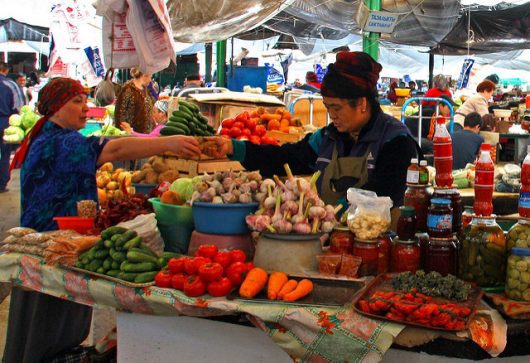
Kyrgyzstan lies in central Asia with much of its land consisting of rugged and mountainous terrain. The country faces harsh winters and hot, arid summers because of its height above sea level that ranges anywhere from 1,000 meters to 3,000 meters. Kyrgyzstan’s land and climate mean there are very few arable locations suitable for growing and sustaining seasonal crops.
With much of their communities being rural, Kyrgyzstan is reliant on their agricultural products as a source of sustenance and income with around 40 percent of laborers focused in agriculture.
Crops
A variety of crops grown in Kyrgyzstan are best-suited for the land and climate, including wheat, barley, maize, potatoes, vegetables and fruits, while sugar beets, cotton and tobacco are grown for export.
Kyrgyz focus more on keeping pastures and maintaining herds of livestock for food because of the small amount of land for farming. Livestock mainly consists of sheep, goats and yak, but some regions can support cattle, pigs and chickens.
Agricultural Practices
Both the agricultural practices of the Kyrgyz and the increasing amount of agricultural production needed for the population make sustainable agriculture in Kyrgyzstan a growing and serious issue.
Due to how rural much of the country is, farmers tend to only have access to the most basic of tools, and often lack the knowledge of proper farming methods, meaning what little land there is to be farmed is being dramatically degraded. The herding of livestock has had a similar effect on the land in the form of desertification in overused pastures.
Nutritional Deficiencies
The lack of farmable and healthy pasture land is not the only issue regarding sustainable agriculture in Kyrgyzstan. Kyrgyz can only grow hearty, starchy crops to survive the harsh conditions of the country, and as a result, many are affected by nutritional deficiencies; children can have stunted growth because of a lack of essential vitamins and minerals found in fairer weather crops.
Nutritional deficiencies can also be contributed to rural Kyrgyz simply not being able to afford food — many have low salaries compared to the cost of food from Kyrgyzstan and imports to the country.
Foreign Aid
Kyrgyzstan often depends on foreign aid to provide what it cannot due to poverty and the agricultural issues the nation faces. Although this aid does fund some food relief programs to provide for Kyrgyz who need it the most, much of the projects and programs focus on the agriculture itself.
USAID programs in the country tend to focus on both making agricultural practices more sustainable, such as how the land is managed and how produce is stored, and on making the agricultural economy of Kyrgyzstan more viable by aiding in the production of in-demand crops for export.
This, in turn, provides farmers with the money needed to purchase better tools and infrastructure for more sustainable practices.
Sustainable Agriculture in Kyrgyzstan
For the time, sustainable agriculture in Kyrgyzstan is a struggle both economically and environmentally, and lack of proper nutrition has a negative impact on the population.
There is hope on the horizon, though, from a variety of programs funded by foreign aid in an attempt to not only provide Kyrgyz with proper nutrition but also make their agricultural practices so sustainable that they will be able to advance themselves in the future.
– Keegan Struble
Photo: Flickr

Understanding the Basics: What is a Parliamentary System?
Many in the United States may be aware that most Europe governments use a parliamentary system, but the question most are probably thinking is: what is a parliamentary system? More importantly, how is it different from the system used by the United States? Here are the answers to these questions and more.
Basics of a Parliamentary System
In terms of the U.S. system, a country’s parliament would serve as both its legislative and executive branches. The most important thing to know about parliamentary systems is that the political parties hold the power and not individuals. When citizens vote, their ballots list party names and when a party wins, seat allotment is assigned to party members based on seniority (in most cases).
When a party wins the majority of seats, it then selects a leader to serve as the executive called a Prime Minister or, in some cases, a Chancellor. This person will most likely already be the party leader and they then select their cabinet which sets the government’s agenda. If one party does not win the majority of seats in the parliament, then it must form a coalition with other parties to form a majority.
This process may take time, but it will eventually allow for the smoother passage of legislation.
One House or Two?
Many parliaments are bicameral, meaning it has two houses, while others may be unicameral, having only one house. In bicameral systems, there is a lower and an upper house, but most legislating actually takes place in the lower house.
The greatest difference between the two is the number of veto points or places where legislation can be halted within the legislative process. Unicameral systems have fewer veto points than bicameral systems making it easier and faster to pass legislation but also easier to overturn. Many parliamentary systems therefore adopt the bicameral system for stability.
Parliamentary vs. Presidential
In a parliamentary system, the executive is the Prime Minister while in a presidential system, the President is the executive. There are many differences between these two positions, but most notably, the Prime Minister and his/her cabinet arises from the legislature, while Presidents are directly elected by the people.
At first glance, many would then prefer a President because citizens choose him/her directly, yet many still prefer Prime Ministers.
First of all, they are beholden to their party, so their decisions are far more predictable than a President’s and voters know exactly what values they are voting for. This applies for all members of the legislature as well, not just the Prime Minister.
Parliamentary systems also entail the possibility for a vote of “no confidence” by the legislature which can remove a Prime Minister from power at any point if they lose the vote. Presidents, however, have fixed terms and cannot so easily be removed.
Success Rate
Citizens in the United States are very fond of the presidential system, yet in reality the success rate for parliamentary systems is far greater. The system has been a part of some European countries for centuries, but that doesn’t mean it’s perfect. When deciding which system to adopt, new countries must consider what is best for its country, and that may or may not be a parliamentary system.
– Megan Burtis
Photo: Flickr
A Crucial Shift: How the US Benefits from Foreign Aid to Venezuela
Human Rights Defense
According to the U.S. Department of State, assistance from the United States to Venezuela is focused mainly on human rights issues, civil services and building up the strength of political interests in the area. One main interest in Venezuela is building a strong counter-narcotics network in the region, but recently the USDS has reported that Venezuela has failed to maintain the network to adequate levels.
Politically, this demonstrates the inability for the Venezuelan government to control its national defense programs, which became even more obvious after a presidential election putting Nicolas Maduro in charge, an action widely disputed for its legitimacy.
Venezuela’s Economy
According to CNN, a major reason for this election and presidential cycle being so tumultuous is due to a decline in Venezuela’s economy, which is one area wherein questions arise about the way the U.S. benefits from foreign aid to Venezuela.
Another article from CNN Money states that the Venezuelan crisis spreads further than just a loss of democracy; it spreads to the pockets of the people as well. Venezuela’s cash revenue has fallen from $30 billion in 2011 to $9.9 billion in 2017. That drastic of a drop is causing a humanitarian crisis disproportionate to Venezuela’s economic capacity.
The U.S. and Venezuela
This being said, the United States remains one of Venezuela’s largest suppliers of goods. According to the U.S. Department of State, the U.S. exports nearly $8.3 billion to Venezuela include agricultural products, car parts and petroleum. In return, the U.S. imports a large number of oil products from Venezuela, totaling around $15.6 billion. However, this number has declined since the price of oil fell, causing an economic shift in Venezuela’s market.
This occurrence, along with a cash-poor economy, has pushed Venezuela into a crisis situation. With food being harder to get and inflation through the roof, humanitarian aid to Venezuela is going to increase in the next few years — that is, if the rest of the world wants to help stabilize the country.
A Global Shift
The way the U.S. benefits from foreign aid to Venezuela is going to change. As long as political alliances don’t shift too far from their current position, there is a high chance that the U.S., through increased humanitarian efforts and support for the agricultural and healthcare systems in the country, can help Venezuela recover before the nation degrades any further.
– Molly Atchison
Photo: Flickr
How the US Benefits From Foreign Aid to Belize
Security
The U.S. government helps Belize fight organized crime and drug trafficking while regulating the number of migrant workers coming into America. The U.S. has helped strengthen the police force in Belize as well as improve the capacity to secure its borders. It has also helped improve citizen security and Belize’s ability to confront and disrupt criminal organizations that run rampant throughout the country. This is all in the effort to strengthen Belize as a country which will be beneficial to the U.S. in the long run.
Immigration and Tourism
The U.S. and Belize have always been very close as the U.S. houses the largest number of Belize nationals outside of the country itself. This is partly because of migrant workers that come to the country from Belize. The U.S. is a major source of investment funds and is the principal trading partner for Belize. The U.S. also helps to promote tourism in Belize. The tourism often results in Americans retiring and moving to Belize permanently. This helps increase the revenue within the country, promoting economic growth while also exposing Belizean culture to Americans that had never experienced it before.
International Relations
Giving help to Belize depicts U.S. diplomacy and also helps with relations among all Latin American countries. The U.S. has operations in over 100 companies located in Belize which helps the Belizean economy while simultaneously assisting corporations in the U.S. All the while, these efforts increase international relations and positive American diplomacy.
These are just a few ways that the U.S. benefits from foreign aid to Belize, and as the relationship between the two countries continues to grow, more benefits will become apparent.
Belize has benefited substantially from America aid which has allowed an increase in economic status with attempts to end organized crime and illicit drug trafficking. U.S. foreign aid helped Belize improve the inner-workings of the country as well as citizen relations. Foreign aid has had a positive effect on Belize as a whole, and this is a trend that seems to be continuing as long as the U.S. is there to offer foreign aid to the country when it needs it.
– Simone Williams
Photo: Flickr
The Success of Humanitarian Aid to St. Vincent and the Grenadines
Composed of smaller islands in the southern Caribbean, St. Vincent and the Grenadines is known for its major sailing destinations and white-sand beaches. However, on Dec. 24, 2013, a heavy tropical storm plagued the islands. Heavy rains, flooding and landslides caused at least eight deaths and massive damage to the country. Declared a level 2 disaster by the government, regional assistance was requested seeing that local resources were limited. That’s when Britain stepped in.
Providing Humanitarian Aid
Britain was the first to offer humanitarian aid to St. Vincent and the Grenadines. Britain provided about $370,000 in early January 2014. In addition to the funds, London provided essential drugs and medical supplies. Water and sanitation equipment were also supplied in an attempt to curb spreading of water-borne diseases. The Pan American Health Organization (PAHO) supplied the goods on behalf of the U.K.
Also in 2014, the European Commission’s Department of Humanitarian Aid and Civil Protection (ECHO) granted €300,000 to bring relief to locations affected by floods. Humanitarian aid to St. Vincent and the Grenadines was granted due to the severe impact left behind by the low-level trough system. A trough refers to an extended time of relatively low atmospheric pressure that can bring clouds, wind shifts and rain.
St. Vincent and the Grenadines have a history of receiving humanitarian aid. In 2010, the Organization of Eastern Caribbean States (OECS) vowed to provide any and all support to the government of St. Vincent and the Grenadines following the destruction of a previous storm, Hurricane Tomas. This including engaging a team from the U.N. to direct macro socio-economic disaster impact assessments in the islands.
Updating Infrastructure
Still rebuilding from years of previous hurricanes and troughs, the Agence Française de Développement (AFD) offered $33 million to St. Vincent and the Grenadines and nine other islands to finance proper infrastructure projects. The AFD is a chief agency established by the French government. At least 50 percent of the funding will also go toward climate change adaptation and mitigation projects. Other areas to be funded are:
The success of humanitarian aid to St. Vincent and the Grenadines gave the island hope. Every effort counted and the people of these islands knew they weren’t forgotten in their time of need.
– Tara Jackson
Photo: Flickr
The Success of Humanitarian Aid to Mauritania
Mauritania gained independence from France in 1960 but has since seen two coups creating some political instability. The first occurred in 1978 and the second 30 years later in 2008. The second coup coincided with a time of poverty reduction, and the 2000s, in general, brought GDP growth for Mauritania. The mining industry is large in Mauritania and was a big factor in that growth due to an increased global value of minerals.
Humanitarian aid to Mauritania can help further boost the growth of the country and benefit the people. Below are four areas in which humanitarian aid has been a success.
Despite the improvements in Mauritania in the 2000s, there are still many people living in poverty and the country faces development challenges. Humanitarian aid to Mauritania has been essential to helping the people of the country and will continue to help grow the economy.
– Hayley Herzog
Photo: Flickr
Infrastructure in Malawi
Scandal
Malawi’s poverty rate has barely changed from 2010 to 2016, falling from 70.9 percent to 69.6 percent. In 2014, Malawi faced an economic scandal known as “cashgate” in which government officials were laundering millions from government reserves. The cashgate scandal caused many donors to withdraw their funding, which resulted in more detriment to the nation because 40 percent of Malawi’s wealth comes from independent donors. While it was very publicized, it was not the first time donors withdrew from the Malawian government due to the corruption within it. This kind of scandal has affected Malawians, as well as infrastructure in Malawi.
Flood Crisis
Infrastructure in Malawi faced a large-scale flood in January 2016 which severely impacted the country’s development. The widespread flood wiped out several villages and much of the country’s agriculture. This has left Malawi in the largest food crisis in a decade. With a significant amount of damage to the country’s people and agriculture (part of country’s economic gains), the economy in Malawi has struggled to prioritize infrastructure development. Many solutions included providing short-term shelter for Malawians who had suffered from the disaster.
Non-Agricultural Development
While efforts to reboot the economy and its agricultural efforts continue, Malawi cannot keep up with its steady population growth. Due to the increasing population, farms are shrinking and limiting economic productivity. As agricultural jobs decrease, infrastructure in Malawi leans toward the creation of non-agricultural jobs in education, finance, and energy. Malawi currently uses hydro-power, and due to climate change and sporadic rain, the country often experiences water shortages and blackouts. Creating more infrastructure, especially providing additional resources for electricity, will benefit Malawi and increase the economy. The plans to develop in the non-agricultural sector will speed up the urbanization process for Malawians.
MGDS
The creation of jobs encourages the creation of infrastructure and vice versa. To combat the nation’s poverty, The Malawi Growth and Development Strategy (MGDS) was created in 2006. The goal of the MGDS is to encourage continued economic growth and infrastructure in Malawi. The MGDS is meant to create long-term jobs for Malawians in mining, trade, and tourism and culture. Another goal is to encourage the use of the environment and natural resources. Utilization of Malawi’s culture and wildlife will increase tourism to create more economic growth. Creating jobs within Malawi’s government, such as in the health and safety sectors, will also provide more growth for the nation’s economy and help the people of Malawi to overcome poverty. In addition to practical job creation and tourism growth, the MGDS will consist of urban improvements such as in airports, more media/telecommunications sources, and housing developments.
While the recent history of Malawi has not been hopeful, the country’s prospects predict a brighter tomorrow for Malawians.
– Courtney Hambrecht
Photo: Flickr
Sustainable Agriculture in Turkey
Barriers to Sustainable Agriculture in Turkey
Up to 20 percent of the Turkish population still works cultivating the land. Nowadays, up to 50 percent of the land is used for agricultural purposes. Regardless, the government has yet to take a step forward towards sustainable agriculture in Turkey.
Pesticides, fertilizers and soil erosion of the arable land, are the three main issues within the agricultural sector. Extreme drought is a fourth, but lesser issue in the Eurasian country. “Anatolian plateau” is the name given to the central part of the Turkish region that suffers most droughts due to its geographical positioning.
The interior part of the territory suffers from a dryer climate. Such conditions can have a significantly prejudicial impact on the arable land and rural economy in its entirety. This is taking a toll by making it a challenge to keep sustainable agriculture as an ongoing achievable goal.
The following affect sustainable agriculture in Turkey:
These augment the pollution levels in the water, the emission of greenhouse gases, and the loss of organic matter within the soil.
Recent Increase in Sustainable Agriculture
Even though multiple issues have emerged, sustainable agriculture in Turkey has increased over the past two years. The use of mineral fertilizers and pesticides has gone up, thus helping sustainability within the rural economic sector.
The agricultural sector is now undergoing a series of initiatives that will hopefully further increase sustainable agriculture in Turkey during the next few years. The Turkish government has provided training in order to create awareness on sustainable agriculture as well as spread new rural techniques that can help farmers with productivity. Sustainable agriculture in Turkey has already been improved, and during the next decades will have an even better and bigger impact that will benefit productivity, the soil, and the Turkish population.
– Paula Gibson
Photo: Flickr
Sustainable Agriculture in Tuvalu
Sustainable agriculture in Tuvalu, a small island developing state (SIDS), requires a cooperative network of individuals that understand and manage an unsure climate and disaster risk. Tuvalu consists of nine islands with its highest point being only a few meters above sea level. This makes for an unfriendly climate and physical environment as well as poor land resources and soil.
Agricultural Challenges
Due to the harsh variation in the climate, Tuvalu faces major setbacks in agricultural development. This forces the government to rely heavily on imported food, rather than locally produced food, to feed the country. According to the USAID Demographic Health Survey, the lack of sustainable agriculture in Tuvalu in 2007 caused a reported 61.2 percent of children under five years old to become anemic because of insufficient nutrients found in vegetables. This resulted in further issues as inflation hiked to 12 percent in 2008 instilling a reliance on imported food that has threatened the health of the country’s children.
Most of the crops grown in the villages are kept for individual sustenance (the taro, breadfruit, pandanus, pumpkin, etc.) with production being limited and often damaged by animals. Coconut trees remain the country’s largest crop and export, despite the high prices and restricted amount of exports by the government.
Sustainable Solutions
To create a reliable food source, the government turned its focus to home gardening, teaching Tuvalu’s women and children how to produce nutritious foods in their backyards to promote health. According to the 2005-2015 Tuvalu National Strategy for Sustainable Development, there is hope for revamping the country’s agricultural practices that have declined or been forgotten due to increasing urbanization, specifically on the local level within the villages.
Sustainable agriculture in Tuvalu centers on creating a reliable food source that can survive the country’s harsh climate and soil conditions. The Food and Agriculture Organization of the United Nations (FAO) partnered with Tuvalu in 2003 to develop an environmentally secure source of food production. The Secretariat of the Pacific Community’s Centre for Pacific Crops and Trees supplied a banana plant that can resist the climate, the black sigatoka disease along with 20 other diseases that are common among plant crops.
Local farmers have been supplied with these disease-resistant plantlets for crops that could support local and household consumption. Workshops and field demonstrations provided by the FAO to farmers and extension officers have helped boost the success of these crops significantly. They demonstrated two cultivation systems appropriate for the successful production of these crops in Tuvalu’s environment.
The FAO provided further workshops to teach farmers how to protect plants against invasive pests and harmful plant species. Educating farmers on these matters is key to creating sustainable agriculture in Tuvalu. Through continued education and working directly with local farmers, Tuvalu’s economy and agriculture will improve.
– Kayla Rafkin
Photo: Flickr
Credit Access in Sri Lanka
Sri Lanka still has a large number of citizens who live in poverty. While only 1.8 percent of Sri Lankans live in abject poverty, nearly 45 percent live on $5 or less a day. It is difficult to maintain a stable income, especially in rural areas. It is even more difficult to achieve personal growth when income covers expenses and there is little left over.
Credit Access in Sri Lanka
That’s why credit access in Sri Lanka, especially in rural communities, is an important stage in its continued development. In a report from 2005, the World Bank Group discusses the best methods of increased access for the rural poor. For example, enhanced remittances and payment services, and long-term saving instruments are highly useful for the poor and can be implemented in small and rural enterprises.
Remittances
Remittances, particularly, have grown rapidly in Sri Lanka. As the report states, Sri Lanka should move from an informal, unsafe network to a formal financial institution with better services, such as savings and insurance. This improvement in credit access in Sri Lanka will allow citizens to manage their financials with lower risks.
Loan Access
A 2011 assessment by the World Bank concluded that only 35 of Sri Lankan small firms can access a loan or a line of credit. Then, in 2013, Sri Lanka’s Credit Information Bureau (CRIB) and the World Bank agreed to boost credit access by making it easier to use movable assets as collateral. The World Bank will help CRIB to develop a legal framework that allows small businesses to mortgage inventory and equipment to bypass the traditional loan agreements.
Loans to Boost Credit Access
And in 2016, the Asian Development Bank (ADB) and LOMC (the nation’s leading microfinance institution) inked a $25 million loan agreement to boost credit access in Sri Lanka, specifically for small businesses and individuals. Under the agreement, LOMC will use the loan as funds for lending to micro-businesses and will improve financial products and outreach to remote farmers. LOMC hopes to improve access to banking, as 70 percent of citizens do not have any access, and, because the deal lasts five years, have the sources for long-term loans.
Sri Lanka continues to grow, and with these credit-based programs and findings, it will do so in a stable and financially viable direction. Hopefully, within the next decade, a majority of the population will have access to banking, and credit will allow for the rural poor to lead more economically independent lives.
– Nick McGuire
Photo: Flickr
The Promotion and Increase of Sustainable Agriculture in Kyrgyzstan
Kyrgyzstan lies in central Asia with much of its land consisting of rugged and mountainous terrain. The country faces harsh winters and hot, arid summers because of its height above sea level that ranges anywhere from 1,000 meters to 3,000 meters. Kyrgyzstan’s land and climate mean there are very few arable locations suitable for growing and sustaining seasonal crops.
With much of their communities being rural, Kyrgyzstan is reliant on their agricultural products as a source of sustenance and income with around 40 percent of laborers focused in agriculture.
Crops
A variety of crops grown in Kyrgyzstan are best-suited for the land and climate, including wheat, barley, maize, potatoes, vegetables and fruits, while sugar beets, cotton and tobacco are grown for export.
Kyrgyz focus more on keeping pastures and maintaining herds of livestock for food because of the small amount of land for farming. Livestock mainly consists of sheep, goats and yak, but some regions can support cattle, pigs and chickens.
Agricultural Practices
Both the agricultural practices of the Kyrgyz and the increasing amount of agricultural production needed for the population make sustainable agriculture in Kyrgyzstan a growing and serious issue.
Due to how rural much of the country is, farmers tend to only have access to the most basic of tools, and often lack the knowledge of proper farming methods, meaning what little land there is to be farmed is being dramatically degraded. The herding of livestock has had a similar effect on the land in the form of desertification in overused pastures.
Nutritional Deficiencies
The lack of farmable and healthy pasture land is not the only issue regarding sustainable agriculture in Kyrgyzstan. Kyrgyz can only grow hearty, starchy crops to survive the harsh conditions of the country, and as a result, many are affected by nutritional deficiencies; children can have stunted growth because of a lack of essential vitamins and minerals found in fairer weather crops.
Nutritional deficiencies can also be contributed to rural Kyrgyz simply not being able to afford food — many have low salaries compared to the cost of food from Kyrgyzstan and imports to the country.
Foreign Aid
Kyrgyzstan often depends on foreign aid to provide what it cannot due to poverty and the agricultural issues the nation faces. Although this aid does fund some food relief programs to provide for Kyrgyz who need it the most, much of the projects and programs focus on the agriculture itself.
USAID programs in the country tend to focus on both making agricultural practices more sustainable, such as how the land is managed and how produce is stored, and on making the agricultural economy of Kyrgyzstan more viable by aiding in the production of in-demand crops for export.
This, in turn, provides farmers with the money needed to purchase better tools and infrastructure for more sustainable practices.
Sustainable Agriculture in Kyrgyzstan
For the time, sustainable agriculture in Kyrgyzstan is a struggle both economically and environmentally, and lack of proper nutrition has a negative impact on the population.
There is hope on the horizon, though, from a variety of programs funded by foreign aid in an attempt to not only provide Kyrgyz with proper nutrition but also make their agricultural practices so sustainable that they will be able to advance themselves in the future.
– Keegan Struble
Photo: Flickr