Top 10 Facts Living Conditions in Kyrgyzstan
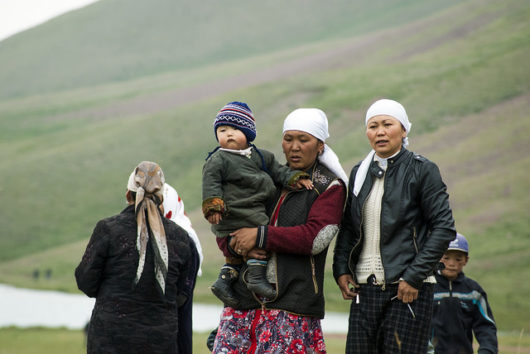
Windswept valleys and snowy mountains characterize the landscape of Kyrgyzstan. Yurts, round tents covered with skins or felt, are a common sight in rural areas. This represents a legacy from nomadic ancestors. Legally speaking, the nation itself is a young one, having officially come into existence in 1990. However, the nation’s cultural roots are far deeper than that.
Descending from nomadic forbearers, animal husbandry is heavily practiced in rural areas. Felt making and carpet weaving are still common household skills. In the 20th century, the country found itself as a part of USSR, remaining a member state for decades. Soviet culture would go on to shape national language, infrastructure and politics. The top 10 facts about living conditions in Kyrgyzstan represented in the text below will provide a better insight into the struggles and progress of a country that is both very young and very old at the same time.
Top 10 Facts about Living Conditions in Kyrgyzstan
- The first peaceful transfer of presidential power happened in 2017. On Nov. 24, 2017, Sooronbai Jeenbekov was inaugurated as president. It was the first normal presidential transfer since the writing of the constitution since each of the previous regimes was overthrown by a people revolt, in 2005 and in 2010 respectively.
- Public schools have high attendance rates. Under the national constitution, basic education (until ninth grade) is guaranteed and mandatory. Secondary education (beyond ninth grade), is also guaranteed to anyone who wants it. In recent years, great progress has been made in youth education. From 2010 to 2014, the number of non-attending youth shrunk from 25,000 to 8,000.
- As of 2015, approximately 32 percent of Kyrgyzstani’s live below the international poverty line. More than 67 percent of all poor live in rural communities, where transportation costs represent a significant part of the total cost of basic goods and services.
- Women’s workforce participation is helping to reduce poverty. To alleviate poverty the Rural Women’s Economic Empowerment Program (sponsored by the U.N.) operates in 73 villages across the country. This service enables rural women to open their own businesses, either utilizing their traditional skills (felt making, farming and baking) or by training them in new areas such as cell-phone repair.
- Kyrgyzstan has the highest rate of bridal kidnap in the world. U.N. cited estimates that suggest that 35-45 percent of all marriages involve some form of abduction. Roughly 43 girls are taken every day. While data is difficult to collect as the crimes are often hidden, high motherhood rates and reports of under-age marriage signal that this issue is far from resolved.
- A local nongovernmental organization is helping young women defend themselves. Started in 2016, the National Federation of Female Communities (NFFCK) trains girls to protect themselves against threats and violence. During the past two years, this organization has helped save 41 girls from forced marriage, given practical support to 482 girls, provided 1,682 consultations on child marriage and educated more than 12,000 young women.
- Water infrastructure is inadequate and falling into disrepair. The Soviet government built the entirety of Kyrgyzstan’s water infrastructure between 40 and 50 years ago. Almost half of the water is lost, spilling through the decrepit pipes, leaving distribution efficiency at 55 percent. Low coverage is a national problem that is more acute in urban areas, leaving cities with less than 40 percent of the amount they need.
- The village of An-Oston now has its water system reestablished with the help of the organization called Women Engage for A Common Future Construction (WECF). Before the house plumbing connections were rebuilt in 2015, villagers had to carry drinking water in pots from the local lake. Due to the WECF’s work, all 225 homes in the village have plumbing reestablished and have 24-hour access to potable water.
- Malnutrition, not starvation, is the biggest food-related problem. A very small part of the country, 1.2 percent, struggles to eat the minimum number of calories per day. However, malnutrition and consequential stunted growth are dangerously common. Thirteen percent of children under the age of 5 are believed to have stunted growth. In Jalal-Abad (the most heavily affected area), that rate is as high as 21.3 percent.
- The World Food Programme helps feed thousands of children in schools. As of 2017, due to the World Food Programme’s efforts with the government, 260 schools have been able to implement a sustainable meal plan for their students. Over 60,000 children under the age of 5 were provided school meals and an additional 213,000 children (aged between 5 and 18) were able to eat nutritious meals because of this program.
Many of these top 10 facts about living conditions in Kyrgyzstan demonstrate that progress is being made despite the terrible problems the Kyrgyzstani people face. There are many organizations and people that take steps toward bringing safety, stability and prosperity to their neighbors every day. Although the road ahead of the country will be a difficult one, all journeys begin with a single step.
– John Glade
Photo: Flickr
