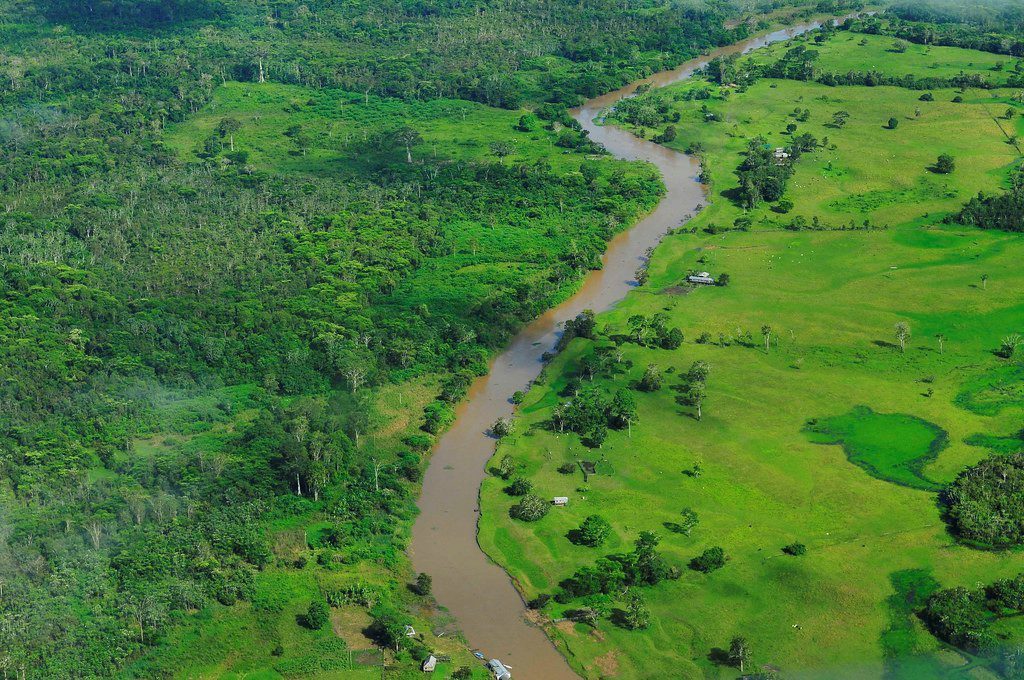
Within hours of being sworn in as the new president of Brazil this past January 2019, Jair Bolsonaro removed land demarcation rights from the National Indian Foundation (FUNAI) and transferred that power to the Ministry of Agriculture.
Under the 1988 Brazil Constitution, it is illegal for agricultural companies to lease land inside indigenous reservations for the growing of commercial crops. However, with the transference of land demarcation rights to the Ministry of Agriculture, the agribusiness sector of Brazil may be allowed to cultivate land inside of indigenous territory – because they will be the ones defining what constitutes “indigenous land.”
This was a controversial decision, but not a surprising one for Bolsonaro. During his campaign, the far-right president-elect of Brazil promised to open up indigenous territories – which make up 13 percent of Brazilian land – to agricultural and mining interests. The Parliamentary Agricultural Front endorsed him, a congressional lobby which represents the agribusiness sector of the Brazilian economy and whose members make up more than a quarter of the nation’s Senate.
Bolsonaro and Indigenous Rights
In addition, Bolsonaro has been a vocal opponent of indigenous rights throughout his political career. The indigenous rights organization, Survival International, created an archive of various speeches, interviews and social media posts where Bolsonaro made racist remarks or proclaimed his intent to remove the rights of indigenous peoples, especially where land demarcation was concerned.
The list extends as far back as 1998 when Bolsonaro said that it was “a shame that the Brazilian cavalry hasn’t been as efficient as the Americans, who exterminated the Indians.” (from the newspaper Correio Braziliense, April 1998). In February 2018, Bolsonaro announced his intent to remove land demarcation altogether: “If I become President, there will not be a centimeter more of indigenous land.”
For many indigenous groups, the fulfillment of these claims is all but a declaration of war against them by the government. The indigenous territories of Brazil are home to approximately 900,000 people from 305 different ethnic groups. These groups range in size from tribes of 50,000 or more to dwindling groups that consist of only a few families; at least one tribe in the Amazon region consists of a single, unnamed survivor. Some of these groups have never made contact with the outside world. If the Brazilian government is to allow their lands to be opened to industrial interests, any of these people could lose the land that they have inhabited for centuries.
Opponents of land demarcation, including President Bolsonaro and the new Minister of Agriculture, Tereza Cristina Dias, have argued that indigenous groups would benefit from being exposed to agricultural and industrial interests.
Indigenous Rights Activists
Nevertheless, indigenous rights activists maintain that the original inhabitants of Brazil have a right to stay on their own land with their own cultures. In a letter to President Bolsonaro, representatives from three different tribes – the Aruak, the Baniwa and the Apurina – stated their opposition to the forced opening of demarcation lines: “Who is not indigenous cannot suggest or dictate rules of how we should behave or act in our territory and in our country. We have the capacity and autonomy to speak for ourselves. We have the full civilian capacity to think, discuss the paths of indigenous peoples according to our rights… Our way of life is different. We are not against those who opt for a Western, capitalist economic model. But we have our own way of living and organizing in our lands and we have our way of sustainability. Therefore, we do not accept development nor an economic model done in any way and exclusive, that only impacts our territories. Our form of sustainability is to maintain and guarantee the future of our generation.”
Bolsonaro’s new policies have sparked protest by indigenous rights activists, who refuse to give their land up without a fight. The “Red January” movement, led by the Association of Indigenous Peoples of Brazil (APIB), has denounced Bolsonaro’s anti-indigenous and anti-environmental stances in Brazil and all over the world. In the words of activist Rosilene Guajajara of the Amazon Guajajara tribe, “We’ve been resisting for 519 years. We won’t stop now. We’ll put all our strength together and we’ll win.”
Environment Impact of Agriculture on the Amazon
Aside from the threat posed to indigenous groups, the environmental impact of agricultural overtaking the Amazon could be devastating for the entire planet. Sometimes referred to as “the lungs of the planet,” the Amazon Rainforest produces more than 20 percent of the world’s oxygen. It is also home to nearly 10 percent of the world’s wildlife, including 427 mammal species, 1,300 bird species and nearly 40,000 different plant species – including many that no one has discovered or named yet.
Since 1970, around 700,000 square miles of land – 20 percent of the Amazon rainforest – have been cleared away for use in cattle ranching, soy plantations and other agricultural ventures. The rate of disappearing land decreased drastically between 2004 and 2012, but in recent years deforestation has seen an increase. Recent research shows that the Amazon rainforest is currently absorbing a third less oxygen than it was a decade ago.
This increase in deforestation is in part due to the prominent agricultural lobby in Brazil pushing for more control over indigenous territory – the same agricultural lobby that endorsed Bolsonaro as he promised to strip indigenous tribes of their land demarcation rights.
Whether or not the combined resistance of Brazil’s indigenous peoples can put a stop to President Bolsonaro’s attempts to industrialize their land remains to be seen. Organizations like APIB and Survival International are attempting to save land demarcation rights by spreading the word about the plight of indigenous peoples in Brazil.
– Keira Charles
Photo: Flickr

Water, Sanitation and Hygiene in India
There is a restricted amount of water, sanitation and hygiene in India on a daily basis. Therefore, the lack of these resources leads to disease and death.
Diseases, Defecation and Lack of Sanitation Facilities
India is one of the world’s most heavily populated countries with more than half residing in suburban neighborhoods. Due to the country’s vast population growth and its limited accessibility to water, people have limited access to sanitation and hygiene in India.
The Water Crisis
Nearly 200,000 Indians pass away each year as a result of insufficient accessibility to consumable water, while 600 million people are water-stressed due to the limited availability of 1,700 cubic meters of water yearly.
Research published in June 2018 predicts that India will undergo an acute lack of availability to water within two decades. The report approximates that the need for water will duplicate the obtainable supply by 2030.
The Government’s Partnerships to End Open Defecation and Increase Sanitation Efforts
In 2014, India’s Prime Minister, Narenda Modi, began advocating to enhance cleanliness efforts by October 2019. Since he announced this objective, there has been significant progress in making clean water and hygiene amenities available.
In 2014, the amount of people living in agricultural areas who defecate openly has decreased from 550 million to 320 million. Overall, clean drinking water and proper sewage disposal have improved from 39 percent in October 2014 to over 90 percent in August 2018.
UNICEF Action endorses the federal and local governments in providing water, sanitation and hygiene in India. UNICEF’s Child’s Environment Programme advocates for the government’s Total Sanitation Campaign, which has the goal to enhance the availability and utilization of sanitation facilities. The National Rural Drinking Water Programme works to implement clean water to each and every family in India; the Child’s Environment program collaborates with Integrated Child Development Services to ensure that proper hygiene facilities are present in schools.
USAID collaborates with India’s government to implement healthful towns by growing access to safe water and cleanliness. Together, USAID and the Government of India assess and distinguish various models to enable consumable water and toilets, which they can put into effect for various localities.
In order to eliminate defecation by 2019, India began the five-year Swachh Bharat (Clean India) Mission to cease open defecation. USAID promotes the commission by educating others about these matters and initiating action from the people and government officials.
The overall goal of USAID is to implement techniques to have safe, clean water access that is inexpensive. The organization also collaborates with civilians to compose sanitation facilities as well as encouraging hand washing along with refraining from defecating in the environment.
In 2017, 300,000 citizens had access to water, sanitation and hygiene in their homes. As a result of the community efforts, 25,000 communities have stopped defecating in the environment, while 175,000 people are able to obtain clean, consumable water.
– Diana Dopheide
Photo: Flickr
Bolsonaro’s Stance on Land Demarcation Rights
Within hours of being sworn in as the new president of Brazil this past January 2019, Jair Bolsonaro removed land demarcation rights from the National Indian Foundation (FUNAI) and transferred that power to the Ministry of Agriculture.
Under the 1988 Brazil Constitution, it is illegal for agricultural companies to lease land inside indigenous reservations for the growing of commercial crops. However, with the transference of land demarcation rights to the Ministry of Agriculture, the agribusiness sector of Brazil may be allowed to cultivate land inside of indigenous territory – because they will be the ones defining what constitutes “indigenous land.”
This was a controversial decision, but not a surprising one for Bolsonaro. During his campaign, the far-right president-elect of Brazil promised to open up indigenous territories – which make up 13 percent of Brazilian land – to agricultural and mining interests. The Parliamentary Agricultural Front endorsed him, a congressional lobby which represents the agribusiness sector of the Brazilian economy and whose members make up more than a quarter of the nation’s Senate.
Bolsonaro and Indigenous Rights
In addition, Bolsonaro has been a vocal opponent of indigenous rights throughout his political career. The indigenous rights organization, Survival International, created an archive of various speeches, interviews and social media posts where Bolsonaro made racist remarks or proclaimed his intent to remove the rights of indigenous peoples, especially where land demarcation was concerned.
The list extends as far back as 1998 when Bolsonaro said that it was “a shame that the Brazilian cavalry hasn’t been as efficient as the Americans, who exterminated the Indians.” (from the newspaper Correio Braziliense, April 1998). In February 2018, Bolsonaro announced his intent to remove land demarcation altogether: “If I become President, there will not be a centimeter more of indigenous land.”
For many indigenous groups, the fulfillment of these claims is all but a declaration of war against them by the government. The indigenous territories of Brazil are home to approximately 900,000 people from 305 different ethnic groups. These groups range in size from tribes of 50,000 or more to dwindling groups that consist of only a few families; at least one tribe in the Amazon region consists of a single, unnamed survivor. Some of these groups have never made contact with the outside world. If the Brazilian government is to allow their lands to be opened to industrial interests, any of these people could lose the land that they have inhabited for centuries.
Opponents of land demarcation, including President Bolsonaro and the new Minister of Agriculture, Tereza Cristina Dias, have argued that indigenous groups would benefit from being exposed to agricultural and industrial interests.
Indigenous Rights Activists
Nevertheless, indigenous rights activists maintain that the original inhabitants of Brazil have a right to stay on their own land with their own cultures. In a letter to President Bolsonaro, representatives from three different tribes – the Aruak, the Baniwa and the Apurina – stated their opposition to the forced opening of demarcation lines: “Who is not indigenous cannot suggest or dictate rules of how we should behave or act in our territory and in our country. We have the capacity and autonomy to speak for ourselves. We have the full civilian capacity to think, discuss the paths of indigenous peoples according to our rights… Our way of life is different. We are not against those who opt for a Western, capitalist economic model. But we have our own way of living and organizing in our lands and we have our way of sustainability. Therefore, we do not accept development nor an economic model done in any way and exclusive, that only impacts our territories. Our form of sustainability is to maintain and guarantee the future of our generation.”
Bolsonaro’s new policies have sparked protest by indigenous rights activists, who refuse to give their land up without a fight. The “Red January” movement, led by the Association of Indigenous Peoples of Brazil (APIB), has denounced Bolsonaro’s anti-indigenous and anti-environmental stances in Brazil and all over the world. In the words of activist Rosilene Guajajara of the Amazon Guajajara tribe, “We’ve been resisting for 519 years. We won’t stop now. We’ll put all our strength together and we’ll win.”
Environment Impact of Agriculture on the Amazon
Aside from the threat posed to indigenous groups, the environmental impact of agricultural overtaking the Amazon could be devastating for the entire planet. Sometimes referred to as “the lungs of the planet,” the Amazon Rainforest produces more than 20 percent of the world’s oxygen. It is also home to nearly 10 percent of the world’s wildlife, including 427 mammal species, 1,300 bird species and nearly 40,000 different plant species – including many that no one has discovered or named yet.
Since 1970, around 700,000 square miles of land – 20 percent of the Amazon rainforest – have been cleared away for use in cattle ranching, soy plantations and other agricultural ventures. The rate of disappearing land decreased drastically between 2004 and 2012, but in recent years deforestation has seen an increase. Recent research shows that the Amazon rainforest is currently absorbing a third less oxygen than it was a decade ago.
This increase in deforestation is in part due to the prominent agricultural lobby in Brazil pushing for more control over indigenous territory – the same agricultural lobby that endorsed Bolsonaro as he promised to strip indigenous tribes of their land demarcation rights.
Whether or not the combined resistance of Brazil’s indigenous peoples can put a stop to President Bolsonaro’s attempts to industrialize their land remains to be seen. Organizations like APIB and Survival International are attempting to save land demarcation rights by spreading the word about the plight of indigenous peoples in Brazil.
– Keira Charles
Photo: Flickr
Ways to Improve Health in Zimbabwe
Zimbabwe’s healthcare system is in need of reformation. Since 2000, approximately three million health workers have fled the nation, and the health of the society has suffered since then. Non-governmental organizations around the world are currently working together to improve healthcare in Zimbabwe.
NGOs are working hard to fix the issue of lack of adequate healthcare; here are ways to improve health in Zimbabwe.
Ways to Improve Health in Zimbabwe
More can be done to improve healthcare in Zimbabwe. The success of these NGOs can mobilize others to join in on the efforts against disease and poverty.
– Katherine Desrosiers
Photo: Flickr
Girls’ Education in Swaziland
In Swaziland, a relatively small, landlocked country in Southern Africa, a surprising trend has emerged: girls are receiving education at a higher rate than boys. According to the latest count on gross enrollment rate, the percentage of girls at every level of schooling has been higher than boys. However, due to the high rate of poverty, the HIV/AIDS epidemic and teenage pregnancies, the education of girls in Swaziland still has a lot of room for improvement.
Girls’ Education in Swaziland
Currently, although 97 percent of girls enroll at some point into primary school, only 37.7 percent of them continue into secondary education. Beyond that, only about 5.5 percent enroll in tertiary education.
One of the biggest obstacles in the way of girls’ education in Swaziland is poverty. Primary education in Swaziland currently operates under the Free Primary Education grant, launched in 2010, which stipulates that families send all children to public primary schools up to grade seven from the ages of six to 11. As of 2014, this program has enrolled about 80 percent of primary school-aged Swazi children. However, schools charge annual top-up fees, averaging at $76 per year, to cover running costs. With 58.9 percent of Swazis living below the national poverty line, defined as $2 or less per day, higher education becomes out of reach for many girls. This has resulted in many families withdrawing from educational programs in order to pay for the ever-growing costs of basic necessities such as food and medications.
Health Care, HIV/AIDS and Pregnancy
Next, the health care issues that have plagued Swazis for decades often disproportionately affect girls. The country experiences a significant HIV/AIDS gender gap which has been widening in recent years, with girls between the ages of 10 and 14 being almost twice as likely to have contracted HIV/AIDS than boys of the same age. HIV/AIDS inhibits children from attending schools as income initially used for school fees often becomes redirected toward medications.
Premature parental deaths caused by HIV/AIDS has also led to record-high numbers of orphans in the country. With few institutions in place to cope with the crisis, many of these minors, especially girls, become heads of families. As a result, they must forfeit their education in order to care for their siblings.
In addition, the country has a high rate of teenage pregnancies, many of them resulting from sexual abuse by close male relatives. One in three girls report having experienced sexual violence before the age of 18. With less than 30 percent of sex occurring with contraceptives, many of these sexual relationships result in teen pregnancies. Although there are no explicit laws in the country to exclude pregnant students from schools, local communities often ridicule and stigmatize these young mothers, which, often in combination with the needs of their children (schools rarely offer childcare or support), frequently results in them dropping out. The numbers indicate this because although 98 percent of Swazi children enroll in primary school at some point in their lives, only 27 percent enroll in secondary school.
UNICEF, Children’s HopeChest and mothers2mothers International
There is, however, much hope for the future for girls’ education in Swaziland. For example, UNICEF is currently actively collaborating with the Swazi government as well as the U.N. to decrease teenage pregnancy and to eliminate mother-to-child transmission of HIV. The organization has dedicated human resources to Swaziland starting in 1968 and has since then engaged the Parliament to adopt better legislation regarding health and education issues and have supported strategies reducing the spread of HIV/AIDS through changes in community behaviors. Many NGOs are also invested in the issue, including Children’s HopeChest, which has been working to empower orphans in Swaziland by constructing housing and other facilities for them. Since 2004, the organization has impacted over 7,000 children. Furthermore, mothers2mothers International operates in Swaziland with the goal of preventing mother-to-child transmission of HIV as well as providing support for individuals and families who have contracted the disease. Between its inaugural year of 2008 to its last data count in 2017, the program has enrolled 68,796 clients.
Conclusively, although the girls’ education in Swaziland still has many obstacles to overcome, including poverty, the HIV/AIDS epidemic and teenage pregnancy, there is much hope on the horizon. Today, over 95 percent of female Swazis are literate and that number should grow. With new educational and health programs being put in place by both the government and NGOs, teenage pregnancy and HIV rates are almost certain to decrease within the next decade.
– Linda Yan
Photo: Flickr
Top 10 Facts About Overpopulation in Asia
Asia is home to almost 60 percent of the people living around the globe. It is the world’s largest and most diverse continent and occupies more than four-fifths of the Eurasian landmass. The majority of Asia’s 48 countries have populations of between 10 and 100 million. Here are the top 10 facts about overpopulation in Asia.
Top 10 Facts About Overpopulation in Asia
Overall, overpopulation in Asia is rapidly on the rise and is a cause for concern. It has a serious impact on the socio-economic fabric of this region and can lead to issues like instability of economy and poverty.
– Isha Akshita Mahajan
Photo: Flickr
10 Facts About Violence in the Northern Triangle
The Northern Triangle is a region in Central America comprised of three countries: El Salvador, Honduras and Guatemala. The title originally described a series of trade agreements but the area is now one of the world’s most violent regions. Listed below are 10 facts about violence in the Northern Triangle.
10 Facts About Violence in the Northern Triangle
1. Asylum Seekers – In 2015, the number of asylum seekers fleeing from the Northern Triangle region reached 110,000, an increase of five times higher than reports from 2012.
2. High Homicide Rates – All three countries have homicide rates which have consistently ranked as some of the highest globally, even given that each has witnessed a recent decline in their respective rates. In 2018, InSight Crime reported that El Salvador’s homicide rate was 51 per 100,000 individuals, a drop from 81.2 in 2017; the report estimated Honduras’ rate at 40, a drop from 42.8; Guatemala’s was 22.4, a drop from 26.1. These high rates of homicide translate to the Northern Triangle’s low rankings on the 2019 Global Peace Index (GPI), which measures nations based on levels of peacefulness, where El Salvador ranked 113th, Guatemala 114th and Honduras 123rd out of 163 countries.
3. Domestic Violence – Many asylum seekers fleeing the region are women and children. This can be credited to female homicide rates that are some of the highest in the world. In Guatemala, only two percent of the over 50,000 cases of violence against women in 2013 saw the perpetrator convicted. The majority of these cases, and those elsewhere in Honduras and El Salvador, involved domestic abuse.
4. Gang Violence – Those living in the region are under a constant threat of violence from gangs, the largest being Mara Salvatrucha (MS-13) and the Eighteenth Street Gang (M-18). The combined membership for both gangs is an estimated 85,000.
5. Drug Trafficking – The Northern Triangle region of Central America has become a major shipping route for illicit drugs coming into the U.S. In 2015, an estimated 90 percent of cocaine seized in the U.S. was of Columbian origin and had traveled through routes in Central America. Despite this high rate of cocaine shipments into the U.S., the region has much lower numbers of other illicit drugs traveling along the same routes, such as heroin, methamphetamine and fentanyl.
6. Extortion – In 2015, estimates indicated that Salvadorans paid $390 million, Hondurans paid $200 million and Guatemalans paid $61 million in extortion fees. The primary victims of these extortionists were public transportation operators, small businesses and residents of poor neighborhoods.
7. Corruption – High levels of corruption at the state level have hindered progress in the region. According to a 2016 index of corruption perceptions by Transparency International, all three countries ranked on the bottom half of the scale.
8. Unemployment – There is a remarkably high number of young people in the region who are out of school and without a job, over one million in total. In El Salvador, this correlates to 24 percent of the youth population, 25.1 percent of Guatemalan youth and 27.5 percent of Honduran youth. This is another factor of economic in-opportunity which leads many to flee or become involved with local gangs.
9. Poverty – Poverty in the Northern Triangle and the lack of economic opportunity play a large role in the proliferation of violence and mass migration. An estimated 60 percent of people who live in rural areas in the region are living in poverty.
10. High Impunity Rates – For all of the recorded violence and homicide covered in these 10 facts about violence in the Northern Triangle, the rate of impunity for crimes is 95 percent or higher. This acts as an incentive to criminals and a further deterrent to public confidence in law enforcement.
While these 10 facts about violence in the Northern Triangle continue to paint an alarming picture of living conditions in the region, it is important to recognize the small steps toward improvement. The Borgen Project is currently working to gain support for the United States-Northern Triangle Enhanced Engagement Act (H.R.2615), which aims to address the root causes of the migration from El Salvador, Guatemala and Honduras.
– Alexandra Schulman
Photo: Flickr
Improving Girls’ Education in Papua New Guinea
Papua New Guinea (PNG) encompasses the eastern half of New Guinea and its offshore islands, sharing the globe’s second-largest island with Papua and West Papua. The country supports a diverse populace and variety of languages; 8.2 million Papua New Guineans speak 820 distinct languages, giving rise to various local communities and rich cultural histories. But PNG faces a number of challenges including stifling economic conditions and persisting gender inequalities. These two factors, along with others, contribute to low rates of girls’ education in Papua New Guinea.
The Gender Gap
Only 73 percent of primary school-aged and 30 percent of secondary-aged girls attend school in PNG. One can understand these strikingly low numbers in light of the country’s broader educational context; many schools lack quality equipment and while very few teachers receive adequate training, almost all manage overstuffed classrooms, according to Professor Ravinder Rena of the Papua New Guinea University of Technology. As a result, total net enrollment rates for primary and secondary school sit at 76 percent and 33 percent.
Still, Papua New Guinean boys are much more likely to enroll in school than their female counterparts. According to the U.N.’s Gender Parity Index, PNG’s most recent ratio of girls to boys in school was .91 for primary education and .76 for secondary education. This gender gap undermines Papua New Guinean girls’ access to crucial literacy, numeracy and social skills. In turn, the bulk of the country’s economic opportunities, especially in the formal sector, go to men.
Reasons for the Gap
For PNG women, economic disparities exacerbate other debilitating gender inequities. Tragically, a majority of PNG women fall victim to rape or sexual assault during their lifetime and the country’s police forces neglect most of their cases. Moreover, traditional, gender-based expectations often mean scant autonomy for females in PNG, where almost a quarter of all girls marry before the age of 18.
This subjugation of women directly relates to girls’ education in Papua New Guinea. As Carolyn Benson, Professor of International and Comparative Education at Columbia University, argues, “The need to move away from home to enroll in schools partially explains lagging rates of female enrollment, as many families fear their female children will become more vulnerable to sexual assault by moving away.”
The need to be at school, in the midst of potentially predatory teachers and male classmates, discourages families from allowing female children to pursue an education. Finally, norms encouraging and/or enforcing early marriage lead to the rigidification of traditional views that disvalue female education. Thus, girls’ education in Papua New Guinea is caught in a vicious cycle since the gap between female and male rates of enrollment contributes to the continuation of oppressive gender relations, which in turn makes the task of getting girls in school even more difficult.
The Solutions on the Table
Many are challenging this vicious cycle. Indeed, girls’ education in Papua New Guinea is a central focus in a number of recent policy initiatives.
One example is the PNG government’s decision to join the United Nations’ campaign to end violence in schools. In so doing, the PNG government will raise awareness around violence against its school attendees and encourage schools to take protective measures. If adequately resourced, these measures may make families feel better about sending their girls to school.
Another initiative is the PNG government’s comprehensive National Education Plan (NEP), which passed in 2015. The NEP has six major goals, including the improvement of teaching quality and the strengthening of local school systems. If the government reaches the former goal, it will probably experience an uptick in overall school enrollment. If it reaches the latter, female enrollment rates will likely receive a special boost, since local schools represent a safer choice for PNG families choosing where to send their daughters. The most exciting feature of the NEP is that gender equality is a cross-cutting theme throughout, meaning that the NEP will implement gender equality into each of its six goals.
Evidence suggests that rates of girls’ education in Papua New Guinea will continue to rise considering that the net rate of female primary enrollment rose six points from 2012 to 2016. If the government’s recent policies are successful and if international organizations continue to help along the way, those rising rates of enrollment will be met with better, safer schools. Thanks to the help of many, the path to gender equality in Papua New Guinea is finally coming into view and it starts with girls’ education.
– James Delegal
Photo: Flickr
Ten Facts About Life Expectancy in the Central African Republic
The Central African Republic is home to around 4.8 million people. Due to its civil unrest, this country also has one of the lowest life expectancies in the world and is in a state of crisis. Here are the top 10 facts about the life expectancy in the Central African Republic that reflect the current quality of life, as well as the steps set for future improvement.
Ten Facts About Life Expectancy in the Central African Republic
1. As of 2018, the average life expectancy in the Central African Republic is 53 years, which gives it a ranking of 217 out of 224 countries. The average male life expectancy is 51.7 years, while the average female life expectancy female is slightly higher at 54.4 years.
2. After winning independence from France in 1960, the Central African Republic suffered decades of political instability. In early 2018, more than 18,000 citizens of the Central African Republic fled fighting in their homeland to take refuge in neighboring Chad. The violence and displacement of these people are some of the main causes of the low life expectancy. As of 2016, more than half of the population was in need of food and the violence had killed thousands. The fighting also forced Muslims to flee their homes in the Christian-majority country.
3. Although the average life expectancy seems despairingly low, the Central African Republic has made improvements in its overall health over the past few years. After the persistent military crisis, the country’s overall life expectancy dropped to a low of 43 years in 2007. Luckily, after President Francois Bozize signed peace pacts with two rebel groups, the Central African Republic was able to tackle more of its own political, economic and social conditions, contributing to a dramatic rise in life expectancy.
4. The leading causes of death in the Central African Republic include HIV/AIDS, influenza, pneumonia and diarrheal diseases. According to the World Health Organization, HIV/AIDS deaths in the Central African Republic account for 13 percent of total deaths in the country. Influenza and pneumonia deaths make up 11 percent of deaths while diarrheal diseases account for around eight percent of deaths.
5. The life expectancy does not account for the fact that an estimated 14.4 percent of the average life is spent in poor health. While diseases account for a high proportion of deaths, poor nutrition is one of the main causes of early decline. Years of conflict have reduced the mobility of populations, which in turn has hindered people’s ability to grow crops, buy food and access health care. “Most of the people live on less than $1 a day. There is little food. Even cassava, the most basic foodstuff in the local diet, is often scarce”, said Dr. Deus Bazira from the World Health Organization. Pregnant women and children are often the most vulnerable individuals and are most susceptible to malnutrition.
6. Throughout the country, there is currently an extreme water and hygiene crisis. Sixty-eight percent of the rural population lacks access to clean and safe water, which increases the risk of diarrheal diseases and otherwise preventable water-borne diseases.
7. Areas outside of Bangui, the capital of the Central African Republic, have limited health care. Much of the population faces poorly equipped and understaffed clinics in the countryside. Bangui itself has only one major hospital, which is limited in care. The distribution of medicine is also difficult due to the lack of transportation.
8. Since 2016, the country is working to improve its overall health with a new trajectory under the leadership of the government. The Central African Republic plans to improve the nutritional status of vulnerable groups, such as those with disabilities, children, pregnant women and malnourished patients. “This new commitment to improving the health and nutrition of the poorest and most vulnerable will help ease the poverty that stymies the Central African Republic’s growth and unlock its economic potential,” said Mariam Claeson, Director of the Global Financing Facility.
9. On January 7, 2019, the U.N. worked with the Central African Republic to launch the 2019 Humanitarian Response Plan. This operation requested around $430 million to provide humanitarian assistance to 1.7 million people this year, a major step in improving health conditions throughout the country.
10. Although providing humanitarian aid is difficult due to security and logistical constraints, international operations and organizations are assisting the Central African Republic through its current crisis. The International Rescue Committee and The European Union’s Civil Protection and Humanitarian Aid Operations department (ECHO) are examples of major strides to offer medical care, water and sanitation services and protection for people in high-risk areas.
These 10 facts about life expectancy in the Central African Republic provide insight into the progress made and steps needed to improve the quality of life in the country. Although the state of health remains unstable, with relief agencies working to assist conflict-affected populations, the Central African Republic will hopefully continue to increase its life expectancy over the next few years.
– Malini Nayak
Photo: Flickr
10 Facts About Poverty in Croatia
Croatia is located between central and southeastern Europe and includes a multitude of small islands that are scattered alongside its maritime coast with the Adriatic Sea. Despite being a member of the wealthy European Union, Croatia is economically unstable and wide-reaching poverty affects much of the population. Here is a list of 10 facts about poverty in Croatia that will illustrate living conditions today.
10 Facts About Poverty in Croatia
Concluding Thoughts
These 10 facts about poverty in Croatia detail the hardships that the Croatian population has endured; however, they also present a few avenues the central government is taking in order to alleviate these issues. Croatia has experienced slow yet impactful progress since 2014. Croatia needs to do more work if it is to become among the most affluent European states.
– Annie O’Connell
Photo: Flickr
Efforts to Help Children Receive An Education in Venezuela
Since 2015, approximately 4 million people have fled Venezuela. For those who have not left the country, food, water and jobs are scarce in the wake of a collapsed economy and hyperinflation. Perhaps the most victimized of the population are children who are unable to find basic access to education in Venezuela.
Why Are Children Not Attending School?
As Venezuelans struggle to afford basic necessities for survival, many children in Venezuela have stopped attending school. For families facing severe hunger, the extra cost of school supplies and uniforms is a price they often cannot afford. Students are unable to perform at school without proper nutrition or clothing. Many parents decide that their children should stay home where they have a chance at a meal.
More than 3 million of the country’s 8 million students have dropped out of school. Some of these students have emigrated with their parents, while others have quit to work and adopt caretaker roles within the family. As Venezuelans face widespread malnutrition, the educational needs of the children in Venezuela remain secondary. It is estimated that 1.1 million children will remain in need of basic education in 2019.
Although education was a hallmark of President Maduro’s campaign, the government can no longer afford to supply schools with proper maintenance and lunches. Public education previously provided a food bonus with a healthy lunch for students. That food program no longer functions, and students cannot rely on meals. In addition, with prices doubling every other month, the transportation system has failed, and both schools and parents struggle to afford bus fares for students.
School Closures without Teachers
Because of low enrollment, hundreds of schools have closed, and thousands of teachers have left their jobs. According to the Venezuelan Teacher’s Association, 176,000 of the country’s 860,000 registered teachers have quit. With wages amounting to about $8 a month, instructors of both private and public schools can no longer afford to work.
Many struggling schools only operate three days a week. Additionally, students from various grade levels are often combined into one class. These schools are desperate to keep the children in Venezuela from dropping out and missing years of formative education under harsh circumstances. Due to the teacher shortage affecting Venezuelan schools, parents are taking on teaching roles, despite a lack of experience or education. Parents believe that any schooling is better than none. As Maria Carmona, a mother-turned-teacher says, “Our children must learn, so I became their teacher.”
Efforts to Help Children Receive An Education in Venezuela
Nonprofit organizations, such as Cuatro Por Venezuela Foundation and Pasión Petare, offer places of refuge and free meals for students. Cuatro Por Venezuela Foundation has provided school supplies for more than 350 families and sent 58,000 pounds of food. Pasión Petare uses soccer to motivate children to stay in school and provides a daily meal for 2,000 students.
Catholic relief organizations like Fe y Alegria and Caritas also raise money to provide food and school supplies. Fe y Alegria provides free education to 170 schools across the country and has implemented a food program for school children. The organization also began a campaign called “A Notebook for Fe Y Alegria,” which raises funds to provide school supplies that most families can no longer afford.
Because President Maduro recently conceded to requests for foreign aid, there are more opportunities for organizations such as the U.N. and Red Cross to offer assistance for Venezuelan schools. UNICEF has partnered with Fe y Alegria and reached more than 100,000 people through radio communication with information on how to help children continue their education. UNICEF and its partner organizations have also provided educational kits for 150,000 children and supply food and water for children in schools. This motivates children and parents to send their children to school.
The Venezuelan government continues to deny problems with their country’s education system. If not for the herculean efforts of international relief organizations, private charities and hands-on assistance from parents and local volunteers, hope would not remain for school children in Venezuela. Children face a bleak future and are vulnerable to exploitation without education. With less than 2 percent of all humanitarian aid allotted to education, it is vital to continue calling for assistance amid the rising crisis. As Susana Raffalli, an advisor to Caritas and renowned nutrition expert, says, “We need our children back in school, because that’s one of the few care and nutrition spaces left.”
– Christina Laucello
Photo: Flickr