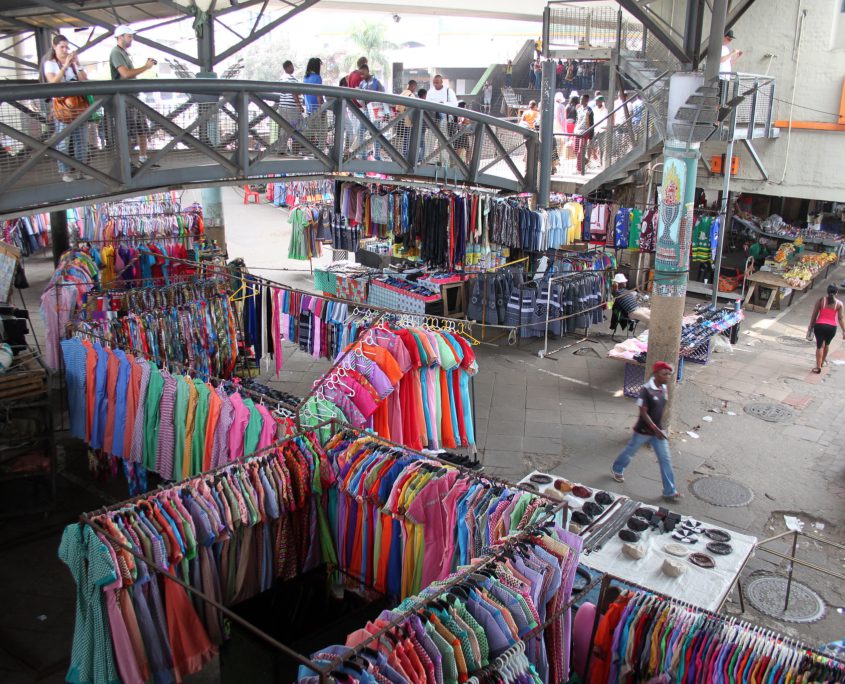
 If you walk down a busy street in any of South Africa’s major cities, you are bound to witness some type of informal economic activity. Whether it be a fruit stand, street-hawker selling earphones or an informal car wash business, the informal economy in South Africa is a crucial part of life for many of its residents.
The Importance of Informal Trade
Informal trade refers to any unregulated, unregistered, unprotected and untaxed activities, enterprises, or transactions. Informal jobs are an essential source of income for many poor South Africans—18 percent of working citizens work in the informal sector—a total of over three million workers. Additionally, the sector accounts for 18 percent of South Africa’s GDP. While these numbers are smaller than those of other developing countries, they emphasize the importance of informal trade in an economy with stark unemployment rates—26.6 percent as of 2016. Informal markets, like Durban’s Warwick Markets, provide jobs for those who are unable to find formal employment. Thousands depend on these markets for produce, cooked meals and clothing at affordable prices. Furthermore, the informal workforce in South Africa is overwhelmingly poor, young females. In fact, the poverty level in an area correlates positively with the proportion of people working in the informal economy.
The government recognizes the informal economy in South Africa as a viable and important form of employment and enabler of economic mobility for the country’s poor. Experience in the informal sector can help untrained people acquire skills, potentially aiding future integration into the formal sector. According to economist Loane Sharp, the informal economy in South Africa is growing faster than its formal counterpart. This prompts the government to pass policy encouraging and protecting the sector. The National Informal Business Upliftment Strategy of 2014 set up a framework of government assistance with skills development, marketing, technical support, infrastructure improvements and management training. This “inclusive growth” strategy focuses on enabling South Africa’s poor to participate in the economy rather than merely redistributing wealth through social welfare programs.
Non-governmental organizations are also working to improve conditions for informal traders. Asiye eTafuleni is an NGO in Durban that works with local government officials and vendors in the informal sector (particularly the Warwick Markets) to assist in developing infrastructure, consultations for urban planning and advocacy for informal workers. The organization also directs tourism to the Warwick Markets, educating foreigners and visitors on the functions and importance of the markets, and bringing the vendors eager customers. Asiya eTufuleni is a member of the Inclusive Cities mission, which focuses on uplifting and strengthening groups of working poor in the informal economy. The Inclusive Cities project aims to support the urban poor through lobbying, policy planning, and research. One of the ways the project does this is by advocating for “waste pickers’ rights,” the legal right of individuals to collect garbage to recycle into sellable goods. These rights are under threat by the privatization of solid waste management in many cities across Africa. Inclusive Cities also conducts research and analysis of the informal economy to support future endeavors and activism.
A Struggle for Informal Business Owners
There are many downsides to informal trade which make its participants particularly vulnerable. Informal business owners are often deterred from registering their enterprises by high taxes and strict regulations. Informal working conditions are unregulated by nature and therefore often poor. Dangerous locations, limited book-keeping skills and lack of insurance put informal traders at constant risk of losing their livelihoods. Average earnings for informal workers are less than half of what the formally employed earn. And although recent policies are attempting to expand this sector of the economy, informal workers still face significant intimidation and harassment by local law enforcement.
In July 2018, hundreds of informal traders protested by-laws which would prohibit trading in certain areas. These potentially harmful by-laws would allow law enforcement to confiscate the goods of traders without permits. The leader of the activist group responsible for organizing a march on Durban City Hall complained that the traders themselves were not included in the creation of these laws. The permit allocation procedure, he says, is corrupt, with officials soliciting bribes in exchange for permits.
It is clear that despite efforts by the government and NGOs, conditions of the informal sector have remained unsatisfactory. The disconnect between national policy, like the National Informal Business Upliftment Strategy, and local municipalities is one obstacle in the way of a safer, healthier informal sector. The informal economy in South Africa provides crucial wages for the country’s poorest and most vulnerable populations; resources should be channeled to encourage and protect laborers and merchants in the sector.
– Nicollet Laframboise
Photo: Flickr

Ukraine: Education During and After Years of Conflict
Nonprofit Organization Helps Children in Honduras
Children in Honduras and their struggling families are often overlooked as a demographic. Helping Honduras Kids (HHK) is dedicated “to improve the level of dignity, education, opportunity and health for orphaned, abandoned, abused, and/or neglected and special needs children, single mother and families on the North Coast of Honduras.” Their mission statement alone alludes to the significant impact HHK has on these children’s lives.
Programs to Empower Children
Based in the Honduran city of La Ceiba, HHK’s central focus is helping children grow and develop through encouragement, counseling and education. Several programs help, like the Hogar de Amor (Home of Love), which cares for more than 20 children at a time. Though the first Hogar de Amor opened its door in 2007, HHK moved to a new location in 2010 due to pressure from local gangs. Their new home has been going strong for more than six years.
Another key program is the Jungle School. Founded in 2007, the Jungle School is an eight-classroom facility whose 10 teachers instruct over 200 hundred students in grades K-8th. HHK provides uniforms, school supplies and books along with a meal five days a week. The school also staffs a volunteer nurse who provides the students with medical and dental checkups. The nurse provides regular checkups to single and pregnant mothers. HHK subsidizes a Stay in School Outreach program that encourages kids of all ages to remain in school. 62 percent of the poorest children in Honduras will drop out of school by age 16. Programs like the Jungle School offer children the possibility for a brighter future in Honduras.
Aid and Impact
In 2007, gangs drove residents of the Campesino village off their land. HHK, along with Amigos of Honduras, purchased land for the displaced villagers in response. In addition, HHK has donated fortified rice, soup and truckloads of ripe bananas to the village. They have also constructed a central building for the village with a concrete floor and roof which will be used for meals and care of the roughly 350 children living in the village.
In a country plagued by gangs, drug violence, and political corruption, HHK is making a real difference for children in Honduras. The Honduran government does not allow adoptions from private orphanages like HHK. This means that many of these children will have the opportunity to take what they’ve learned from HHK and build a better Honduras for tomorrow.
–Henry Burkert
Photo: Flickr
The Informal Economy in South Africa
The Importance of Informal Trade
Informal trade refers to any unregulated, unregistered, unprotected and untaxed activities, enterprises, or transactions. Informal jobs are an essential source of income for many poor South Africans—18 percent of working citizens work in the informal sector—a total of over three million workers. Additionally, the sector accounts for 18 percent of South Africa’s GDP. While these numbers are smaller than those of other developing countries, they emphasize the importance of informal trade in an economy with stark unemployment rates—26.6 percent as of 2016. Informal markets, like Durban’s Warwick Markets, provide jobs for those who are unable to find formal employment. Thousands depend on these markets for produce, cooked meals and clothing at affordable prices. Furthermore, the informal workforce in South Africa is overwhelmingly poor, young females. In fact, the poverty level in an area correlates positively with the proportion of people working in the informal economy.
The government recognizes the informal economy in South Africa as a viable and important form of employment and enabler of economic mobility for the country’s poor. Experience in the informal sector can help untrained people acquire skills, potentially aiding future integration into the formal sector. According to economist Loane Sharp, the informal economy in South Africa is growing faster than its formal counterpart. This prompts the government to pass policy encouraging and protecting the sector. The National Informal Business Upliftment Strategy of 2014 set up a framework of government assistance with skills development, marketing, technical support, infrastructure improvements and management training. This “inclusive growth” strategy focuses on enabling South Africa’s poor to participate in the economy rather than merely redistributing wealth through social welfare programs.
Non-governmental organizations are also working to improve conditions for informal traders. Asiye eTafuleni is an NGO in Durban that works with local government officials and vendors in the informal sector (particularly the Warwick Markets) to assist in developing infrastructure, consultations for urban planning and advocacy for informal workers. The organization also directs tourism to the Warwick Markets, educating foreigners and visitors on the functions and importance of the markets, and bringing the vendors eager customers. Asiya eTufuleni is a member of the Inclusive Cities mission, which focuses on uplifting and strengthening groups of working poor in the informal economy. The Inclusive Cities project aims to support the urban poor through lobbying, policy planning, and research. One of the ways the project does this is by advocating for “waste pickers’ rights,” the legal right of individuals to collect garbage to recycle into sellable goods. These rights are under threat by the privatization of solid waste management in many cities across Africa. Inclusive Cities also conducts research and analysis of the informal economy to support future endeavors and activism.
A Struggle for Informal Business Owners
There are many downsides to informal trade which make its participants particularly vulnerable. Informal business owners are often deterred from registering their enterprises by high taxes and strict regulations. Informal working conditions are unregulated by nature and therefore often poor. Dangerous locations, limited book-keeping skills and lack of insurance put informal traders at constant risk of losing their livelihoods. Average earnings for informal workers are less than half of what the formally employed earn. And although recent policies are attempting to expand this sector of the economy, informal workers still face significant intimidation and harassment by local law enforcement.
In July 2018, hundreds of informal traders protested by-laws which would prohibit trading in certain areas. These potentially harmful by-laws would allow law enforcement to confiscate the goods of traders without permits. The leader of the activist group responsible for organizing a march on Durban City Hall complained that the traders themselves were not included in the creation of these laws. The permit allocation procedure, he says, is corrupt, with officials soliciting bribes in exchange for permits.
It is clear that despite efforts by the government and NGOs, conditions of the informal sector have remained unsatisfactory. The disconnect between national policy, like the National Informal Business Upliftment Strategy, and local municipalities is one obstacle in the way of a safer, healthier informal sector. The informal economy in South Africa provides crucial wages for the country’s poorest and most vulnerable populations; resources should be channeled to encourage and protect laborers and merchants in the sector.
– Nicollet Laframboise
Photo: Flickr
5 Facts from the UN Report on “Climate Apartheid”
5 facts from the UN report on “climate apartheid”:
Weather-related conditions like droughts and flooding are much more likely to occur if climate change continues to worsen. People who already experience extreme poverty tend to live in communities that depend on local harvests to survive. If weather causes food supplies to disappear, these people are likely to experience famine and malnutrition. This can result in illness and death.
Next, Alston says that “even if current targets are met, tens of millions will be impoverished, leading to widespread displacement and hunger.” Reaching current targets would mean only a 1.5 degree Celsius increase in temperature by 2100. This would cause many already poor regions to become food insecure.
Alston notes that “an over-reliance on the private sector could lead to a climate apartheid scenario in which the wealthy pay to escape overheating, hunger and conflict, while the rest of the world is left to suffer.” For example, he cited the 2012 Hurricane Sandy as an example of this, because many impoverished New Yorkers were without basic necessities during the disaster, while “the Goldman Sachs headquarters was protected by tens of thousands of its own sandbags and power from its generator.”
If weather conditions lead governments to declare states of emergency, it is likely to cause drastic changes in power structures. The report says “states may very well respond to climate change by augmenting government powers and circumscribing some rights. This will be a very fraught process and require great vigilance on the part of governments, human rights institutions and national and regional courts.” Additionally, some governments will be under-prepared to cope with serious conditions. As a result, this can cause social unrest and community discontent. It could even spark nationalist, xenophobic and racist responses.
The report also suggests that tackling the problem with a human-rights-focused response may be the best way. It includes giving vulnerable communities access to protective infrastructure, financial aid, relocation options, employment support and land tenure. Additionally, this includes access to food, clean water and healthcare. Furthermore, the report noted that building coalitions are key to addressing the issue, saying “major human rights actors must tackle questions about emissions, resource allocation, and energy and economic policy that states are grappling with and where there is a real need for detailed, actionable recommendations.”
Why the report matters
Overall, the release of the UNHR document has sparked widespread media coverage and global awareness. Understanding these 5 Facts from the UN report on “climate apartheid” is a critical step in addressing the problem.
-Natalie Malek
Photo: Flickr
How the Starkey Hearing Foundation is Changing Impoverished Lives
So the World May Hear
Providing Life-Changing Equipment
While the majority of those who are hearing disabled live in the developing world, less than 3 percent of them can afford or have access to hearing health care. The Starkey Hearing Foundation’s solution to this problem goes beyond simply putting a bandaid over the wound. Their model is community-based, creating sustainable hearing healthcare through local teams and partnerships.
First, the foundation identifies an area in need. After local health workers are educated and trained, then communities begin to receive hearing aids. During this phase, the foundation also works to educate patients and their families and communities about hearing health care. Monthly aftercare services are provided at a central location that also offers free repair and replacement for damaged hearing aids. Finally, the foundation works to foster self-reliance in their patients by employing speech-language pathologists to track the progress of those who have received aid. The follow-up that this model provides ensures that impoverished people who are affected by hearing loss can continue to have access to the care they need for the rest of their lives.
How Individuals Can Help
The Starkey Hearing Foundation’s “Hear Now” program is a recycling initiative that makes it easy to get involved by donating old hearing aids, or even parts of old hearing aids. This program collects about 60,000 hearing aids per year which are then restored and redistributed to those who need them most.
If you don’t have a hearing aid or know anyone who does, you can still get involved by visiting the Starkey Hearing Foundation’s donation page. The page is extremely user-friendly and includes a guide showing what a given donated amount of money can do. For example, a $20 donation can provide one mold for a hearing aid, and a $70 donation will pay for a hearing aid replacement.
– Ryley Bright
Photo: Flickr
4 Ways to Use Artificial Intelligence for Global Development
4 Ways to Use Artificial Intelligence for Global Development
These impressive uses of AI will save lives and will assist citizens of many countries in achieving a better standard of living. As experts continue to work on machine learning and artificial intelligence, and as computers become smarter and more capable, the use of artificial intelligence for global development will likely continue to improve conditions for people around the globe.
– Meredith Charney
Photo: Flickr
Personal Technology and Poverty
According to the Pathways for Prosperity Commission on Technology and Inclusive Development, only one in four people in developing countries utilize smartphone technologies for digital financial services. Digital financial services can allow small businesses to grow through online lending, thus resulting in sustainable economic development.
Digital Financial Services
Encouraging the usage of digital financial services is one way that personal technology and poverty must be addressed . In order for this to occur, there needs to be more widespread access to smartphones and cell phones in developing countries. Melinda Gates, co-chair on the Pathways for Prosperity Commission, cited that a phone costs at least two month’s salary for someone living below the poverty line in Tanzania. If businesses and governments prioritize expanding access of smartphones to developing countries, then costs may be lowered. As a result, citizens wouldn’t need to fall deeper into poverty in order to harness the power of personal technology.
Invest in Tech
Founded in 2010, Go-Jek is a transportation network company located in Jakarta, Indonesia. Go-Jek was able to change the market of ride-sharing in Indonesia. They accomplished this by utilizing technology to expand where ride-sharing services were available. Additionally, they facilitated communication between drivers and riders. CNN reports that Go-Jek has helped drivers see a 44 percent increase in income.
Offering incentives to businesses and governments to subsidize personal technology in developing countries is one-way access can be expanded. Policymakers must also address the inequitable technological access between men and women based on social inequality. Many developing countries do not grant women the same social and political rights as men. This means fewer women would likely gain access to personal technology than men. The Pathways for Prosperity Commission stated that in many developing countries, women are 40 percent less likely to have used the internet than men. While tech companies work to expand access to personal devices, there is still more that can be done. It is imperative that governments are working simultaneously to grant women equal political and social rights. The U.S. House of Representatives recently passed the Digital Global Access Policy Act of 2019, which seeks to increase investments in expanding internet access across the world.
Beyond the iPhone
Phones are one way for people in developing countries to utilize personal technology to lift themselves out of poverty. Still, there are other “low-tech” opportunities for sustainable growth and development. Susan Davis, in the Harvard Business Review, points out that small, localized tech solutions often prove to be more beneficial than large-scale, generic tech investments. Implementing technological solutions requires more than businesses giving personal tech devices to those in need. With regard to personal technology and poverty, proper training, policy implementation and assurance that barriers to access are broken down are ways that personal technology can be an effective solution to help end poverty.
-Erin Grant
Photo: Flickr
10 Facts About Agriculture in Africa
Top 10 Facts About Agriculture in Africa
Improving agriculture in Africa not only addresses food instability. In fact, it is likely to bring about political rights, a steady economy and lower rates of poverty.
– Emma Uk
Photo: Flickr
5 Facts about Sudan’s Vulnerable Position in MENA Politics
People, cameras and everything in between are paying close attention to Sudan’s vulnerable position in MENA Politics. This past month, the political crisis in Sudan has received worldwide attention. For example, internet users implemented blue social media avatars commemorating fallen Sudanese activist Mohamed Mattar. The conflict exists between Sudanese democracy advocates and the Transitional Military Council (TMC) currently governing the country, following the ousting of Omar Al-Bashir. However, it is important to understand just what is keeping Sudan and innocent civilians from moving forward with a more egalitarian society. Here are five facts about Sudan’s vulnerable position in MENA Politics.
The majority of Sudan’s geography is rich in minerals and natural gas. In 2011, when the two countries became independent, this was left with South Sudan. A crucial 7,945 square miles of land, known as the Halayeb Triangle, is still within Sudanese land claims.
This region has a coastline on the Red Sea, a location seemingly ideal for new oil exploration ventures. But, it’s not Sudanese efforts that have jumped on this opportunity. This leads to the next fact about Sudan’s vulnerable position in MENA politics.
Following Sudan’s independence from colonialism in 1956, Egypt has been in conflict with Sudan. The conflict is over which country has a right and full claim to the land and all its potential as a natural resource for either country’s economy.
In March of this year, The Arab Weekly reports that Egyptian state-sponsored South Valley Egyptian Petroleum Holding Company has invited up to ten separate oil and gas exploration bids to the very same Halayeb region. The report claims that the area surrounding is “Egyptian territorial waters.”
The same article quotes a statement by Sudan’s Foreign Ministry: “The Foreign Ministry summoned Egyptian Ambassador Hossam Eissa… to protest against the tenders invited by the Egyptian Oil Ministry for areas under the sovereignty of Sudan.” The Sudanese Oil and Gas Minister of State called it “a direct intrusion” of both the country’s right to issue exploration licenses to that region. Sudanese officials claim the Halayeb region has been the sovereign territory of Sudan since 1956, the country’s year of independence.
On June 20, 2019, the Council on Foreign Relations wrote that countries like Saudi Arabia and the United Arab Emirates are putting their support behind the Transitional Military Council in Sudan. These two countries have pledged $3 billion in aid for the TMC to disperse to civilians in the form of food, water and medicine.
The International Crisis Group finds this political and economic move to be simply another example of something common among Gulf states. That is, moving “from one military regime to another.”
This fact about Sudan’s vulnerable position in MENA Politics focuses on a continued disenfranchisement of Sudanese civilians even after the authoritarian president Omar Al-Bashir was forced out of office. These Gulf Nations’ support of the military government is not in accordance with the wants of Sudanese civilians.
Mohamed Hamdan Dagalo (known as Hemeti) was a close political aide to Omar al-Bashir before the military coup. He has now outwardly shown his appreciation for Saudi Arabia’s and the UAE’s contribution to Sudan’s military-governmental complex. He showed this by meeting with Saudi Prince Mohammed Bin Salman and vowing to support Riyadh against “all threats and attacks” by the country’s political opponents for power in the Middle East.
As Hemeti is a representative of the military presence that currently governs Sudan. His commanding activity must also be taken into account to better understand the conflict and protests of earlier this June.
Hemeti is the commander of the Rapid Support Forces, a militia group that grew from Sudan’s Janjaweed presence. The Janjaweed (or “devils on horseback” in a Sudanese colloquial language) were also under Hemeti’s supervision. They are widely acknowledged as responsible for the genocidal crimes against humanity of 2005 in the Sudanese region of Darfur.
Civilians no longer appreciate this modern-day reincarnation of an overbearing militia. One activist, Hajooj Kuka, stated: “We do not want to move forward with the RSF as part of the Sudanese army. At this point, we have totally lost trust in them.”
The Rapid Support Forces are also responsible for the fast publicized retaliation to civil protests on June 3, 2019. Around 100 Sudanese Activists died during and after this crisis. This occurred on what would have been a festive Eid al-Fitr, or the end of Ramadan.
How to Help
Overall, these five facts about Sudan’s vulnerable position in MENA politics show how Middle Eastern powerhouses are hoping to take control of Sudanese land and government for personal gain. They are doing this without the interest of Sudanese civilians at heart.
While it may be difficult to address this misrepresentation directly, Bustle outlines that there are simple ways to help show the inequity Sudanese people are experiencing regularly. Individuals around the world can:
-Fatemeh Zahra Yarali
Photo: Flickr
8 Facts about Education in Sri Lanka
Sri Lanka has shocked the world with its success in its system of education. Within less than forty years of independence, the number of schools has increased by 50 percent. In fact, the number of students has increased by 300 percent. Such substantial growth is exemplified in the following eight facts about education in Sri Lanka.
Progress in Education
These eight facts about education in Sri Lanka illustrate its tremendous progress since achieving independence. But, it is clear there is still much to do before Sri Lanka has ironed out their education strategy. However, these eight facts about education in Sri Lanka depict the substantial progress made in the past few years as proof that the country is on the path to providing its children with the education necessary to succeed in the world today.
– Adya Khosla
Photo: Flickr