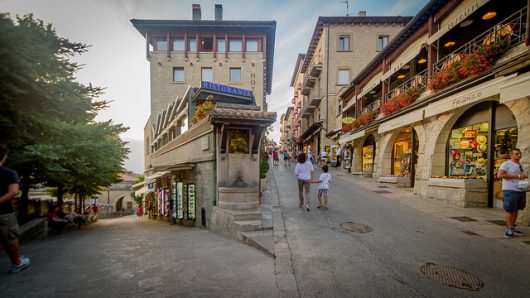
 The Republic of San Marino is a high-income, landlocked microstate surrounded by Italy and claims to be the world’s oldest republic. At 23.6 square miles and with a population of 35,000, it is the smallest independent state in Europe.
Economy and Economic Outlook
San Marino negotiated an association agreement with the European Union in December 2023 that awaits ratification. Once ratified, San Marino will experience free movement in the EU of goods, services, capital and people.
San Marino’s economy is relatively diverse but experiences volatile performance due to its small size.
More than a third of its GDP is estimated to be attributed to manufacturing, unusual for a “micro-sovereign,” followed by the services and commerce sectors. Tourism is a strong sector that has increased since the pandemic, while a substantial decrease in demand from Italy slowed the economy in 2023. Ratification of the EU association agreement is expected to have an impact over the next two years, with broadened export opportunities that would facilitate increased diversity of the economy.
San Marino and Poverty
There is no data on poverty in San Marino, but the country has been described as the eighth-richest nation in the world. It has been reported that its extensive social net provides assistance to those with incomes below that to provide a “basic standard of living.”
San Marino and Hunger
In 2021, San Marino published a Voluntary National Review of its progress in implementing the United Nations 2030 Agenda for Sustainable Development. Its report on SDG 2, Zero Hunger, addressed crops and breeding, organic farming, multifunctional agriculture and management and monitoring of the country’s agricultural and forestry heritage. Ongoing initiatives are directed toward “sustainable eating behavior,” promoted by food education in schools. These initiatives include a Working Group on Health Education in Schools and a Mind Your Health annual survey of physical activity in schools, and dietary habits. The Working Group focuses on healthy lifestyles and healthy school meals, with particular attention to obesity.
A consortium of owner farmers, agricultural producers and professional associations has developed a certification process to assure food quality in the local product supply chain in an “identity and cultural process.” Indeed, the branded products have brought recognition to, and enhancement of, typical local products, led to the “rediscovery of culinary traditions” and culminated in the establishment of the Museum of Rural Life.
San Marino has participated in the International Day of Awareness of Food Loss and Waste designated by the United Nations and co-convened by the U.N.’s Food and Agriculture Organization and its Environment Programme.
San Marino and Nutrition
The 2022 Global Nutrition Report includes San Marino in its country’s nutrition profiles, although there were data available on only two of the study’s 13 indicators—low birth weight and anemia. Furthermore, San Marino was reported as “on course” for the low-birth-weight target, which has been declining over the last two decades. However, there was no progress regarding the reduction of anemia among women of reproductive age or the proportion of those women affected by anemia. The country has implemented national food and noncommunicable disease policies in four of 10 suggested areas and included national policy targets for five of eleven global nutrition targets.
A Hunger Problem?
While there undoubtedly are hungry people in San Marino, thanks to its solid economy and attention to social issues, hunger would not be a significant problem for the country.
– Staff Reports
Photo: Flickr

10 Facts About Zambia Refugees
Zambia has been welcoming refugees for more than 50 years and is currently hosting over 54,000 refugees. The majority come from Angola, Democratic Republic of Congo, and Rwanda. Here are 10 facts about Zambia refugees:
– Mary Barringer
Photo: Flickr
20 Global Poverty Facts
Living in poverty is a reality that many across the world face every single day. Here are 20 global poverty facts to help better understand these realities.
These 20 global poverty facts help to better understand the global situation facing us today. While there has been progress in global poverty reduction, many challenges still lie ahead.
– Shannon Elder
Photo: Flickr
Education in Uruguay: Ending Gender Bias in the Classroom
Supporting the education of women and girls around the globe is often a key component in efforts to end extreme global poverty. Statistics show that educated women marry later. This results in fewer child marriages and reduces fertility and infant mortality rates. Educated women are also more likely to go to work. When a woman receives regular pay, she can give back to her community, and when the working population in a community doubles due to female education, the cycle of poverty ends. This is why the World Bank Group (WBG) is focusing on ending the gender disparity in education in Uruguay.
Educating girls and women is WBG’s main goal in their fight to eradicate poverty. In Uruguay, women and girls face gender-based violence that discourages them from attending school. Gender bias and stereotyping is a long-standing issue in Uruguay that extends beyond the classroom. Recently the government in Uruguay has prioritized addressing the gender bias. They teamed up with WBG to implement the Improving the Quality of Initial and Primary Education in Uruguay Project to end gender-based violence and discrimination in schools.
The project is a part of the $2.5 billion investment in global education that WBG President Jim Yong Kim announced at the Let Girls Learn event in April 2016. Improve the Quality of Initial and Primary Education in Uruguay is a $40 million project that will implement teacher training to make educators aware of the gender disparity and equip them with the knowledge and tools to address it. The training will focus on social norms regarding masculinity versus femininity. In the process, WBG will direct a study of gender equality that will inform the Gender Equality Action Plan from 2017-2020.
In addition to addressing gender inequality, the project will also improve access to quality early childhood education. WBG plans to utilize the teacher training component of the project to focus on emotional and social development in primary schools. Their hope is to create a sustainable, gender-equal education system by implementing these practices from the beginning of a child’s schooling.
In April 2016, WBG President Jim Yong Kim said, “empowering and educating adolescent girls is one of the best ways to stop poverty from being passed from generation to generation and can be transformational for entire societies.” The Improve the Quality of Initial and Primary Education in Uruguay plans to do just that.
– Rachel Cooper
Photo: Flickr
Water Quality in Canada
The drinking water in Canada is generally of excellent quality. The risks to the drinking water supply are minimal. However, the minerals, silt, vegetation, fertilizers and agricultural run-off in the water may pose some health risks.
Canada has a multi-barrier approach to safe drinking water which serves as a guideline for every drinking water system and is used to maintain water quality.
The federal government plays the most important role in scientific research monitoring and leadership on the development of guidelines for water quality in Canada. Seventy-five percent of Canadians are serviced by municipal sewer systems and the remaining 25 percent by septic disposal systems. Despite the best efforts of suppliers, municipal water supplies can sometimes become contaminated and in these cases, precautionary measures such as boiling water before consumption is advised.
Municipal water waste discharges were one of the largest sources of pollution to the water quality in Canada in 2006 and generated 84 percent of the water effluents reported to the National Pollutant Release Inventory.
The water quality in Canada earns an ‘A’ grade for water quality and ranks 4th out of 17 peer OECD countries. Water quality in Canada is mostly affected by industrial effluent, agricultural runoff and municipal sewage pollution.
Sewage treatment continues to improve as more municipalities upgrade their treatment facilities and there has been an increase in the frequency and extent to which drinking water guidelines for nitrate have been exceeded in groundwater across the country.
Data collected from the Canadian Council of Ministers of the Environment’s water quality index reports that from 2007 to 2009, the freshwater quality was rated marginally fair at 41 percent of the water stations, good at 33 percent of the stations and excellent at 10 percent of the stations, with only 16 percent rated poor.
The quality of water in Canada is the best it has ever been and is much better today than it was 30 years ago.
– Rochelle R. Dean
Photo: Flickr
15 Foreign Aid Statistics
The following 15 foreign aid statistics help to understand the topic of foreign assistance. Most Americans don’t know much about U.S. foreign aid. There are many misconceptions about what foreign aid is and how much of the federal budget goes to it each year. Here are 15 foreign aid statistics.
These 15 foreign aid statistics help to better understand what U.S. foreign aid is, how much money goes where and what needs to be reworked as we look towards the future.
– Shannon Elder
Photo: Flickr
Is Hunger in San Marino a Problem?
Economy and Economic Outlook
San Marino negotiated an association agreement with the European Union in December 2023 that awaits ratification. Once ratified, San Marino will experience free movement in the EU of goods, services, capital and people.
San Marino’s economy is relatively diverse but experiences volatile performance due to its small size.
More than a third of its GDP is estimated to be attributed to manufacturing, unusual for a “micro-sovereign,” followed by the services and commerce sectors. Tourism is a strong sector that has increased since the pandemic, while a substantial decrease in demand from Italy slowed the economy in 2023. Ratification of the EU association agreement is expected to have an impact over the next two years, with broadened export opportunities that would facilitate increased diversity of the economy.
San Marino and Poverty
There is no data on poverty in San Marino, but the country has been described as the eighth-richest nation in the world. It has been reported that its extensive social net provides assistance to those with incomes below that to provide a “basic standard of living.”
San Marino and Hunger
In 2021, San Marino published a Voluntary National Review of its progress in implementing the United Nations 2030 Agenda for Sustainable Development. Its report on SDG 2, Zero Hunger, addressed crops and breeding, organic farming, multifunctional agriculture and management and monitoring of the country’s agricultural and forestry heritage. Ongoing initiatives are directed toward “sustainable eating behavior,” promoted by food education in schools. These initiatives include a Working Group on Health Education in Schools and a Mind Your Health annual survey of physical activity in schools, and dietary habits. The Working Group focuses on healthy lifestyles and healthy school meals, with particular attention to obesity.
A consortium of owner farmers, agricultural producers and professional associations has developed a certification process to assure food quality in the local product supply chain in an “identity and cultural process.” Indeed, the branded products have brought recognition to, and enhancement of, typical local products, led to the “rediscovery of culinary traditions” and culminated in the establishment of the Museum of Rural Life.
San Marino has participated in the International Day of Awareness of Food Loss and Waste designated by the United Nations and co-convened by the U.N.’s Food and Agriculture Organization and its Environment Programme.
San Marino and Nutrition
The 2022 Global Nutrition Report includes San Marino in its country’s nutrition profiles, although there were data available on only two of the study’s 13 indicators—low birth weight and anemia. Furthermore, San Marino was reported as “on course” for the low-birth-weight target, which has been declining over the last two decades. However, there was no progress regarding the reduction of anemia among women of reproductive age or the proportion of those women affected by anemia. The country has implemented national food and noncommunicable disease policies in four of 10 suggested areas and included national policy targets for five of eleven global nutrition targets.
A Hunger Problem?
While there undoubtedly are hungry people in San Marino, thanks to its solid economy and attention to social issues, hunger would not be a significant problem for the country.
– Staff Reports
Photo: Flickr
Hunger in Croatia: Progress Continues
On February 22, 2017, citizens gathered at Zagreb’s Croatian National Theater in celebration. That day marked the 100th year anniversary of Friar Didak Buntic’s efforts to save children in Croatia, Herzegovina and Bosnia from the famine plaguing the last two years of World War I. Through his efforts between 1917 and 1919, an estimated 29,000 famished children were moved to more affluent areas in the North. They were greeted by organized shelters led by Buntic and other prominent citizens. Prime Minister Andrej Plenkovic lauded the humanitarian’s work at the anniversary celebration.
Since then, and especially in the past few years, Croatia has made significant gains when it comes to hunger. The Global Hunger Index in 2015 cited that, along with 17 other countries, Croatia had reduced the number of people with lack of access to food supplies by 50 percent. This improvement came on the heels of the damaging 2008 recession, which caused the United Nations Children’s Fund (UNICEF) to report in 2014 that Croatia’s children were among the hardest hit — ranking 38th in the world as those years saw an 11.8 percent rise in impoverished children.
Regardless of recent improvement, UNICEF’s findings in 2014 caused political turmoil between Croatian Prime Minister Zoran Milanovic and Mladen Levak, a member of the Croatian parliament for the Labour party. Milanovic insisted that the findings were false and tinted with populist bias. Levak offers a rebuttal, “….Yes, there is food but not for all — for some opportunities pile up while for others poverty piles up.”
This sentiment reflects the fact that poverty and hunger in Croatia mimic that of other developed countries. How one is poor, and not just the fact that one is, does matter. Poverty can be felt in different ways, especially between the 21 different counties across Croatia — all of whom experience poverty slightly differently. The difference lies between poverty depth and poverty severity — how far away households are from the poverty line versus the income inequality between the poor classes.
The 2016 Global Hunger Index for Croatia is rated as a low score of less than five. There is still work to be done, as there is in every nation globally, but hunger in Croatia has improved markedly from the damaging 2008 recession. It seems hopeful that in another 100 years the people of Croatia will be able to celebrate Friar Didak Buntic’s work once again.
– Tammy Hineline
Photo: Flickr
Seven Facts About Improved Education in the Maldives
In 2004, a devastating tsunami in the Indian Ocean hit the coasts of several countries in South and Southeast Asia, resulting in massive damage and more than 100 reported casualties in the Maldives. With unwavering aid and support from internal communities and UNICEF, the island country has experienced significant achievements in its health, poverty and economic status, but particularly in the field of education.
The Maldives is the first country in South Asia labeled as an ‘MDG Plus’ country by achieving five of the eight United Nations Millennium Development Goals before 2015.
Because early childhood education is obligatory and free of charge, the country’s net enrollment increased from 51.2 percent in 2001 to 99.6 percent in 2016.
Higher secondary enrollment increased dramatically from 2013 to 2016 due to the successful implementation of the No Child Left Behind policy.
Student passing percentage in GCE O’Level 5-subjects rose significantly from 27 percent in 2009 to 56 percent in 2015. Goals have been set for education in the Maldives to achieve the national target of 60 percent in 2017.
As a direct response to the tsunami disaster, UNICEF brought resources to ‘hard-to-reach’ children through Teacher Resource Centers (TRCs), as a part of its Tsunami Recovery Programme. TRCs allow students to access a global e-network of teacher training and educational resources.
UNICEF ensures that education in the Maldives reaches all children with special needs. In addition, Life-Skills Based Education (LSBE) targets secondary school children and includes lessons on HIV/AIDs, civic education and vocational training to prepare Maldivian youth for adulthood.
Since the Maldives unified its education system in 1978, the literacy rate has risen from 70 percent to 98 percent.
The work of teachers and caregivers in the Maldives continues to put improved learning standards in place. Just as the nation’s overall conditions of life have reached a high since the struggles brought on by natural disaster, education in the Maldives will hopefully only advance in the future.
– Mikaela Frigillana
Photo: Flickr
Reforming Education in Tonga
Education in Tonga is free and compulsory between ages six and 14, and the literacy rate is approximately 99 percent. Roughly 80 percent of all primary schools and 90 percent of secondary schools are run by religious organizations.
Although there are some post-secondary agricultural, medical, nursing and teaching education programs, most young Tongan people pursue their studies overseas. As a result, many young Tongans live in New Zealand and Australia, while 22.5 percent of their peers residing in Tonga live below the poverty line.
Over the last decade Tonga’s Ministry of Education, Women Affairs and Culture has sought educational reform through the Tonga Education Support Program (TESP), which has been segmented into two phases. TESP I addresses three particular areas of improvement identified by the 2003 Tonga Education Sector Study:
The Ministry also developed TESP II, an adapted form of the Tonga Education Lakalaka 1 Policy Framework, to improve student, teacher and institutional performance rates across all schools.
Australia has contributed AUD $6.5 million to this project, while New Zealand has cosponsored NZD $8.2 million.
Lack of comprehensive reporting has made it difficult to assess whether or not these education development programs have successfully achieved their goals, but from what has been reported, these programs show promise in improving education in Tonga. The Ministry also expects to achieve at least 99 percent access to and participation in formal education programs and 99 percent retention and completion in the coming years.
– Casie Wilson
Photo: Flickr
The Drought in Somalia Escalates
Within 48 hours, 110 people die from starvation and dehydration as the drought in Somalia escalates.
The newly-elected prime minister, Hassan Ali Khaire, reported on the matter at a meeting with the Somali National Drought Committee. The majority of victims consisted of women and children from the rural regions of Somalia’s southwestern Bay, where the drought is most severe.
This drought has affected more than 6.2 million people. As little rain has fallen and rivers have dried up, the people of Somalia are facing severe food insecurity and lack of clean water. Nearly 5.5 million are at high risk of contracting acute watery diarrhea, cholera and measles — all of which are waterborne diseases that rapidly spread through poor water quality.
As the death toll increases, the World Health Organization warned that the country is on the brink of famine, its potential third case in 25 years. The last famine, which lasted from 2011 to 2012, killed around 260,000 people. The famine of 1992 killed about 220,000.
Peter de Clercq, the U.N. humanitarian coordinator for Somalia, echoed the potential of famine — but only if the world is slow to step-up and increase humanitarian assistance. He warned, “If we do not scale up the drought-response immediately, it will cost lives, further destroy livelihoods, and could undermine the pursuit of key state-building initiatives.”
As the drought in Somalia escalates, children are the ones impacted the most. Three million children are missing school in order to maintain the lives of their family’s livestock, and another 100,000 may soon join them. Perhaps more tragically, over 363,000 children have been reported as acutely malnourished and another 70,000 severely malnourished, all of which are in desperate need of life-saving support.
Somalia is one of four nations listed by the U.N. as at-risk of famine, alongside Nigeria, South Sudan and Yemen. Famine is declared when 20 percent of households cannot function during food shortages, more than 30 percent of the population experiences acute malnutrition and more than two deaths occur per 10,000 people.
The Associated Press has reported the U.N. is calling for $864 million in humanitarian assistance, with a recent appeal for another $26 million that will fund a response as the drought in Somalia escalates.
– Brenna Yowell
Photo: Flickr