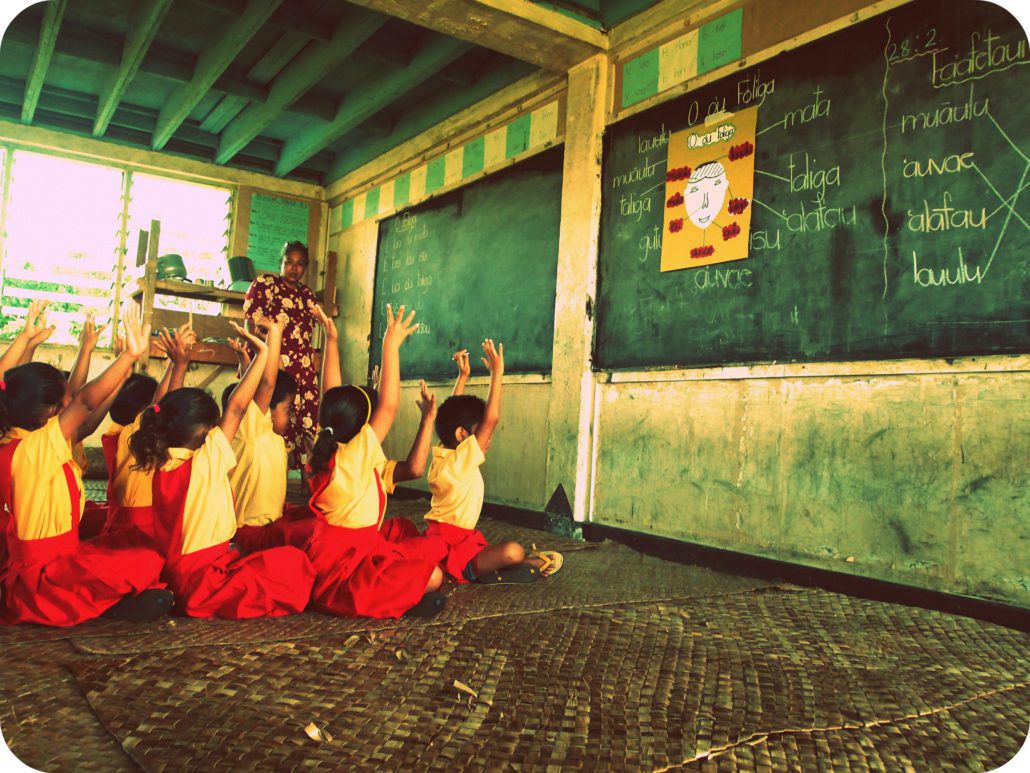
Samoa is an upper-middle-income island nation in the South Pacific with a population of about 219,000, nearly 45% of whom are children. Education in Samoa is compulsory for children from ages 5 to 14. Primary schooling comprises the first eight years of education and includes kindergarten. Junior secondary school is three years, and upper secondary is two years. Post-secondary programs are available at the National University of Samoa and the University of the South Pacific. The country’s adult literacy rate is 99.1% (2021). Preprimary net attendance is 55%. The upper secondary school completion rate is 56%.
Samoa has high enrollment rates in primary and lower secondary education, but participation declines as students get older. By upper secondary school, about one-fifth of students are no longer in education. Challenges begin even earlier, with pre-primary enrollment remaining relatively low at around 25%, limiting access to early learning opportunities for many children.
Samoa’s education sector faces several challenges, including declining literacy and numeracy levels, high dropout rates and a shortage of teachers. Although the government allocates about 14% of its total expenditure to education, this falls below the Global Partnership for Education’s benchmark of 20% or more. Marginalized groups, including women and people with disabilities, are disproportionately affected, while civil society organizations continue working to improve access to quality education.
Partners Addressing Education Challenges
Global Partnership for Education. The Global Partnership for Education (GPE) has partnered with Samoa since 2020 and has so far provided more than $20 million in support. The Samoa Partnership Compact aims to ensure the availability of relevant seamless pathways for learners across all levels of learning. Success is supported through quality early learning and support programs for progression and transition through education. The full engagement of families and communities is important to this success.
Education Out Loud. Funded by the Global Partnership for Education (and managed by Oxfam Denmark), Education Out Loud is the world’s largest fund supporting civil society advocacy and social accountability in education. Building on a previous 2022-2023 project in Samoa, Education Out Loud provided $345,240 to fund a 2024-2026 project in conjunction with the Samoa Education Network (SEN) focused on a shared understanding of education for all, so that no child is left behind. SEN is working to ensure that the voices of marginalized groups are heard in policy processes by providing training, resources, and opportunities for marginalized groups to participate in education policy dialogues and reviews. Activities include workshops and forums, training courses and materials, public awareness campaigns and behavioral guides.
A follow-up IIEP-UNESCO online course for civil society organizations offered in spring 2024 was designed to prepare these organizations to hold the government accountable by monitoring progress, identifying shortcomings and advocating for improvements. Said Joy Leaupepetele, Director and Coordinator of the Samoa Education Network, “By taking this course, we are better positioned to leverage our EOL grant and make a real difference. I understand the educational landscape, can strategically advocate for our community’s needs, and collaborate effectively with others to shape a brighter future for Samoan education.”
GPE System Transformation Grant Education Transformation Project. Samoa’s Ministry of Education and Culture launched the System Transformation Grant of $2.5 million in February 2026, along with UNESCO and international partners, funded by GPE. The project goals are to achieve more inclusive and equitable education by addressing systemwide challenges such as low participation in early childhood education, gaps in foundational literacy and numeracy, gender disparities in learning outcomes and secondary school pathways, from secondary education to advanced education, training and employment. Education reforms will be designed to be culturally responsive, inclusive and supported by families and communities.
Samoan Government Activities
Education Sector Plan 2025-2030. The Samoa Education Sector Plan 2025-2030 is the strategic plan that the Ministry of Education and Culture put forth to operationalize the government’s commitments “through quality education, inclusive access, relevant skills development, strong governance, and long-term resilience.” The plan will in part receive support from the GPE System Transformation Grant. Priorities are focused on four key outcomes and strategies:
- Improved learning achievement and graduate outcomes
- Equitable, inclusive access to quality education and training
- Improved education and training relevance and contribution to sustainable development
- An effective, efficient and resilient education sector
The plan includes a risk management framework that identifies eight key internal risks and two key external risks. All risks are estimated to be of medium likelihood, with the exception of staffing and capacity risks, which are seen to be of high likelihood—not enough teachers; high teacher turnover; teacher resistance to change or development; unhappy or inadequately supported teachers. This strategy to address this particular risk area is competitive salary and career paths and wellbeing support, mentoring for new teachers and the creation of professional learning communities.
Back-to-School Assistance Scheme. In January 2026, the Samoan government announced an $11.7 million back-to-school support program to help families with education costs at the start of the school year. Distribution of funds to eligible citizens began in April 2026, The Back-to-School Assistance program provided $55 to more than 105,000 citizens who are registered voters (with almost $6 million distributed as of April). All levels of education were included, from early childhood to tertiary education, young adults, mid-career people, pre-retired people and the elderly. This government initiative was to help cover education-related expenses such as fees, uniforms and supplies. The funds were drawn from district development funds under the national budget.
Education Management Information System. In July 2026, the Pacific Community, in collaboration with Samoa’s Ministry of Education and Culture, launched the Samoa Education Management Information System (SEMIS) in Apia, Samoa. The launch of the SEMIS represents a significant milestone in strengthening the foundations of education planning, management and decision-making, not only in Samoa but across the Pacific region. Hon. Alono Ekeroma, Minister of Education and Culture for the Government of Samoa said: “SEMIS means that, for the first time, the ministry will have a living, real-time picture of every school in this nation, the students, the teachers serving them, the infrastructure they learn and teach in, and the data needed to make decisions that actually improve outcomes.”
Overcoming Education Challenges
Recent funding and activities reveal considerable attention being given to Samoa’s education system. These improvements and the country’s already high literacy rate can only strengthen educational outcomes, while embracing and meeting the needs of the marginalized communities.
– Staff Reports
Photo: Flickr

Meeting Education Challenges in Samoa
Samoa is an upper-middle-income island nation in the South Pacific with a population of about 219,000, nearly 45% of whom are children. Education in Samoa is compulsory for children from ages 5 to 14. Primary schooling comprises the first eight years of education and includes kindergarten. Junior secondary school is three years, and upper secondary is two years. Post-secondary programs are available at the National University of Samoa and the University of the South Pacific. The country’s adult literacy rate is 99.1% (2021). Preprimary net attendance is 55%. The upper secondary school completion rate is 56%.
Samoa has high enrollment rates in primary and lower secondary education, but participation declines as students get older. By upper secondary school, about one-fifth of students are no longer in education. Challenges begin even earlier, with pre-primary enrollment remaining relatively low at around 25%, limiting access to early learning opportunities for many children.
Samoa’s education sector faces several challenges, including declining literacy and numeracy levels, high dropout rates and a shortage of teachers. Although the government allocates about 14% of its total expenditure to education, this falls below the Global Partnership for Education’s benchmark of 20% or more. Marginalized groups, including women and people with disabilities, are disproportionately affected, while civil society organizations continue working to improve access to quality education.
Partners Addressing Education Challenges
Global Partnership for Education. The Global Partnership for Education (GPE) has partnered with Samoa since 2020 and has so far provided more than $20 million in support. The Samoa Partnership Compact aims to ensure the availability of relevant seamless pathways for learners across all levels of learning. Success is supported through quality early learning and support programs for progression and transition through education. The full engagement of families and communities is important to this success.
Education Out Loud. Funded by the Global Partnership for Education (and managed by Oxfam Denmark), Education Out Loud is the world’s largest fund supporting civil society advocacy and social accountability in education. Building on a previous 2022-2023 project in Samoa, Education Out Loud provided $345,240 to fund a 2024-2026 project in conjunction with the Samoa Education Network (SEN) focused on a shared understanding of education for all, so that no child is left behind. SEN is working to ensure that the voices of marginalized groups are heard in policy processes by providing training, resources, and opportunities for marginalized groups to participate in education policy dialogues and reviews. Activities include workshops and forums, training courses and materials, public awareness campaigns and behavioral guides.
A follow-up IIEP-UNESCO online course for civil society organizations offered in spring 2024 was designed to prepare these organizations to hold the government accountable by monitoring progress, identifying shortcomings and advocating for improvements. Said Joy Leaupepetele, Director and Coordinator of the Samoa Education Network, “By taking this course, we are better positioned to leverage our EOL grant and make a real difference. I understand the educational landscape, can strategically advocate for our community’s needs, and collaborate effectively with others to shape a brighter future for Samoan education.”
GPE System Transformation Grant Education Transformation Project. Samoa’s Ministry of Education and Culture launched the System Transformation Grant of $2.5 million in February 2026, along with UNESCO and international partners, funded by GPE. The project goals are to achieve more inclusive and equitable education by addressing systemwide challenges such as low participation in early childhood education, gaps in foundational literacy and numeracy, gender disparities in learning outcomes and secondary school pathways, from secondary education to advanced education, training and employment. Education reforms will be designed to be culturally responsive, inclusive and supported by families and communities.
Samoan Government Activities
Education Sector Plan 2025-2030. The Samoa Education Sector Plan 2025-2030 is the strategic plan that the Ministry of Education and Culture put forth to operationalize the government’s commitments “through quality education, inclusive access, relevant skills development, strong governance, and long-term resilience.” The plan will in part receive support from the GPE System Transformation Grant. Priorities are focused on four key outcomes and strategies:
The plan includes a risk management framework that identifies eight key internal risks and two key external risks. All risks are estimated to be of medium likelihood, with the exception of staffing and capacity risks, which are seen to be of high likelihood—not enough teachers; high teacher turnover; teacher resistance to change or development; unhappy or inadequately supported teachers. This strategy to address this particular risk area is competitive salary and career paths and wellbeing support, mentoring for new teachers and the creation of professional learning communities.
Back-to-School Assistance Scheme. In January 2026, the Samoan government announced an $11.7 million back-to-school support program to help families with education costs at the start of the school year. Distribution of funds to eligible citizens began in April 2026, The Back-to-School Assistance program provided $55 to more than 105,000 citizens who are registered voters (with almost $6 million distributed as of April). All levels of education were included, from early childhood to tertiary education, young adults, mid-career people, pre-retired people and the elderly. This government initiative was to help cover education-related expenses such as fees, uniforms and supplies. The funds were drawn from district development funds under the national budget.
Education Management Information System. In July 2026, the Pacific Community, in collaboration with Samoa’s Ministry of Education and Culture, launched the Samoa Education Management Information System (SEMIS) in Apia, Samoa. The launch of the SEMIS represents a significant milestone in strengthening the foundations of education planning, management and decision-making, not only in Samoa but across the Pacific region. Hon. Alono Ekeroma, Minister of Education and Culture for the Government of Samoa said: “SEMIS means that, for the first time, the ministry will have a living, real-time picture of every school in this nation, the students, the teachers serving them, the infrastructure they learn and teach in, and the data needed to make decisions that actually improve outcomes.”
Overcoming Education Challenges
Recent funding and activities reveal considerable attention being given to Samoa’s education system. These improvements and the country’s already high literacy rate can only strengthen educational outcomes, while embracing and meeting the needs of the marginalized communities.
– Staff Reports
Photo: Flickr
Indian Authorities Fight Human Trafficking with New Technology
The numbers are startling — in 2015, 9,127 people were reported as victims of human trafficking in India. According to the most recent data gathered by the National Crime Records Bureau (NCRB), this was a 25 percent increase from 2014’s numbers. Fortunately, a new case management system, the Impulse Case Info Centre (ICIC), shows promise in the war against human trafficking.
In early February 2017, authorities in the northern part of India received the ICIC software. Developed by the Impulse NGO Network, an organization created to battle human trafficking, ICIC acts as a clearinghouse to track information on human trafficking cases. A few of the objectives of the ICIC are to maintain information on a victim’s biographical details, their family background, circumstances surrounding their disappearance, suspected trafficker(s) and the investigation’s progress.
Tackling Trafficking with Collaboration
In order to reach these goals, the ICIC connects Indian authorities with their counterparts in the neighboring countries of Bangladesh and Myanmar, enabling smoother cross-border investigations.
All governmental entities, law enforcement agencies, civil society organizations and media outlets that partner through the ICIC have access to a database that is shared with Indian Anti-Human Trafficking Units (AHTU). This increased communication between entities means that there would be no repetition of enforcement efforts, therefore boosting overall efficiency.
“The best feature is the alert mechanism that tells investigators if there are other cases registered involving the same trafficker they are looking for,” said Salomi Thommy of Impulse NGO Network.
ICIC’s Approach
The ICIC software uses a straightforward, yet comprehensive approach. Individual ATHUs have an account in which to report their cases, and the software implements a standardized format for easier use by all contributors. The ICIC then acts as a hub of real-time information and contacts appropriate entities when relevant updates are uploaded.
The ICIC also assists users when trafficking victims are identified and rescued. The software ensures that legal support, victim protection, post-rescue vocational training, counseling and medical care are offered to the individual victim.
Yankeela Bhutia, head of one ATHU, was pleased with the approach: “We have been able to solve many cases by logging into this system. Many traffickers are crisscrossing the borders in the region and this system makes it easy to track them.”
– Gisele Dunn
Photo: Flickr
The Water Quality in Spain
Spain’s tap water is fairly safe to drink, as it is in most of western Europe. Even if the water quality in Spain is fairly safe to handle, there still might be issues Spain needs to work on.
Because of the reduction in rainfall and increasing temperatures caused by climate change, Spain is losing its freshwater quantity. In the last 20 years, Spain lost 20 percent of its freshwater. Experts have said that the figure will rise to 25 percent by 2021 if human practices cannot stop the process of global warming and climate change.
Even though Spain uses 80 percent of its water to irrigate crops, consumer demand is up by 10 percent. Water volume is decreasing while the demand for water is increasing. To solve the problem, Spain would have to reduce the amount of irrigated areas from four million hectares to three million hectares.
Some cities have safer tap water to drink than others. While the major cities Madrid and Barcelona have fairly safe drinking water, there are still cities that might have some problems.
The cities of Burgos and San Sebastian have the best water quality in Spain. Burgos has had the highest scores in water quality in Spanish studies with having low qualities of minerals. Two cities with very poor tap water are Caceres and Huelva. Caceres’ water has been described as no longer being odorless, colorless and tasteless. Huelva’s tap water has been reported to have high levels of aerobes.
Even though cities like Madrid have fairly safe drinking water, reports last updated in 2016 about fluoride levels in the tap water raise warning signs. Though Madrid only has about .3 ppms of fluoride, Vitoria and San Sebastian have the highest amount of artificial fluoride permitted.
Spain has relatively safe drinking water, though it might be losing some of it because of climate change. However, clear regulations and big fixes to agriculture can keep the water quality in Spain in good shape.
– Emma Majewski
Photo: Flickr
One-Cent Microchip Offers Inexpensive Healthcare Option
What can you buy for a penny nowadays? Not much, until just recently.
A team of Stanford researchers conducted a study and developed a microchip that can perform multiple, minimally-invasive medical tests. Even better, the microchip takes only twenty minutes to make. This development has the potential to make inexpensive healthcare in developing countries a reality.
The study, which was published on Feb. 6 in the Proceedings of the National Academy of Sciences, recognizes the need for new diagnostic technology in developing and resource-limited areas. The scientists noted that technologies would need to be inexpensive, easy to use and applicable to a wide range of medical situations. The team advised that their microchip is simple enough to be operated by non-specialists, yet it integrates multiple steps and analyses, creating viable point-of-care diagnostic testing. The combination of inexpensive health care and ease of use is a major advancement for developing countries.
Minimally Invasive — Redefined
Researchers explained that the affected cells must be isolated from healthy cells in order to diagnose common lethal diseases like malaria, tuberculosis, cancer and HIV. Previously, complicated tools like centrifuges, magnets or membranes were necessary to isolate the diseased cells. With the microchip, the process is simple, cheap, portable, reusable and minimally invasive.
The microchip consists of conductive particles printed on flexible plastic. A regular inkjet printer can be used to print the particles using conductive nanoparticle ink. A separate silicone section reserved for storing the sample sits on top of the chip. The chip only requires a sample size barely a millionth of a liter.
Once a sample is placed on the chip, an electric current is applied, forcing the conductive particles to react. The user can then alter the current as needed to sort the cells in the sample and perform a variety of diagnostic tests. Additionally, drug screens can be conducted with this microchip.
A Penny and 20 Minutes
The Stanford team notes in their paper that manufacturing the chip is considerably less expensive and time-consuming over its predecessors, as the process requires only an inkjet printer. Electrical engineer and lead author of the study, Rahim Esfandyarpour, explained, “We designed it to eliminate the need for clean-room facilities and trained personnel to fabricate such a device.” Creating the microchip takes just 20 minutes, versus up to weeks for other diagnostic tools. The best part is the price — just a penny per chip.
Esfandyarpour recognized that the microchip has great potential to provide inexpensive healthcare in developing countries.
“Enabling early detection of diseases is one of the greatest opportunities we have for developing effective treatments,” Esfandyarpour said. “Maybe $1 in the U.S. doesn’t count that much, but somewhere in the developing world, it’s a lot of money.”
– Gisele Dunn
Photo: Flickr
The Good News About Education In Seychelles
Four Facts about Poverty in Macedonia
The small landlocked European country of Macedonia, located north of Greece, has only been officially declared an independent nation since 1991 after winning independence from Yugoslavia. During this short time, the population of Macedonia has struggled with the spread of poverty and remains among the ten poorest countries in Europe. Here are four facts about poverty in Macedonia:
Future efforts to improve the economic standing of Macedonia will depend largely on expanding the job market and improving local infrastructure. Foreign investors may be able to solve both problems, especially from the United Kingdom and from Germany, as Macedonia continues to stabilize its new governmental structure and appeal to other European countries for support.
– Dan Krajewski
Photo: Flickr
Three Ways Blockchain Can Help the Poor
Many people have heard about bitcoin, the cryptocurrency that has more than doubled in value over the past year. However, few are familiar with blockchain, the technology behind bitcoin. Blockchain creates a tamperproof public ledger of transactions, thus removing the need for a trusted third party between strangers. Because it is public and contains multiple nodes, the blockchain is practically impossible to corrupt. The potential applications for blockchain are promising and diverse. Blockchain could revolutionize the financial industry, as well as the healthcare sector. There are at least three ways blockchain can help the poor.
These are just a few of the many ways blockchain can help the poor. The technology also holds promise for improving access to credit and establishing land ownership, among a myriad of other applications. It’s no wonder that more and more people are expressing interest in the blockchain.
– Rebecca Yu
Photo: Flickr
Facts to Know About Education in Spain
Education in Spain was hit hard by the financial crisis of 2008, leaving one in three children in poverty — nearly 2.7 million children — and has one of the highest jobless rates in Europe. Since the financial crisis, the government has been trying to recover, but they have not succeeded in improving education in Spain.
The school drop-out rate is the highest in the EU. In 2014, the drop-out rate was nearly 25 percent. Compared to other countries in the EU, Denmark’s drop-out rate was eight percent, and France’s drop-out rate was 9.7 percent. Only 57 percent of adults in Spain have completed upper secondary education, which is lower than the average 76 percent, according to the Organization for Economic Co-Operation and Development (OECD). This number has been increasing slightly, but it still continues to be the lowest in the EU.
An education bill was introduced in 2013 that has gained controversy. It was passed in 2014 by the conservative Popular Party, which controlled Spanish parliament, despite opposition from other political parties. The bill increased the number of annual exams, organized school funding based on students’ test scores and reintroduced religion as a mandatory subject.
Many Spanish students have protested against this education bill and the subsequent increased costs for college tuition. In 2016, thousands of university students participated in protests in Madrid, Barcelona, and Valencia.
During the years 2012-2013, there were massive budget cuts on education amounting to 2.2 billion euros. Higher education in Spain took the bulk of the cut at 62.5 percent. The budget cuts led to increases in college tuition, which led to the student protests. The overall investment in education was 21 percent lower than in previous years.
Education in Spain
However, even after the last few years of disarray with education in Spain, the Spanish government is trying to make improvements. In 2016, the government increased the education budget by 10.8 percent even after the large cuts in previous years. The early school leaving percentage is also falling, even as it remains the highest in the EU. The Spanish government has also been reforming the basic vocational education and training (VET) system to improve the chances of gaining employment after graduation for young people. The process seems to be working. The employment rate is one of the lowest in the EU but has risen from 40.9 percent in 2013 to 54.9 percent in 2015.
According to Article 27 of the Spanish Constitution, “Everyone has the right to education.” Therefore, the people of Spain have the right to affordable education to achieve opportunities. Education in Spain still has a chance to improve.
– Emma Majewski
Photo: Flickr
10 Facts About Spain Refugees
Despite having a history of being a welcoming and friendly culture, Spain does not have a very inviting asylum policy. Citizens are pushing their leaders to make Spain a viable location for refugees escaping war-torn countries. Here are 10 facts about Spain refugees.
Even though Spain’s recent attempts at accepting refugees are lower than past years, and regardless of the government putting staunch regulations on incoming refugees, the regular citizens of Spain still want to give their assistance and try to make a difference.
– Karyn Adams
Photo: Flickr
Rebuilding Education in Liberia
From 2014-2015, the Ebola virus swept through Liberia. The disease left nearly 5,000 people dead and thousands orphaned, childless or without access to education. The outbreak, combined with 14 years of civil war, weakened an already crumbling education system. In 2014, the Liberian government closed more than 4,000 schools for six months. The action left 1.5 million children without access to sufficient education. Organizations like UNICEF, USAID and the Global Partnership for Education (GPE) developed the following programs to rebuild the education system. Their hope is to provide better access to quality education in Liberia.
The goal: to ensure that children had access to education during school closures and to protect children from the Ebola virus after schools were reopened.
The methodology: During the Ebola epidemic, USAID broadcast lessons on the radio for students affected by the school closures. After the Liberian government reopened schools in Feb. 2015, the organization trained teachers and administrators in Ebola prevention. USAID also assisted schools in creating response plans in case of another Ebola outbreak.
The goal: to make education in Liberia easily accessible for children living in poverty or with disabilities.
The methodology: UNICEF collaborates with local initiatives to make children’s physical and mental health a part of the curriculum. The program also encourages needs assessments for students and educates parents through PTA programs.
The goal: to fund student scholarships and rebuilding projects.
The methodology: After the Ebola crisis, GPE donated $40 million in grants to over 2,500 schools. GPE used the grants to supply students with textbooks, build and furnish classrooms and construct housing units for teachers. The funds were also used for teacher training and scholarships for children whose parents didn’t previously have the means to send their children to school.
In a GPE video, Elizabeth Toe, a K2 teacher, stressed the role of education in sustaining and building communities, “They are Liberian children, and Liberia needs them. They are important. Whether you are poor or rich, you are a part of this country. And you will make a difference in your country and in your family, especially for the girls.”
The goal: to supply schools with a quality curriculum.
The methodology: USAID trains teachers in a curriculum that improves literacy and numeracy in primary schools. It prepares students to continue furthering their education. Two of the programs are mentioned here:
The goal: to certify all teachers in primary school education. According to USAID, this will “implement the national plan to ensure all children are reading by the end of Grade 3.”
The methodology: USAID trains teachers in basic curricula, with a focus on reading and math. This training ensures that students in rural areas are receiving the same education as children in larger communities.
The goal: to assist schools with developing new administration and operations.
The methodology: USAID trains administrators in policy-making, monitoring learning and making basic management decisions so that schools can develop sustainable practices and operate without assistance.
The goal: to “provide increased access to […] basic education, social opportunities, leadership development and sustainable livelihood pathways for out-of-school Liberian youth.”
The methodology: The project is for youth who have been affected by the education crisis, who either did not attend school or had their schooling interrupted. They are able to take skill-building classes to secure an occupation and contribute to their community’s economy.
The goal: to increase girls’ enrollment in school.
The methodology: GOAL Plus grants girls in grades one through six with scholarships to ensure their enrollment and continued success in higher education in Liberia. Educating girls is often the main focus of programs like USAID’s because educated women are able to financially contribute to their communities in nations where men have traditionally been the breadwinners.
The goal: to address Liberia’s development challenges.
The methodology: In partnership with the University of Liberia and Cuttington University, USAID is building “Centers for Excellence.” There, students with interests in engineering and agriculture can pursue quality higher education in Liberia. Citizens with engineering and agricultural skills are crucial to rebuilding Liberia’s economy.
The goal: to “improve the quality of instruction through faculty and staff strengthening, curriculum development and upgrades in instructional resources.”
The methodology: In partnership with the University of Liberia and Indiana University, USAID created a new two-year undergraduate program for students pursuing careers in medicine, midwifery, life sciences or public health.
– Rachel Cooper
Photo: Flickr