The Promising Future of Education in the Maldives
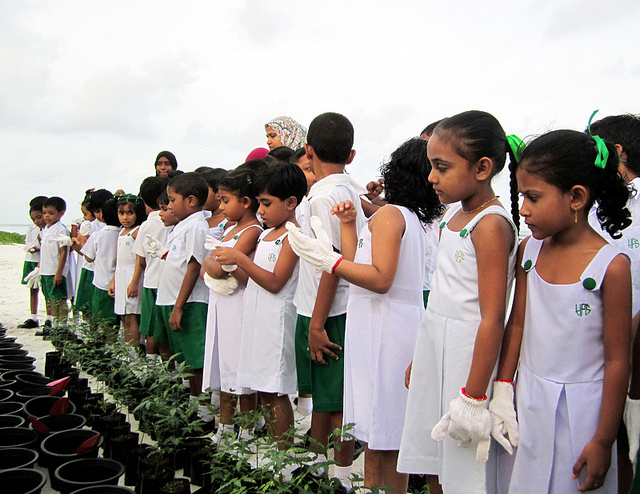 After spending seven centuries as a sultanate, the Maldives became a British protectorate in 1887. In 1986, three years after gaining its independence, the country became a republic. Education in the Maldives is faring well, as the island spends about 5.7 percent of its Gross Domestic Product on education. 99.3 percent of its population over the age of 15 can read and write. The country’s functional literacy rate of 98 percent is the highest in South Asia and in the Indian Ocean region.
About 35 percent of the population in the Maldives is under 18 years of age. In order for the country to have a sustainable future, greater social investment in education is required for young children.
Schools in the Maldives are divided into three types: English language primary and secondary schools, Quranic Schools and Dhivehi language primary schools. Primary and secondary education in the Maldives is free. The country’s colleges and universities are managed by the Ministry of Education.
In the past, traditional education in the Maldives was the responsibility of religious leaders and institutions. Known as “edhuruge,” the schools followed the patterns of Quranic schools. Today, the British system of education is followed, but there are still several modern schools that continue to provide Arabic and Islamic education. The system of education in the Maldives is designed within a specific curriculum to foster cultural and religious values in students, as well as so that they may obtain training and employment opportunities. A typical curriculum in schools includes Dhivehi, mathematics, environmental studies, Islam, English, fine arts, physical education, handwriting and study of the Quran.
In 1998, the Maldives College of Higher Education (MCHE) was established and provided Bachelor’s degrees. Before MHEC, only primary and secondary levels of education were available and students who wanted to pursue higher education studies had to go abroad. Since then, however, Maldives National University condensed and upgraded the existing facilities of MCHE in 2011.
UNICEF and the Ministry of Education have created tsunami recovery programs that have enhanced development, raised educational standards nationally and integrated schools in dispersed areas of the islands. This has included the construction of teacher resource centers, programs encouraging active involvement of caregivers in children’s learning, revision of curriculum to reflect national development priorities and knowledge-sharing initiatives at both national and local levels.
There are several vocational training centers and schools scattered throughout the islands. The Vocational Training Center in Male offers training in subjects such as engine repair and maintenance, refrigeration, electricity, welding and machinery. A Rural Youth Vocational Training Program is maintained by the Maldivian government and provides training in atoll localities. Other schools in the country include the Maldives Center for Social Education, Maldives Institute of Technical Education, Science Education Center and Arabic Islamic Education Center.
UNICEF has noted the success of the child-friendly teaching methods which have caused many communities to voluntarily join the educational system. In order to expand participatory learning into secondary schools to continue learning opportunities for interested students, the government of Maldives has developed its own national development programs.
The government of the Maldives needs to maintain and sustain its educational investments and devise innovative solutions to the problems of travel and distance that prohibit many students from learning in an institutional environment. The young population of the country will be the future job-seekers – and leaders – of the country. As such, they deserve the best opportunities education can provide.
– Mohammed Khalid
Photo: Flickr
