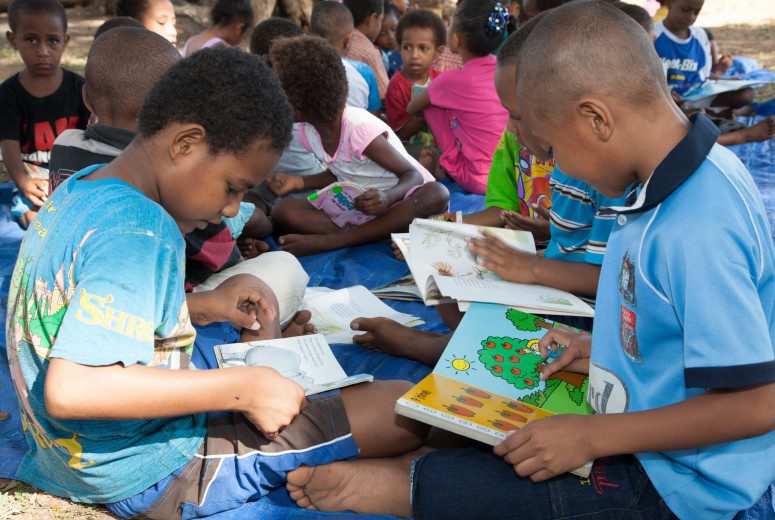
Recently, the northern Pacific island nation of Palau hosted its 25th Education Convention from July 23 to July 25, with approximately 530 public and private school teachers attending. The convention follows years of progress in improving education in Palau by increasing enrollment rates, creating primary school retention programs and prolonging the average school life for both boys and girls. All these factors allow Palau to further develop its education system.
Education in Palau and Gender
Surprisingly, girls and young women in Palau have at times had higher enrollment rates than boys and men, according to a 2008 analysis by UNICEF. The Ministry of Education of Palau even stated, “…gender disparity is not an issue in Palau. If there are any cases of gender disparity, they would involve males rather than females.”
The numbers are telling. According to the Ministry in 2005, the adjusted ratio of women to men with post-secondary education was 1.11, and the ratio of girls to boys in secondary school and primary school was 1.23 and 0.92, respectively. Furthermore, according to Palau Census Data as cited in the United Nations Millennium Development Goals (MDG) status report, a larger proportion of Palau women have reached higher education than men for a college degree since 2000, an associate degree since 2005 and a bachelor degree since 1990.
Only 1.5 percent of women 25 years old and over have no education background compared to 2 percent for men in the same age group. In the same category, 81.5 percent of women have one to four years of college education, while the number only stands at 75 percent for men.
Palau has outperformed some Pacific island countries in such efforts. The Global Partnership for Education states that in Papua New Guinea, for example, the 2016 primary completion rate for boys and girls was 84.7 and 73.5 percent, respectively. Meanwhile, Palau’s 2014 primary completion rate for boys and girls was 96.947 and 94.69 percent, respectively. Although the Pacific Education for All effort lists various concerns of gender equity, low enrollment rates and high dropout rates for many Pacific island countries, many of these metrics do not apply to Palau.
Other Improvements Still Needed
While efforts to offer better girls’ education in Palau have been successful, other metrics for assessing the education system in Palau show that there is still room for improvement: The CIA World Factbook states that the school life expectancy for women in primary to tertiary education is 18 years compared to 16 for men. Further, the male literacy rate is 96.8 percent compared while the female literacy rate is 86 percent.
Other areas of the education system require further attention. Improving the quality of instruction is one of Palau’s top priorities, as the U.S. National Center for Educational Evaluation and Regional Excellence reported in 2016 that instructors scored “relatively low” on reading, writing and math skills in an assessment test. The accompanying survey found that the teachers scored particularly low on data analysis and probability; the report additionally found that teachers who scored higher had higher levels of education, taught upper-level schoolchildren and had higher reported proficiency in English.
Other indicators show weaknesses in the education system. In 2016, the student to teacher ratio in primary and secondary schools was 12:1, suggesting the possibility of overworked teachers who may not be able to give personalized attention. In primary schools in 2018, the CBE -– Life Sciences Education found that only 40 percent of teachers possessed a high school diploma. According to UNICEF, in 2015, 29 percent possessed an Associate of Arts or Science degree, and only 9 percent possessed a Bachelor of Arts or Bachelor of Sciences. Past just the teachers, many schools do not even have adequate funding for school supplies and many buildings are in desperate need of renovations.
Tertiary education opportunities are also limited, given the small nature of Palau’s education system. With only one public high school in the country, many students attend private schools. Should students choose to attend college, the country only has one––Palau Community College (PCC). Though scholarships to attend the University of California San Diego are available, little data on tertiary education in Palau indicates few opportunities for students to expand on their education following high school.
Given that Palau has a matrilineal society and aforementioned indicators demonstrate successes in improving girls’ education in Palau and the country’s high regard for education, the main challenge is not to achieve gender parity in education but to generally boost the quality of education.
To address these concerns, the Ministry of Education has made calls for Palau schools to begin formal accreditation processes to bring more international attention to the country. Accompanying this have been efforts to implement teacher certification procedures. Studies have found varying results in English language teaching proficiency that underscore a greater need to establish training requirements for teachers and offering more opportunities for students to engage in a variety of fields, including STEM collaborations with PCC. To achieve this, the Palau government passed legislation requiring that teachers participate in a teacher preparation program at PCC.
Shaping the Landscape
International movements, organizations and regional efforts, alongside national educational improvement programs, have all helped Palau maintain high enrollment rates for girls and women and generally improve the education system. Palau’s educational achievements come almost two decades after the 2000 World Education Forum sparked Educational for All, an international movement calling for nations across the world to identify and achieve six educational goals.
With the 2006-2016 Ministry of Education’s 10-year plan to improve the quality of instruction, children have access to education from first grade until the end of high school, with compulsory primary and secondary education. The nation’s Early Childhood Comprehensive System and Head Start program––modeled similarly to American programs––provide support for families, medical services and works with Human Services and the Department of Health to help primary care providers, teachers, caregivers and families holistically care for 400 children and their development.
The ever-increasing access women have to financial stability and a wider variety of careers and roles in society throughout the past few decades have not been linked directly to women surpassing men in educational performance and attainment, according to the U.N. The 2005 census shows that women have a higher life expectancy than men, and though women are still less likely to be employed than men are, women’s median income is greater ($9,740) than that of men ($8,417). Women have “dominated” the judiciary in Palau and roles in public boards, but have yet to achieve equity in politics at the national level.
With the 25th convention coming up, the opportunities are endless for how Palau can build off its successes in creating more educational opportunities for both genders, particularly girls, by improving the overall quality of education and allowing for that education to carry over into careers and contributions to Palau society.
– Jeongyoon Han
Photo: Flickr

An In Depth Look At Education in Palau
Recently, the northern Pacific island nation of Palau hosted its 25th Education Convention from July 23 to July 25, with approximately 530 public and private school teachers attending. The convention follows years of progress in improving education in Palau by increasing enrollment rates, creating primary school retention programs and prolonging the average school life for both boys and girls. All these factors allow Palau to further develop its education system.
Education in Palau and Gender
Surprisingly, girls and young women in Palau have at times had higher enrollment rates than boys and men, according to a 2008 analysis by UNICEF. The Ministry of Education of Palau even stated, “…gender disparity is not an issue in Palau. If there are any cases of gender disparity, they would involve males rather than females.”
The numbers are telling. According to the Ministry in 2005, the adjusted ratio of women to men with post-secondary education was 1.11, and the ratio of girls to boys in secondary school and primary school was 1.23 and 0.92, respectively. Furthermore, according to Palau Census Data as cited in the United Nations Millennium Development Goals (MDG) status report, a larger proportion of Palau women have reached higher education than men for a college degree since 2000, an associate degree since 2005 and a bachelor degree since 1990.
Only 1.5 percent of women 25 years old and over have no education background compared to 2 percent for men in the same age group. In the same category, 81.5 percent of women have one to four years of college education, while the number only stands at 75 percent for men.
Palau has outperformed some Pacific island countries in such efforts. The Global Partnership for Education states that in Papua New Guinea, for example, the 2016 primary completion rate for boys and girls was 84.7 and 73.5 percent, respectively. Meanwhile, Palau’s 2014 primary completion rate for boys and girls was 96.947 and 94.69 percent, respectively. Although the Pacific Education for All effort lists various concerns of gender equity, low enrollment rates and high dropout rates for many Pacific island countries, many of these metrics do not apply to Palau.
Other Improvements Still Needed
While efforts to offer better girls’ education in Palau have been successful, other metrics for assessing the education system in Palau show that there is still room for improvement: The CIA World Factbook states that the school life expectancy for women in primary to tertiary education is 18 years compared to 16 for men. Further, the male literacy rate is 96.8 percent compared while the female literacy rate is 86 percent.
Other areas of the education system require further attention. Improving the quality of instruction is one of Palau’s top priorities, as the U.S. National Center for Educational Evaluation and Regional Excellence reported in 2016 that instructors scored “relatively low” on reading, writing and math skills in an assessment test. The accompanying survey found that the teachers scored particularly low on data analysis and probability; the report additionally found that teachers who scored higher had higher levels of education, taught upper-level schoolchildren and had higher reported proficiency in English.
Other indicators show weaknesses in the education system. In 2016, the student to teacher ratio in primary and secondary schools was 12:1, suggesting the possibility of overworked teachers who may not be able to give personalized attention. In primary schools in 2018, the CBE -– Life Sciences Education found that only 40 percent of teachers possessed a high school diploma. According to UNICEF, in 2015, 29 percent possessed an Associate of Arts or Science degree, and only 9 percent possessed a Bachelor of Arts or Bachelor of Sciences. Past just the teachers, many schools do not even have adequate funding for school supplies and many buildings are in desperate need of renovations.
Tertiary education opportunities are also limited, given the small nature of Palau’s education system. With only one public high school in the country, many students attend private schools. Should students choose to attend college, the country only has one––Palau Community College (PCC). Though scholarships to attend the University of California San Diego are available, little data on tertiary education in Palau indicates few opportunities for students to expand on their education following high school.
Given that Palau has a matrilineal society and aforementioned indicators demonstrate successes in improving girls’ education in Palau and the country’s high regard for education, the main challenge is not to achieve gender parity in education but to generally boost the quality of education.
To address these concerns, the Ministry of Education has made calls for Palau schools to begin formal accreditation processes to bring more international attention to the country. Accompanying this have been efforts to implement teacher certification procedures. Studies have found varying results in English language teaching proficiency that underscore a greater need to establish training requirements for teachers and offering more opportunities for students to engage in a variety of fields, including STEM collaborations with PCC. To achieve this, the Palau government passed legislation requiring that teachers participate in a teacher preparation program at PCC.
Shaping the Landscape
International movements, organizations and regional efforts, alongside national educational improvement programs, have all helped Palau maintain high enrollment rates for girls and women and generally improve the education system. Palau’s educational achievements come almost two decades after the 2000 World Education Forum sparked Educational for All, an international movement calling for nations across the world to identify and achieve six educational goals.
With the 2006-2016 Ministry of Education’s 10-year plan to improve the quality of instruction, children have access to education from first grade until the end of high school, with compulsory primary and secondary education. The nation’s Early Childhood Comprehensive System and Head Start program––modeled similarly to American programs––provide support for families, medical services and works with Human Services and the Department of Health to help primary care providers, teachers, caregivers and families holistically care for 400 children and their development.
The ever-increasing access women have to financial stability and a wider variety of careers and roles in society throughout the past few decades have not been linked directly to women surpassing men in educational performance and attainment, according to the U.N. The 2005 census shows that women have a higher life expectancy than men, and though women are still less likely to be employed than men are, women’s median income is greater ($9,740) than that of men ($8,417). Women have “dominated” the judiciary in Palau and roles in public boards, but have yet to achieve equity in politics at the national level.
With the 25th convention coming up, the opportunities are endless for how Palau can build off its successes in creating more educational opportunities for both genders, particularly girls, by improving the overall quality of education and allowing for that education to carry over into careers and contributions to Palau society.
– Jeongyoon Han
Photo: Flickr
7 Facts About Overpopulation in Brazil
Brazil is located in South America and neighbors every country within the continent except for Chile and Ecuador. It has the largest number of Portuguese speakers in the world and is known as one of the most ethnically and culturally diverse countries in the world. Since the 1930s, immigrants from many countries have become the backbone of Brazil. Although the country’s growth does not necessarily cause poverty, there is a correlation between overcrowdedness and population growth in specific regions of the country that are poor. Here are seven facts about overpopulation in Brazil.
7 Facts About Overpopulation in Brazil
– Francisco Benitez
Photo: Flickr
How Oral Rehydration Therapy is Saving Lives
Background
Children in impoverished countries are diagnosed with dehydrating diarrhea approximately four times per year. Most cases of diarrheal diseases can be prevented with proper hygiene, sanitation and access to clean water. However, when prevention efforts fail, oral rehydration therapy has proven to be an effective treatment option for diarrhea.
Treatment
Oral rehydration therapy (ORT) uses available fluids such as breastmilk or rice water mixed with salt to rehydrate the ill. Oral rehydration solutions or ORS is a specific way of delivering ORT. Discovered in the 1970s, ORS is a mixture of sugar, salt and water that can be made at home to replenish electrolytes. In 2001, a new version of ORS, with reduced sodium and glucose, was packaged and distributed in powdered form.
The 2001 low-osmolality ORS reported decreases in stool volume and vomiting by 25 and 30 percent, respectively. Since the implementation of ORT in the 70s, it has saved 50 million lives at an individual cost of less than 30 cents per package. Further, supplementary zinc treatments have proven to reduce the duration and recurrence of diarrheal illness, and provide strong supplementation to oral rehydration solutions.
However, ORT use between 1992 and 2005 decreased in 23 developing countries because they had no knowledge nor access to oral rehydration solutions. The World Health Organization (WHO) estimates that ORT has the potential to save an additional 300,000 children’s lives each year with ORT and zinc supplementation, but, currently, only 42 percent of children in prioritized countries are receiving ORT treatment. Further, only 7 percent receive both ORS and zinc.
Even though oral rehydration solutions sell for only 25 cents, impoverished families living on less than $1 a day cannot afford these costs. Additionally, there are common misconceptions in poor, less educated, communities that those suffering from diarrhea should be restricted from the consumption of food and fluids including oral rehydration solutions.
Solution
The Global Maternal, Child Health Network and the American Public Health Association have worked together to create a strategy involving international policymakers and health organizations with four main components:
While prevention efforts such as improving hygiene and sanitation should remain a priority, it is not always possible to address the consequences of poverty. Approximately, 58 percent of diarrhea fatalities in low and middle-income countries is a result of poor sanitation and inadequate access to clean water. This problem cannot be fixed overnight, however, if provided to everyone, oral rehydration therapy is an affordable treatment that could prevent 93 percent of diarrhea deaths.
– Haley Myers
Photo: Flickr
Children’s Hunger Fund Provides Meals to Families
Located on the junction of the Interstate 5 and Highway 14 is Children’s Hunger Fund (CHF), which nestles between the yellow, brownish foothills that lead to Santa Clarita. The drive to CHF ends in an industrial, office-complex space along northern Balboa Boulevard, in what people know as Sylmar, which is about 30 miles northwest of downtown Los Angeles.
Yet the heart and work of this organization belie its rather nondescript location. CHF is a Christian nonprofit with the mission of delivering hope to suffering children by equipping local churches for gospel-centered mercy ministry. Per its name, Children’s Hunger Fund most tangibly fulfills its mission through the delivery of meals to families in need and equipping local churches in an international network in order to build relationships and support communities for those families.
The Numbers
CHF operates in at least 24 mercy-network countries. There are seven countries in North and Central America, two countries in South America, seven countries in Africa, four in Eastern Europe and four in Asia. Since its founding in 1991, CHF served approximately 1,055 churches. In 2017 alone, the nonprofit delivered approximately 44.1 million meals across 503 international churches and 271 domestic churches in the organization’s network.
The Volunteers
At the nucleus of CHF’s worldwide impact is its volunteers who put in over 70,000 hours and packed over 90,000 Food Paks in 2017. Each food packs can provide up to 48 meals worth of food. Besides packing boxes of food, volunteers help with a variety of projects, such as packing bags of beans, macaroni and lentils in a packing facility at Children’s Hunger Fund’s headquarters. They also sort through gift-in-kind (GIK) products from Costco to give to local churches.
Volunteers, led by Children’s Hunger Fund staff, come in for two-hour-long shifts between Wednesday and Saturday, whether they come on their own or with their church, school or business. Volunteers can serve in a variety of ways, especially if they do not live near CHF headquarters in California or Texas.
For example, around 100 high school and college students in Johnson City, New York met at their local K&K The Old Tea House for bubble tea, music, board games and socializing. Organizers of the event sold wristbands and donated proceeds to Children’s Hunger Fund.
In August 2019, volunteers from Zion Lutheran Church in Texas organized a project to package approximately 3,000 boxes providing around 144,000 meals. Children’s Hunger Fund achieved that calculation from the fact that $0.25 translates to one donated meal.
The International Mission
With over $80 million in donations and gifts-in-kind, Children’s Hunger Fund generates and distributes Food Paks that start a relationship. The Food Paks specifically offer churches an open door to pray, serve and minister to these families and invite them into the network of support and hope. The hope is that these Food Paks can start the process of providing for the material, social and spiritual needs of those in poverty and hunger.
Education through the Poverty Encounter
Beyond its work and mission, CHF’s most recent development is the Poverty Encounter, which provides visitors with an interactive encounter with poverty around the globe. The 90-minute tour takes visitors through four different countries including Guatemala, Haiti, Nepal and Romania. In each room, visitors receive experiential education on four different aspects of poverty. Learning about hunger in Guatemala, visitors follow the life of a young boy living in a landfill. To explore disaster in Haiti, children share stories in the wreckage of the earthquake in 2010. The injustice in Nepal shows through children slaving away in brickyards. Finally, visitors witness hope in Romania, where children must live in the sewer systems of cities. The tour ends with giving visitors the opportunity to volunteer, packaging beans or macaroni in CHF’s packaging facility.
CHF’s international work, its army of volunteers, partnerships with corporations and ventures into poverty education all speak to its overarching mission to FACE poverty. FACE stands for feed, aid, connect and equip where it feeds families in need; aids those families with hygienic, educational or other material supplies; connects those families to a local church and support network and equips churches to meet these families needs.
Children’s Hunger Fund is always looking for volunteers. These efforts show that sometimes it only takes 25 cents to make an impact. Anyone can join the fight against poverty and hunger.
– Luke Kwong
Photo: Flickr
The Future of Peek: Vision Health for All
The world is experiencing a vision crisis. In total, over 200 million people around the world are visually impaired, and 7 million people develop blindness every single year. One-third of those who seek help and health care for their eyes are unable to obtain it. Developing countries are the most at risk, with 90 percent of individuals suffering from vision impairment living in underdeveloped nations. The organization Peek is seeking to change this, and the future of Peek could mean health care for everyone.
What is Peek?
Peek is proof that great things often come from small ideas. The organization began as a simple, developing research project in the International Centre for Eye Health at the London School of Hygiene and Tropical Medicine. Now, Peek consists of two entities: The Peek Vision Foundation, an official charity in the United Kingdom, and Peek Vision Ltd, a manufacturing company that develops medical devices for people all over the world.
Peek began with smartphone apps and hardware that provided affordable and accessible eye examination kits that could be used in every home, school and community. This hardware, the Portable Eye Examination Kit (PEEK), was used in 50 schools in Kenya in 2015 to evaluate 20,000 children who otherwise would have been left in the dark concerning their eye health. Further, Peek’s individual products, Peek Acuity, the smartphone app that examines vision, and Peek Retina, a portable ophthalmoscope that captures detailed images of the retina, are currently being used in over 150 countries around the world.
The Future of Peek
Now, Peek is moving beyond portable eye examination kits and onto how technology can play a role in making sure health care is readily available for everyone, everywhere. Concerning Peek’s future journey, Daisy Barton, head of communications and PR at Peek, wrote, “Today, we’ve moved beyond developing and validating our basic technology to building software systems that capture the information from smartphone-based eye health screening and surveys. To bring better vision and health to everybody, we need to understand where people fall through the gaps when trying to access eye care and how eye care providers can ensure their systems improve.”
Their smartphone-based eye care kits laid the foundation and proved that there was a viable way to test vision anywhere in the world using only a smartphone. Now, Peek is building upon that foundation to ensure nobody gets left behind when it comes to vision health.
Tracking Universal Health Care
Universal health coverage seems like a tall order, but Peek is following the lead of organizations such as the World Health Organization (WHO) and Global Goals for Sustainable Development to make it possible. For example, officials from the WHO along with the United Nations are working to develop specific indicators of health that enable different countries to mark their growth and advancements along their journeys toward universal health care. These indicators cover a variety of topics concerning different aspects of health. While the official list of indicators will not be announced until later in 2019, a preliminary list announced that there would be at least two indicators involving eye health.
Part of the struggle in making universal health care a reality is the impracticality of measuring every single aspect of a country’s health coverage; however, Peek is playing an important role in overcoming this challenge. Peek is using their smartphone-based software to provide countries and organizations with raw data that can be used to help develop certain health care indicators. This data allows health services to analyze and evaluate statistics pertinent to making universal health care a reality. Barton said this information includes “who is attending treatment, where they are based, and what the outcome is.”
Peek, along with the development of the rapid assessment of avoidable blindness eye health survey, is using and developing advanced technology and software to measure the aforementioned vision indicators as well as to develop treatments in a cost-effective, accurate and practical way. Their work will be fundamental in ensuring universal health care and improved vision worldwide.
With members of Peek all over the world, and offices in England, Pakistan, Kenya, Zimbabwe and Botswana, it is only a matter of time before Peek’s vision of eye care and universal health care is achieved. The future of Peek along with their groundbreaking work will ensure that those who so often fall between the cracks will no longer be left behind.
– Melissa Quist
Photo: Flickr
10 Facts About Life Expectancy in Israel
Multiple Middle Eastern countries and the Mediterranean Sea surround the State of Israel. The nation declared its independence in 1948 after the British cabinet ended its rule of Palestine and the area could not be partitioned into Arab and Jewish States due to dissent from Arab groups. The day after the establishment of the State, this disagreement escalated into a civil war known as the 1948 Arab–Israeli War. Since Israel’s inception, conflict and bloodshed have plagued its history, including the Six-Day War in 1967 and Operation Badr in 1973. Yet today, Israel is the only democracy and technologically advanced economy in the Middle East. Reports show that Israel ranks high in various health indicators, especially life expectancy, yet there are still concerns for the nation’s well being. These 10 facts about life expectancy in Israel will provide insight into the country’s current state.
10 Facts About Life Expectancy in Israel
These 10 facts shed light on how factors such as Israel’s health care system and lifestyle contribute to its high life expectancy, while also highlighting areas for improvement. The life expectancy of Israel’s neighboring countries provides extra context for these facts, such as Egypt at 70.5 years. These 10 facts about life expectancy in Israel reveal why, despite recent challenges, the nation is an ideal model for other unstable Middle Eastern countries to strive toward and ensure longer, healthier lives for their citizens.
– Adam Bentz
Photo: Pixabay
8 Facts About Education in Serbia
Education levels have been improving in the Balkan country of Serbia since the early 2000s and especially since Serbia’s partnership with Switzerland. It is evident that Serbia‘s work with other European countries and its attempt to bridge the gap between the rich and poor are doing wonders for Serbia’s education system. Here are eight facts about education in Serbia that highlight the progress of its education.
8 Facts About Education in Serbia
These eight facts about education in Serbia show that while Serbia has issues, the country has greatly improved its education system, and will continue to do so at the apparent rate it has set themselves. So long as Serbia is open to accepting outside help and to work to bridge the gap between the wealthy and the poor, the number of people that will benefit from its system will only grow. These eight facts about education in Serbia will hopefully serve as something Serbia can expand upon in the future.
– Collin Williams
Photo: Flickr
Women Negotiate in “Women, War and Peace”
When resolving conflict in the face of war, women are noticeably absent. Throughout history, however, women have occupied important roles during wartime, including as soldiers, politicians, factory workers and even baseball players. People often exclude women and under-represent them among the governmental and conflict-resolution side of the war. Between 1990 and 2017, 92 percent of all peace negotiators were male. Accordingly, the perspectives and interests of women are disproportionately missing, even when war affects women just as much, if not more than men.
Evidence suggests that including women in peace negotiations significantly reduces the presence of violence and aids in bringing peace. Some evidence goes so far as to say that when others include women in negotiation, there is a 70 percent chance that peace will stay for 20 years, compared to a 25 percent chance if only men participate in the conversation.
The “Women, War and Peace” Docuseries
“Women, War and Peace” is a docuseries that began with the idea that when women are part of peace processes, the outcome is often more peaceful for a longer period of time.
Produced by Abigail Disney and a team of all-female executives, the first season of “Women, War and Peace,” which first premiered in 2011, follows female peace negotiators in Afghanistan, Liberia and Northern Ireland. With tactics ranging from sit-ins, mass rallies and negotiating around a table, despite challenges and doubts of their legitimacy, the women attempted to convince leaders of their worth and usefulness in wartime proceedings.
Season two, which premiered in 2019, follows the stories of women in Gaza, Haiti and Egypt. In one episode, directors Geeta Ganbhir and Sharmeen Obaid-Chinoy told the story of one of the only all-female peacekeeping units in the world. One hundred and sixty Bangladeshi women traveled to Haiti following the 2011 earthquake where they encountered devastating poverty and ravaged health care systems and attempted to stabilize peace in the country. Another episode followed three Egyptian women in the height of the Arab Spring, struggling to restore peace in the crosshairs of the military and the Muslim Brotherhood.
What Disney Hopes the Docuseries Achieves
In addition to the general public, people use the series for educational purposes, teaching women and all individuals about political advocacy, female empowerment and gender equality. Most of all, the docuseries is a look into the realities of war.
In an interview for Women and Hollywood, the interviewer asked Abigail Disney what she would like viewers to take away from “Women, War and Peace.” She responded, “I would love people to take a moment and ask themselves what they understand about war. What do they believe happens in war, and what is war about to them?” “Women, War and Peace” is a look at war through the perspectives people usually ignore. Disney and the production team of the docuseries aim to dispel the heroism and nobility that many perceive in war through movies, stories and myths. Rather, through the eyes of women working towards peace, viewers of the docuseries see what victims of wartime see. In Disney’s words, the “high-minded view of war” is impossible “through a woman’s eyes.”
– Orly Golub
Photo: Flickr
Digital Solutions for Poor Indian Farmers
Digital Green
Digital Green is a global development organization that enables smallholder farmers to escape poverty through technology and collaboration. With this connection between farmers, individuals are likely to share their knowledge of farming. This collaborative effort not only improves the lives of one farming family but the lives of many. Digital Green began in 2006 as a project of Microsoft Research. Two years later, Digital Green became an independent nonprofit.
Digital Green’s life as a nonprofit began in India in 2008 when it broke off of Microsoft Research. Using participatory videos to teach smallholder farmers, Digital Green managed to help over 1.8 million farmers across 15,200 villages India. Of these farmers, an astounding 90 percent were women. Through Digital Green’s training videos, farmers learn how to use the system in order to properly and efficiently improve agriculture and nutrition.
Digital Green’s Knowledge Sharing
Digital Green builds technology tailored to communities for communities. Each video Digital Green creates focuses on the locals and their specific needs to improve their livelihoods. With more than 6,000 videos in more than 50 languages, Digital Green’s collaborative approach encourages farmers to share their knowledge. Digital Green supplies farmers with a data collection and analysis of production through its online and offline database, CoCo. CoCo displays data in near real-time, which supplies farmers with the most accurate information. When it comes time to harvest their crops, farmers have the option of using Digital Green’s app, Loop. Loop enables farmers to sell their produce in a more timely manner.
In 2011, Digital Green expanded into Ethiopia. Working with Ethiopia’s Ministry of Agriculture and Natural Resources, Digital Green has produced 980 videos, which have reached nearly 375,000 families. With nearly 60 video screenings a day across the country, farmers can rely on Digital Green to answer any questions they might have. Through Digital Green’s platform, the nonprofit connects researchers, extension agents and farmers through videos, radio and mobile devices. These lines of communication aid farmers with knowledge from experts and their neighbors.
Digital Green’s Partnership with India and its Five-Year-Plan
In 2012, Digital Green partnered with the Government of India and introduced over 1.1 million farmers to the National Rural Livelihood Mission. This particular project focused on “improv[ing] the efficiency of agriculture and livelihood interventions.” Fifty-six percent of the farmers adopted one or more techniques they had learned during the program.
In 2017, Digital Green committed to a five-year plan to achieve a 25 percent increase in income for 1.1 million South Asian and African farmers. Digital Green’s mission is to expand beyond India and share its agriculture development programs with the world. Digital Green has reached nearly 700,000 people across India and Ethiopia. Through Loop, Digital Green has help farmers sell over 4,700 tonnes of vegetables.
Digital Green’s solutions for poor Indian farmers are changing the agriculture field not just for India but the world. Through technology and innovation, Digital Green continues to expand and improves the lives of smallholder farmers.
– Emily Beaver
Photo: Flickr
The Best Countries to Live in for Women
Where in the world do women have the most opportunities? One must consider many factors when evaluating a country’s appeal to women. Gender equality, women’s rights, equal pay, the poverty rate for women, the rate of education for women and more specific issues like paid parental leave all play a significant role in building an egalitarian society. The following five countries are the best countries to live in for women.
Sweden
The Swedish government has declared itself a feminist government, setting forth a nation-wide standard of gender equality. Gender equality in Sweden goes beyond equality of opportunities and extends into ensuring equal qualities of life to ensure a positive future for Sweden. Workplace gender discrimination has been illegal beginning in 1980 and Swedish legislation further developed gender equality when the Swedish Discrimination Act passed in 2009. This law states that all employers and businesses must take active steps to ensure the existence of equality between women and men and the absence of harassment in the workplace. In 2017, the law expanded to include the prevention of all harassment, not only harassment on the basis of gender. Notably, Sweden’s legislation prevents discrimination against individuals seeking to take parental leave, the absence of which causes a major financial burden on families worldwide. These policies ensure that women, whether single or married, mothers or not, receive protection against all major forms of harassment. A telling fact of the extent of gender equality in Sweden is the percentage of women comprising Swedish parliament and cabinet – 46 and 50 percent, respectively.
Denmark
Women in Denmark integrate incredibly into the workplace, as women generally maintain jobs outside of their homes. With a generous parental leave policy, women are able to raise families while working without worrying about maintaining income. Similar to women in Sweden, Danish women have respect and can participate in government affairs, with 40 percent of Swedish parliament being female. According to a 2016 survey that the U.S. News and World Report conducted, Denmark is the number one country in the world for women to live in. Respondents considered five factors including safety, progressiveness, income equality and gender inequality.
Canada
Canadians have ample legislation to preserve the presence of equality for women and men. Previously, Canadian women did not experience such egalitarianism, and the government of Canada has made tremendous strides in bettering the country for women. In 2015, Justin Trudeau famously appointed an equal number of males and females to his cabinet, setting forth a precedent for his time in office. Canadian women receive protection from discrimination through the Charter of Rights and Freedoms. Women are, on average, more educated than men in Canada, indicating definite equality when it comes to educational opportunities. However, Candian women still experience the wage gap and income inequalities in the workplace. Canadians claim that these issues are the largest and greatest obstacles standing in the way of true equality in Canada.
Norway
In 2014, the Constitution of Norway expanded to include more human rights, including the Equality and Anti-Discriminatory Act. This act improved the status and rights of women and minorities and was necessary due to violence against women and the segregation of men and women in the workplace. In 2016, the Government of Norway signed a new plan into action that would take steps to further women’s rights and gender inequality. The Action Plan for Women’s Rights and Gender Equality in Foreign and Development Policy focused on five different goals, including equal participation for men and women in politics, full economic rights for women to participate in the labor workforce and inclusive education programs for all children, male or female. These policies contribute to why Norway is on the list for top countries for women to live in.
The Netherlands
Prior to 1956, women in the Netherlands automatically lost their job as soon as they married. This fact is hard to fathom when compared to the state of women’s rights and gender equality of the Scandinavian country today. Dutch law legally prevents discrimination and explicitly bans any type of inequality in men’s rights and women’s rights. However, a closer look into the Netherlands reveals that the country is not exactly a perfect place to live for women. For example, though men and women have close to equal levels of education, there still exists a gap in the comparison of individuals doing paid versus unpaid labor. In terms of safety, 45 percent of Dutch women will experience domestic violence in their lifetimes. Governments in countries like the Netherlands have had to implement new platforms and legislation to ensure that citizens feel safer in favor of true gender equality.
These best countries for women to live in concentrate in North America and Scandinavia. The top 10 list also includes Finland, Switzerland, Australia, New Zealand and Germany, expanding the geographic regions outward. The United States of America ranks at around number 16, appearing lower on the list due to crippling income inequality. Additionally, some regions in the world provide very dangerous environments for women, including the Middle East and Asia in countries such as Afghanistan and India.
– Orly Golub
Photo: Flickr