• Link to X
  • Link to Facebook
  • Link to Instagram
  • Link to TikTok
  • Link to Youtube
  • About
    • About Us
      • President
      • Board of Directors
      • Board of Advisors
      • Financials
      • Our Methodology
      • Success Tracker
      • Contact
  • Act Now
    • 30 Ways to Help
      • Email Congress
      • Call Congress
      • Volunteer
      • Courses & Certificates
      • Be a Donor
    • Internships
      • In-Office Internships
      • Remote Internships
    • Legislation
      • Politics 101
  • The Blog
  • The Podcast
  • Magazine
  • Donate
  • Click to open the search input field Click to open the search input field Search
  • Menu Menu

Tag Archive for: United Nations

Posts

Global Poverty, Hunger, United Nations

6 Things to Know About Hunger in Guinea-Bissau

6 Things to Know About Hunger in Guinea-Bissau
Located on the Atlantic coast of West Africa, the Republic of Guinea-Bissau lies between Senegal and Guinea. Since establishing independence from Portugal in 1974, the fledgling nation has struggled to maintain a stable government, most recently experiencing a military coup in 2012. Constant infighting among the country’s leading political factions and the Civil War of 1998, have exacerbated issues of hunger in Guinea-Bissau.

6 Things to Know About Hunger in Guinea-Bissau

  1. Since Guinea-Bissau gained its independence more than 40 years ago, no elected leader has served a full term. Military coups and constant political upheaval have plagued the fragile democracy. Without a steady government, promises to eradicate poverty and hunger, like the one made by current President José Mário Vaz in a speech following his election win in 2014, have gone unfulfilled.
  2. Sixty-nine percent of Bissau-Guineans live below the poverty line used by the World Bank and over a quarter of the population suffers from chronic malnutrition. According to UNICEF, chronic malnutrition is a form of growth impediment that occurs over a long period of time, showing how persistent food insecurity and hunger in Guinea-Bissau has led to harmful long-term effects for its residents.
  3. In addition to subsistence farming in Guinea-Bissau, agriculture is the main source of income for approximately 85 percent of the population, with cashew nuts as the primary crop. Since many Bissau-Guineans depend on farming for income, irregular rainfall and volatility in the cashew market lead to periods of severe food insecurity.
  4. According to the World Food Programme, 11 percent of homes in Guinea-Bissau are food insecure, meaning they lack reliable access to proper nutrition. Issues of food insecurity in Guinea-Bissau are worsened by political instability, which disrupts governmental nutrition programs.
  5. In coordination with the government of Guinea-Bissau, the U.N. implemented a strategic five-year plan in 2015, aimed at promoting government and community collaboration in programs that improve nutrition and food security. The U.N. program is part of the Zero Hunger Challenge and the World Food Programme’s Regional Roadmap for West Africa.
  6. To support local agriculture production, the World Food Programme subsidizes the production of fresh vegetables like spinach and okra, and purchases locally produced rice for school meals. This support makes farmers less vulnerable to volatile price changes.

In 2014, Guinea-Bissau held its first elections since the military coup in 2012, and former finance minister José Mário Vaz won easily. As long as he is leading the country, foreign aid will be vital in keeping President Vaz committed to his people and solving hunger in Guinea-Bissau.

– Yosef Gross

Photo: Flickr

June 12, 2017
https://borgenproject.org/wp-content/uploads/borgen-project-logo.svg 0 0 Borgen Project https://borgenproject.org/wp-content/uploads/borgen-project-logo.svg Borgen Project2017-06-12 01:30:522024-05-28 00:02:026 Things to Know About Hunger in Guinea-Bissau
Global Poverty, Refugees, United Nations

10 Facts About Refugees in Taiwan

Taiwan
Taiwan, officially known as the Republic of China (ROC), is not a United Nations member and therefore does have a United Nations High Commission for Refugees office. However, the country has made great strides to provide for refugees all over the world. Here are 10 facts about refugees in Taiwan.

10 Facts About Refugees in Taiwan

  1. Taiwan does not yet accept refugees into the country, but, in July 2016, draft legislation for a refugee law passed its first of three legislative committee reviews. This new law, if passed, would ease the asylum process into Taiwan and allow it to take in more refugees.
  2. However, in 1981, Taiwan was one of the only Asian countries to grant temporary asylum to refugees and offered permanent settlements to all who reach its shores. However, this stopped after several hijackings of planes by Chinese asylum seekers in the 1990s.
  3. In addition, in January 2009, the Legislative Yuan passed an amendment to the National Immigration Act to allow anyone who is persecuted in their country to apply for residency. This really only involved the neighboring those from Myanmar, Tibet, Chinese dissidents or others in a “refugee-like situation,” rather than actual refugees.
  4. Although Taiwan currently does not accept refugees, since 1963, approximately 150,000 illegal Chinese immigrants have entered the country seeking refuge from the communist government.
  5. As a result of this huge annual illegal immigration rate, Taiwan has cracked down on illegal Chinese immigrants since 2003. This crackdown includes the trend of “foreign brides” that has risen in the last two decades.
  6. To compensate for not accepting refugees, two Taiwanese organizations, The Rising People Foundation and a nonprofit organization established by William Hsieh, have launched “Casa di Love,” to build a refugee facility on the Italian island of Lampedusa. The organizations will spend $0.37 million over the next three years to build the facility that will give shelter to refugees all over the world.
  7. In addition, Taiwan donated 10 prefabricated houses to Caritas, an organization in Jordan, to provide housing for 41 Syrian refugees.
  8. In 2013, Taiwan donated 5,000 sets of solar-LED lights to the Azraq Refugee Camp. In 2015, Taiwan signed a $100,000 grant with the International Medical Corps Jordan Country Office to support Syrian and Iraqi refugees.
  9. With the recent movements trying to ban refugees in the United States, Taiwan is now trying to push its own refugee law through the legislative process to allow refugees to seek permanent settlements in the country. Taiwan hopes the acceptance of refugees will stimulate the economy and help the country to become a tech power and be able to further separate itself from China.
  10. Although Taiwan helps refugees all around the world, many of its own citizens have fled the country due to China’s hold on the territory. More than half of all Taiwan refugees reside in the United States, accounting for around 360,000 Taiwanese people.

These 10 facts about refugees in Taiwan show the evolution of Taiwan from a place of solitude to quite the opposite in the 1990s, to once again trying to reinstate the country as a “land of fortune” for both global refugees and its own citizens.

– Amira Wynn

June 10, 2017
https://borgenproject.org/wp-content/uploads/borgen-project-logo.svg 0 0 Borgen Project https://borgenproject.org/wp-content/uploads/borgen-project-logo.svg Borgen Project2017-06-10 01:30:172024-06-04 01:08:2010 Facts About Refugees in Taiwan
Developing Countries, Global Poverty, Sustainable Development Goals, United Nations

What Are Sustainable Development Goals?


The Sustainable Development Goals (SDGs), also known as “Transforming Our World”, are part of a U.N. initiative adopted in September 2015. The SDGs are designed to build on the Millennium Development Goals.

As former U.N. Development Program (UNDP) administrator Helen Clark explained, the goals “provide us with a common plan and agenda to tackle some of the pressing challenges facing our world such as poverty, climate change and conflict.” The 2030 Agenda for the Sustainable Development Goals includes 17 global goals, which are as follows.

17 Sustainable Development Goals

  1. No Poverty: An end to global poverty means ensuring a sustainable livelihood for all people.
  2. Zero Hunger: Work to achieve food security, improved nutrition, and the promotion of sustainable agriculture.
  3. Good Health and Wellbeing: Ensure healthy lives and promote wellbeing through universal health coverage, production of safe and affordable medicines and vaccines and funding for research and development.
  4. Quality Education: Ensure that all boys and girls get free primary and secondary education and access to affordable vocational training, without experiencing gender and wealth biases.
  5. Gender Equality: Gender equality and female empowerment is a human right, as well as a necessity for sustainable development.
  6. Clean Water and Sanitation: Universal access to safe and affordable water requires investment by the international community in infrastructure and sanitation facilities, and taking steps to protect and restore forests, mountains, wetlands, and rivers.
  7. Affordable and Clean Energy: Critical to the achievement of many other SDGs, investing in infrastructure and technology to provide clean energy will also cause economic growth in developing countries.
  8. Decent Work and Economic Growth: Promoting inclusive and sustainable economic growth and employment for all people.
  9. Industry, Innovation, and Infrastructure: Industrialization creates jobs and generates income, reducing poverty and increasing living standards for all people. Technological innovation encourages development and provides new jobs.
  10. Reduced Inequalities: Reducing income inequality, as well as inequalities based on race, sex, age, and other statuses, requires improvement in policies and regulations, promoting economic inclusion.
  11. Sustainable Cities and Communities: Most of those who are living in extreme poverty reside in cities. Achieving sustainable development in cities requires providing access to affordable housing, investing in public transportation, and improving urban planning.
  12. Responsible Consumption and Production: Countries must change the way they produce and consume goods, minimizing the toxic materials used and waste generated in the production and consumption processes.
  13. Climate Action: Climate change affects every country. The international community is working together to develop sustainable low-carbon pathways to the future, and mobilizing $100 billion annually, by 2020, to meet the needs of developing countries.
  14. Life Below Water: Marine pollution has reached critical levels – every square kilometer of the ocean has an average of 13,000 pieces of plastic litter. Sustainable management and protection of marine and coastal ecosystems from pollution and the impact of ocean acidification is extremely important.
  15. Life On Land: Forests make up 30 percent of the Earth’s surface. They provide habitats for millions of animal, insect, and plant species, and are sources for clean air and water. The goal is to conserve and restore forests, wetlands, drylands and mountains by 2020.
  16. Peace, Justice, and Strong Institutions: Promote peaceful and inclusive societies for sustainable development, provide access to justice for all, and build effective, accountable, and inclusive institutions at all levels.
  17. Partnerships for the Goals: Strengthen the means of implementation, and revitalize the global partnership for sustainable development.

These 17 SDGs are bold and will require continued strong leadership to achieve. Many countries succeeded in achieving their Millennium Development Goals, so while there is a difficult road ahead it is not an impossible task to create a more prosperous and sustainable world for all.

– Mary Barringer

Photo: Flickr

June 5, 2017
https://borgenproject.org/wp-content/uploads/borgen-project-logo.svg 0 0 Borgen Project https://borgenproject.org/wp-content/uploads/borgen-project-logo.svg Borgen Project2017-06-05 07:30:512020-04-19 17:01:22What Are Sustainable Development Goals?
Developing Countries, Global Poverty, Health, United Nations

How to Improve Health in Developing Countries


Despite the modern advancements of this era, developing countries still have poor access to quality, cost-effective healthcare. Attempting to close the socioeconomic gap created by poverty, there are three initiatives that governments and national organizations can take to improve health in developing countries.

3 Ways to Improve Health in Developing Countries

  1. Investing in Education: One of the most important ways to improve health in developing countries is by educating citizens. Educating people enables them to obtain safer jobs, increased health literacy, take preventive healthcare measures, avoid riskier health behaviors and demand better-quality health services.This is especially true for women living in developing countries, from girls entering puberty to pregnant mothers. Most deaths that occur in developing countries are neonatal, or during the first five years of life. By “providing formal or vocational education, adequate family planning, and antenatal services can break the cycle of poverty and empower women”, this type of education would begin providing soon-to-be mothers with the necessary knowledge to keep her family, future children, and self both safer and healthier.
  2. Increasing Health Benefits for the Poor: Poorer countries receive much lower health benefits than richer countries. In developing areas, the poor are subjected to higher risk of contracting diseases and lower access to quality healthcare. This is solely due to the cost of medicine, treatments and vaccinations. Through the creation of targeted systems that strategies identify who is poor and eligible for lower-cost health care. Another attribute of this system is directing programs directly towards lesser developed areas. This targeting system has the potential to “eliminate poverty at less than 10 percent the cost of development programs that do not discriminate between poor and rich”. These systems are done on different levels: most specifically they target individually poor, geographically poor, what diseases need to be prioritized, and the age of those that need health care the most.
  3. Promoting Primary and Essential Healthcare: A way to improve health in developing countries involves governments providing cost-effective health packages for everyone. An example of this would be Ethiopia and Malawi, where governments have focused on achieving universal vaccine coverage, developing cleaner water supplies and creating better sanitation practices.On a broader scale, as part of the Sustainable Development Goals, the U.N. has agreed to pursue universal healthcare by 2030. The initiative to create universal healthcare includes “access to quality essential healthcare services and access to safe, effective, quality and affordable essential medicines and vaccines for all”. By making availability universal, resources can be directed towards primary-level facilities of care that strengthen the overall treatments that people will be receiving.

These are not the only ways to improving health in developing countries. Governments and organizations have taken many different initiatives to closing the socioeconomic gap. With the Sustainable Development Goals, there should be a significant increase of developed countries contributing to establishing safe, quality healthcare systems.

– Taylor Elgarten

Photo: Flickr

June 4, 2017
https://borgenproject.org/wp-content/uploads/borgen-project-logo.svg 0 0 Borgen Project https://borgenproject.org/wp-content/uploads/borgen-project-logo.svg Borgen Project2017-06-04 07:30:342024-05-28 00:00:06How to Improve Health in Developing Countries
Global Poverty, United Nations, Water

A Resolution to the Quality of Water in Sri Lanka

A Resolution to the Quality of Water in Sri Lanka
The U.N. estimates that in just nine years, half the people in the world will not have access to safe water. Water sources will be affected by climate change, pollution, war, over-development and unsustainable agriculture. Sri Lanka has an abundance of safe water resources, however, the water is not distributed equally.

Almost 90 percent of the people living in urban areas have access to safe water, compared with 60 percent of rural communities. The quality of water in Sri Lanka for the three million people living in dry zones can only be described as contaminated. There is no safe water source within a 200-mile radius, leaving people in the dry zones dependent on groundwater from dug wells and tube wells.

Chemicals, such as fluoride, nitrates and arsenic, are present in groundwater at very high levels as a result of their geogenic origin. Consequently, these chemical contaminants affect the quality of water in Sri Lanka’s dry zones and in turn, the health of people who get their water in dug wells and tube wells. An increase in kidney diseases and cancer in Sri Lanka has been attributed to exposure to these chemicals.

People have attempted to resolve issues with the quality of water in Sri Lanka with bowser-driven water distribution, residential rainwater harvesting plants and bottled water, but a long-term solution is needed. The Sri Lankan National Water Supply and Drainage Board awarded Veolia, a French firm, a $164 million contract to design and build five water treatment plants, 12 service reservoirs, five pumping stations and 430 kilometers of transmission and distribution pipes. The water treatment plants will be located in Matale, Ambangang, Ukuwela, Udatenna and Rattotta. The plants will provide clean safe drinking water to more than 350,000 people in the agricultural area of Greater Matale in central Sri Lanka.

Clean, safe water is critical to the health of a nation and its people. The five water treatment plants are just the beginning of efforts to provide a sustainable solution to the quality of water in Sri Lanka that provides the entire population with a clean, safe water.

– Mary Barringer

Photo: Flickr

May 25, 2017
https://borgenproject.org/wp-content/uploads/borgen-project-logo.svg 0 0 Borgen Project https://borgenproject.org/wp-content/uploads/borgen-project-logo.svg Borgen Project2017-05-25 01:30:082024-12-13 17:56:33A Resolution to the Quality of Water in Sri Lanka
Education, Global Poverty, United Nations

6 Facts About Education in Montenegro

Read more
May 24, 2017
https://borgenproject.org/wp-content/uploads/borgen-project-logo.svg 0 0 Borgen Project https://borgenproject.org/wp-content/uploads/borgen-project-logo.svg Borgen Project2017-05-24 01:30:212026-03-31 10:22:026 Facts About Education in Montenegro
Global Poverty, United Nations, Water

The Current Water Quality in Tajikistan


Tajikistan has a population of 8.3 million, with an average life expectancy of 68 years. In the past 15 years, the country’s health policies were targeting many issues, including the water quality in Tajikistan.

The country has plentiful water resources through its two main river systems — the Amu Darya and the Syr Darya. These rivers account for 90 percent of Central Asia’s river water and 75 percent of the water used in irrigated agriculture, which account as fresh water reserves. The hydro-graphic network of Tajikistan is comprised of more than 25 thousand rivers, which mostly originated from glaciers totaling 69,200 km in length.

Despite the abundant water resources in the country, the drinking water supply system in rural areas remains underdeveloped. As much as 57.6 percent of the population had access to safe drinking water in Tajikistan in 2011.

After the first visit of Léo Heller, a U.N. expert on the right to safe drinking water and sanitation in 2015, the World Health Organization (WHO) had launched a support program for Tajikistan. The program particularly focuses on water quality in Tajikistan’s rural areas, which includes nearly 72 percent of the country’s population.

Water Safety Plan, one of the main guidelines on managing drinking water quality and sanitation developed for Tajikistan is supported by the German Federal Ministry for the Environment, Nature Conservation and Nuclear Safety (BMU). The plan was adopted by the government to be utilized prior to 2020. This was “a critical moment for the realization of the human rights to water and sanitation in Tajikistan,” Heller said.

Meanwhile, water in Tajikistan is mainly used for irrigation, as the water traveling through pipes is not safe for consumption. The government of Tajikistan is attempting to prioritize its budget to help fundamental human rights and slow the spread of water-borne diseases through allocating its budget for sanitation and water supply. These measures are to ensure access to drinkable water in every part of the country.

– Yana Emets

Photo: Flickr

May 17, 2017
https://borgenproject.org/wp-content/uploads/borgen-project-logo.svg 0 0 Borgen Project https://borgenproject.org/wp-content/uploads/borgen-project-logo.svg Borgen Project2017-05-17 01:30:562024-05-27 09:34:41The Current Water Quality in Tajikistan
Education, Global Poverty, United Nations

Striving For a Better Education in Benin

The Strive for a Better Education in Benin
Over the past decade, issues with the system of education in Benin have been met and addressed with an increased sense of urgency by government officials.

The U.N. has set into place extensive measures directed at addressing the common problem of educational inequality within the country. As a result, the “Ten-Year Plan for the Development of Education” was created to ensure the implementation of these measures.

In the ten-year development plan, financial resources for education in Benin have been directed towards greater recruitment of teachers, technical and vocational training, tuition support and improvements in secondary education. Between 2006-2013, there was a 16.5 percent increase in public spending for education in Benin. Government officials are looking to continue increasing the spending budget for both primary and secondary education.

According to the Global Partnership for Education, Benin faces geographic and social inequalities due to a “high absenteeism of teachers and a lack of capacity to manage the education system overall.” Since 2013, government officials have implemented measures increasing the availability of education, funding research, advancing literacy of national languages and improving sector management.

The overall system of education in Benin will continue to advance due to the “2017-2025 Education Sector Plan Development Grant,” passed and approved in March of 2016 by the Global Partnership for Education. Totaling $428,794, the grant money will be used to create the strategy and analytical framework for the plan’s development.

Furthermore, because studies have shown that increased access to education can be a direct correlation of decreased child exploitation in developing countries, the United Nations Children’s Fund (UNICEF) has also been dedicated to helping towards the advancement of education in Benin. Some of the preventative measures implemented by UNICEF include, “establishing partnerships with community and religious leaders; providing furniture and school supplies; and upgrading schools through the provision of latrines and safe drinking water.”

UNICEF has also created a monopoly and trivia style board game called “Anaylse en Boite” that is specifically designed to teach children about their educational rights and how to better protect themselves from criminal exploitation when the opportunity for such exploitation arises.

– Lael Pierce

Photo: Flickr

April 29, 2017
https://borgenproject.org/wp-content/uploads/borgen-project-logo.svg 0 0 Borgen Project https://borgenproject.org/wp-content/uploads/borgen-project-logo.svg Borgen Project2017-04-29 01:30:362024-06-12 07:49:31Striving For a Better Education in Benin
Food & Hunger, Global Poverty, Hunger, United Nations

Hunger in Guyana Halved


Hunger in Guyana has improved exponentially over the past decade as the number of people who suffer from hunger has been halved.

According to the U.N., Guyana is one of 38 countries that have met internationally established targets in the effort to eliminate hunger.

The country was recognized by the World Food Summit (WFS) for more than halving the absolute number of undernourished people between 1992 and 2012. The number reduced from more than 19 percent to just over five percent in that 20-year time span. The number lowered from 143,000 to 38,000 undernourished people.

Reflected in the WFS report are the implications of poverty, food insecurity and hunger in Guyana. Extreme poverty in Guyana has declined from 28.7 percent in 1993 to 18.6 percent in 2006. In order to reach the U.N.’s Millennium Development Goals, that rate must have fallen by four percentage points by 2015.

The report raised concern not about the availability of food in the region, but rather the ability to make food widely accessible. Guyana has remote rural regions of underdeveloped communities to which it is difficult to distribute quality, nutritious meals. Raising agricultural productivity is the key in this regard because remote rural areas are largely dependent on their own crops and livestock.

Sixty percent of the country’s gross domestic product is represented by six exports: sugar, gold, bauxite, shrimp, timber and rice. Guyana was once a powerful producer of sugar, yet its production sunk to an all-time low in 2014. However, more recent crop production numbers have shown improvement.

To limit malnutrition, assuring the right food choices is important. In 2008, less than one percent of children under five suffered from extreme malnutrition. In addition, less than six percent experienced mild to moderate malnutrition.

The country’s minister of agriculture Leslie Ramsammy produced a food security report in July 2012. The report stated that an increasing population and the adverse of effects of climate change were the drivers of food insecurity. The U.N.’s Food and Agriculture Organization (FAO) recently established a National Disaster Risk Management (DRM) Plan for the agriculture sector.

Ramsammy noted that a high food import bill and high national debt were the two biggest threats. At that time, debt levels were at more than 45 percent of Guyanese Gross Domestic Product (GDP).

The minister of agriculture concluded that Guyana must reaffirm its commitment to the science of crop management and agriculture practices.

Hunger in Guyana has improved greatly over the past 20 years. The country has resolved to work with international organizations to reach global goals to develop locally groundbreaking agriculture advancements.

– Shaun Savarese

Photo: Flickr

April 24, 2017
https://borgenproject.org/wp-content/uploads/borgen-project-logo.svg 0 0 Borgen Project https://borgenproject.org/wp-content/uploads/borgen-project-logo.svg Borgen Project2017-04-24 01:30:442024-12-13 17:57:48Hunger in Guyana Halved
Aid, Global Poverty, United Nations, USAID

10 Facts About the International Affairs Budget


International Affairs Budget

The Trump Administration recently released its federal budget proposal for Fiscal Year 2018 (FY18), proposing deep cuts for the International Affairs Budget. The proposal includes plans to cut State Department and USAID funding by 31 percent and the Treasury International Programs budget by 35 percent. The proposed $37.6 billion total budget cut for the State Department and USAID starkly contrasts the $54 billion increase proposed for the Department of Defense.

There has already been pushback to the proposal, including a letter signed by more than 120 retired generals and admirals against the cuts, and another opposition letter signed by more than 100 faith leaders.

Top 10 things you need to know about the International Affairs Budget

  1. It’s tiny. The International Affairs Budget accounts for less than one percent of the federal budget. The amount spent on foreign aid is often overestimated by the general public. A Kaiser Family Foundation poll published in 2015 asked respondents: “What percentage of the federal budget is spent on foreign aid?” — the average response was 28 percent.
  2. The International Affairs Budget is also referred to as the “150 account.” Foreign aid can be split into two functions: economic and development assistance (151), and security assistance (152). For FY17, the State Department requested $25.6 billion for the 151 account and $16.8 billion for the 152 account.
  3. Seven out of the top 10 recipients of economic and development assistance are African nations. Afghanistan is the largest recipient of economic and development assistance, as part of the ongoing reconstruction of the country after the U.S. military invasion in 2001.
  4. Money allocated to help alleviate global poverty is mutually exclusive from money allocated to help fund domestic poverty-reducing programs. In the overall federal budget, the International Affairs Budget is a completely separate account from the domestic expenditure. Therefore, spending money on global poverty does not have to compete with spending money on poverty here at home. Mattis Foreign Aid Quote
  5. The U.N. suggests that developed countries put 0.7 percent of their Gross National Income (GNI) toward overseas development and assistance. According to 2015 OECD statistics, the U.S. spends just 0.17 percent on overseas development and assistance — missing the U.N. target by 76 percent.
  6. The International Affairs Budget funds vital programs that have profound impacts on major global health threats. USAID assistance helped stall the recent Ebola outbreak in West Africa and continues to partner with local governments and organizations to ensure any further outbreaks are mitigated.
  7. USAID is the largest provider of food assistance in the world. Nearly 800 million people worldwide suffer from chronic hunger. Since its inception, around three billion people have benefited from USAID’s assistance programs.
  8. The International Affairs Budget has bipartisan support in Congress. U.S. Senator Ben Cardin (D-MD) led three of his bipartisan Foreign Relations Committee members in proclaiming that funding for the budget is “every bit as essential to ensuring America’s national security as funding for the Department of Defense, the Intelligence Community and law enforcement.”
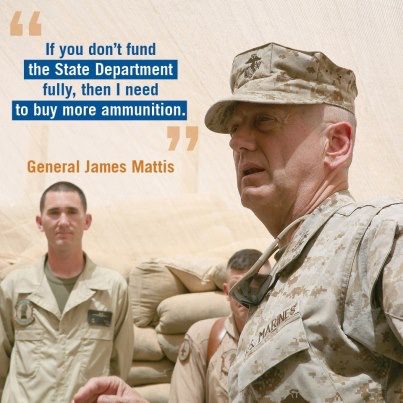
  9. The soft power of foreign assistance and development is supplementary to the hard power of the military. In 2013, U.S. Secretary of Defense James Mattis, as Commander of U.S. Central Command, remarked to Congress, “If you don’t fully fund the State Department, then I need to buy more ammunition.” Foreign aid and development can undoubtedly play a role in fostering positive growth and warm feelings toward the U.S. in societies that are at risk of succumbing to terrorist groups.
  10. Spending money on international development is not just a moral decision. In an ever-connected world, funding the International Affairs Budget creates jobs for American workers and boosts the American economy. In 1996, 39 percent of exports went to developing countries. Now, more than half of U.S. exports go to developing economies. Through aid and development, people living in developing economies are becoming more wealthy and more capable of affording American products.

The International Affairs Budget is a tiny component of the overall federal budget, but its impact in myriad areas is enormous. American jobs, economic growth, national security, and global health are just a few areas that will be affected if the proposed cuts by the Trump Administration are implemented.


– Michael Farquharson

Photo: Oxfam

April 22, 2017
https://borgenproject.org/wp-content/uploads/borgen-project-logo.svg 0 0 Borgen Project https://borgenproject.org/wp-content/uploads/borgen-project-logo.svg Borgen Project2017-04-22 01:30:402024-12-13 17:57:4510 Facts About the International Affairs Budget
Page 26 of 44«‹2425262728›»

Get Smarter

  • Global Poverty 101
  • Global Poverty… The Good News
  • Global Poverty & U.S. Jobs
  • Global Poverty and National Security
  • Innovative Solutions to Poverty
  • Global Poverty & Aid FAQ’s
Search Search

Take Action

  • Call Congress
  • Email Congress
  • Donate
  • 30 Ways to Help
  • Volunteer Ops
  • Internships
  • Courses & Certificates
  • The Podcast
Borgen Project

“The Borgen Project is an incredible nonprofit organization that is addressing poverty and hunger and working towards ending them.”

-The Huffington Post

Inside The Borgen Project

  • Contact
  • About
  • Financials
  • President
  • Board of Directors
  • Board of Advisors

International Links

  • UK Email Parliament
  • UK Donate
  • Canada Email Parliament

Get Smarter

  • Global Poverty 101
  • Global Poverty… The Good News
  • Global Poverty & U.S. Jobs
  • Global Poverty and National Security
  • Innovative Solutions to Poverty
  • Global Poverty & Aid FAQ’s

Ways to Help

  • Call Congress
  • Email Congress
  • Donate
  • 30 Ways to Help
  • Volunteer Ops
  • Internships
  • Courses & Certificates
  • The Podcast
Scroll to top Scroll to top Scroll to top