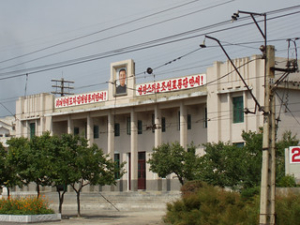
Using new Google Earth images, analysts and human rights groups have uncovered visual proof of several prison camps operating in the oppressive North Korean state. Long an unconfirmed and secret program that the country continually denied as foreign propaganda, the regime’s prison camps are now verifiable through high-definition satellite imagery.
The UN has been encouraged by rights groups to investigate the situation that has persisted for nearly 50 years, as there are thought to be nearly 200,000 political and civilian prisoners held in a series of camps – many detained as punishment for attempting to flee North Korea in search of food or work, according to a report by the National Human Rights Commission.
With the release of the latest satellite imagery courtesy of Google Earth, a newly constructed prison camp can be seen in Kaechon, South Pyongan Province, that did not exist when the last images were released in 2006, according to the North Korean Economy Watch website. Analysts were able to determine such details as a 13-mile-long fence, with two checkpoints and six guard posts, and a seemingly nonoperational coal mine.
Reports of conditions inside North Korea’s prison camps have been few and far between, as very few prisoners have ever escaped alive, with little chance of ever leaving the prison at all once they are in. The accounts of life inside, where perceived “enemies” of the regime and three generations of their family can become imprisoned for the rest of their lives, are extremely harrowing. Such stories include prisoners “forced to to survive by eating rats and picking corn kernels out of animal waste.”
Other such conditions include abuse, torture, sexual violence, and disease; analysts suspect that nearly 40 percent of prisoners die of starvation and malnourishment, while those who survive are worked to death in harsh conditions for up to 16 hours per day. Prisoners who attempt to escape and are caught face execution.
The role of Google Earth has played a large part in the increased amount of knowledge that rights groups have available on the prison system. Former prisoners have, with the improvement in imagery that is now high-definition, been able to work with analysts in pinpointing the exact features of the prison camps that they were in, including their barracks and camp execution grounds.
Although the UN high commissioner for human rights, Navanethem Pillay, stated that steps are needed in order to take stronger action against the regime, she also acknowledged that the UN had hoped that the change in leadership would improve the human rights situation in the country. Ms. Pillay stated that the UN will look into creating an international investigation into the North Korean prison camps system since it is clear that the situation is not improving.
– Christina Kindlon
Source: The Telegraph

UN Declares 2013 “International Year of Quinoa”
Bolivian President Evo Morales recently appeared before the UN to promote the unusual resilience of the quinoa crop to the international community. Fittingly, President Morales-himself a quinoa farmer-was appointed Special Ambassador by the UN’s Food and Agricultural Organization (FAO) following their declaration of 2013 as the “International Year of Quinoa.”
Pronounced correctly as keen-wah, quinoa-a staple in Bolivian and Peruvian diets for years-has the unique ability to grow under the most challenging of conditions; including high altitude, poor soil quality, and low annual rainfall. A distant cousin of both beets and spinach, quinoa has been thrust into the limelight lately as a realistic solution to the chronic food security problems faced by many developing nations. Thus, the FAO hopes to increase awareness and production of the crop by calling for 2013 to be known as “International Year of Quinoa.” Additionally, the high nutrient value and relatively low production costs make even Western European nations such as Italy and the Netherlands keen to make full use of their limited amounts of farmland.
Source UN News
3 Important Factors For Haiti Earthquake Recovery
Despite global outreach following the massive earthquake on January 12, 2010, Haiti has been stalled in effectively alleviating the widespread poverty historic to the island, which has increased dramatically after the disaster. President Michel Martelly, elected twenty months ago, has recently proposed a five-point plan of employment, rule of law, education, environment, and energy to help lift his country out of turmoil. But this plan will not affect stagnation unless Haiti addresses its dysfunctional political system, public frustration, and donor fatigue.
1. Political System
The political system in Haiti is one factor that is working against the Haiti earthquake recovery. The system is conducive to winner-takes-all politics, which makes compromise, an essential aspect of a stable political system, difficult to attain. It is also unhelpful that President Martelly faces an opposition-dominated parliament that only exacerbates the inability to compromise. Haiti does not currently have any strong political parties that represent the majority of its poor citizens. This has lead to a system that relies mainly on cronyism rather than public support in order to get things done.
2. Public Frustration
The unfair political climate has led to frustration among the Haitian public. A staggering 350,000 citizens that lost their homes during the earthquake over two years ago are still living in camp settlements across the capital. These people are waiting to see tangible improvements to their daily lives. Their plight has not been made any easier by the drought, two tropical storms and rising food prices. The president faced 128 public protests across Haiti between the months of August and October alone, according to the International Crisis Group.
3. Donor Fatigue
Not only the general public, but also foreign aid donors are feeling frustration over Haiti’s political gridlock. The lack of transparency with foreign aid funds and lack of progress in reconstruction is causing Canada, one of the biggest supporters of Haitian renewal, to reconsider tens of millions of dollars that was meant for the country. According to figures published by the United Nations, only half of the $6.04 billion pledged to Haiti since the earthquake has been disbursed to the country thus far, and only ten percent of that figure was distributed directly to the government. Until Haiti finds a solution for its political woes, the financial aid that Haiti’s earthquake recovery needs could be in a gridlock of its own.
While these issues are important to consider for the Haiti earthquake recovery, it is also important to keep in mind that the international community is still deeply interested in seeing a Haitian recovery. Identifying the key obstacles to any issue is the first step to solving them. Hopefully, steps two to infinity will present themselves sooner rather than later.
– Sean Morales
Source: AlertNet
Photo: Christian Science Monitor
Divided Congress a Threat to Foreign Aid
As a budget-cut-inducing sequester looms, Congress must come to an agreement on the national debt and budget – which includes funding for foreign aid and diplomacy programs, many of which have been the target of proposed cuts by conservatives. Kerry said that it is more important now than ever for America to have financial stability in order to set an example through diplomacy for developing countries. He went on to argue that diplomacy strengthens our economy at home by providing economic markets abroad for US exports, which negates the initial cost of government-sponsored foreign aid and international development ventures.
Kerry cited the success of the Marshall Plan in post-World War II Berlin, and asserted that the United States would have to stay relevant in the global arena in order to keep up with rising economic super powers like China and India.
Kerry gave additional real-world examples in support of foreign aid, including increased exports to Vietnam in the last decade, and the high number of former aid recipients who now import US goods. Learn more about how the US economy depends on participating in foreign aid here.
– Christina Kindlon
Source: The Telegraph
Teenager Helps Residents of a Garbage Dump
According to the Lake Zurich Patch, Courtney first fell in love with Guatemala when she was nine and her family took a trip to build playgrounds with Kids Around the World, an organization whose primary goal is to provide safe play equipment for children who find it difficult to be “just a kid.” Courtney describes the garbage dump as being 40 acres filled with trash and yet the children somehow manage to stay positive and in high spirits.
While her family has been on other mission trips, Courtney has fallen in love with Guatemala. She was able to return in 2011, meeting a family of seven who lived in a 9 x 10 shack. One of the children, a 15-year-old girl, was pregnant and Courtney decided that something needed to be done to help improve their living condition.
To help, Courtney and her friends are hosting a “Hope’s in Style” fashion show fundraiser on February 24 at the Garlands Center in Barrington, Illinois.
Although she is now living in the United States, the memory of the children in Guatemala still remains vivid in her mind.
“There is nothing here that is hopeful, but when you shake hands, hug, and talk to people, they are so full of hope, so full of faith,” Courtney said. Their determination to make the best of their situation is what inspires her to keep moving forward.
– Pete Grapentien
Source: Lake Zurich Patch
Flooding Disaster in Mozambique
While the victims of flooding in Mozambique are dealing with destroyed homes and families, the natural disaster has been exacerbated by the outbreak of cholera. There have been over 250 cases so far, fortunately, no cases have proved fatal. Mozambique has experienced problems with cholera for years, so their response has been effective thus far. However, the potential for more flooding means that they must remain vigilant.
The complete rebuilding effort is estimated to cost over $30 million, according to The Humanitarian Country Team in Mozambique, an organization comprised of NGO and UN officials. UNICEF itself seeks $6.8 million from this fund to pay for projects to improve the welfare of children and those around them, like building clean water pumps and constructing new homes.
According to Jesper Morch of UNICEF, “emergency supplies and funding has been depleted…we urgently need additional funds if we are to help many children and families recover.”
– Jake Simon
Sources: news24, UNICEF, Al Jazeera
Photo: Times Live
Red Nose Day Turns 25
What now appears to the public as a well-rehearsed and professional telethon was once a much more amateur affair with the most earnest of the organizers and performers of Red Nose Day holding it together. British talk show host and comedian Jonathan Ross recalls one mix-up from the early years when Welsh comedian Griff Rhys Jones began a comedic bit with his trademark enthusiasm only to realize that he was supposed to be presenting a tragic event. Despite moments of confusion, the event was a wild success and continues to be an important national event to this day.
The organization does not simply raise money to be passed on to indiscriminate sources. Walking through the halls of a Comic Relief-assisted school in Accra, Ross was impressed by the real-world impact that a little money collected from thousands of people can make. He recognized the importance of the school to the community in helping the children gain a solid education to escape poverty. When faced with the reality of the effect that the charity money makes, it is obvious that the school is more than just a place to collect impressive donation statistics or take riveting photos for a catalog. It is an institution that means a great deal to the community.
Ross admits that the idea of using comedy to highlight the tragedy, as in the staggering poverty in Africa, is a risky way to raise awareness. Regardless, the performers and the organization have built a large following in the early years that has only grown since then. At the least, Red Nose Day is a bright and cheery way to bring awareness to global poverty on the international stage.
– Sean Morales
Source: The Guardian
North Korean Prison Camps Uncovered Using Google Earth
Using new Google Earth images, analysts and human rights groups have uncovered visual proof of several prison camps operating in the oppressive North Korean state. Long an unconfirmed and secret program that the country continually denied as foreign propaganda, the regime’s prison camps are now verifiable through high-definition satellite imagery.
The UN has been encouraged by rights groups to investigate the situation that has persisted for nearly 50 years, as there are thought to be nearly 200,000 political and civilian prisoners held in a series of camps – many detained as punishment for attempting to flee North Korea in search of food or work, according to a report by the National Human Rights Commission.
With the release of the latest satellite imagery courtesy of Google Earth, a newly constructed prison camp can be seen in Kaechon, South Pyongan Province, that did not exist when the last images were released in 2006, according to the North Korean Economy Watch website. Analysts were able to determine such details as a 13-mile-long fence, with two checkpoints and six guard posts, and a seemingly nonoperational coal mine.
Reports of conditions inside North Korea’s prison camps have been few and far between, as very few prisoners have ever escaped alive, with little chance of ever leaving the prison at all once they are in. The accounts of life inside, where perceived “enemies” of the regime and three generations of their family can become imprisoned for the rest of their lives, are extremely harrowing. Such stories include prisoners “forced to to survive by eating rats and picking corn kernels out of animal waste.”
Other such conditions include abuse, torture, sexual violence, and disease; analysts suspect that nearly 40 percent of prisoners die of starvation and malnourishment, while those who survive are worked to death in harsh conditions for up to 16 hours per day. Prisoners who attempt to escape and are caught face execution.
The role of Google Earth has played a large part in the increased amount of knowledge that rights groups have available on the prison system. Former prisoners have, with the improvement in imagery that is now high-definition, been able to work with analysts in pinpointing the exact features of the prison camps that they were in, including their barracks and camp execution grounds.
Although the UN high commissioner for human rights, Navanethem Pillay, stated that steps are needed in order to take stronger action against the regime, she also acknowledged that the UN had hoped that the change in leadership would improve the human rights situation in the country. Ms. Pillay stated that the UN will look into creating an international investigation into the North Korean prison camps system since it is clear that the situation is not improving.
– Christina Kindlon
Source: The Telegraph
Oscar Nominated Film Documents Children’s Heart Surgery
Filmed in 2012, ‘Open Heart’ documents the journey of eight patients going through surgery at the Salam Center in Khartoum, Sudan. Salam is Africa’s only state-of-the-art, free-of-charge cardiac hospital offering children’s heart surgery and has been operating since 2007.
‘Open Heart’ follows Dr. Gino Strada, a surgeon at Salam and features Angelique Tuyishimere, the six-year-old daughter of a Rawandan farmer. Close to a third of the patients at Salam are under 14 making children’s heart surgery a common occurence at Salam.
Salam employs four cardiac surgeons and is set up for 1,500 operations per year. However, due to funding issues, last year only 600 patients were operated on. Dr. Strada is forward about admitting the need in Africa is more than Salam can aid, but is still very happy with the progress that has been made and optimistic about the future.
Now, Davidson and the doctors – Rusingiza and Strada – will be attending the Oscars. If passport and visa issues are resolved, six-year-old Angelique and her dad will also be attending. Although he stands the chance of being honored at the Oscars, documentarian Kief Davidson still has not lost sight of the original problem being addressed – the lack of affordable healthcare in Africa, especially concerning the preventable diseases fought at Salam.
– Pete Grapentien
Source ABC News
The Link Between Volunteering and Happiness Levels in the Elderly
Source: Journal of Aging and Health
Photo: New York State Senate
Human Development Report Has Good News
After the longest time of a Northern-dominated global economy, the Global South seems to be catching up. This year’s United Nations Development Program’s annual report has some incredible news: lots of livelihoods have improved and are continuing to move in the right direction in terms of development. The Human Development Report suggests that 40 countries are doing better economically and socially. According to The Yemen Times, these improving nations aren’t solely the “economic tigers” of the world, such as China, and Brazil; they also include Turkey, Mexico, South Africa and several more.
The good news is that countries that were once considered “backward” are rising up to the plate, demanding that their voices be heard. Such a shift in global development and human well-being tips the scale for the dominating countries, mainly the United States, member nations of the European Union, and Japan, which have always set and controlled policies.
The UNDP collected measurements of income, literacy levels, gender rights, and longevity to form this year’s rankings, and the results evinced sustainable success and growth: “a fifth of the nations surveyed – all in the developing world – did better than expected.” Although sub-Saharan African countries did not do so well as to be included in this “rise of the South” phenomena, and there is clearly much more to be done, this year’s results are evidence that much good is being generated nonetheless. There is hope that more work will continue to result in greater improvements.
– Leen Abdallah
Source: Yemen Times
Photo: Static