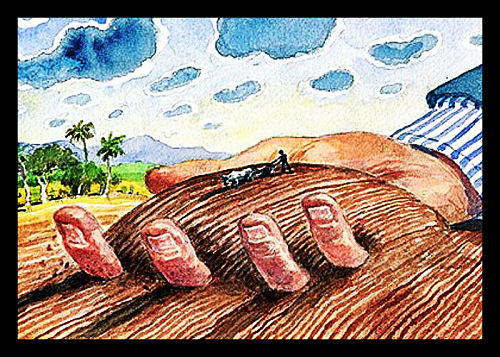
 It is assumed that the already existing gap between developed and developing nations is large and apparent enough that wealthier nations would try and fill this gap and bring these opposite ends closer together. According to an ABC Environmental article, however, wealthy nations are instead competing over ‘land’ and ‘water grabbing’ to appease their growing populations and the “stressed” supply of basic necessities such as food and water. Investors in a foreign land, or better yet, the land-grabbers, are countries and investment firms from biofuel producers to large-scale farming operations (agricultural investors).
Since 2000, the major countries that have contributed to this land purchasing are the U.S., Malaysia, the U.K., China, and the U.A.E. Experts aren’t sure of these investors’ motives but it is clear that they are only focusing on buying land where there is clear access to water.
‘Land grabbing’ is defined by Paolo D’Odorico, a professor at the University of Virginia, as “a deal for about two km2 or more that converts an environmentally important area currently used by local people to commercial production.” According to an environmental study, 454 billion cubic meters sums up the ‘water-grabbing’ per year by corporations on a global scale, which is about 5 percent of the world’s annual water consumption. According to the public database Land Matrix “1,217 deals have taken place, which transferred over 830,000 square kilometers of land” since 2000, with 62 percent of such deals happening in Africa alone.
From 2005 to 2009, during a major food price crisis, land purchases, which fall under a very low level of regulation, skyrocketed. In 2011, the Food and Agricultural Organization of the U.N. released guidelines that advise investors to consider the people and communities whose land is being used. However, such guidelines are viewed as humanitarian concerns and have little enforcement, meaning that they aren’t strict enough to have corporations and investors abide by them or even care for them.
Governments who are interested in and have been leasing and selling land to foreign countries and investors are mainly those in Eastern Africa and Southeast Asia. They are interested in these sales because they want to modernize their farming and believe this is the way to do it. However, the reality is that the resulting development from such ‘land and water grabbing’ depends on the investors’ terms and conditions, as well as their sense of morality.
The main problem is that the majority of these sales are happening in poor countries in which there are high rates of hunger and where resources valuable to the local populations are being purchased by wealthier developed nations or even by private corporations. The main question of the matter is this: Who is benefiting from land and water grabbing? Are these sales helping the local people since it is their land? Or are these purchases only concerned about foreign benefits and the population concerns of developed nations?
– Leen Abdallah
Source: ABC
Photo: Water Governance

New Proposals for Development in Haiti
In an ambitious goal to help other nations help themselves and possibly shift the paradigm of foreign aid forever, Canadian aid worker Hugh Locke has started a forestry program aimed at fostering a sense of independence in the Haitian citizenry. Lock, critical of the current state of NGO and government involvement in projects, is employing his aptly titled “exit strategy aid” to change the scope of development in Haiti.
The country of Haiti, still emerging from the destruction wrought by Hurricane Sandy and previous natural disasters, has had no shortage of challenges involving their crippled infrastructure and forecasted food shortages. However, Lock, armed with his forestry background, noticed that the Caribbean nation was lacking key ecological resources and decided to embark upon a re-forestation program dependent upon native farmers to encourage development in Haiti. When questioned about the efficacy of such a program, Lock remarked: “A road that is built by donor money using foreign contractors is never going to be fully a part of the national transportation system,” before clarifying that such a project, because of its foreign ownership, would need foreign aid to maintain it, which is neither sustainable nor helpful to empowering local projects.
Source: World News
Photo: Trees for the Future
2013: The International Year of Quinoa
Quinoa is a semi-cereal, not quite a grain, that is mostly grown in Peru and Bolivia. If you have any “foodie” friends or know any hip cooks, you will probably have heard a lot about quinoa. In fact, the factor of “hipness” may have had a huge part in increasing the popularity of the food, as well as the fact that it has astonishing nutritional value. The UN’s declaration of 2013 being the International Year of Quinoa is part of an effort to further increase the food’s popularity. The real reason that quinoa is being pushed as a popular food is that quinoa is extraordinarily hardy, and is a great source of amino-acids. It is one of the most durable foods on Earth. Quinoa is able to thrive even in semi-arid deserts and the high Altiplano.
Quinoa is now being planted more and more in other harsh climates that span countries like Chad and Niger. While most of the world’s quinoa still comes from Peru and Bolivia, it is gaining ground in other countries. The heightened popularity of the food has increased the average crop value and provided higher income to farmers and local business owners alike. Hopefully, the popular attention that quinoa is receiving will help consumers make the choice to join in and celebrate the International Year of Quinoa.
– Kevin Sullivan
Source: United Nationsl
Smog From China is Crossing Borders
Until recently, the problem has been largely confined to China itself. Those afraid of global climate change, however, have been calling attention to the issue for years. Now, smog from China is crossing borders and affecting its Japanese neighbors. This presents another challenge to test Chinese-Japanese already strained relations.
Associate Professor Toshihiko Takemura of Kyushu University, who studies pollution for the University, explained that in Kyushu, “the level of air pollution has been detectable in everyday lives since a few years ago.”
China is notorious for quashing public dissent on sensitive issues like government shortcomings. However, in recent weeks, there have been uncanny amounts of focus put on environmental shortcomings by both state television and party officials.
Hopefully, the new Chinese Premier will work hard to drastically reduce China’s levels of pollution, bettering the health of the country’s citizens while improving relations with China’s estranged neighbor.
– Jake Simon
Source: news.com.au
Photo: Japan Times
Everything You Need to Know About Malnutrition
Malnutrition is not necessarily about not having enough to eat, but rather not having the right minerals and vitamins in what you eat. This World Food Program (WFP) video says everything you need to know about malnutrition – in two minutes.
The cycle of malnutrition starts in the womb, malnourished mothers give birth to children with health problems who grow up to be adults with health problems, then raising the next generation, and so on. The goal of the WFP is not just to treat malnutrition, but to also help it from happening in the first place. WFP realizes that it costs half as much to help a child under two, than it does to wait until the child is older and in need of greater assistance.
In raw figures, WFP indicates it would cost $3.6 billion to provide the special foods needed to treat all the moderately malnourished infants and toddlers in the world. Seemingly a large sum of money, but it is less than half of the $10 billion that Europeans spend on ice cream annually. Thus, the amount needed to treat malnourished is attainable.
Relatively, the fight against malnutrition is not that daunting; the world has the ability and the means, “the challenge is to do it.”
– Mary Purcell
Source: Youtube
Free Oxford Course on Climate Change
Oxford University, one of the top-rated British schools, boasting such notable alumni as Stephen Hawking, Kris Kristofferson, and Dr. Seuss is now offering a free online course on climate change titled “An Introduction to the Science of Climate and Climate Change.”
The course, conducted entirely online, is being made available through the website www.climate.net, which is a global program that aims to educate the public about climate science, thereby increasing awareness of climate change-related issues.
The course content outlines the basics of climate science and modeling, which considers specific variables involving climate change in an attempt to paint a wider picture of the possible effects on local ecosystems and weather patterns. In addition to having a greater understanding of climate science and modeling, this course on climate change will also allow for a deeper interpretation of the modeling results. Once completed with an overall score of 90 percent or higher, there is also the option to take the advanced course titled “Constructing and Applying High Resolution Climate Scenarios.” This course is tutor-supported, allowing for instructor feedback that enables the student to have a better grasp of the production and/or analysis of climate-related data.
This course is a wonderful opportunity for anyone looking to be better informed on the often confusing climate-related issues that dominate the daily news. And even better, it educates those looking to separate truth from fiction in regards to global warming, annual rainfall, and food security, all issues that underpin global poverty.
Source: Climate Education
Photo: The Telegraph
5 Reasons Why Social Responsibility Matters in Business
Here are 5 reasons why social responsibility matters in business:
1. Consumers Look For Corporate Social Responsibility (CSR)
2. Employees Look For and Perform Better for Socially Responsible Businesses
3. It is a competitive advantage (Harvard Business Review)
4. Capitalism focused strictly on profit is no longer viable
5. It is a moral obligation
– Mary Purcell
Source: Movingworlds.org
Photo: Chieforganizer.org
Embrace Infant Health in the Developing World
The Embrace infant health “sleeping bag” is an innovative, low-cost baby warmer, engineered for at-risk babies in developing countries. Around the world over 20 million low-birth-weight and premature babies are born every year, in the right environment, these babies can still thrive. However, in impoverished areas without resources or in turmoil, these babies are at risk of dying – and over four million will die within their first month of life. Amazingly, just keeping these newborns at the right temperature can be the difference between life and death.
The design of the Embrace incorporates materials that will stay a constant 98.6F, the critical temperature for a newborn’s survival. After being heated via any AC power source, the “WarmPak” inside the wrap traps the heat and then slowly releases it for up to 6 hours, keeping the “microclimate” inside the Embrace perfect for healthy development. Under normal conditions, a baby’s body temperature can be maintained through basic contact with the mother, but sometimes this is not always an option. Particularly for women who are working and/or caring for other children, who may be recovering from a traumatic birth, and those in disaster-relief and post-conflict settings.
The biggest problem these pre-mature babies face is hypothermia, when they cannot regulate their own body temperature and cannot stay warm. Average room temperature for these tiny bodies actually feels freezing to them. Those that can survive even without proper care will often develop life-long problems like diabetes, heart disease, and low IQ. Simply keeping a baby warm can save its life immediately and allow proper development in the long term.
– Mary Purcell
Source: Embraceglobal.org
Books For Africa Teams Up With The Peace Corps
In countries where few classrooms have suitable resources, Books for Africa ship libraries of new scholarly and leisurely texts as well as new law and human rights texts. Classrooms in countries such as Ghana, Ethiopia and South Africa are filled with avid learners whose parents have sacrificed greatly to provide them with an education but often lack adequate supplies.
While many classrooms have adequate textbooks to constitute as reading material, noted on project organizer, the establishment of reading centers such as libraries indulge the hope that “Ethiopian children and their families will be able to experience the joys of reading and literacy activities directly.”
– Pete Grapentien
Source Huffington Post
Poverty Reduction Can Take Many Paths
With a need as immense as reducing global poverty, there are many different ways one can choose to affect change and inspire others to get involved. Poverty reduction can take many paths and many methods can be employed in the fight. One compelling and effective approach is the use of documentary film as a means of educating and emotionally inspiring others.
In an effort to raise awareness and ignite involvement, the non-profit organization Global Citizen has partnered with Development and Aid World News Service (DAWNS) to provide two $1,000 grants for humanitarian documentaries.
By going to the Global Citizen website, interested parties can vote for the 12 finalists who have started projects to impact and create a better understanding of the complex effects of extreme poverty.
One film follows 15 grassroots organizers in Cameroon who are mobilizing communities through peacebuilding, social justice, human rights and more. Another tries to tell the day-to-day story of war victims in Somalia. Many others address women’s issues, such as a film based in Libya which consist of interviews with Nobel Peace Prize winners, or an entry from Gambia focusing on the largely female impoverished agricultural population, or in the Hindu culture of India where boys represent status and girls are regarded as a financial drain on the family, or in Sub-Saharan Africa where maternal death is still systemic.
Finalist Nosarieme Garrick, an African woman living in America, focuses on innovations on the African continent evolving from younger generations. Her series will follow unexpected and “hopeful” developments in the humanitarian, music, fashion, film, arts and business sectors. Garrick wants to change the perception of “her” continent. “Africa is a growing force to be reckoned with. As young people return back from the diaspora, and democracies become more stable, the former image of the “Hopeless Continent” is in desperate need of shedding.”
Anyone can affect change in a way that speaks to them; it’s just a matter of taking that first, crucial step.
– Mary Purcell
Source: Global Poverty Project
Who is Benefiting From Land and Water Grabbing?
Since 2000, the major countries that have contributed to this land purchasing are the U.S., Malaysia, the U.K., China, and the U.A.E. Experts aren’t sure of these investors’ motives but it is clear that they are only focusing on buying land where there is clear access to water.
‘Land grabbing’ is defined by Paolo D’Odorico, a professor at the University of Virginia, as “a deal for about two km2 or more that converts an environmentally important area currently used by local people to commercial production.” According to an environmental study, 454 billion cubic meters sums up the ‘water-grabbing’ per year by corporations on a global scale, which is about 5 percent of the world’s annual water consumption. According to the public database Land Matrix “1,217 deals have taken place, which transferred over 830,000 square kilometers of land” since 2000, with 62 percent of such deals happening in Africa alone.
From 2005 to 2009, during a major food price crisis, land purchases, which fall under a very low level of regulation, skyrocketed. In 2011, the Food and Agricultural Organization of the U.N. released guidelines that advise investors to consider the people and communities whose land is being used. However, such guidelines are viewed as humanitarian concerns and have little enforcement, meaning that they aren’t strict enough to have corporations and investors abide by them or even care for them.
Governments who are interested in and have been leasing and selling land to foreign countries and investors are mainly those in Eastern Africa and Southeast Asia. They are interested in these sales because they want to modernize their farming and believe this is the way to do it. However, the reality is that the resulting development from such ‘land and water grabbing’ depends on the investors’ terms and conditions, as well as their sense of morality.
The main problem is that the majority of these sales are happening in poor countries in which there are high rates of hunger and where resources valuable to the local populations are being purchased by wealthier developed nations or even by private corporations. The main question of the matter is this: Who is benefiting from land and water grabbing? Are these sales helping the local people since it is their land? Or are these purchases only concerned about foreign benefits and the population concerns of developed nations?
– Leen Abdallah
Source: ABC
Photo: Water Governance