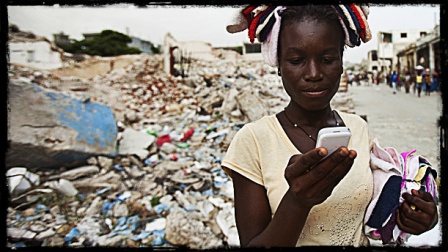
Mobile money, or mobile payments/mobile banking, is a rapidly growing industry that serves as an alternative to traditional banking. What is mobile money and why is it important is a question most acutely significant to those in developing countries.
Of the 2.6 billion people in the world who live on less than $2 a day, about 80 percent of them do not have access to a bank account. This is completely understandable due to banking fees and lack of access to banks. Thus, for this population, all transactions are chiefly done through “informal financial tools.”
Payments are made in cash or through physical bartering (e.g., food, livestock, traded goods, etc). Or, for bigger expenses, people are forced to go through other informal means of acquiring money like money lenders and payment couriers although these methods are unreliable, hard to access and can carry even higher fees. Meaning that those living in poverty are further hindered in breaking away from their circumstances.
At the Bill & Melinda Gates Foundation, the Financial Services for the Poor (FSP) team believes that given the right financial tools like mobile money, poor households can capture more opportunities. Mobile phones serve as virtual devices for holding money and making payments electronically, like a bank account and/or credit card. Paychecks can even be credited to mobile devices. Access to mobile phones is widespread in all regions of the world, far more than traditional banks.
In an effort to further develop these technologies, FSP has partnered with the Electronic Transactions Association (ETA) and created an industry-wide competition for finding new and innovative electronic payment methods via mobile banking.
This has “the potential to make a profound impact on the global market, particularly to un-banked or under-banked consumers in the developing world. Thus far, we have seen a large drop in costs and increased access when mobile channels are used,” says Megan Oxman, a program officer with the FSP.
It is expected that the mobile money market will grow from a $13.8 billion dollar business in 2013, to $278.9 billion by 2018. The more the industry grows, the more reliable and accessible this form of “banking” will become, allowing for more stability and development within impoverished communities.
– Mary Purcell
Source: Mobilepaymentstoday.com, PRnewswire.com
Photo: Gatesfoundation.org

Heroes of Advocacy
There are many more social activists or heroes of advocacy who dedicated their lives to social reform and political change by fighting for people’s rights and freedoms. The activists listed above were a few of the most prominent and most influential throughout history.
Today, we’re fighting for a different kind of freedom, although it is not any less important: we’re fighting to end global poverty and free people from the shackles of poverty. Martin Luther King Jr. once said, “Injustice anywhere is a threat to justice everywhere,” during his fight for equal rights for colored people in the United States.
With advocacy, we deliver information and vital knowledge to the masses, thereby engaging them and mobilizing them to stand up for an issue and demand justice as the heroes of advocacy did.
– Leen Abdallah
Sources: Gandhi, Nelson Mandela: Biography, Mandela: Nobel Peace Prize, The King Center, I Have a Dream, Nobel Peace Laureates
Photo: Daily Good
Investing in the Future with Universal Pre-K
The White House has released an infographic sharing that at-risk children who do not receive a high-quality early education are 25 percent more likely to drop out of school, 40 percent more likely to become a teen parent, 50 percent more likely to be placed in special education, 60 percent more likely to never attend college and 70 percent more likely to be arrested for a violent crime.
The investment in preschools, therefore, means investing in the future of American life, according to an administration that has championed demands that every child one day receive an affordable college education, and who has also called for sharp restrictions to be placed on assault weapons as a result of increasingly sensationalized acts of gun violence.
The investment in early education may raise a generation out of poverty, as current reports claim that the United States provides, at the moment, some of the least access to the social mobility of the world’s utmost developed nation. This has proven disheartening to a society that functions on the ideals of the American Dream, which is that anyone can achieve anything if they work hard enough.
Investing in the future is a principle that is both bipartisan and essential to the capitalist identity of America. We can only hope that legislators can overcome their differences to invest in this preventative social program, as has been done in the states of Georgia and Oklahoma.
– Nina Narang
Sources: The Huffington Post, The Washington Post
Photo: Post University
Raise the Minimum Wage, Inflation is Real!
This demand comes at a time when the National Center for Law and Economic Justice supports that one in seven Americans lives in poverty, with one in sixteen Americans living in deep poverty. Poverty, of course, exacerbates tension and has been linked to decreased social mobility, increased rates of violence, and increased likelihood of being a young parent.
Addressing poverty, both at home and abroad, is a key, central way to better the standard of living for millions as the better able families are to support themselves, the more efficient the employee, the better the consumer, and the more stable the economy.
CNNMoney, however, has debunked the myth that raising the minimum wage in America is the only element necessary to raise a family out of poverty. For a family of four making at least $9/hr, and while taking advantage of several key tax breaks, Tami Luhby of CNNMoney writes that the new rate would be barely enough to lift the family above the poverty line, and hardly enough to raise their standard of living by much in light of the U.S.’s dependence on a tax code that has been decried as “broken” by many.
While raising the minimum wage would be a step in the right direction towards addressing poverty in the United States, advocates for economic justice argue that helping people find higher-paying jobs is another, more effective, means of fighting poverty.
– Nina Narang
Sources: NCLEJ, CNNMoney
Photo: Occupy
The Top 3 Suprising Health Benefits of Globalization
Contrary to popular opinion, globalization has several little known and widely unpublicized effects on overall health and longevity. Previously, this phenomenon was primarily centered around the interconnectedness of people, ideas and economic capital; however, recent findings show that it might not be operating within the preconceived limitations and that there may actually be some health benefits of globalization.
Researchers at the University of Netherlands and Luephana University collaborated to analyze the mortality rates of globalized versus non-globalized countries. Utilizing the Maastricht Globalization Index (MGI) as a barometer to measure the various associations between globalization and health in a nation, scientists were able to determine-via statistical analysis-certain positive outcomes. Their results were unexpected, and what emerged from the study were three surprising health benefits of globalization.
It appears that based upon these findings, there is a certain amount of scientific evidence highlighting the health benefits of globalization. Thus, advocating for the increased economic stability and food security factors of global poverty reduction is exactly what is needed to combat infant, under five, and adult mortality rates.
– Brian Turner
Source: Globalization and Health
Photo: Imperial International Public Health
10 Countries with the Shortest Life Expectancy
The 10 countries with the shortest life expectancy can be found in one continent, Africa, with the exception of Afghanistan. Short life expectancy in sub-Saharan Africa can be caused by famine, poor governments, low levels of education (research has suggested that education correlates with healthcare awareness), availability of clean water and the existence of widespread AIDS. In Afghanistan, the main reason for short life expectancy has been due to infant mortality and women not surviving through childbirth. According to The Guardian, better access to healthcare in the last decade has helped cut infant mortality rates in Afghanistan.
What can we do? Well, donating and persuading our government to give more foreign aid helps solve the poverty issue. Once these countries move up, they can begin to fund higher levels of education, afford advanced agricultural tools which can help sustain growth, and improve healthcare.
(Listed top-to-bottom from the country with the shortest life expectancy)
– Leen Abdallah
Source: CIA World Factbook, The Guardian, Econs Guide
Photo: Google: Short Life Expectancy
What Exactly is Mobile Money?
Mobile money, or mobile payments/mobile banking, is a rapidly growing industry that serves as an alternative to traditional banking. What is mobile money and why is it important is a question most acutely significant to those in developing countries.
Of the 2.6 billion people in the world who live on less than $2 a day, about 80 percent of them do not have access to a bank account. This is completely understandable due to banking fees and lack of access to banks. Thus, for this population, all transactions are chiefly done through “informal financial tools.”
Payments are made in cash or through physical bartering (e.g., food, livestock, traded goods, etc). Or, for bigger expenses, people are forced to go through other informal means of acquiring money like money lenders and payment couriers although these methods are unreliable, hard to access and can carry even higher fees. Meaning that those living in poverty are further hindered in breaking away from their circumstances.
At the Bill & Melinda Gates Foundation, the Financial Services for the Poor (FSP) team believes that given the right financial tools like mobile money, poor households can capture more opportunities. Mobile phones serve as virtual devices for holding money and making payments electronically, like a bank account and/or credit card. Paychecks can even be credited to mobile devices. Access to mobile phones is widespread in all regions of the world, far more than traditional banks.
In an effort to further develop these technologies, FSP has partnered with the Electronic Transactions Association (ETA) and created an industry-wide competition for finding new and innovative electronic payment methods via mobile banking.
This has “the potential to make a profound impact on the global market, particularly to un-banked or under-banked consumers in the developing world. Thus far, we have seen a large drop in costs and increased access when mobile channels are used,” says Megan Oxman, a program officer with the FSP.
It is expected that the mobile money market will grow from a $13.8 billion dollar business in 2013, to $278.9 billion by 2018. The more the industry grows, the more reliable and accessible this form of “banking” will become, allowing for more stability and development within impoverished communities.
– Mary Purcell
Source: Mobilepaymentstoday.com, PRnewswire.com
Photo: Gatesfoundation.org
“Frequency of Peace”: World Radio Day
February 13 was World Radio Day. Started in 2011 by the U.N. Educational, Scientific and Cultural Organization (UNESCO), World Radio Day is meant to commemorate the establishment of United Nations Radio in 1946. Since then, there have been unbelievable strides in mass-media and communication. According to UNESCO however, the radio still manages to reach 95 percent of the world, a feat neither television or the internet can claim to have achieved.
But what is it about the radio that has enabled it to be such a helpful tool for developing countries in times of war and general disconnect? Wave frequencies can be produced with the simplest transmitters. The actual radio itself, being portable and in many cases, battery-operated, makes it much more available than television and computers in villages and other rural areas where electrical outlets are hard to come by, let alone a stable flow of electricity.
Secretary-General Ban Ki-moon commended the use of radio “as a channel for life-saving information”. Discussing his life growing up in a Korean village, Ban Ki-moon stresses the importance of the radio for emergency instructions in times of war as well as the main source of information and knowledge for many. Whether it delivers breaking news or issues warnings to those living far from civilization, radios save lives.
UNESCO Director-General Irina Bokova gave a speech on World Radio Day that focused on the wide-spread use of radios not just on a global scale but in smaller communities. Even though the areas the waves reach may not be extensive, it gives the younger generation an opportunity to learn and experiment with technology. Community radio, Bokova says, helps address poverty and social exclusion as well as empowers marginalized rural groups, young people, and women.
As UENSCO optimistically revives the meaning and purpose of the radio, evidence of its pricelessness can be found everywhere. In November of last year, the non-profit THNKR, which is a Youtube channel that showcases people doing amazing things around the world that have the potential to change the way we think and view each others’ and our own potential, posted a video of Kelvin Doe. Kelvin, better known from his radio name as DJ Focus, comes from Sierra Leone. He has become quite famous over the past year for his talent and gift of being a self-taught engineer. By scraping together whatever metals he could, he built his own FM transmitter and generator. With his own radio station, DJ Focus broadcasts music, has an open forum and enjoys entertaining over the radio like any other 16-year-old would, taking full advantage of everything his small radio has to offer.
– Deena Dulgerian
Source:UN News Centre
Energy 101 at Georgia Tech
Whether it’s the annoying news reporter or that obnoxious know-it-all in your Air Pollution class, people everywhere seem to be making up facts and statistics about our energy consumption. Does charging your phone from a laptop save more energy than if you were to charge it from a wall plug? Would using solar energy to power factories actually reduce air pollution?
Energy 101, a free online class offered by the Georgia Institute of Technology, sheds light on “the driving forces of energy used in transportation”, the production of energy-efficient products, and the process of converting renewable resources into a more desired form.
Dr. Sam Shelton, a veteran in energy systems, teaches the course. Aside from his multi-million dollar funded research and development, he is the founder of two companies that produce and market energy-efficient products. He was also a leading developer in the 1980s of the first commercial solar energy systems and investigated the efficiency of offshore wind farms.
The format of the Energy 101 is as simple as they come: over the span of nine weeks, lectures are taught in 5-12 minute videos. Quizzes are also given and upon finishing the program, students will receive a Certificate of Completion.
But what use is studying the complexities of thermodynamics to the average curious cat? For one thing, Dr. Shelton stresses the ‘no experience necessary’ aspect of the class. You don’t need to be able to understand physics or be able to use mathematical formulas to do well in the class. The information from this class can be put to use in a variety of settings from an elementary school classroom in Arkansas to sustainable farming training in Cambodia.
Understanding the truth about how we use energy and where it comes from will help dictate our policies on diverting our focus to the right alternatives.
Before even listening to one lecture, Dr. Shelton lets his potential students in on an unexpected secret, “Building nuclear, wind and solar energy systems does not save any oil in the U.S..” This only goes to illustrate the new and exciting information students of Energy 101 can look forward to learning that will enlighten them on the truth about energy consumption in the world.
– Deena Dulgerian
Source: Coursera.org
Nasty Secrets of Indian Healthcare
Private healthcare has grown in prominence in India, constituting 93 percent of all hospitals and 85 percentof doctors today. The government clinics are sparse, leaving Indians no choice but to seek private healthcare. With no real government regulations, many private practices are taking advantage of the poor, uneducated or illiterate patients, and especially women. By providing expensive treatments that are not necessary, many are left in atrocious debts and physical pain.
Oxfam personnel in India have obtained substantial evidence on these abuses committed against Indian women at these private clinics and hospitals. Doctors have coerced thousands of women to get unnecessary hysterectomies when they come in for treatment for stomachaches or abdominal problems. Akhil Bhartiya Grhak Panchayat, a local NGO in Dausa, has found that almost 70 percent of the women who have gone to the clinics, which the NGO obtained information from, have had hysterectomies performed on them. The investigation also revealed that many of these women were less than 29 years old.
Besides hysterectomies, many women were also tricked into having cesarean surgeries instead of a natural delivery. A cesarean operation can cost about four times as much as a normal delivery. In addition to the cost of the operation, the doctors would then charge for consultation and hospital beds. These unwarranted procedures leave the women deeply in debt, and sometimes in worse physical shape and unable to work.
These unnecessary treatments for financial gains are unethical and a violation of human rights. Oxfam urges the Indian government to regulate the private healthcare sector and work towards developing an affordable healthcare system for everyone in India. Oxfam is working to end this exploitation of women in need of health services.
– Pimrapee Thungkasemvathana
Source: Guardian
Photo: Time
Oxfam Provides Water from Lake to Lips in 6 Weeks
North of Lake Kivu in the city of Goma, Democratic Republic of Congo, civil strife has caused thousands of refugees to flee to the Bulengo Camp. Home to about 45,000, Bulengo has been given the remodeling of a lifetime thanks to the hard work of Oxfam volunteers. Over a six week period, a basic yet high-functioning water filtration system has been set up that provides enough clean water for the entire camp.
The entire system is comprised of hundreds of meters of piping. Water is pumped directly from Lake Kivu and sent to large tanks. Within these tanks, the water is filtered and chlorinated to prevent diseases such as cholera. The tanks can hold up to 70,000 liters (approximately 18,492 gallons) each and are filled twice a day.
An amazing aspect of this system, aside from the fact that it provides the most basic need to thousands, is that the system is managed by the refugees. They maintain the pipes and check the chlorination process to ensure everything runs smoothly from the lake to the lips of thirsty refugees. The best job, however, is that of the young children who run to the taps in the camp to freely fill up their buckets and bottles.
Oxfam shows that through providing basic building materials, it is possible to greatly impact more than 45,000 people. It is proven through successful aid work that developing countries do not need the most modern technology; they do not only require a constant stream of millions of dollars but also the time and creativity of those willing to go out to these countries and help. In a matter of just six weeks, thousands of lives have instantly changed. There was no need for excessive donors, elongated presentations or even extensive research on how to solve the problem. Six weeks, plastic pipes and plastic bottles was all it took to get clean water from lake to lips.
– Deena Dulgerian
Source:Oxfam International