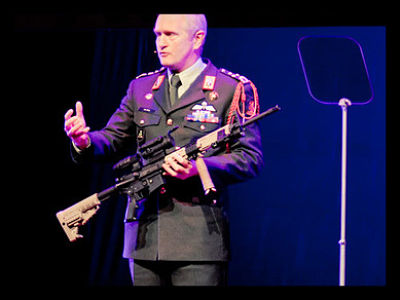
Why I Chose the Gun, Peter van Uhm
“When I look around, I see people who want to make a contribution, I see people who want to make a better world, by doing ground-breaking scientific work, by creating impressive works of art, by writing critical articles or inspiring books, by starting up sustainable businesses. All of you have chosen your own instruments to fulfil this mission of creating a better world….I chose this instrument. I chose the gun.” – Peter van Uhm
The idea of guns being used as a tool for peace is counter-intuitive. In his talk, Uhm explains how weapons can be used not as a source of violence, but as a protective measure against injustice. It is a talk that is full of controversial ideas, and worth listening to and thinking about. In a world where it is overly idealistic to imagine that it is possible to develop a blanket ability to avoid all conflict, Uhm’s outlook is one that does not immediately sit well with our gut, but it all the more important to listen to because of it.
Fighting with Non-Violence, Scilla Elworthy
“The training of troops has to change. And I think there are signs that it is beginning to change. The British military have always been much better at this. But there is one magnificent example for them to take their cue from, and that’s a brilliant U.S. lieutenant colonel called Chris Hughes. And he was leading his men down the streets of Najaf — in Iraq actually — and suddenly people were pouring out of the houses on either side of the road,screaming, yelling, furiously angry, and surrounded these very young troops who were completely terrified, didn’t know what was going on, couldn’t speak Arabic. And Chris Hughes strode into the middle of the throng with his weapon above his head, pointing at the ground, and he said, “Kneel.” And these huge soldiers with their backpacks and their body armor, wobbled to the ground. And complete silence fell. And after about two minutes,everybody moved aside and went home.” – Scilla Elworthy
Elworthy’s talk stands in stark contrast to Uhm’s. Speaking through her personal experience, and the histories of famous non-violent leaders like Mandela and Suu Kyi, Elworthy explores the alternative to military power. Elworthy has no illusions about the difficulty of non-violent reactions; it goes against our instincts and she speaks about the necessity of developing our ability to understand before we react. A relatively short but powerful talk, Elworthy manages to show us how hard and how important it is to rethink how we fight our battles.
Ending Hunger Now, Josette Sheeran
“I believe we’re living at a time in human historywhere it’s just simply unacceptable that children wake up and don’t know where to find a cup of food. Not only that, transforming hunger is an opportunity, but I think we have to change our mindsets. I am so honored to be here with some of the world’s top innovators and thinkers. And I would like you to join with all of humanity to draw a line in the sand and say, “No more. No more are we going to accept this.” And we want to tell our grandchildrenthat there was a terrible time in history where up to a third of the children had brains and bodies that were stunted, but that exists no more.” – Josette Sheeran
Often, people think of the world’s greatest crises as enormous, separate challenges. World peace as separate from world hunger, poverty and women’s rights and education all distinct entities with unique challenges. The truth is they are all connected, feeding into each other. The presence of one almost inevitably creates breeding grounds for the others. Sheeran, head of the UN World Food Programme, walks us through the practicalities of ending hunger, and the potential ramifications of doing so. Though it sounds like a huge project, Sheeran uses real-life examples to show how innovative thinking and concerted effort can lead to real, large-scale change. Sheeran’s passion and pragmatism make ending hunger seem infinitely achievable.
Why To Believe in Others, Viktor Frankl
“If you don’t recognise a young man’s will to meaning, man’s search for meaning you make him worse. You make him dull, you make him frustrated, you still add and contribute to his frustration. While, if you presuppose in this man, in this so called criminal or juvenile delinquent or drug abuser, or so forth, there must be a – what do you call it – a spark, a spark of search for meaning. Let’s recognize this…let’s presuppose it and then you will elicit it from him and you will make him become what he in principle is capable of becoming.” – Viktor Frankl
Better spoken than summarized, holocaust survivor and psychologist Viktor Frankl explains, in four humorous and poignant minutes, why to believe in others.
– Farahnaz Mohammed

5 Poverty Statistics on Sub-Saharan Africa
Leading Facts on Poverty in Sub-Saharan Africa
– Josh Forgét
Sources: The World Bank, The New Times, Farmers Weekly, The National, Rural Poverty Portal, World Concern
Photo: City Data
4 TED Talks on Peace
Why I Chose the Gun, Peter van Uhm
“When I look around, I see people who want to make a contribution, I see people who want to make a better world, by doing ground-breaking scientific work, by creating impressive works of art, by writing critical articles or inspiring books, by starting up sustainable businesses. All of you have chosen your own instruments to fulfil this mission of creating a better world….I chose this instrument. I chose the gun.” – Peter van Uhm
The idea of guns being used as a tool for peace is counter-intuitive. In his talk, Uhm explains how weapons can be used not as a source of violence, but as a protective measure against injustice. It is a talk that is full of controversial ideas, and worth listening to and thinking about. In a world where it is overly idealistic to imagine that it is possible to develop a blanket ability to avoid all conflict, Uhm’s outlook is one that does not immediately sit well with our gut, but it all the more important to listen to because of it.
Fighting with Non-Violence, Scilla Elworthy
“The training of troops has to change. And I think there are signs that it is beginning to change. The British military have always been much better at this. But there is one magnificent example for them to take their cue from, and that’s a brilliant U.S. lieutenant colonel called Chris Hughes. And he was leading his men down the streets of Najaf — in Iraq actually — and suddenly people were pouring out of the houses on either side of the road,screaming, yelling, furiously angry, and surrounded these very young troops who were completely terrified, didn’t know what was going on, couldn’t speak Arabic. And Chris Hughes strode into the middle of the throng with his weapon above his head, pointing at the ground, and he said, “Kneel.” And these huge soldiers with their backpacks and their body armor, wobbled to the ground. And complete silence fell. And after about two minutes,everybody moved aside and went home.” – Scilla Elworthy
Elworthy’s talk stands in stark contrast to Uhm’s. Speaking through her personal experience, and the histories of famous non-violent leaders like Mandela and Suu Kyi, Elworthy explores the alternative to military power. Elworthy has no illusions about the difficulty of non-violent reactions; it goes against our instincts and she speaks about the necessity of developing our ability to understand before we react. A relatively short but powerful talk, Elworthy manages to show us how hard and how important it is to rethink how we fight our battles.
Ending Hunger Now, Josette Sheeran
“I believe we’re living at a time in human historywhere it’s just simply unacceptable that children wake up and don’t know where to find a cup of food. Not only that, transforming hunger is an opportunity, but I think we have to change our mindsets. I am so honored to be here with some of the world’s top innovators and thinkers. And I would like you to join with all of humanity to draw a line in the sand and say, “No more. No more are we going to accept this.” And we want to tell our grandchildrenthat there was a terrible time in history where up to a third of the children had brains and bodies that were stunted, but that exists no more.” – Josette Sheeran
Often, people think of the world’s greatest crises as enormous, separate challenges. World peace as separate from world hunger, poverty and women’s rights and education all distinct entities with unique challenges. The truth is they are all connected, feeding into each other. The presence of one almost inevitably creates breeding grounds for the others. Sheeran, head of the UN World Food Programme, walks us through the practicalities of ending hunger, and the potential ramifications of doing so. Though it sounds like a huge project, Sheeran uses real-life examples to show how innovative thinking and concerted effort can lead to real, large-scale change. Sheeran’s passion and pragmatism make ending hunger seem infinitely achievable.
Why To Believe in Others, Viktor Frankl
“If you don’t recognise a young man’s will to meaning, man’s search for meaning you make him worse. You make him dull, you make him frustrated, you still add and contribute to his frustration. While, if you presuppose in this man, in this so called criminal or juvenile delinquent or drug abuser, or so forth, there must be a – what do you call it – a spark, a spark of search for meaning. Let’s recognize this…let’s presuppose it and then you will elicit it from him and you will make him become what he in principle is capable of becoming.” – Viktor Frankl
Better spoken than summarized, holocaust survivor and psychologist Viktor Frankl explains, in four humorous and poignant minutes, why to believe in others.
– Farahnaz Mohammed
Will Africa be Middle-Class by 2040?
The issue of Africa’s emerging economy has been a staple of global news for the past few years. Many realize now that political stability is starting to become common throughout many African nations, and economic stability is following suit. The recent case of Somalia is a good example. Somalia has had its first fair election since the start of its civil war and even established a new constitution. And now they are enjoying the benefits of an improving economy, particularly in the capital city of Mogadishu.
Carlos Lopes, the UN Under-Secretary-General and Executive Secretary of the Economic Commission for Africa (ECA), is one of the experts who is extremely optimistic about Africa’s economic future. He explains that African economies are gradually shifting from a reliance on the agricultural sector to a reliance on the industrial sector. He claims that the economic conditions are in place for most African countries to be middle income level by the year 2040.
Lopes argues that in the coming years, African nations should not have to rely as much on the export of soft commodities (e.g. cocoa, cotton, and sugar) to other countries, and that there will be a transformation into an industrialized economy. “Yes, we need to produce agricultural products big-time—but for Africa,” not for export to other countries, says Lopes.
We are already seeing signs of the growth of the middle class in Africa. Over the last decade, six of the world’s 10 fastest growing economies were African nations, and the World Bank even recently stated that about half of the countries in Africa had attained middle-class income status. Jacob Zuma, President of South Africa, recently argued that the emerging middle class and the youthful population are going to be game-changers in how Africa deals with economic issues in the future. Zuma noted that the expansion of the middle class is beneficial for Africa, because it means a growth in a population with skills to help manage the economy.
Regional executive for Starwood Hotels in Africa recently said that “Africa’s middle class is almost as large as the entire populations of Russia and Brazil combined.” At this rate, it seems that Lopes’ prediction of a complete middle-class transformation in Africa is not so far off.
– Sagar Desai
Sources: IOL South Africa, AllAfrica, HowWeMadeItInAfrica
Photo: Boing Boing
5 Facts about Clean Water and Sanitation
– Ali Warlich
Sources: Water.org, UNDP, WHO
Photo: Blogspot
3 Incredible Accomplishments of the Carter Center
“We can choose to alleviate suffering. We can choose to work together for peace. We can make these changes—and we must.” These words of our remarkable former President Jimmy Carter form the foundation of a center striving for a better world. In 1982, former President Carter and wife, Rosalynn founded a non-profit organization “committed to advancing human rights” named, “The Carter Center.” In partnership with Emory University, the Atlanta-based organization has made great strides in improving the human condition worldwide. Here are three noteworthy initiatives of the Carter Center:
Learn more at https://www.cartercenter.org/index.html.
– Lina Saud
Sources: Carter Center, CDC
Women in War
Women in War is the Harvard Humanitarian Initiative’s groundbreaking interdisciplinary approach to addressing problems that females face in impoverished and conflict-ridden states. By conducting research in affected areas, the program strives to produce pragmatic community and policy-based solutions.
Although Women in War has worked in countries ranging from Sierra Leone to Sudan, it has concentrated the majority of its efforts into ending sexual assault and violence against women in the Democratic Republic of Congo. For decades, DRC has been embroiled in what has been referred to as the greatest multistate war in the African continent.
Despite its estimated worth of $24 trillion in natural resources (DRC holds up to a third of worldwide diamond reserves), DRC’s annual GDP per capita of $171 is shockingly low. Just as political instability and social unrest have undoubtedly contributed to its struggling economy, they too have factored into the prevalence of sexual assault–often by military personnel–against civilians.
While the roots of gender-based violence are manifold, Jocelyn Kelly, an HHI Research Coordinator, postulates that soldiers–who are often enlisted at a young age through coercion–may justify rape by dissociating their actions from themselves as individuals. It has been noted that the crude process of army initiation dehumanizes the soldiers and strips them of their former identities. Moreover, among soldiers, there exists the superstitious belief that rape may lead to victory on the battlefield.
The aftermath of sexual assault is equally complex. Many women have been raped in the confines of their own homes and in front of their loved ones. Naturally, rape may also result in unwanted pregnancies and/or damage to a woman’s reproductive organs, thereby adding tangible reminders on top of psychological wounds. Women in War has sought the skills and expertise of both gynecologists and counselors to give survivors a new lease–both inside and out–on life.
A helping hand has also been extended to the perpetrators. Researchers have been developing methods to reintegrate traumatized ex-soldiers into civilian society. By recognizing the humanity inherent in both the survivor and the offender, Women in War serves as a beacon of hope in times of strife.
– Melrose Huang
Sources: Harvard Humanitarian Initiative, Women Under Siege Project BBC The OTC Investor Global Security PBS
Photo: Ms. Magazine
5 Quotes About Changing the World Through Education
Education is another one of the things we tend to take for granted in this country. In fact we even frequently complain about having to spend so many hours a day and so many years of our lives in a classroom. But so many other people in the world never have the opportunity to enter the classroom let alone. These next 5 quotes are from some of the biggest proponents for providing everyone in the world a chance to get a good, and safe, education.
– Chelsea Evans
Sources: Good Reads, UN
Sources: Global Higher Education
Read Humanitarian Quotes.
USAID Worker Finalist for 2013 Sammies Medal
Every year the Samuel J. Heyman Service to America Medals (Sammies) pay tribute to the United State’s federal workers by recognizing those who have made significant contributions to the U.S. Medalists are honored based on their commitment, innovation, and the impact of their work on addressing the needs of the nation.
This year USAID worker and her team are one of the finalists for the 2013 National Security and International Affairs Medal, one of the eight Sammies medal categories. Cara Christie and USAID’s Horn Drought Emergency Response Team are among the finalists in this category for their tireless endeavors in leading the relief effort following the drought in Ethiopia, Somalia, and Kenya in the Horn of Africa. Christie coordinated the relief effort from her office in Washington D. C., providing immediate emergency relief to the affected countries and enacting methods to improve their agrarian economies after they had been decimated by three years of the worst drought that the Horn of Africa has ever seen.
Not only did Christie lead the relief efforts, but she is credited with recognizing the significance of the impending famine almost a year before it unfolded. Christie convinced her superiors in USAID of the need to be proactive by making advance preparations in the fall of 2010—a move that hastened aid to the region and saved lives. Christie used lessons learned from other drought response situations to come up with a program pairing health, nutrition, water, and sanitation program with food and voucher programs that helped repair the damaged economies in the Horn of Africa.
It may seem strange that an award given for service to the United States could be received by a team dedicated to giving relief to another country, but in reality Christie’s actions were crucial to U.S. national security interests. The Horn of Africa represents one of the regions of the world that most threatens U.S. national security because it houses some of the most conflict prone states in the world, including Somalia, Eritrea, and Ethiopia. It also is in close proximity to Yemen, a major center of U.S. counterterrorism action. The U.S. also houses the military base Camp Lemonnier in Djibouti on the Horn of Africa, which serves as the most important staging ground for U.S. counterterrorism efforts in Africa and the Arabian Peninsula.
Aid efforts in the region, along with in the rest of the world, contribute to stability and thereby hold radicalization at bay, furthering U.S. interests, and making the U.S. more secure.
– Martin Drake
Sources: Washington Post
Photo: USAID
How Do Kenyan Men React to New Marriage Bill?
A bill on marriage introduced in the Kenyan parliament has generated outrage amongst Kenyan men. The marriage bill is intended to unify the many and various local marriage laws and customs in the country to a single code. However, in doing so, the bill also strengthens some aspects of women’s rights in the country.
The bill allows for polygamy in Kenya under Islamic and customary traditions. However, the code will stipulate that men disclose the possibility of polygamy to his future spouse prior to marriage. All marriages will also be issued a certificate, even those performed under traditional laws. Issuing this certificate is intended to provide a legal proof of the union. Many marriages performed under traditional customs are not currently issued certificates, leaving spouses without a legal proof of the marriage.
Many wives are unaware that their husband has additional spouses and children until he passes away leaving behind a custody battle for assets. Polygamy is not permitted in Christian or civil marriages.
The majority of negative reactions seem to be caused by a clause stating “damages may be recoverable by a party that suffers a loss when the other party refuses to honor a promise to marry.” This clause seems to imply a man making a promise of marriage is required to follow through or pay for any monetary loss. In Kenya, a dowry is often paid from the prospective husband’s family to his intended wife’s family. The bill limits these payments to “token amounts” in the hope to dissuade poor families from selling daughters into marriage. The bill also sets the minimum age for marriage at 18.
Under Kenya’s 2010 constitution women gained the right to own and inherit land, unprecedented in the country’s history. While the constitution provides additional rights for women, these are often unknown or ignored in more traditional rural areas of the country.
A program launched in 2011 by Landesa and USAID in Kenya engages rural tribal leaders and elders in a discussion about women’s rights and the new constitution. Through this the program has seen progress in male acceptance of women’s rights provided in the constitution. As a result, some areas served by the program have seen increased female enrollment in schools and engagement of women in the community. Engaging community members in a frank conversation about the benefits of women’s rights and their impact is an essential element to gaining widespread acceptance. While many constitutions in sub-Saharan Africa include women’s rights they remain largely ineffective if many rural villages ignore them.
– Callie D. Coleman
Sources: Thomas Reuters Foundation, The Huffington Post
Photo: Thomas Reuters Foundation
Economic Growth in North Korea?
Relying on a significant amount of guesswork and speculation, the Bank of Korea, headquartered in Seoul, produces an annual report on the North Korean economy. Because North Korea does not release economic data, South Korea’s efforts rely on intelligence gathered by the National Intelligence Service and other institutions, and link that information on North Korea to South Korea’s own growth rates. All of this is in order to compare the growth rate of the two countries, and aid in calculating the cost of the distant goal of reunification of the two countries.
The report found that, surprisingly, economic growth in North Korea has actually expanded for the second year running. The economy grew by 1.3% last year, after a growth rate of 0.8% in 2011. While it is hardly an economic boom – and much of the growth is attributed to international donors and an influx of aid after Typhoon Bolaven in August 2012 – sustained growth is nevertheless significant for the beleaguered nation.
However, expected policy changes from a regime that has prioritized economic growth have so far failed to manifest. Thus, the growth has failed to make an impact on much of the North Korean population. Despite an estimated 3.9% growth last year in agriculture, 2.8 million North Koreans still require food aid as the country once again faces severe food shortages.
Per capita income in North Korea resta at about $1200, despite the recent growth. For perspective, per capita income in South Korea is nearly 20 times higher. One further problem with the North Korean economy that the distribution of wealth is not reflected in estimates of per capita income. Much of the wealth of North Korea is located in the capital city of Pyongyang, the one place in the country where reports of economic growth can be believed. And meanwhile, the wealth gap widens and economic growth continues to fail to reach the citizens who would benefit the most.
– David Wilson
Sources: Wall Street Journal Huffington Post
Sources: Global Grind