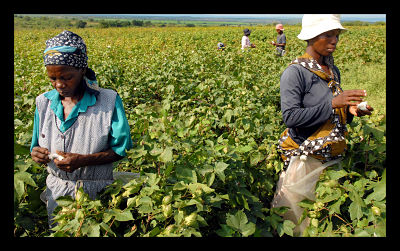
One of the most intriguing business ideas is that of a co-op. It can be like a corporation, only it’s governing body is chosen democratically by it’s members, not shareholders. From a business standpoint, the co-op isn’t profit motivated but exists to serve it’s members. When a surplus is realized by the co-op, the excess is divided among members by individual use of the organization and not by how much was initially invested. Members can be essentially anyone, from sole proprietors to nonprofit organizations.
Among the many benefits of co-op membership, knowledge may be the most important. Nowhere is this more evident than in the developing world, specifically in the nations of Senegal, Zambia, and Mozambique. In their efforts to alleviate poverty, increase income and food production, and provide a higher standard of living for their people, farmers there have partnered with the National Cooperative Business Association (NCBA) in the United States.
Initially founded in 1916, the NCBA has existed as the soundboard for all co-ops in the U.S., touting the benefits and successes of this business framework. Known today as NCBA CLUSA International, their focus also includes advocacy, cross-sector support and education, and co-op community advancement in a total of 15 different nations.
NCBA CLUSA International maintains a strong presence in Senegal and Zambia through the USAID’s “Farmer-to-Farmer” initiative. The co-op organization calls on it’s extensive volunteer base, culling professionals from the agricultural, development, technological, and even financial fields. However, most volunteers for the program are American farmers and agribusiness people who are directly involved with teaching and sharing techniques with farmers in Zambia and Senegal. Everything from business development, soil fertility, and crop processing is all covered. NCBA CLUSA International provides transportation, logistical support, and translators for its volunteers.
Recently, USAID acknowledged the NCBA’s efforts in Niger. Backed by USAID funding, the group’s volunteers have been working with farmers and people in the nation for several years teaching them the best way to grow highly nutritious moringa. Areas of southwest Niger have transformed from drought-stricken to fields of lush vegetation suited for the climate.
In Mozambique, the NCBA has been granted a contract worth $14 million by Norwegian Ministry of Foreign Affairs. In a press release dated in December 2012, the NCBA reports their mission is to:
“…boost agriculture production by 20% and increase household resilience by 30%, helping these small farmers progress from the subsistence level, to income generation… This program will train 54,000 farmers and 50 emerging commercial farmers in proven Conservation Agriculture (CA) techniques and nutrition, benefitting more than 140,000 individuals. The practice of Conservation Agriculture is a method of farming that, when adhered to, achieves high and sustained production levels, while concurrently conserving the environment.”
An empowering facet of the program is that half of those 54,000 farmers are women. This move no doubt increases community capacity and women’s efficacy as they are literally equal partners.
The NCBA is living proof that the co-op model can be successful in myriad ways and is especially helpful in the developing world. By connecting impoverished farmers and communities with learned volunteers, they’re fostering inclusive, sustainable and economically robust communities.
– David Smith
Sources: NCBA, USAID Frontlines
Photo: TechnoServe

Malnutrition Killing Children in Cameroon
A growing number of children in Cameroon are falling victim to malnutrition. A hospital in Garoua confirmed that in June alone, thirty-one cases of childhood malnutrition came through and six died.
Cameroon conducted a study in 2011 to gauge malnutrition levels within in the country. The study found that of children under five years old, thirty three percent of them suffered from chronic malnutrition and fourteen percent of them were severely malnourished.
There are several theories as to why Cameroon experiences such high malnutrition rates. Cameroon’s ministry of public health believes that malnutrition is linked to Cameroon’s complex climate. They cite certain regions with dry, semi-arid climates having higher rates of nutritional deterioration in children than in other regions. Additionally, it is believed that the influx of refugees from Chad and the Central African Republic has added an increased strain to Cameroon.
The northern and far northern regions of Cameroon experience the highest rates of childhood malnutrition. Unfortunately, however, malnutrition exists throughout the entire country and not just in the north. This is believed to be due to the lack of food in certain seasons, and in certain regions as previously explained. Cameroon also has a lack of food variety, creating a deficiency of certain vitamins and minerals in many children’s diets.
However, Cameroon’s problem is not food insecurity. The country is capable and does produce enough food to sustain its population, and does not need to import food. Unfortunately, however, poverty is a severe roadblock to battling malnutrition. Poverty keeps a large portion of Cameroon from having access to a varied and balanced diet.
UNICEF has estimated that 57,616 children under the age of five are at risk of severe acute malnutrition in the North and Far North regions of Cameroon. Additionally, UNICEF believes 145,000 children under the age of five will experience stunted growth. Very few children in Cameroon are breastfed after birth, which leads to such inflated statistics.
UNICEF has partnered with the government of Cameroon to increase prevention efforts. They have increased their presence at nineteen feeding centers in the country to prevent complications associated with malnutrition. They are working to educate mothers to recognize the signs of malnutrition and to seek medical help when they are noticed. Despite limited medical staff in many regions in Cameroon, it is hoped that the increased effort in prevention programs will work to effectively decrease malnutrition and death rates in the country.
– Caitlin Zusy
Sources: Inter Press Service, All Africa
Photo: Healthcare Volunteer
Fighting Hunger With Hunger: The Fast-a-Thon
Hundreds of organizations around the world work to raise awareness of world hunger. “Nearly 870 million people, or one in eight people in the world, were suffering from chronic undernourishment in 2010-2012.” Statistics such as this, along with photographs and true stories of the world’s hungry have found their way to people who can help. But what these figures and images cannot do to a person is allow them to know what hunger really is—to move one beyond sympathy and allow them to possess real comprehension of what hunger feels like. This is the premise upon which the “Fast-a-Thon” was laid.
For years, college campuses across the U.S. and Canada have held annual “Fast-a-Thons” in an effort to fight hunger, both locally and internationally. The idea was coined by the Muslim Students Association (MSA) at University of Tennessee, Knoxville, and has since been taken on by hundreds of college campuses, charity organizations, and businesses across continental America.
Here’s how it works: a group of students, community members, co-workers, etc. pledge to fast for a day (some for 24 hours, some from morning to evening). For each pledge, a business sponsor donates a certain amount of money to a charity of the group’s choosing. At the end of the day, Fast-a-Thon participants come together to share a meal to break their fast. In solidarity with those in hunger and in support of alleviating their pain, Fast-a-Thon participants have raised hundreds to thousands of dollars to feed the hungry.
Interested in hosting a Fast-a-Thon in your community? Follow this easy step-by-step guide:
1. Find the beneficiary to whom all donations will go towards. This could be a local soup kitchen or an umbrella organization fighting hunger.
2. Find businesses that will sponsor your Fast-a-Thon or, in other words, agree to donate a certain amount of money to your chosen beneficiary for every Fast-a-Thon pledge made.
3. Spread the word and encourage everyone to pledge and participate!
4. Host a dinner where participants can break their fasts together.
– Lina Saud
Sources: World Hunger, MSA Texas
Photo: Stephen Leahy
Do You Know the Definition of Poverty?
Although poverty is an international issue, there is no internationally agreed-upon definition of poverty.
The most common definition of poverty is the World Bank’s threshold: living at $2 a day, and its definition of extreme poverty at $1.25 a day. This figure that was created by averaging the poverty line in the world’s 15 poorest countries. These are definitions of absolute poverty, in which a certain amount of income is set, and anyone making below that income is considered poor. Under these definitions, around 3 billion people live in poverty, and 1.3 billion live in extreme poverty.
However, poverty can also be defined in relative terms. In many countries, poverty is simply defined by the threshold of income for the bottom 10 percent of the population, or taking into account cost of living into account when setting a poverty line.
Both of these definitions, however, deal almost exclusively with income and consumption, and ignore the social and political aspects of poverty. The United Nations Education, Scientific, and Cultural Organization (UNESCO) contends that there are three perspectives which need to be taken into account when conceptualizing poverty: the income perspective indicates that a person is poor only if his or her income is below the country’s poverty line; the basic needs includes the need for the provision by a community of the basic social services necessary to prevent individuals from falling into poverty; and finally, the empowerment perspective suggests that poverty signify a lack of some basic capability to function.
Something to consider is that although the global definition of extreme poverty is $1.25 dollars a day, the US sets its poverty line at $11,490 of income per year, which comes out to roughly $30 a day. If we held the whole world to that standard, almost everyone would be in poverty; 80 percent of the world’s population lives on less than $10 a day.
Poverty undermines basic political, economic, social, and cultural rights. As Mahatma Gandhi said, “Poverty is the worst form of violence.” As a country with the economic capabilities to lift everyone in the world out of extreme poverty (it would cost around $30 billion), the United States should be the leaders in poverty eradication efforts. Not only this, but it is important to remember how much lower the standard o poverty is set for the rest of the world, and how most in the developed world could never consider living on $1.25 a day.
– Martin Drake
Sources: UNESCO, DoSomething.org, The Economist
Photo: WordPress
Helping Hand for Relief and Development
There are few organizations with as many different programs dedicated to helping impoverished people around the world as Helping Hand for Relief and Development (HHRD). Although this group is relatively young (founded in 2005), its staff and volunteers have wasted no time making a huge impact on the world. This Islamic organization sticks to its vision of “strengthening the bond of humanity” by providing humanitarian relief and development assistance to all types of people, no matter their ethnicity or background.
One of the ways HHRD provides aid is through its program “Islamic Interest Free Microfinance,” a microenterprise development concept, which is an interest-free loan that helps alleviate poverty. Someone participating in this program could use it to purchase something like seeds or fertilizer.
Other ways HHRD provides sustainable growth in poverty-ridden communities is through programs like Orphan Support Program (sponsor a child for $1 a day), Education Support (student scholarships), Health Care, Infrastructure Development (rebuilding homes and schools), Physical Rehabilitation (provides new limbs for those hurt in disasters), Skill Development (focuses on empowering women), Youth Empowerment (internships) and Public Advocacy and Social Justice (raising awareness of global issues, like climate change and social injustices).
Water for Life and Emergency Appeals are two other important programs the Helping Hand for Relief and Development organizations provides. Water sanitation is a major issue for many people in developing countries. HHRD sets up wells, hand pumps and devices for filtering water so that people can finally have access to clean drinking water. The Emergency Appeals program works is also vital for those in the third world who do not have access to basic medicines, food, mosquito nets, tools for rebuilding shelters or even clothes. This program provides these necessities and more for those living in disaster areas.
Different areas of the world have different needs and Helping Hand for Relief and Development has a program for each of these issues. By focuses on a wide range of problems, HHRD is able to reach out and help more and more impoverished people.
– Mary Penn
Sources: Helping Hand Relief and Development Charity Navigator Rating
Photo: Blogspot
What is the NCBA?
One of the most intriguing business ideas is that of a co-op. It can be like a corporation, only it’s governing body is chosen democratically by it’s members, not shareholders. From a business standpoint, the co-op isn’t profit motivated but exists to serve it’s members. When a surplus is realized by the co-op, the excess is divided among members by individual use of the organization and not by how much was initially invested. Members can be essentially anyone, from sole proprietors to nonprofit organizations.
Among the many benefits of co-op membership, knowledge may be the most important. Nowhere is this more evident than in the developing world, specifically in the nations of Senegal, Zambia, and Mozambique. In their efforts to alleviate poverty, increase income and food production, and provide a higher standard of living for their people, farmers there have partnered with the National Cooperative Business Association (NCBA) in the United States.
Initially founded in 1916, the NCBA has existed as the soundboard for all co-ops in the U.S., touting the benefits and successes of this business framework. Known today as NCBA CLUSA International, their focus also includes advocacy, cross-sector support and education, and co-op community advancement in a total of 15 different nations.
NCBA CLUSA International maintains a strong presence in Senegal and Zambia through the USAID’s “Farmer-to-Farmer” initiative. The co-op organization calls on it’s extensive volunteer base, culling professionals from the agricultural, development, technological, and even financial fields. However, most volunteers for the program are American farmers and agribusiness people who are directly involved with teaching and sharing techniques with farmers in Zambia and Senegal. Everything from business development, soil fertility, and crop processing is all covered. NCBA CLUSA International provides transportation, logistical support, and translators for its volunteers.
Recently, USAID acknowledged the NCBA’s efforts in Niger. Backed by USAID funding, the group’s volunteers have been working with farmers and people in the nation for several years teaching them the best way to grow highly nutritious moringa. Areas of southwest Niger have transformed from drought-stricken to fields of lush vegetation suited for the climate.
In Mozambique, the NCBA has been granted a contract worth $14 million by Norwegian Ministry of Foreign Affairs. In a press release dated in December 2012, the NCBA reports their mission is to:
“…boost agriculture production by 20% and increase household resilience by 30%, helping these small farmers progress from the subsistence level, to income generation… This program will train 54,000 farmers and 50 emerging commercial farmers in proven Conservation Agriculture (CA) techniques and nutrition, benefitting more than 140,000 individuals. The practice of Conservation Agriculture is a method of farming that, when adhered to, achieves high and sustained production levels, while concurrently conserving the environment.”
An empowering facet of the program is that half of those 54,000 farmers are women. This move no doubt increases community capacity and women’s efficacy as they are literally equal partners.
The NCBA is living proof that the co-op model can be successful in myriad ways and is especially helpful in the developing world. By connecting impoverished farmers and communities with learned volunteers, they’re fostering inclusive, sustainable and economically robust communities.
– David Smith
Sources: NCBA, USAID Frontlines
Photo: TechnoServe
USAID Seeks to Empower Afghan Women
Despite the progress Afghanistan has made in regard to women’s rights since the end of the Taliban regime in 2001, the position of Afghan women in society is deplorable. Afghan women have won the vote and the opportunity for jobs and education, but there is much work to be done. Afghanistan is still a male-dominated culture, one that is rampant with forced marriages, cruelty, and violence against Afghan women.
Recently, the United States Agency for International Development (USAID) launched the “Promote” program to further the position of Afghan women in society. With “Promote,” the U.S. will fund a $200 million program to empower women between the ages of 18 and 30 in Afghanistan. With expressed interest in assistance from Australia, Britain, Japan, and the European Union, the funding for this program could double. In addition to furthering women’s position in society, this program also seeks to engage in economic development in Afghanistan.
This five-year program, the largest of its kind to date, intends to help at least 75,000 women overcome the restraints on their true potential and attain economic and educational security. Rajiv Shah, head of USAID in Afghanistan, states that this program seeks to create 3,500 small businesses by providing women entrepreneurs with credit and microfinance to promote economic growth. Training will also be provided to women who want an active role in the economy so that women will seek out government and policymaking positions in higher numbers.
USAID’s Women in Government Internship Program over the last three years has provided training and placed more than 440 interns in Afghan government agencies. This program seeks to increase female representation in government to 30%. Currently less than 20% of government officials in Afghanistan are women.
If women are successful, Afghanistan will be successful, which is why Shah demonstrates that there must be progress on women’s role in Afghan society. If the withdrawal of U.S. forces after the Afghan presidential elections scheduled for 2014 results in the resurgence of the Taliban, women will continue to be undermined, and all developments in women’s rights issues may be lost. Shah urges that the opportunities for women to be successful must increase because their role in society is vital for poverty reduction efforts and economic development. It is now more crucial than ever to empower women, because after foreign troops withdraw from Afghanistan, there will likely be a decrease in foreign assistance.
– Rahul Shah
Sources: Khaama, Washington Post, Al Arabiya, USAID
Photo: Women of Vision
USAID to Improve Water Systems in Karachi
As a part of the US Agency for International Development’s (USAID) Power Distribution Program, the agency is currently helping Karachi Water and Sewage Board to improve water supply for the 21 million inhabitants of Karachi, Pakistan’s biggest city. The Power Distribution Program is a 5 year, $60 million project to improve electric power utilities across Pakistan.
Karachi currently uses a 20-year old system of pumping stations that pump water from filtration plants into the city, but are extremely energy inefficient. The pumps use huge amounts of electricity from the grid, creating expensive electricity bills for the city, and providing less water to its citizens. Some areas of the city are unable to access water several times a month, simply because the pumps are unable to provide enough for the entire city.
The new pumps installed by USAID will be modern, and highly efficient. 41 out of 75 new pumps have already been installed, and the rest are expected to be completed by the end of September. The electric efficiency rate before the new pumps was at an average of 29 percent, but the new pumps will boost that to 55-65 percent, decreasing the city’s energy cost by $1.15 million per annum. All residents of Karachi will now be able to access water on a regular basis. In addition to saving energy and providing more water, the new pumps will save time and money spent on daily maintenance for the pumps.
In addition to improving the water systems in Karachi, the Power Distribution Program is also working directly with Pakistan’s government owned power distribution companies to increase their efficiency by introducing new technologies, training in human resources management and customer service, and creating legal and political space for the companies to operate.
– Emma McKay
Sources: PDIP, Daily Times
Sierra Leone Demands Maternal Health Improvements
In Sierra Leone, a new initiative is encouraging local communities to demand a higher level of health care services, in order to reduce the country’s high maternal mortality rates. One in every 21 women in Sierra Leone is at risk of death due to childbirth, and the campaign aims at empowering communities to push healthcare higher on the political agenda, by providing evidence to local authorities that they require higher standards.
The initiative, Evidence for Action (E4A), works in Sierra Leone and five other sub-Saharan countries, and brings together experts from academic institutions, internationally recognized advocacy and accountability coalitions and civil society organizations. E4A acknowledges while progress is possible, reducing infant and maternal mortality requires the effort of everyone involved. The leader of the project, Dr. Mohamed Yilla, said “The issue of babies and maternal health should no longer just be a government issue; it should be of community interest. The community can bring about the sustainable health system and maintain it.”
As part of E4A, the MamaYe! campaign is an program that advocates for safer maternal clinics. The campaign provides information to individuals and communities so that they can make more well-informed decisions about supporting maternal healthcare and encourage government authorities and politicians to improve healthcare services. The project collects data from clinics across the country, and draws attention to those that fall short on utilities such as electricity, running water and blood supply.
Last year, the program distributed 5,000 score cards to communities, rating clinics from all over the country. Yilla notes that thanks to the information, people started to ask questions and demand more from their government. Since the election in November 2012, Sierra Leone’s health spending has increased from 7.5% to 10.5%. Regarding the increase in spending, Yilla said, “Attribution is always difficult, but this advocacy work showed we were way below the budget target and contributed to that increase.”
Looking forward, Sierra Leone has huge prospects, partly due to a thriving mining industry and iron ore production. With an increase in GDP, along with more awareness concerning the condition of maternal healthcare facilities, Yilla is hopeful that investment in health will see major progress over the next two years.
– Chloe Isacke
Sources: The Guardian, Evidence for Action
Photo: New Security Beat
World Hepatitis Day
July 28th is World Hepatitis Day, a time meant for people to learn and think about the wide-spread impact of hepatitis and how they can help combat its prevalence. Throughout the world, more people are living with hepatitis than are living with HIV or any kind of cancer, yet hepatitis lacks the large amount of public awareness that these other diseases receive. World Hepatitis Day was established to help bring a larger discussion about hepatitis and how the disease impacts global health.
Over 500 million people live chronically with either Hepatitis B or C. This translates to roughly 1 out of 12 people in the world living with a chronic form of the illness. An additional 2 billion people suffer from Hepatitis B and 150 million from Hepatitis C. Of those infected with the disease, nearly one million will die each year.
Hepatitis B and C are both transmitted through contact with infected body fluids. Hepatitis B can be spread during unsafe sex, when using unsterilized needles, or from mother to baby during birth. Hepatitis C is spread through direct contact with infected blood. In both forms of hepatitis, the infected patient will experience a swelling of the liver and will be at extreme risk of developing other liver problems. Those contracting hepatitis have a greater chance of having liver damage or developing liver cancer in the future.
One of the most effective ways to prevent the spread of hepatitis and to encourage that infected patients seek treatment for the disease is through education. World Hepatitis Day works to educate the public by encouraging that people practice safe sex, are vaccinated against the disease, and avoid sharing razors, toothbrushes, or equipment for injecting drugs with one another. It also encourages healthcare providers to ensure that their equipment is adequately sterilized between patients to eliminate the virus from their tools.
Symptoms of hepatitis are very similar to symptoms of the flu. Those experiencing flu-like symptoms are encouraged to seek care from a medical professional for accurate diagnosis and treatment.
World Hepatitis Day events will be taking place all over the world on July 28th. The World Health Organization is hoping that the day will help raise hepatitis awareness and lead to increased availability of resources to help prevent the spread of the disease.
– Jordan Kline
Sources: Medical News Today, World Hepatitis Alliance Azerbaijan News
Photo: GEO
Reducing Your Carbon Footprint by Celebrating Ramadan
This year, the United Arab Emirates will connect the religious period of Ramadan with the theme of World Environment Day, “reduce your footprint”. Traditionally a time of introspection, fasting, and prayer, the Muslim holy month of Ramadan is an important time of year, and the impact of an environmental movement during this time could be very powerful.
The Environment Agency-Abu Dhabi has partnered with charitable organizations to donate 250 meals of untouched leftover food to homeless. The agency is committed to this goal for the next 5 years. The program will be introduced at the beginning of Ramadan and launched at the end of the month around August 7.
Organic waste accounts for nearly 395 of all total household waste in the Emirate of Abu Dhabi. This organic waste actually increases the percentage of waste in landfills and leads to the increase in carbon emissions as well. According to UN experts, this type of waste in landfills emits large amounts of greenhouse gases. To combat this environmental issue, The Environmental Agency will use the month of Ramadan as a moral incentive to protect the environment by reducing food waste. Using a quote from the Quran, the agency encourages people to make only enough food for the guests at the table and to measure portions amongst other environmentally friendly actions.
By reducing food waste, more meals can be delivered to the poor. Quattro Group, a food service company, will provide restaurants with 250 uneaten meals from cafes and restaurants. These meals will be given to the Saving Grace Project, which will then hand them over to low-income communities. The food-handling team has established a timetable to collect and distribute meals efficiently, as well as ensuring that health and safety are top priorities.
In addition to the food donation program, the Environment Agency-Abu Dhabi has launched its own awareness campaign to encourage people throughout the country to consider waste when making food decisions. Fozeya Ibrahim Al Mahmoud, director of the agency’s environmental outreach division, has stated that waste reduction is vital for a nation with limited food and water resources. To Mahmoud and other, Ramadan is the ideal time to begin to instill a new culture of reducing food waste.
The campaign incorporates religious values with 10 tips on reducing your carbon footprint. Tips range from planning meals, avoiding grocery shopping when hungry, composting organic waste, to donating food to those in need.
– Grace Zhao
Sources: Muslim Village, The National
Photo: Washington Post