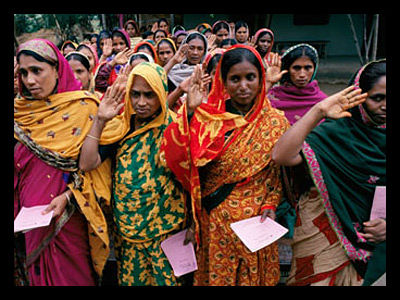
Poor populations in developing countries worldwide are often ignored by most lending institutions. Traditional banks typically do not loan to those with little income or other forms of collateral. As a result, it is extremely difficult for those in poverty to advance economically without access to forms of credit, insurance, or savings mechanisms.
Microfinance services provide these low-income individuals with a broad range of financial tools involving small amounts of money in the hopes that services like capital, banking, and insurance will assist them in rising out of poverty. The World Bank estimates that there are around 160 million people in developing countries that are currently benefiting from microfinance. Many of the institutions that provide microfinance services are nonprofit organizations like Kiva and government agencies such as the United States Agency for International Development (USAID).
Many case studies have demonstrated that microfinance is responsible for helping low-income households meet basic needs, improve their economic welfare, and grow their livelihoods. Microfinance also helps to empower women by providing microcredit, thereby promoting equality and economic opportunities.
Microcredit provides poor entrepreneurs the ability to start or expand their businesses. Having this reliable source of credit makes it easier for them to manage cash flow and business activities. Even though the size of the capital lent seem comparatively small, sometimes less than a couple hundred dollars, it is a significant sum for half of the world’s population, who lives on less than $2 a day.
After using credit to start a business or buy land, poor individuals in developing countries can benefit from savings services that microfinance institutions provide. Since the poor are more likely to lose control of their money due to mismanagement, fraud, and corruption, secure financial services allow safer and more responsible transactions. Additionally, low-income families in developing countries are more likely to be adversely affected economically due to many uncontrollable factors such as death, illness, and natural disaster. Access to credit, insurance, and savings can make these precarious conditions easier to manage and maintain financial security.
Empirical evidence from the Consultative Group to Assist the Poor (CGAP) shows the benefit that microfinance services can provide to the world’s poor. For example, members of the Grameen Bank, a nonprofit microfinance organization for women, who use microfinance services have over 40% higher incomes than those who do not. Development in countries like India, the Philippines, and Morocco has also been advanced due to microcredit. Businesses have expanded and industries have diversified.
Individuals in developing countries are in dire need of a broad range of financial services. Microfinance services provides these people with the opportunity to develop their own businesses, build assets, and manage their incomes and risks. Those who are given access to microfinance services live in significantly better economic conditions than those who do not. And in time, many of these people are able to pull themselves out of poverty.
– Rahul Shah
Sources: KIVA, CGAP, Lend with Care
Photo: The Guardian

Biogas Program has Major Benefits for Ugandans
Heifer International’s Uganda Domestic Biogas Program has drastically changed the lives of many Ugandans. The instillation of the biogas units (12,000 over five years) is not only bringing jobs, revenue, and efficiency to the people of Uganda, it also cutting down on pollution.
The biogas program works with readily available resources to provide Ugandans with essentials to improve quality of life. The units convert animal manure into clean and cheaper energy. This energy can be used as electricity for lighting and cooking. Not only is this a cleaner option than using kerosene lamps and burning charcoal and wood, it is also much cheaper. Households are now able to save the money they would have spent on firewood and charcoal, as well as healthcare expenses they may have been forced to pay from contracting illnesses related to breathing in unclean air.
This program teaches masonry skills and provides jobs to men and women. These masonry skills are transferrable to future jobs and have even attracted many young people. The energy has also afforded new business options for Ugandans small business owners.
The biogas program also benefits environment as it stops deforestation by reducing the need for wood and charcoal. It also cuts down on harmful burning fumes. Bio-slurry, which is a byproduct of the process, can also be uses as a fertilizer as it is much cheaper and more effective than other options on the market. Bio-slurry is organic and has resulted in higher crop yields and better-enriched soil than can continue producing crops in future years. Some households have even been able to sell excess bio-slurry to neighbors and colleagues to gain extra income.
Uganda is one of six African countries in the Africa Biogas Partnership Program (ABPP). Including Kenya, Ethiopia, Tanzania, Burkina Faso, Uganda, and Senegal, the ABPP’s goal is to fund 70,000 biogas units across these countries by the end of 2013 to bring much-needed revenue to people.
– Sarah C. Morris
Sources: Tanzanian Domestic Biogas Programme, Electrify Africa Act
Photo: The Global Journal
Women’s Disempowerment in Yemen
In Yemen, the custom of early marriage just met a vocal challenger.
Going viral last week was a video of 11-year-old Nada al-Ahdal ranting about her parents’ decision to forcibly marry her off to a much older man. “What have the children done wrong? Why do you marry them off like that?” she asks the camera. Her powerful words have touched a delicate nerve amongst Yemenis, some of whom have upheld and continue to practice the custom of early marriange for generations. According to a 2006 joint report by the Ministry of Public Health and Population, the Pan-Arab Project for Family Health and UNICEF, this tradition is still widely practiced: 52% of Yemeni women and girls are married by the time they turn 18.
The recent video highlights Yemen’s history of early marriage laws and the government’s and society’s unwillingness to modernize conceptions of marriage. In 1994, the official age for lawful marriage stood at 15. Five years later, the law was abolished on religious grounds, eliminating a minimum age for early marriage. A brief legislative effort in 2009 to amend the situation was ultimately stalled and aborted, despite that fact that Yemen is party to multiple international treaties that require married couples to be at least 18 years old. Overall, the issue remains to be addressed, leaving countless children susceptible to premature marriage and the social and economic disadvantages that come with it.
Interviews with Yemeni girls and women reveal troubling facts. In rural areas, some girls were married off at the age of 8. Once married, women often have little power in their marriages which can also mean they have limited control over the timing and spacing of children, which increases the risk of reproductive health problems. Early marriage also diminishes the chance that wives will return to school to complete their education, putting them at a distinct social and economic disadvantage. Verbal and physical abuse against women is also prevalent in early marriages in Yemen.
In some ways, Nada al-Ahdal’s words do not just refute the practice of robbing girls of their childhood and sexual purity; they also underline the crucial “cycle of poverty and early marriage” that plagues tens of millions of women around the world. Poverty and early marriage tend to be mutually reinforcing phenomena: girls born into poverty are more likely to have mothers who ‘transmit intergenerational poverty’ and lack social assets and networks. In addition, early marriages greatly increase the chance that young girls will live in poverty. The cycle, parallel to the strong customary tradition of early marriage most prevalent in rural areas, reinforces young women’s roles as undereducated child-bearers with limited social networks.
Nada al-Ahdal eloquently defends her decision to flee from arranged marriage. But behind her words lies Yemen’s ugly reality of women’s disempowerment and its central role in the country’s greater puzzle of poverty reduction and economic growth. As one of the poorest nations on earth and a hotbed of terrorist activity, poverty in Yemen has resulted in a globally destabilizing situation. Instituting a minimum age for marriage could be a key policy for addressing women’s inequality and poverty. In doing so, Yemen would have a more solid foundation for development and more human capital to support its economy.
– Zach Crawford
Sources: BBC, Multiple Indicator Cluster Survey (MICS), Human Rights Watch, Save the Children’s “Champions for Children” report, Washington Post
Photo: Washington Post
Dubai “End Poverty. Educate Now.” Campaign
Dubai Cares, a nonprofit working to improve children’s access to education in developing countries, recently launched a new campaign called “End Poverty. Educate Now” to raise awareness about the link between education and eradicating poverty.
The “End Poverty. Educate Now” campaign will run through the Islamic holy month of Ramadan to raise funds to assist children worldwide by improving their access to primary education. Dubai Cares is currently reaching more than 8 million children in 31 developing countries worldwide. The campaign is building and renovating classrooms, providing clean water wells and latrines, distributing nutritious meals, and providing treatment for intestinal worms. Additionally, teachers are receiving training and millions of books are being distributed.
CEO of Dubai Cares, Tariq Al Gurg, stresses that education is one of the most important investments in breaking the cycle of poverty. Education leads to in increases in income levels and reductions in social inequalities caused by poverty.
Gurg states that this campaign seeks the support of the United Arab Emirates community in order to reduce the number of underprivileged children globally who do not have access to education, which is currently estimated to be 57 million according to UNESCO. UNESCO affirms that education is one of the best tools to combat poverty by stating that if all children in developing countries could read, global poverty rates would fall by at least 12 percent.
Dubai Cares is running this campaign by setting up an interactive stand at the Dubai Mall’s Star Atrium. The campaign is also raising funds through donations via SMS and the Internet. Visitors of the Dubai Mall will be able to make contributions while shopping or through donations boxes throughout the mall. In the atrium, there are black and white posters on tiles which show children living in destitute conditions. These images will gradually transform into a positive colored images as more people donate. These colored images represents the lives of children who are receiving the opportunity for an education.
This symbolic transformation represents the dramatic change that education can make in the lives of children and the fight against poverty.
– Rahul Shah
Sources: The Gulf Today, Emirates Today, Gulf News
Sources: Sunny Varkey
Tibetan Atrocities Revealed by Communist Party Official
An ethnic Tibetan who grew up under the Chinese Communist regime and currently works as a high-ranking Communist Party official has decided to speak out against the Tibetan atrocities currently taking place. Choosing to remain anonymous, the government official claims that the current state of Tibet is “far worse than people in the West suspect.”
When the Chinese military invaded Tibet in 1950, many Tibetans thought the Chinese would modernize the region and bring order to the land that was previously ruled by monks and monasteries. These thoughts were quickly dashed when the Chinese began erasing any signs of Tibetan culture and forcibly removing people from their homes into communes. During the Great Proletarian Cultural Revolution from 1966 to 1976, Tibetan leaders were sent to Maoist reeducation camps and hundreds of monasteries and relics were destroyed. Many of these injustices are still occurring today.
The streets of Lhasa, Tibet’s capital city, are still patrolled by Chinese security forces that act like occupiers. The Communist official claims that the security forces often take property and beat residents at their own discretion and without cause. During another Lhasa revolt surrounding the 2008 Beijing Olympics, the military arrested 6,000 people. The practice of self-immolation, or the public death by lighting oneself on fire, has gained popularity with monks to raise awareness for their struggle. Since 2011, over 100 people have resorted to self-immolation to protest the Chinese occupation of Tibet.
Another horrifying byproduct of Chinese rule has been the destruction of the Tibetan plateau. The Communist official alleges that the increase in cultivation due to Chinese immigrants coming to Tibet has resulted in diminished grasslands and desertification. The number of rivers that feed into Qinghai Lake decreased from 108 to 8 due to extensive irrigation systems. Furthermore, the area as a whole is said to be a toxic dumping ground for Chinese industries.
Human Rights Watch recently published a 115-page report corroborating many injustices that the Communist official is claiming. Their report focuses on the re-housing project currently underway that has relocated over 2 million Tibetans since 2006. Hundreds of thousands of nomadic herders have been placed into “New Socialist Villages” destroying their livelihoods without adequate compensation.
These obvious and blatant human rights abuses are occurring all across Tibet. The Communist official hopes to publish a book in the West detailing his eyewitness accounts of the current state of Tibet and hopes that the Chinese will someday allow public debate on the matter. He says that a style of democracy tailored to the culture and people of Tibet would be the best solution if such an option were possible.
– Sarah C. Morris
Sources: Spiegel, Human Rights Watch
Sources: New York Times
Microfinance and the World’s Poor
Poor populations in developing countries worldwide are often ignored by most lending institutions. Traditional banks typically do not loan to those with little income or other forms of collateral. As a result, it is extremely difficult for those in poverty to advance economically without access to forms of credit, insurance, or savings mechanisms.
Microfinance services provide these low-income individuals with a broad range of financial tools involving small amounts of money in the hopes that services like capital, banking, and insurance will assist them in rising out of poverty. The World Bank estimates that there are around 160 million people in developing countries that are currently benefiting from microfinance. Many of the institutions that provide microfinance services are nonprofit organizations like Kiva and government agencies such as the United States Agency for International Development (USAID).
Many case studies have demonstrated that microfinance is responsible for helping low-income households meet basic needs, improve their economic welfare, and grow their livelihoods. Microfinance also helps to empower women by providing microcredit, thereby promoting equality and economic opportunities.
Microcredit provides poor entrepreneurs the ability to start or expand their businesses. Having this reliable source of credit makes it easier for them to manage cash flow and business activities. Even though the size of the capital lent seem comparatively small, sometimes less than a couple hundred dollars, it is a significant sum for half of the world’s population, who lives on less than $2 a day.
After using credit to start a business or buy land, poor individuals in developing countries can benefit from savings services that microfinance institutions provide. Since the poor are more likely to lose control of their money due to mismanagement, fraud, and corruption, secure financial services allow safer and more responsible transactions. Additionally, low-income families in developing countries are more likely to be adversely affected economically due to many uncontrollable factors such as death, illness, and natural disaster. Access to credit, insurance, and savings can make these precarious conditions easier to manage and maintain financial security.
Empirical evidence from the Consultative Group to Assist the Poor (CGAP) shows the benefit that microfinance services can provide to the world’s poor. For example, members of the Grameen Bank, a nonprofit microfinance organization for women, who use microfinance services have over 40% higher incomes than those who do not. Development in countries like India, the Philippines, and Morocco has also been advanced due to microcredit. Businesses have expanded and industries have diversified.
Individuals in developing countries are in dire need of a broad range of financial services. Microfinance services provides these people with the opportunity to develop their own businesses, build assets, and manage their incomes and risks. Those who are given access to microfinance services live in significantly better economic conditions than those who do not. And in time, many of these people are able to pull themselves out of poverty.
– Rahul Shah
Sources: KIVA, CGAP, Lend with Care
Photo: The Guardian
Red Nose Day – What is it?
For celebrities and average Joes alike, Red Nose Day is a great chance to make a complete fool of yourself. The idea, originating in the U.K. and supported by the BBC, is to take one day every other year to donate some of your time, humor, and your nose to help change lives across the U.K. and Africa. Wearing red noses, thousands of people across the United Kingdom take to “comic relief” (also the name of the organization behind Red Nose Day) as a way to raise money for households in need.
The U.K. audience is no stranger to those laying it all on the line for a laugh. So, it’s no surprise when even the more serious celebrities, including David and Victoria Beckham, take to donning red “badges” of courage and let themselves be the butt of a little sporting humor. The famous couple was interviewed by Ali G, or Sacha Baron Cohen, to raise a few bucks for the cause and hilarity ensued.
But the day is not reserved for the wealthy or famous. Young and old people across the U.K. get together to raise money by hamming it up on and off the stage. From schools and grocery stores, to a live comedic set on the BBC Red Nose night, few public spaces and TVs are safe from the do-gooders and their jokes. This year, the day saw contributions accumulating to well over 100 million pounds.
Although Comic Relief and Red Nose Day donations go to fund projects worldwide, the vast majority of money is centered on projects in the U.K. and Africa. Generally, the issues addressed by these projects concern poverty and social justice, but also include mental health and asylum causes, among others. Every four years, the funding structure and program investments are reevaluated to accommodate change in the world and the local communities in which these projects take place.
On a rolling basis starting September of this year, Comic Relief accepts grant applications to receive funding for potential projects. The 2009-2012 funding cycle just ending, so now is the time for organizations to apply for these grants. So, if you have an idea that you would like to pursue, check out the application process here.
– Herman Watson
Sources: BBC, Red Nose Day, Comic Relief
Photo: Chronicle Live
Landfill Harmonic: A Recycled Orchestra
‘The world sends us garbage. We send back music,” said Favio Chávez, the conductor of the Landfill Harmonic Orchestra.
The Cateura Dump, in the Bañado Sur area along the Paraguay River, is surrounded by seven neighborhoods. 2,500 families live in these neighborhoods, and the majority rely on the landfill to survive, sorting through the 1,500 tons of waste delivered daily and reusing whatever can be found. Poverty has forced many children to work with their families instead of attending school, resulting in inadequate education and a low level of literacy. The area also faces frequent flooding, as well as problems with sanitation and clean drinking water. It is from these troubled beginnings that the Landfill Harmonic originated.
Whilst working in the area, Favio Chávez, an ecological technician decided to teach music to some of the children. Chávez had previously trained as a musician and initially used his own instruments to give lessons. But he soon had too many students and not enough instruments. It was then that the idea to create instruments from recycled materials first struck him. The result was “Los Reciclados” (the Recycled Orchestra) was born using oil cans and scavenged wood, forks and kitchen utensils to create orchestral instruments.
Since its beginnings, the Recycled Orchestra has toured the world, performing in Argentina, Brazil, and Germany, and will be the subject of an upcoming documentary, “Landfill Harmonic.” And while the orchestra may have been created to “educate the world and raise awareness,” as Chávez says, the profound impact on individual lives is very apparent. Chavez continues, “…even though these students are in extreme poverty, they can also contribute to society. They deserve an opportunity.”
One of the orchestral members stated, “My life would be worthless without music.” For children living in poverty, and in an environment where the potential for education and advancement is slim, being given the opportunity to study music and travel the world can be invaluable.
“People realize that we shouldn’t throw away trash carelessly,” Chávez says. “Well, we shouldn’t throw away people either.”
– David Wilson
Sources: Time, Notes on the Road, UNICEF
Photo: MSNBC Media
South Sudan Focuses on Reducing Youth Poverty
The issue of poverty in South Sudan is very complex, however, the organization Plan International is adamant that a key component to poverty reduction is concentrating on decreasing poverty among young people in the country. A 2009 Southern Sudan Household Survey disclosed that 50.6% of the population survives on less than $2 a day. In addition to income limitations, poverty also brings a lack of healthcare, food, sanitation, and clean water.
In order to improve these conditions, Nigal Champman, the Chief Executive Director of Plan International, suggests focusing on children as a financially small investment. He explained, “We all know that young people can play an important role in national development if provided with the right tools, the learning and capacity to employ those tools, and a supportive environment in which to use them.” However, these children can just as easily continue to live in the poverty cycle if they are not provided with education, healthcare or proper nutrition.
The organization has invested $30 million in South Sudan since 2006 and is planning on providing another $30 million in the next three years. Plan International will utilize this money by working with government officials to implement policies meant to keep children in school. Other ways Plan International contributes to the reduction of poverty in South Sudan is through food and clean water distribution, supporting agricultural developments, peacekeeping programs, and providing access to health services.
In a country where 50% of the population is young children or adolescents, about 60% of the poor belong to this demographic. In addition to the previously mentioned disadvantages, these young people also struggle because many are orphans of parents who have AIDS or victims of conflict or child labor. While South Sudan may be a convoluted situation, organizations like Plan International are working to ensure that poverty is a thing of the past by investing in children, who are our future.
– Mary Penn
Sources: All Africa, Youth Policy
Photo: Doctors without Borders
5 Ways to End Global Poverty
The end of global poverty is in sight. While this may seem like a difficult, if not impossible feat, in fact, the opposite is true. By adhering to these concepts, the United Nations states that poverty can be ended in the near future.
Although this is a simplified list, these big ideas are vital for finally ending world poverty. Once poverty is reduced, hunger, war, and illicit operations common to developing countries will no longer be prevalent because people will no longer be imprisoned by extreme poverty. The U.N. is on track for meeting its Millennium Development Goals and hopes to see the end of world poverty by 2030.
– Mary Penn
Sources: Plan Canada, Government of the United Kingdom
Photo: The Guardian
World Bank & Energy Efficiency
20% of the world’s population lives without access to electricity and nearly 40% depend on wood and other biomass for household fuel. Energy is essential for growing an economy and reducing poverty. The recent global initiative, Sustainable Energy for All, recognizes the importance of providing energy in developing countries. Energy is needed for business development, job creation, and income generation.
Over the last decade, the World Bank has committed more than $3 billion to Europe and Central Asia (ECA) to countries who face a potential energy crisis. This region is one of the most energy intensive regions in the world. Poorly constructed buildings throughout that provide low heating which increases energy consumption. The region accounts for 12% of global greenhouse gas (GHG) emissions, which is twice the amount is should contribute given its output.
The World Bank has already helped countries such as Belarus reduce its energy intensity by 60% and has saved Uzbekistan 50,000 MWhs of energy that would have otherwise been lost to inefficiency. The energy efficiency projects in the region over the past ten years have already saved an amount equal to the power generated in New Zealand in 2010.
Going forward countries will need to invest about $3.3 trillion over the next 20 years. While it may seem like a large amount, these energy efficiency projects pay off in the end. Cutting energy subsidies, protecting the poor and investing in energy efficiency could mean that nearly half the countries in ECA would gain more than 1 percent of its GDP back.
Over the next 20 years the World Bank along with ECA will focus on adopting more efficient technologies, increasing the energy efficiency of existing infrastructure, moderating demand for energy, and making cities more energy efficient. These initiatives will help the region by increasing their energy security, enhancing economic growth, and reducing the environmental and social impacts of the energy sector.
– Catherine Ulrich
Sources: World Bank, European Commission