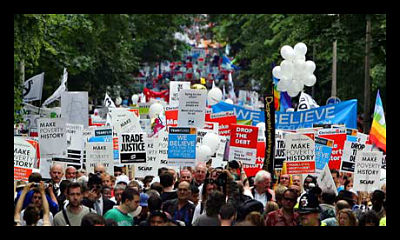
Make Poverty History (MPH) is staging a worldwide campaign. Its mission statement matches its name as it aims to raise awareness about global poverty and make concrete policy changes in various nations’ governments and in intergovernmental organizations.
The various national Make Poverty History campaigns are part of a larger international campaign called Global Call to Action Against Poverty, a worldwide alliance committed to making world leaders live up to their promises and ending global poverty.
The Admirable Aims of Make Poverty History
In comparison to other aid organizations that may struggle trying to apply single, cure-all strategies on a universal scale, MPH has experienced such widespread success because each participating country can focus its national campaign on different issues within the broader topic of alleviating global poverty.
Despite these slight variations, however, all countries generally focus on issues such as aid, trade, and justice that are relevant to the UN’s eight Millennium Development Goals. Besides alleviating global poverty, MPH also aims to reduce the corruption that plagues many developing countries’ governments and prevents foreign aid from reaching the poorest members of society.
For example, the British MPH campaign is a coalition of charities, religious organizations, trade unions, and celebrities whose campaign slogans include “trade justice,” “drop the debt,” and “more and better aid.”
The call for “trade justice” demands a global trade system that does not allow half of the world’s population to live on less than $2 USD per day. This aspect of the campaign seeks to prevent the wealthiest countries and individuals from reaping all of the trade benefits at the expense of the impoverished.
Meanwhile, the “drop the debt” aspect of the campaign suggests canceling unpayable debt of the world’s poorest countries without cutting these countries off to the prospect of future aid. This includes creating a fair and transparent international process to ensure that human needs take priority over debt repayments .
Finally, the “more and better aid” component notes that increasing the proportion of national budgets allocated to foreign development aid will not make much of a difference unless nations can also change the way in which they deliver their aid. MPH believes that targeting aid specifically to basic health care and education, rather than giving money to governments for further allocation, is the best way to avoid corruption and address the underserved people’s true needs.
Meanwhile, Australia’s MPH campaign focuses on increasing Australia’s effective foreign development aid to 0.7% of its gross national income, tackling global climate change issues, and addressing chronic hunger problems across the globe.
While both the MPG and its parent campaign were originally created as a one-time-only campaign in 2005, the dual campaigns’ continued success have spurred leaders to extend the campaigning alliance until at least 2015. MPH is now considered the biggest, most widespread anti-poverty movement in history.
The leaders of MPH acknowledge that, despite its many successes, the fight against poverty continues on. Through campaigning, fundraising, and fighting to make their voices heard by politicians and policy makers around the globe, MPH can ensure that the fire it has ignited in the hearts of its followers never dies.
– Alexandra Bruschi
Sources: Make Poverty History, The Guardian, Oxfam Australia, Millennium Development Goals,
Photo: The Guardian

Malala Day: July 12, 2013
Perhaps no adolescent in the world is regarded with more widespread veneration than sixteen-year-old Malala Yousafzai, the well-known Pakistani advocate for female education who was shot by the Taliban for her convictions in October 2012. Seriously injured from the shooting, Malala was immediately flown to the United Kingdom to undergo a series of emergency operations. Miraculously, she recovered.
Just over a year later, Malala is back in school. However, her life is far from blithe—the urgency for access to education for all girls is ever present. Thus, Malala continues to ceaselessly advocate for girl’s rights, disseminating her message on the global stage.
In order to honor her prodigious efforts in the name of girls everywhere, the United Nations hosted Malala Day on July 12, 2013, her sixteenth birthday. The event—which evolved to be known as “Malala Day”—included a speech by Malala herself, pushing for female education everywhere.
Standing amongst the most powerful leaders in the world, Malala spoke confidently. She beseeched courage from the world’s women: “Let us pick up our books and pens. They are our most powerful weapons. One child, one teacher, one pen and one book can change the world. Education is the only solution.”
She then addressed the personal, demonstrating the unwavering nature of her principles: “The terrorists thought that they would change my aims and stop my ambitions but nothing changed in my life, except this: weakness, fear and hopelessness died. Strength, power and courage were born.”
In a world where 115 schools were attacked last year in Mali, 165 in Yemen, 321 in occupied Palestine, and 167 in Afghanistan, Malala’s struggle has never been more pressing.
– Anna Purcell
Sources: AlJazeera, The Guardian
Photo: National Secular Society
TechnoServe – What is it?
On a trip to Adidome, Ghana in 1963, Ed Bullard, businessman by trade, was struck by the poverty in the area and decided to help. Five years later, Ed founded a non-profit to facilitate the spread of business knowledge and the strengthening of market systems. He named it TechnoServe, an abbreviation of the phrase “technology in the service of mankind.”
Bullard envisioned the organization as an innovative non-profit that would empower the poor by connecting them to the resources they need to thrive while also emphasizing a commitment to integrity. Although Bullard passed away in 1996, TechnoServe has stayed true to his mission, enabling millions of people worldwide and earning a perfect score in transparency from Charity Navigator.
TechnoServe works to improve market systems as a whole, particularly focusing on markets that have a clear unmet demand for a product or service, potential for growth that would benefit poor communities, and the opportunity to impact large groups of people. The organization sees market systems as comprised of three primary facets: direct market players (e.g. consumers, producers, middlemen), suppliers (e.g. producers of intermediary products such as chicken feed), and influential entities (e.g. governments, infrastructure providers).
Based on this understanding, TechnoServe works in three main ways. First, they develop capacity by enabling individuals and communities to improve their skills, share knowledge, and gain access to necessary technologies. They also strengthen market connections by fostering collaboration between market players, and integrating new farms and businesses into the market system. Finally, they improve the business environment and facilitate independent economies by addressing policy issues.
TechnoServe operates in over 40 countries and has affected an estimated 10 million people. Their innovative and adaptable programs have proven that businesses have the potential to empower people and raise them out of poverty. For example, cacao farmers in Peru have doubled their yields thanks to TechnoServe’s training on how to properly prune and fertilize their trees, improve their handling and processing after harvest, and earn higher market prices by selling their cacao together.
TechnoServe has an impressive history of partnerships with for-profit companies. A recently announced partnership with Nespresso is creating a more sustainable coffee supply. Work is taking place in Ethiopia and Kenya to provide support for smallholder farmers and improve supply chain efficiency, and in South Sudan to rebuild the coffee industry after decades of instability. Project Nurture, a partnership with The Coca-Cola Company and the Bill & Melinda Gates, helps foster a sustainable and profitable mango and passion fruit industry in Uganda and Kenya.
Over the past 55 years, TechnoServe has positively affected the lives of millions of people by connecting them to the tools they need to create successful businesses. Their commitment to integrity has earned them the trust of individuals, communities, corporations, governments, and fellow nonprofits. Meanwhile, their work has proven that improving markets systems reduces poverty and empowers the poor. Their success is an excellent model that should be praised, supported, and followed.
– Katie Fullerton
Sources: The New York Times, Charity Navigator, TechnoServe
Photo: Humanosphere
Restored Canal in Cambodia Brings Hope
The restored canal in Cambodia has transformed lives for small rice-farming communities that depend heavily on rice for their livelihoods. Rice farming is the main source of income for 80% of Cambodia’s 14.5 million population, however, for years, farmers in the region have only been able to expect one rice cycle. Thanks to the restored canal, those in the area have enjoyed three harvests in just nine months, increasing total rice yield three times over.
Previously, the canal that zigzags across the rice paddy in the southern region of Cambodia was shallow, meaning that farmers had to depend on rainwater for a successful crop yield. Rainfall can be erratic and unpredictable. Two years before the restoration of the canal started, a bad drought destroyed rice crops, leaving scores of people hungry. The restoration involved dredging and enlarging 47 kilometers of canal in order to feed water to more than 41,100 hectares of rice in 12 provinces. Now at 6.5 kilometers wide, the canal is linked to a lake, and provides farmers with enough water to grow rice in three cycles of three months each. As a result of the project, approximately 11,240 families across the 12 provinces will have better irrigation for farming.
The restoration of the canal was funded by Sweden and Australia, and the work was carried out by an NGO in conjunction with local authorities. It was launched in an effort to help communities in vulnerable areas manage the risks of climate change. With the impacts of climate change expected to adversely affect the production of rice, it has been a goal of the UNDP to put mechanisms in place that will help to guarantee food production and food security in the future.
With rice yields already on the increase, farmers in the region are beginning to feel the financial benefits. Lim Savoeun, a rice-farmer, said the increased profits have made a big difference for her family. “In the past, we struggled to scrape by and sometimes had to loan money from others to fill the gap [in the income],” she said. “But we can avoid that since we are now able to grow rice for often that before. As long as there is water, we will keep working tirelessly on our land. We can’t complain.”
– Chloë Isacke
Sources: UNDP, United Nations
Photo: New York Times
Refugees in Ethiopia Receive Monetary Relief
Somali refugees continue to arrive in Ethiopia in large droves due to poor growing conditions, food shortages, and continued conflict. While the situation is slowly improving, John Ging, Director of Operations in the Office for the Coordination of Humanitarian Affairs, urges continued attention to the crisis and says, “I call on the international community to invest now to build the resilience of Somalis and stop the cycle of crisis they have endured far too long.”
To that end, The United Nations World Food Program, UNHCR, European Commission Humanitarian Aid and Civil Protection, and the government of Ethiopia have partnered to launch an aid project that provides Somali refugees with monthly cash installments in addition to food aid. Currently, 12,000 refugees are receiving monetary relief and the project plans to extend cash aid to 13,000 more by October.
Monetary relief allows Somali refugees to round out their diet with fresh produce, proteins, and dairy from the local market, providing an important supplement to the basic grains and non-perishables received from aid agencies. It also gives the refugees an opportunity to inject money into the local economy. This economic boost is helpful to the communities supporting the large number of refugee settlements.
Currently the refugees who are part of the pilot cash program receive 100 Ethiopian Birr per month, or about $5.00. The organizations backing this program are optimistic that these cash transfers will greatly alleviate the most acute suffering and make the refugee situation less of a burden. Between Ethiopia, Kenya, and Yemen, there are over 1 million Somali refugees. The cash relief program gives refugees an opportunity to regain a little agency and make decisions about what groceries to purchase while also offering much needed hunger relief.
– Zoe Meroney
Sources: World Food Program, United Nations, All Africa
Photo: UNHCR
Make Poverty History
Make Poverty History (MPH) is staging a worldwide campaign. Its mission statement matches its name as it aims to raise awareness about global poverty and make concrete policy changes in various nations’ governments and in intergovernmental organizations.
The various national Make Poverty History campaigns are part of a larger international campaign called Global Call to Action Against Poverty, a worldwide alliance committed to making world leaders live up to their promises and ending global poverty.
The Admirable Aims of Make Poverty History
In comparison to other aid organizations that may struggle trying to apply single, cure-all strategies on a universal scale, MPH has experienced such widespread success because each participating country can focus its national campaign on different issues within the broader topic of alleviating global poverty.
Despite these slight variations, however, all countries generally focus on issues such as aid, trade, and justice that are relevant to the UN’s eight Millennium Development Goals. Besides alleviating global poverty, MPH also aims to reduce the corruption that plagues many developing countries’ governments and prevents foreign aid from reaching the poorest members of society.
For example, the British MPH campaign is a coalition of charities, religious organizations, trade unions, and celebrities whose campaign slogans include “trade justice,” “drop the debt,” and “more and better aid.”
The call for “trade justice” demands a global trade system that does not allow half of the world’s population to live on less than $2 USD per day. This aspect of the campaign seeks to prevent the wealthiest countries and individuals from reaping all of the trade benefits at the expense of the impoverished.
Meanwhile, the “drop the debt” aspect of the campaign suggests canceling unpayable debt of the world’s poorest countries without cutting these countries off to the prospect of future aid. This includes creating a fair and transparent international process to ensure that human needs take priority over debt repayments .
Finally, the “more and better aid” component notes that increasing the proportion of national budgets allocated to foreign development aid will not make much of a difference unless nations can also change the way in which they deliver their aid. MPH believes that targeting aid specifically to basic health care and education, rather than giving money to governments for further allocation, is the best way to avoid corruption and address the underserved people’s true needs.
Meanwhile, Australia’s MPH campaign focuses on increasing Australia’s effective foreign development aid to 0.7% of its gross national income, tackling global climate change issues, and addressing chronic hunger problems across the globe.
While both the MPG and its parent campaign were originally created as a one-time-only campaign in 2005, the dual campaigns’ continued success have spurred leaders to extend the campaigning alliance until at least 2015. MPH is now considered the biggest, most widespread anti-poverty movement in history.
The leaders of MPH acknowledge that, despite its many successes, the fight against poverty continues on. Through campaigning, fundraising, and fighting to make their voices heard by politicians and policy makers around the globe, MPH can ensure that the fire it has ignited in the hearts of its followers never dies.
– Alexandra Bruschi
Sources: Make Poverty History, The Guardian, Oxfam Australia, Millennium Development Goals,
Photo: The Guardian
Jim Yong Kim on Reducing Poverty
At the USGLC (US Global Leader Coalition) 2013 Conference, June 26-28, Jim Yong Kim president of the World Bank spoke of the importance of poverty reduction. Kim believes that “for the first time in human history, we have an opportunity [to eradicate poverty]”.
The first of Kim’s goals is to end poverty by 2030. By reducing poverty rates to below 3 percent, we can “bend the arc of history”, Kim told the USGLC. With consistent growth rates, the 2030 projected poverty rate is between six and nine percent. But lowering the poverty rate down below three percent will virtually remove all poverty and leave only frictional poverty, according to Kim.
Kim defined frictional poverty as the poverty resulting from circumstances difficult to control. Situations that have to be responded to on a case by case basis, like famine or other natural disasters, will be the only poverty left after levels are reduced to below three percent worldwide.
Kim’s second goal is to boost the incomes of the bottom 40 percent. Kim emphasized that without an all-inclusive economy, societies will become increasingly unstable.
The World Bank president also placed critical importance on foreign assistance. Today, total development assistance is about $125 billion. Although influential, the amount of assistance needs to increase, Kim said. Funding for Africa infrastructure is $95 billion alone. Kim also emphasized the importance of private sector investment in eliminating poverty.
“Change will not happen,” Kim concluded, unless everyone “decides that the ultimate goal is more important than raising the flag for our single organizations.”
– Danielle Doedens
Sources: USGLC, YouTube
Photo: Merco Press
Venezuela’s Crime Rates Rise Due to Poverty
Venezuela is a beautiful country known for its striking natural beauty and urbanized culture. Venezuela is also home to some of the world’s largest oil deposits, and houses large quantities of coal, iron, ore, bauxite, and gold. The country has experienced great wealth and prosperity as a result of its natural resources.
However, economic growth in Venezuela had disproportionately benefited some people more than others. A majority of Venezuela’s citizens live in impoverished areas and have not benefited from the oil wealth. Over 60% of the households in Venezuela are poor families, and the unemployment rate has only been increasing over the last few years. Sewage flows into the once beautiful Guaire River, which has led to its declining safety and toxicity. Streets are covered in trash, and citizens to not have enough clean water to bathe in regularly.
Venezuela has also been experiencing an increasing crime rates. Families such as the Olivero family, live in fear of the violence, for gangs and increasing violent crimes are growing in their home town of Caracas. Every night around six, the family gathers together in their home and locks the main entrance to their house. Their homes are not the most secure protection from the violence outside, for Mr. Olivero has stated to the Huffington Post that their neighbor’s roof was penetrated by a stray bullet recently.
For the Olivero family and many others, the violence does not seem to end. Venezuela’s homicide rate is the fifth highest homicide rate in the world and is 20 times higher than that of the United States. Unfortunately, RFI explains, crime within Venezuela continues as a result of the high poverty and lack of impunity, and will not come to an end until the country’s economy improves.
Venezuelan cities are also undergoing current food shortages, for store owners are unable to fill their shelves with basic goods. Anglys Bericote, a local, explains how private businesses hold on to the supplies and goods. Bericote also stated to the Huffington Post that her town has been so low on supplies, that she was unable to buy toothpaste or toilet paper for herself and her family.
Another local, Yaneth Solano, said she does not believe that the government will help the citizens of Venezuela with these current issues of violence or poverty. She believes that nothing can or will change Venezuela, for only God could help them now. As crime, food shortages, and littering continue within Venezuela, its citizens will not see improvement until the government places more focus on helping the impoverished improve their standard of living.
– Grace Elizabeth Beal
Sources: The Huffington Post, BBC, RFI
Improving Access to Reproductive Health Services
Improving access to reproductive health services in the developing world is critical to poverty alleviation. Pregnancy and childbirth-related complications are a leading cause of death of girls, aged 15 to 19, in developing countries. An estimated 7.3 million girls under age 18 give birth each year, and a great percentage of births occur in Africa. To counter this, the United Nations Population Fund (UNFPA) has announced it will partner with eight African countries to improve access to reproductive health services for millions of girls. The programs will span over the next three years, and will hopefully make a difference in lives of millions of young people.
“We are working specifically to ensure that the continent’s adolescent girls, between the ages of 15 and 19 – some 45 million of whom live in sub-Saharan Africa – get a good education, are able to decide whether and when to marry and have children, are protected from HIV, remain safe from violence, and have their fair share of opportunities to work and contribute to the economic development of their countries,” said UNFPA Executive Director Babatunde Osotimehin.
UNFPA will partner with the Democratic Republic of the Congo, Ethiopia, Mozambique, Niger, Nigeria, Sierra Leone, South Sudan and Tunisia. The programs will deliver comprehensive sexual and reproductive health services for young people. The hope is to reach disadvantaged and impoverished girls who are most at risk for poor sexual and reproductive health, violence and exploitation.
UNFPA programs will ensure young people have access to age-appropriate sex education, whether they are in school or out, to prepare them for adult life. The programs will bring together governments, young people, the private sector and other stakeholders to access the needs of young people.
UNFPA is the lead United Nations agency that promotes sexual and reproductive health services. They are at work in 150 countries, ensuring that young people have the information, services, and supplies they need to make safe and healthy decisions.
“Over the next three years, in partnership with governments and young people themselves, we will commit to making a tangible difference in the lives of millions of young people right across the continent. It is their rights we must uphold and it is they who are our best hope for a prosperous and peaceful Africa,” said Dr. Osotimehin.
– Catherine Ulrich
Sources: UNFPA, UN News
Photo: Join Tokyo
HIV/AIDS and Poverty in South Africa
For South Africa, HIV/AIDS is a disease specific to poverty. In 2009, over half the country’s population lived in poverty. As of 2011, almost 6 million South Africans were living with HIV/AIDS, the highest number of affected in a single country in the world. Despite these daunting figures, this year?s scientific breakthrough in antiretroviral drugs brings hope.
Samantha Oliver, 23 and a Michigan State University graduate, spent August through December in 2011 interning in Cape Town, South Africa. While working with an organization to promote HIV/AIDS research and best practices, she saw the effects of the disease. “HIV/AIDS spreads poverty and poverty spreads HIV/AIDS,” she said. Though which came first is harder to determine. Oliver went on to explain that the disease “attacks what should be the most productive sector of an economy.” People between the ages of 15-49 are most likely to contract HIV/AIDS and they are also the people making most of the contributions to the economy. When a family member becomes sick from the disease, they are unable to work and another family member must stay home to help care for them. As of 2011, about one fifth of South African women in their reproductive ages had HIV, thus continuing the problem of mother-infant transmission of HIV/AIDS.
The United Nations reported that in a national South African survey, 66 percent of people asked reported a drop in the amount of income per household due to “HIV-related illness, including the direct loss of earners.”
Despite the cyclical nature of the relationship between HIV/AIDS and poverty in South Africa, progress has clearly been made throughout the past decade. While in Cape Town, Oliver saw something a lot of people watching the news or reading online reports do not see. She was able to see the work being done by South Africans for South Africans. “A lot of people think that over in Africa in particular, people are sitting around waiting for foreign aid to happen… All I saw was local doctors, nurses and pharmacists going way above and beyond their jobs to try to come up with solutions,” Oliver said. “It was creative problem solving… I think that people would be a lot more supportive of different types of aid programs if they could see that local people on the ground are already starting the kinds of projects that the funding would be needed for.” Oliver’s stay in Cape Town in 2011 was her sixth visit to South Africa.
In March of this year, the Center for Strategic and International Studies reported that the transition from United States-led policy to South African-led policy that began in October of 2010 was going well. The U.S. is no longer “a lead role in the provision of lifesaving services” and has moved “to an approach focused increasingly on technical support.” The good news continues this July as the UN noted that South Africa has the second largest antiretroviral program in the world and their continued battle against the spread of HIV/AIDS is showing progress. The UN also estimated that in South Africa, the rate of infection is between 17 and 32 percent lower than if the treatment were not being provided.
While attending Michigan State University, Samantha Oliver double majored in International Relations and Comparative Politics with a specialization in International Development. Of her experiences while in Cape Town, Oliver said, “If people could see what community-based organizations are doing [in South Africa], I think they would be really moved.” She also recommended that if someone were interested in learning more that they look into South Africa-based aid organizations as well as international organizations.
– Jordan Bradley
Sources: The Center for Strategic and International Studies SouthAfrica.info United Nations Development Programme Times Live UNAIDS UN Chronicle
Photo: The Telegraph
Poverty in Mexico
This July, Coneval, the Mexican government social development agency, reported that while the national poverty rate declined a measly .6 percent, an increase in the population meant a half million increase in the number of people living at or below the poverty line. The report revealed that 45.5 percent of Mexico’s citizens live in poverty. Coneval defines poverty as living on 2,329 pesos, the equivalent of $183, per month in the city and 1,490 pesos, or $117, in rural areas. It defines extreme poverty in the city at $88 per month and $62 per month in rural settings. As of 2012, almost 10 percent of the population of Mexico lives in extreme poverty, totaling 11.5 million people.
After the Coneval data was published, Mexican Finance Minister Luis Videgaray said, “The only feasible, permanent answer to reducing poverty in Mexico is through economic growth.”
President Enrique Peña Nieto echoed a similar sentiment, promising plans for modernizing existing assistance programs and creating new programs. While Mexico’s current government assistance program Oportunidades has been internationally recognized for its success, the program mainly offers monetary support and lacks focus in policies concerning income growth.
The National Bureau of Economic Research found suggestive evidence of a connection between globalization and poverty in Mexico. Because the country was so aggressive when they opened their economy completely in 1985, Mexico’s GDP has almost tripled. In 1980, five years before tariffs were cut and other trade restrictions removed, eleven percent of the GDP was from international trade. In 2002, it reached 32 percent.
A majority of Mexico’s poorest states are in the southern region of the country. The four poorest in the nation are Chiapas with 74 percent of its population living in poverty, Guerrero at 69 percent, Puebla at 64 percent and Oaxaca at 61 percent. All four states sit well above the national poverty percentage of 45.5 percent. In Oaxaca, Chiapas and Guerrero, 50 percent of the population lives on $62 or less a month.
Rural areas in Mexico are the areas that see the least amount of economic growth and development. This is also where 61 percent of the indigenous population lives in extreme poverty. Oportunidades focuses 99 percent of its services on rural or semi-urban areas. They are currently assisting 6.5 million families in a number of ways. Most benefits come in the form of cash deposits for the people who qualify for the program. A section of the program called Youth with Oportunidades gives economic incentives to students who graduate high school before they turn 22 years old. Because women head eight of every ten single-parent household in Mexico, Oportunidades also gives cash transfers to help pay for high-quality food for children.
The assistance that Oportunidades is offering those living in poverty benefits lives in the short run, but the global community hopes it will be a launching pad for greater economic growth in Mexico.
– Jordan Bradley
Sources: The Latin Times, World Bank, The National Bureau of Economic Research, Rural Poverty Portal, Mexidata Reuters
Photo: Allison Orthner