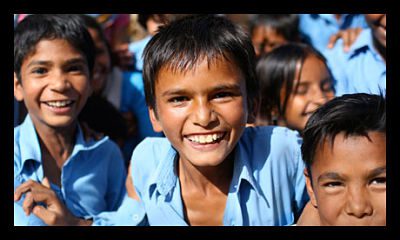
You’ve heard about the problems, but what are global poverty solutions? In fact, there are many:
1. Clean Water and Sanitation
A lot of people in the developed world take clean water and sanitation for granted. We do not realize at times how lucky we are that we don’t have to travel miles to get access to clean water, or drink seemingly safe water only to later find out it was contaminated. Improving water quality and overall sanitation are steps already being taken by non-profit and non-governmental organizations like UNICEF, etc. In fact, UNICEF’s Clean Water Campaign is attempting to do just this: help bring clean and safe tap water to people in developing and third world nations. The potential for a high impact is definitely present: just 5 U.S. dollars can provide clean tap water for one child for 200 days. Cleaner water and safer sanitation lead to healthy and fit children who are able to learn and go to school.
2. Healthcare and the Elimination and Prevention of Diseases
Similar to clean water and sanitation, proper healthcare can also help children and adults be vigorous enough to better take care of their families and work, or pursue education. Many potentially deadly diseases can be averted very simply: for example, one can greatly increase one’s chances of avoiding malaria simply by sleeping inside a mosquito net. Many charities are actively trying to save lives simply by sending nets to poverty stricken families in Africa. Vaccinations and inoculations prevent children from getting easily treatable diseases. Some very treatable diseases go unnoticed and/or untreated in families living in extreme poverty because they are often ignored, not recognized as illnesses, or treatments can’t be afforded. By eliminating and preventing easily treatable diseases, we give a chance to millions of children who otherwise might die of easily treatable maladies.
3. Education
Again, access to basic education is also perhaps something those in developed nations take for granted. Young children living in extreme poverty often have no choice but to seek employment when they reach a certain age in order to help the family financially. They often forgo an education for many reasons: for some, it’s a lack of nearby schools, for others, it’s simple economic necessity, and then there are some who cannot attend school because a lack of proper sanitation and clean water has left them with health problems; these children are unable to learn and perform well in school. Education is a positive feedback cycle in which children who receive an education are able to bring more money home for their families, thereby allowing other children to go to school rather than work. Education empowers people not only economically, but also spiritually and intellectually, potentially leading to a cyclical liberation of the poor.
4. Encouraging Local Innovation
Encouraging local innovation is a great solution to poverty because it stimulates the economy of poverty struck areas as well as supporting self-sufficiency. Some great inventions are currently coming out of Africa; some of them are simple solutions to problems only those living in extreme poverty face. Regardless, this is an eventual result of education, and if encouraged and fostered, it will result in a brighter future for those actively fighting poverty. Organizations like the African Innovation Foundation take it upon themselves to release the potential of individuals in poor African nations who would otherwise go unnoticed.
5. Eliminate Corruption
Eliminating corruption is an extremely significant move in the fight against global poverty. If it’s the higher up officials who hoard money, and prevent aid from going where it is most needed, it will hold back individual countries from eliminating diseases, educating the young, and making clean water accessible to the general population. Additionally, corruption can often result in lax law enforcement, which allows poor nations to become breeding grounds for extremist, sometimes terrorist groups. Eliminating corruption, therefore, would be taking a very big step towards eliminating poverty in general.
– Aalekhya Malladi
Sources: Clean Water Campaign, Netting Nations, Nets for Life Africa, Nothing But Nets, African Innovation Foundation
Photo: The Guardian

Leveraging the Private Sector
Last Sunday, the Brookings Institute held its 10th annual Blum Conference on global development. This year, the conference emphasized the increasingly significant role of the private sector in lifting the world out of poverty.
Currently, 1.2 billion people still languish in extreme poverty, which is defined as living on less than $1.25 a day. The head of the World Bank, Jim Yong Kim, recently made sweeping promises that by 2030, that number will have dwindled to less than 300 million. And, by all appearances, Kim’s claim has a solid basis: in the past decade, global extreme poverty rates have been cut in half.
The recent Brookings conference in Aspen, Colorado confirms that hope. And, more importantly, it lays out the path to achieve it: by engaging the private sector on a large scale. World leaders like Partners in Health co-founder Paul Farmer, UN Human Rights commissioner Mary Robinson, and former U.S. Secretary of State Condoleezza Rice used their voices on Sunday to reinforce this principle. Major development agencies have already been operating with this idea, including USAID which leveraged over $525 million in private investment last year alone.
The road forward, however, contains many obstacles. Homi Kharas, the author of Brookings’ policy brief, “Reimagining the Role of the Private Sector in Development,” lays out three major hurdles for partnerships between the private sector and the public, academic, and civil sectors.
The first is the massive project of adapting to private funding in development. As part of the process, Kharas recommends that development agencies project “leverage ratios” that link public dollars to private dollars. He applauds the Power Africa Act for using $7 billion in government spending to guarantee $9 billion in private investment pledges.
Secondly, innovation is the key to increasing agricultural productivity and improving access to necessities like water and medicine. Kharas argues that public subsidies for private-led innovation in these areas need to increase to harness the creative power of for-profit businesses.
Finally, Kharas suggests that perhaps the greatest obstacle to engagement is mistrust of private companies by public and civil actors. To build confidence and pave the way for future partnerships, companies need to make their footprints and supply chains more transparent.
“Every high-level development report and project now has private sector involvement,” wrote Kharas. “The time is ripe to systematize this approach and experiment with new forms of partnerships.”
– John Mahon
Sources: Devex, Brookings
Photo: Carnegie
China’s Increasing Investment in Africa
Over the last two decades, China has gradually invested in Africa, gaining ownership of more and more resources and growing industries. Recently, China has sharply increased these investments, taking on a much larger role in Africa’s future. China’s increasing investment in Africa may signal that the U.S. needs to similarly increase their investment in the region.
Africa’s biggest creditor is the China Import-Export Bank. Officials are in the process of creating the China-Africa Development Fund, which will pump over $2 billion into the developing continent over the next three years. China has replaced the United Sates as Africa’s largest trading partner, as its trade levels with Africa have shot up from $10 billion to $200 billion, over just thirteen years.
There are mixed feelings over China’s growing presence in Africa. To its credit, China has provided much-needed support, providing funding for expensive infrastructure projects and other developmental plans. Such projects have included building schools and roads, creating opportunities for many people in Africa. Similarly, China’s huge economic growth rates have helped boost Africa’s pace of growth as well. China also aids Africa’s growing consumerism by providing cheap products that improve quality of life for many people across the continent.
Conversely, many critics criticize China for overreaching in regards to Africa and taking advantage of their disorganization and lack of regulations. Others emphasize China’s exploitation of Africa’s natural resources. This has left Africa with very little profit compared with what China has made off of these resources, causing many to draw an eerie comparison to the days of European imperialism and exploitation of the continent. China’s mass manufacturing and distribution network, which makes cheap consumer products available, also has a huge advantage over Africa’s smaller upcoming production facilities. China’s ability to distribute cheap products on a wide scale discourages competition and drives many local start-ups out of business.
More alarming still is China’s focus on acquiring Africa’s natural resources. Raw materials comprise approximately 85 percent of Africa’s exports to China, largely consisting of oil and various minerals. The African Development Bank has voiced complaints over this mass export of natural resources, calling for the resources to be processed and developed within Africa in order to create jobs and profit.
Many African governments have started demanding China offer up a greater number of jobs to the African population. As Africa’s population continues to grow, the need for more jobs simultaneously increases. However, China’s established investment patterns tend to bring in their own Chinese workforce, leading to an influx of an estimated one million Chinese migrants to Africa throughout the last twenty years.
China’s soft power investment in Africa will surely lead to greatly increased Chinese influence throughout the developing continent. The question remains whether this will propel Africa to new levels or simply act as a crutch for Africa’s struggle for healthy development and economic growth.
– Allison Meade
Sources: Forbes, Reuters, International Business Times
Photo: USC Dornsife
5 Global Poverty Solutions
You’ve heard about the problems, but what are global poverty solutions? In fact, there are many:
1. Clean Water and Sanitation
A lot of people in the developed world take clean water and sanitation for granted. We do not realize at times how lucky we are that we don’t have to travel miles to get access to clean water, or drink seemingly safe water only to later find out it was contaminated. Improving water quality and overall sanitation are steps already being taken by non-profit and non-governmental organizations like UNICEF, etc. In fact, UNICEF’s Clean Water Campaign is attempting to do just this: help bring clean and safe tap water to people in developing and third world nations. The potential for a high impact is definitely present: just 5 U.S. dollars can provide clean tap water for one child for 200 days. Cleaner water and safer sanitation lead to healthy and fit children who are able to learn and go to school.
2. Healthcare and the Elimination and Prevention of Diseases
Similar to clean water and sanitation, proper healthcare can also help children and adults be vigorous enough to better take care of their families and work, or pursue education. Many potentially deadly diseases can be averted very simply: for example, one can greatly increase one’s chances of avoiding malaria simply by sleeping inside a mosquito net. Many charities are actively trying to save lives simply by sending nets to poverty stricken families in Africa. Vaccinations and inoculations prevent children from getting easily treatable diseases. Some very treatable diseases go unnoticed and/or untreated in families living in extreme poverty because they are often ignored, not recognized as illnesses, or treatments can’t be afforded. By eliminating and preventing easily treatable diseases, we give a chance to millions of children who otherwise might die of easily treatable maladies.
3. Education
Again, access to basic education is also perhaps something those in developed nations take for granted. Young children living in extreme poverty often have no choice but to seek employment when they reach a certain age in order to help the family financially. They often forgo an education for many reasons: for some, it’s a lack of nearby schools, for others, it’s simple economic necessity, and then there are some who cannot attend school because a lack of proper sanitation and clean water has left them with health problems; these children are unable to learn and perform well in school. Education is a positive feedback cycle in which children who receive an education are able to bring more money home for their families, thereby allowing other children to go to school rather than work. Education empowers people not only economically, but also spiritually and intellectually, potentially leading to a cyclical liberation of the poor.
4. Encouraging Local Innovation
Encouraging local innovation is a great solution to poverty because it stimulates the economy of poverty struck areas as well as supporting self-sufficiency. Some great inventions are currently coming out of Africa; some of them are simple solutions to problems only those living in extreme poverty face. Regardless, this is an eventual result of education, and if encouraged and fostered, it will result in a brighter future for those actively fighting poverty. Organizations like the African Innovation Foundation take it upon themselves to release the potential of individuals in poor African nations who would otherwise go unnoticed.
5. Eliminate Corruption
Eliminating corruption is an extremely significant move in the fight against global poverty. If it’s the higher up officials who hoard money, and prevent aid from going where it is most needed, it will hold back individual countries from eliminating diseases, educating the young, and making clean water accessible to the general population. Additionally, corruption can often result in lax law enforcement, which allows poor nations to become breeding grounds for extremist, sometimes terrorist groups. Eliminating corruption, therefore, would be taking a very big step towards eliminating poverty in general.
– Aalekhya Malladi
Sources: Clean Water Campaign, Netting Nations, Nets for Life Africa, Nothing But Nets, African Innovation Foundation
Photo: The Guardian
Seleka’s Reign in Central African Republic
In December of 2012 a rebellion group formed under the name ‘Seleka’ marched through the Central African Republic, threatening to overthrow President François Bozizé for failing to follow through with the promises he made in 2007. Since then their reign has been one of terror and abduction, forcing people who are already living in the throes of poverty to adopt a life of fear and anticipation as well. Bozize has since been chased out of the country and the people of the Central African Republic are too afraid to take action against Seleka.
Translated the word Seleka simply means “coalition” in Sango. In January the group was estimated to have between 1,000 and 3,000 members. It is thought that they are made up of a collection of smaller groups allied together in opposition of the former president. However, government officials believe that the core of Seleka may be made up of a more varied cast of people, suggesting that the are harboring foreigners who wish to take control of the country’s mineral wealth. Some even believe that nationals from Chad, Nigeria, and Sudan are involved.
On March 24, 2013 Michel Djotodia marched into the capital Bangui with 5,000 Seleka fighters to seize control of the country. He immediately disbanded the parliament and suspended the constitution. And since then he and the Seleka fighters have waged a campaign of harassment and terror against the very people they claimed to protect. Unemployment has soared to 70% and the rebels take whatever they want, including computers used for education, solar panels, and even goats. Schools have shut down and electricity has become unavailable to the public.
Now the rebel group is no longer simply stealing from the people they claim to help, they are stealing the people as well. On a daily basis people disappear from their homes, schools, and the street itself. They are picked up by men in trucks and never seen again. If they are, they have been tortured or killed. The economy has collapsed entirely, most people are out of work, international aid workers have fled, and farmers are unable to tend to their fields because of all the violence. The country is on the verge of absolute disaster.
The self-proclaimed president of the country seems to be either unaware or uncaring of the reality of the situation. He is quoted in the New York Times as stating, “Peace has already returned to Bangui. When we came, it was like a miracle. It was God that willed it.” But the reality is that 173,000 people have been displaced from their homes since December. The Central African Republic has always been one of the poorest countries in the world and frequently fraught with conflict.
– Chelsea Evans
Sources: CNN, BBC, USA Today, New York Times
Photo: BBC
Prenatal Sprinkles Offer Easy Solution to Malnourishment
According to the Hunger Project, a non-profit organization that works to end global hunger, “malnutrition occurs when the variety or quality of food is insufficient to support proper development and health.”
Roughly 15 percent of babies born in developing countries are of low birth weight due to maternal malnutrition, and even those born at a healthy weight are at risk for malnutrition due to insufficient breastfeeding. Malnutrition causes one-third of global child deaths, perpetuated as undernourished women give birth in low-resource settings.
When a malnourished woman gives birth to a low-birth weight baby that has already been affected by her mother’s malnourishment, the child will suffer from a compromised immune system and will most likely stay malnourished, even when she reaches reproductive age. Her child, too, will be born malnourished, and the cycle of malnourishment will continue.
Seeking to break the cycle of malnourishment, the Hospital for Sick Children in Toronto, Canada is developing a daily microencapsulated micronutrient powder through its affiliate SickKids.
Called “Prenatal Sprinkles,” this powder contains iron, folic acid and calcium. Pregnant and lactating women in poor areas can simply sprinkle their food with this supplement in order to combat malnutrition.
Prenatal Sprinkles will help to combat anemia during pregnancy, which often leads to premature birth, and preeclampsia associated with hypertension, which often causes maternal and fetal death.
Prenatal Sprinkles can potentially lower maternal hypertensive disease related mortality by 20 percent and preterm birth by 24 percent. Previously, supplements could not contain both iron and calcium due to poor absorption, but Prenatal Sprinkles contain differential time-release nutrients that increase iron and calcium absorption and prevent calcium-iron interaction. They also have a smooth texture and a pleasant flavor, making them palatable for malnourished women.
The Hospital for Sick Children is partnering with companies in the private sector in order to finance the production of Prenatal Sprinkles, but the projected cost of mass production is very low for the supplement.
Though Prenatal Sprinkles are not yet in wide circulation, they offer a simple and cost effective solution to malnutrition, a problem that cannot be solved by food aid alone.
– Katie Bandera
Sources: Sprinkles (R) 60mg Fe for Pregnant and Lactating Women, Issues: Malnutrition
Photo: Girls’ Globe
Remembering Kosovo Genocide
Ermira Babamusta, Ph.D is a guest writer and a Regional Director for The Borgen Project.
World Humanitarian Day is an opportunity to recognize those people around the world often in dangerous and difficult circumstances. This year I would like to pause and remember the tragic events in Kosovo and the humanitarian catastrophe of ethnic Albanians being killed, expelled and persecuted in their own land. The ethnic cleaning campaigns led by Slobodan Milosevic and the Yugoslav and Serb forces against Albanian civilians shall forever be recorded as dark years in the history of Albania and Kosova.
This August 19, 2013 as the world commemorates the fight against genocide, it is important to reflect on the historical aspects of genocide against ethnic Albanians. I dedicate this day to the Families of those who were harmed during the Kosovo Genocide.
As I witnessed the injustice being inflicted on the Kosovar refugees in 2007 and on the genocide survivors in 2012, I was reminded of their struggle to hang on and lead a normal life despite the horrible trauma they experienced. Today, I think about those who are still missing and their families who have no answers.
We have a great opportunity to learn from the past, become united and encourage leaders to build a better future. It is essential to peace, diplomacy and prosperity to ground our efforts on the four pillars of democracy: justice, good governance, economic development and social welfare.
I applaud America for leading the way in this effort of peace and democracy building. I had the chance to visit and meet with great leaders and US Congress members like Senator Harry Reid, Senator Tom Harkin, former US Secretary Colin Powel, UN Secretary General Kofi Annan, all of who share my commitment to peace, human rights and democracy. I applaud the brave actions and the extraordinary efforts of President Bill Clinton, former US Secretary Hillary Clinton, President Obama, Vice President Joe Biden, US Secretary of State John Kerry, Dr. Jill Biden and First Lady Michelle Obama for staying at the forefront of building and strengthening democracy in US and around the world and promoting human rights.
As J. F. Kennedy stated, “the world is very different now, for man holds in his mortal hands the power to abolish all forms of human poverty, and all forms of human life.” This is the time to start the movement for global equality, promote human rights, improve governance and deliver justice around the world. I am proud that Albania and Kosovo are great successful models of such moral and democratic principles.
Ermira Babamusta, Ph.D
African Growth and Opportunity Act’s Importance
The Economist once labeled Africa “The Hopeless Continent.” The magazine determined that the widespread effects of disease, poverty, conflict and corruption rendered the continent economically unfavorable. That was in 2000, the same year that President Clinton signed into law the African Growth and Opportunity Act (“AGOA”). Today, the continent—and particularly sub-Saharan Africa—is home to several of the world’s fastest growing economies. In 2011, The Economist revised its moniker, referring to Africa as the “The Rising Continent.”
Many economists view AGOA as an integral element of growth in sub-Saharan Africa. The primary objective of AGOA is to expand the volume and variety of trade and investment between the United States and sub-Saharan Africa. According to government sources, AGOA’s trade provisions are responsible for 350,000 direct and 1 million indirect jobs in Africa as well as 100,000 jobs in the United States. Since the program’s inception, exports from AGOA nations to the U.S. have risen more than 300 percent.
AGOA is scheduled to expire in 2015, but President Obama has initiated an early campaign to extend the trade agreement. While praising the success of the program the President explained that, “The economies of sub-Saharan Africa are among the world’s fastest-growing, and this economic expansion, partly a result of our long-standing investment in Africa, provides an opportunity to lift millions out of poverty and foster long-term stability.”
Though oil and gas exports comprise more than 90 percent of African exports under the program, leaders hope to expand investment in other industries such as textile and apparel exports. Economists have stressed the importance of diversifying exports in trying to achieve long-term development and sustainable growth.
This month, leaders from the United States and participating African nations will meet in Ethiopia for the AGOA Forum. The theme of the event is Sustainable Transformation Through Trade and Technology. African representatives are hoping for a long-term extension of the trade agreement. Jas Bedi, chairman of the African Cotton and Textile Industries Federation, explained it simply, “You can’t do a $200 million deal if you don’t know what’s going to happen in three year’s time.”
Renewal of AGOA is crucial if the United States hopes to keep pace with China, which has recently overtaken the United States as sub-Saharan Africa’s largest trading partner. A recent report from the Brookings Institute criticizes the American business community for failing to capitalize on the continent’s emerging markets. As the region continues to grow, the United States hopes to accelerate trade and investment with its African partners. The renewal of AGOA will certainly be a good start.
– Daniel Bonasso
Sources: Financial Times, AGOA, Brookings Institute
Photo: It News Africa
LandWise: Empowering Women
Landesa Center for Women’s Land Rights, a capacity building organization, has recently launched LandWise, a free online searchable database and tool. LandWise provides important information and practical applications that may be used for capacity building and technological assistance for strengthening women’s land rights across the globe.
In many places across the world, women’s land tenure is not recognized or is consistently undermined. Without rights to their land, women lack the ability to use, control, and transfer this asset. In some areas, men may have sole control of land that is owned by their wife. The absence of legal land ownership by women is recognized as a constraint for overcoming rural poverty. Without legal ownership of this valuable asset, women are placed in a precarious position where they may lose their family’s only form of income.
There are many facets to women’s rights to land that must be addressed. The country’s legal codes, cultural norms, and administration all play a part in this problem, since these factors can often be very complex and difficult to determine. Landesa’s LandWise seeks to organize this information in an easily searchable database that practitioners may access. While LandWise is not intended to take the place of field work, it will help with the initial research, since the legal codes that govern land rights are often difficult to uncover. The issue of land rights is often bound up with family and marriage law as well as property law. LandWise organizes these laws in an easily searchable database.
Sometimes, rural women are unaware of the rights they have under law. In these cases, practitioners can use the research gathered to engage women in clinics or information sessions. In areas where women’s land rights are not legally codified practitioners may use advocacy to engage civil society and government officials and promote policy recommendations.
LandWise also provides Practice Guides. The Practice Guides help practitioners use the information provided on the database. The Guides include checklists that help analyze the issues that may affect women and men differently in regards to property rights. In addition to the legal codes provided on LandWise, users also receive information regarding how the law is in fact carried out and cultural norms that may affect its implementation.
LandWise is overseen by a full-time librarian. Practitioners in the field are encouraged to submit information that they may come across to LandWise in order to help expand its database.
– Callie D. Coleman
Sources: IFAD, LandWise, Landesa Center for Women’s Land Rights
Photo: Landesa
Project Concern International
Project Concern International (PCI) is an organization which seeks to to prevent disease, improve community health, and promote sustainable development worldwide. PCI was founded in 1961 by Dr. James Turpin after saving the lives of two children suffering from pneumonia while working in a Tijuana clinic. This experience inspired the young doctor to go on and forever change the lives of millions. PCI envisions a world in which resources are abundant and shared, communities are capable of providing for the basic health and well-being of its members, and children and families can achieve lives of hope, good health and self-sufficiency. PCI conducts its work through field offices in host countries where directors can live in the area and get an intimate understanding of local needs.
Working in 16 countries, PCI hopes to reach at least 5 million people per year with its services. Overtime, PCI has expanded its reach through increased funding: from the Bill and Melinda Gates Foundation to government grants to the Starbucks foundation, PCI has a well rounded list of supporters. PCI’s ultimate goals include addressing the root causes of poverty and poor health; working with the community to leverage their assets, capabilities and goals to create community-inclusive solutions; implementing holistic solutions; cultivating long-standing relationships with community leaders, investors, and stakeholders to catalyze the impact of aid spent; and developing tools which measure the long-term success of such programs. PCI addresses poverty through programs focused on women’s empowerment & poverty, children’s health, disease prevention, food & water programs, and disaster relief & recovery. Between 2013-2016, PCI hopes to reach over 10 million people worldwide and become a leader in building community capacity, resilience and self-sufficiency.
In addition to its programs worldwide, PCI also has a series of initiatives to further promote its goals. These intiatives include: Women Empowered, Legacy, Who Cares? and SHE.
To learn more about PCI’s work, explore PCIglobal.org for more info.
– Kelsey Ziomek
Sources: PCI Global, The San Diego Foundation, Washington Global Health Alliance, Coronado Eagle
AmericasRelief Team
Although there are many international aid organizations, few exist that focuses all their resources on one specific region of the world. AmericasRelief Team is one of the exceptions. This organization is devoted to providing immediate, as well as sustainable, humanitarian and educational aid for people in the Americas experiencing some form of disaster.
The group works to provide such assistance by creating a three-part process: disaster preparedness, disaster response and aid and humanitarian assistance. However, like any effective international organization, AmericasRelief Team does not work alone. It partners with other international groups, local groups, nonprofits, emergency centers, corporate donors, the U.N. Office for the Coordination of Humanitarian Affairs and other independent experts to ensure that it is able to help as many people as possible.
AmericasRelief Team has many success stories to solidify its position as a key source of aid to the Americas during disasters. In 2005, the AmericasRelief Teams provided vital assistance to the Florida State Government after Tropical Storm Jeanne devastated the Caribbean region. More recently, in 2010, the group organized the distribution and utilized of 20 million pounds in humanitarian aid money and worked with the United Nations to quickly respond to the earthquake in Haiti.
In addition to monetary aid, the AmericasRelief Team provides clothing, household items and transportation for victims of disasters. Also, the group works with local news and media teams to spread information about the disaster and ways to avoid further complications. Overall, the group is one of the first responders to disasters in the Americas and one of the most effective organizations to provide vital services to those affected by any tragedies.
– Mary Penn
Sources: AmericasRelief Team, InterAction