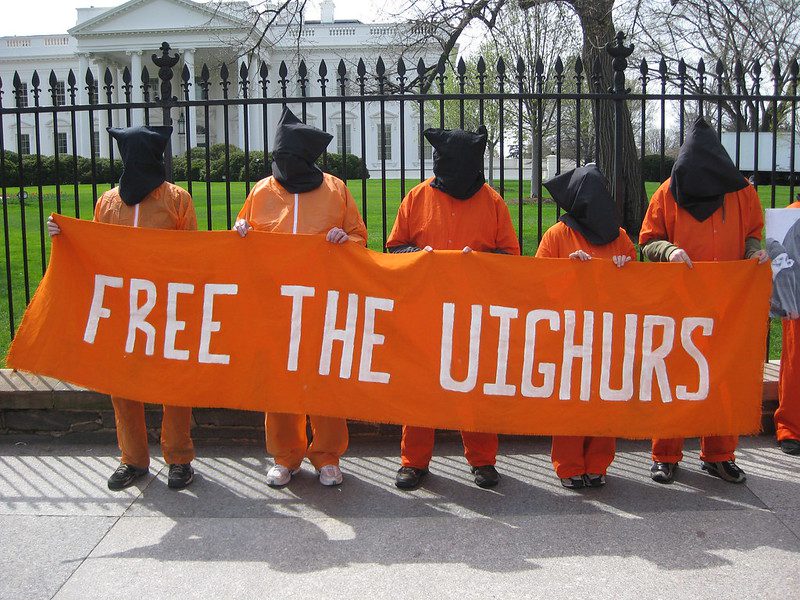
The Chinese government is committing atrocities and human rights violations against the Turkic Muslims in the Xinjiang Uighur Autonomous Region, a northwestern province of China. Chinese authorities detained at least 800,000 and up to 2 million Muslims since 2017; mainly Uyghurs, a predominantly Turkic-speaking ethnic group, along with other ethnic Muslim minorities.
China’s Motives
Riots broke out in Xinjiang in 2009 due to Uyghur mass protests against cultural and economic discrimination and state-incentivized migration of Han Chinese, the dominant ethnic group in China. Since then, the Chinese government worries that Uyghurs hold separatist, religious extremist ideas. Therefore, it justifies its repressive actions as necessary measures in response to threats of terrorism.
Chinese officials launched a Strike Hard Campaign against Violent Extremism in 2014 in Xinjiang, but the repression escalated significantly when Chen Quanguo, the communist party secretary, became the leader of Xinjiang in 2016. Prior to this, Chen Quanguo ruled Tibet from 2011 to 2016, where he implemented a dual strategy to restore and secure national security and social stability. He used aggressive policies to reduce ethnic differences and assimilate Tibetans to Han Chinese, such as re-education programs and intermarriage initiatives. Aside from these ethnic policies, Chen established dense security systems to reinforce this cultural transformation, including militarized surveillance systems. After ruling Tibet, people got to know Chen for restoring stability through the enforcement of the Chinese Communist Party (CCP) rule and for his innovative ethnic policies, which he expanded in Xinjiang, targeting the Uyghur population.
Xinjiang is of particular strategic and economic importance for Beijing as it has the country’s largest natural gas and coal reserves with 40 percent of the national total. Xinjiang is a key area for China’s Belt and Road Initiative, a massive global trade project, as it connects China to the rest of Asia and Europe. Therefore, Beijing may be repressing the Uyghur in Xinjiang for economic reasons to protect its Belt and Road Initiative project in which China invested between $1 to 8 trillion.
China’s Human Rights Violations and Abuses
The autonomous region of Xinjiang changed its legislation to allow local governments to set up re-education camps to intern Muslims, where they must renounce aspects of their religion, learn Mandarin Chinese and praise the CCP, in order to combat extremism. As stated by the Chinese Communist Youth League in March 2017, “the training has only one purpose: to eradicate from the mind thoughts about religious extremism and violent terrorism, and to cure ideological diseases.”
Former detainees reported the use of stress positions, beatings, sleep and food deprivation by authorities, as well as the mistreatment and torture in some mass internment facilities as punishment for resisting or failing to learn the lessons taught.
The 11 million Uyghur living in Xinjiang outside of the camps also endure the tightening repressive policies of Chinese authorities who subject people to pervasive surveillance. Authorities use cutting-edge technology including artificial intelligence, big data and phone spyware. The CCP leader Chen Quanguo installed a grid-management system in Xinjiang, which divides the cities into squares of 500 people. A police station monitors each square that is in charge of regularly checking IDs, fingerprints and searching phones.
Global Response to China’s Human Rights Violations
The E.U. issued a statement in 2018 demanding China to respect the freedom of religion and the rights of minorities, as well as change its policies in Xinjiang. In July 2019, over 20 countries collectively signed a letter to the U.N. High Commissioner for Human Rights, condemning China’s human rights violations against Uyghurs in Xinjiang. The letter urges China to allow U.N. experts access to the camps. However, no Muslim-majority country co-signed the joint statement. Instead, Saudi Arabia alongside 36 other countries signed their own letter in which they praised China’s achievements and argue that “human rights are respected and protected in China in the process of counter-terrorism and deradicalization.”
Most human rights organizations and non-governmental organizations also condemned China’s detention of Uyghurs. This was demonstrated in a joint letter that a coalition of five human rights organizations (including Amnesty International, Human Rights Watch, and more) issued to the U.N. Secretary-General, urging the U.N. to take action.
On October 7, 2019, the U.S. blacklisted 28 Chinese organizations, both government agencies and top surveillance companies. This marked the U.S.’s first concrete action in response to China’s human rights violations against Uyghurs, along with the imposed visa restrictions on the Chinese government and communist party officials.
Conclusion
China still dismisses all allegations of human rights violations and uses its permanent seat on the U.N. Security Council to block human rights issues discussions. Immediate investigations on China’s human rights violations against Uyghurs must transpire and the U.N. should access detention camps. The situation in Xinjiang conveys the level of vulnerability ethnic minorities face, and the urgency for the international community to take concrete action.
– Andrea Duleux
Photo: Flickr

8 Facts About Life Expectancy in Senegal
The Republic of Senegal is a country on the West African coast bordered by Mauritania, Mali, Gambia and Guinea-Bissau. Around 46.7 percent of Senegal’s 15.85 million residents live in poverty. Today, life expectancy at birth in Senegal is 67.45 years, representing a significant improvement from 39.24 years in 1970 and 59.7 years in 2000. Many factors contribute to a country’s life expectancy rate including the quality and access to health care, employment, income, education, clean water, hygiene, nutrition, lifestyle and crime rates. Keep reading to learn more about the top eight facts about life expectancy in Senegal.
8 Facts About Life Expectancy in Senegal
These eight facts about life expectancy in Senegal have shown that the combined efforts of nonprofits and the Government of Senegal are making real progress on many fronts that contribute to life expectancy. These efforts must continue and intensify to reduce poverty and increase life expectancy in Senegal.
– Camryn Lemke
Photo: Flickr
Maxima Acuña: In Defense of the Land
News about native peoples fighting for the rights to their land is, sadly, nothing new. For many years, the indigenous populations of many nations around the world have struggled to keep their rights to their land. They are often ignored by their own country’s governments as well as international entities. However, that didn’t stop Maxima Acuña from fighting against the powerful Newmont and Yanacocha Mining Companies in defense of her land.
The Case
Maxima Acuña’s battle started one day when the Peruvian Mining Company Yanacocha, through the Newmont Mining Company, claimed rightful ownership of her property. Acuña’s land, as well as four lagoons near it, were the new grounds for the Conga mining project. While Conga was projected to be one of the most ambitious gold extraction projects, it didn’t sit well with the farmers that live around the land.
For the successful extraction of the materials, four critical lagoons would have to be “sacrificed” as they would be turned into waste pits or be completely dried out. Since 2011, the Newmont Mining company has been trying to claim the rights to her land. Maxima and her family were told to move as they were on official mining grounds. But, there was no way Maxima Acuaña would go out without a fight.
The Brutality of the Authorities
Because of her refusal, Yanacocha and the Newmont committed several acts of brutality and abuse of power against Maxima Acuña and her family. On more the one occasion, armed men destroyed her home and crops. They sent death threats and even “beat her and one of her daughters unconscious.” Despite all of this, Maxima refused to leave her land. The local authorities accused her of invasion of private land and sentenced her to three years in prison with a $2,000 fine. Luckily, through the help of an environmental NGO called GRUFIDES, Maxima Acuña was released from her sentence and granted legitimate property rights.
With the majority of the local population opposing the Yanacocha and the Conga project and the unconditional support of Grufindes, Maxima Acuña had the means to fight the mining companies. GRUFIDES fights for the environmental rights that were ignored by the Conga Project. With their help, Maxima Acuña was able to overturn the court’s decision. This huge win was not only for her but also for the farmers protesting the Conga project and protecting the lakes. Maxima Acuña now had the support of the local and even the international community.
The Lesson of Hope
In 2016, she became the winner of The Goldman Environmental Prize, making her case known in America. In March 2019, Maxima Acuña and her family won a vital appeal against the Newmont Mining Company against the company’s abuse. The motion guaranteed a fair trial for both parties, something big for Peruvian Farmers.
For many years, the abuse against indigenous farmers has been a topic that many choose to ignore. However, Maxima Acuña’s case is not the first and won’t be last. Her case shows that the fight is not over yet. Even with all the stakes against the environment, even the big companies can overthrow a fighting spirit.
– Adriana Ruiz
Photo: Flickr
Zambia’s Growing Energy Sector
Zambia is improving livelihoods, especially for those residing in rural areas without electricity access, through investing in its growing green energy sector. About 70 percent of the population—more than eight million Zambians—lack electricity and could benefit from clean, affordable and reliable power. Electricity access in rural regions is less than 10 percent. Zambia is changing that statistic by focusing on providing affordable and widespread green energy to the nation. Zambia is currently one of the top 10 producers in hydroelectric power, but it is currently focused on diversifying into underappreciated areas within Zambia’s growing energy sector.
Green Energy Developments
The Power Africa: Beyond the Grid Fund for Zambia (BGFZ) emerged in 2016. Sweden funded the BGFZ and the Renewable Energy and Energy Efficiency Partnership (REEEP) manages it. The aim is to provide affordable and clean sustainable energy to Zambia. The program works with the government to provide power for rural areas. As of 2019, more than 100,000 households, reaching 500,000 Zambians, received power as part of the program.
The program’s goal is to reach 1.6 million Zambians by 2021. BGFZ and its partners have created more than 1,100 jobs, about 2.3 MW of energy and affected more than 1,400 businesses. According to a study on the BGFZ program’s impact on the population, more than 25 percent have opened new income streams thanks to electricity access. Also, 87 percent of people in the survey stated that they spend less on lighting and power. Participants in the study mentioned that not having to use candles also alleviates potential fire hazards and helps them feel more at ease with children at home.
Enel Green Power, a renewable energy business, will build Zambia’s first power plant as part of the World Bank Group’s Scaling Solar program. It will be a 34 MW solar PV plant in Ngonye and is part of Zambia’s goal of diversifying its energy sector and providing power to the entire population. Zambia’s Industrial Development Corporation (IDC) carries out the project. Enel owns about 80 percent of the project and the IDC owns 20 percent.
“With the connection to the grid of Ngonye in Zambia, we are reconfirming our commitment to helping the country leverage on its vast wealth of renewable resources, which poses a great opportunity for growth,” said Antonio Cammisecra, Head of Enel Green Power. The facility should generate 70 GWh once complete.
Widespread Impact of Power
Electricity provides much more than a simple electric light in a room. It enables schools to use the technology they could not utilize without power. Computers, calculators and lights to illuminate a chalkboard are all benefits that appear simple but are important in educating and developing a country. Educating a country is yet another way of reducing poverty, yet that is hard to achieve without electricity, whether from green sources or traditional sources.
Health care is another area that Zambia’s growing energy sector impacts. Equipment, such as x-ray machines, requires some sort of power and providing electricity to almost 70 percent would affect more than 8 million Zambians. An important and basic aspect of developing a country is electricity access, as an economy cannot thrive without a widespread and reliable power source. Zambia understands that developing the energy sector, particularly green technology, is the first step to not only sustainable energy and economic development, but also the health of its people.
Outlook
Zambia’s growing energy sector is improving thanks to involvement from businesses, the government and the World Bank. One of Zambia’s largest food suppliers is constructing an approximately $42 million 50 MW solar farm, demonstrating that major businesses are also transitioning into affordable and sustainable energy sources. Zambia’s impact on providing electricity to its people has only begun in recent years, yet its progress shows promise in helping to develop the economy through increasing electricity access.
– Lucas Schmidt
Photo: Flickr
10 Facts About Life Expectancy in Kyrgyzstan
Kyrgyzstan is a landlocked country in Central Asia with a population of 6.4 million. Since its independence from Russia in 1991, Kyrgyzstan has had unstable political conditions, leading to poor health conditions. Here are 10 facts about life expectancy in Kyrgyzstan.
10 Facts About Life Expectancy in Kyrgyzstan
These 10 facts about life expectancy in Kyrgyzstan shed light on health and living conditions in the nation. With new health initiatives being undertaken in the country, there is hope that life expectancy rates will continue to improve.
– Navjot Buttar
Photo: UNICEF
Helen Keller International is Combating Poverty
Helen Keller International (HIK) is an organization that is dedicated to helping the world’s poor by combating poverty, blindness, poor health and malnutrition for all people. It predominately helps those who are less fortunate and do not have accessibility to the resources that help maintain an adequate living.
The Main Focus
HIK primarily focuses on preventing blindness in people by providing them with cataract surgery, vision correction and distributing treatments and cures for tropical diseases. This is how it plans on combating poverty in developing countries. It currently has more than 120 programs in about 20 countries all over the world.
It works with various partners to implement strategies that will combat poverty and strengthen these programs. Some of its partners include organizations such as the West African Health Organization, Food and Agriculture Organization, UNICEF, World Health Organization and the World Food Program.
Helen Keller International’s Accomplishments
According to reports from Impact Information in 2018, HIK provided 15,000 free precision glasses to disadvantaged youth and performed 40,000 cataract surgeries.
In 2014, USAID funded a five-year Morbidity Management and Disability Prevention Project (MMDP) to strengthen illness management and prevent disabilities in African countries. HIK has led the MMDP project in Burkina Faso, Cameroon and Ethiopia since July 2014. As a result, thousands of people have benefited from HIK’s help and dedication to the project.
The project combats painful diseases such as trichiasis which can cause scarring to the cornea because it causes the eyelash to grow backward. The project also treats hydrocele, which causes the male scrotum to swell causing extreme pain. This is most common in male newborns.
HIK’s work with the MMDP project in the countries above has helped 2.1 million people get screenings for trichiasis and 76,000 people received trichiasis surgery. Additionally, HIK was able to train 280 trichiasis surgeons. This organization also provided hydrocele surgery to over 2,000 men and trained 200 hydrocele surgeons. HIK has changed the lives of many people at risk.
Global Impact
Helen Keller International is combating poverty by improving the lives of the world’s poor at a global level as well. The MMDP project improves data availability and use by sharing knowledge worldwide. The project also assisted in developing tools and resources for communities to use internationally in trachoma and LF programs around the world.
HIK believes that neglected tropical diseases are direct consequences of poverty. To combat this poverty it has turned its focus to protect health. HIK aids in the fight against five diseases including trachoma, river blindness, intestinal worms, snail fever and lymphatic filariasis. All of these diseases cause extreme pain and can even lead to death.
To combat these diseases, HIK has helped deliver thousands of trachoma surgeries to poor communities and will continue to do so in hopes of eliminating trachoma by 2020. The organization has helped develop a platform that is effective in the treatment of river blindness across Africa. HIK also helps developing countries distribute deworming medication to children in at-risk communities.
Helen Keller International is combating poverty all over the world through efforts to protect health and advert the causes of blindness and more in poor countries. Through its efforts, it has aided many in poverty and that number should only grow.
– Jessica Jones
Photo: Flickr
Improving Literacy Rates in South Sudan
The Republic of South Sudan, more commonly known as South Sudan, has one of the lowest literacy rates in the world. It is a very young nation, having only declared independence from the Republic of Sudan in July 2011. However, recent data shows that only 26.8 percent of South Sudanese people aged 15 or older are literate. Additionally, while 35 percent of men can read and write only 19.2 percent of women possess these important skills. The government has created several initiatives over the past few years to improve literacy rates in South Sudan.
Factors Affecting Literacy
One reason literacy rates in South Sudan are so high is the fact that approximately 2 million, or about 70 percent of children in South Sudan are out of school, mostly young girls. Instead of attending primary school, children often work alongside their families for survival.
Implementing quality literacy programs for children is also costly, and South Sudan has been struggling to fund equal opportunities for all students. For the many who are unable to communicate via writing or consume written media, radio is often a popular alternative for getting the news.
Efforts to Improve Literacy
In recent years, the government has worked to improve literacy rates for both children and adults in South Sudan. For school-aged children, The General Education Strategic Plan, 2017-2022 has been proposed. Also referred to as the Strategic Plan, it has three primary goals: “to improve the quality of general education; to enhance the management capacity of senior staff of the Ministry, State Ministries, the County Education Department and affiliated institutions; and to promote Technical and Vocational Education and Training (TVET) to improve the employability of youth and adults in the next five years.”
According to the Strategic Plan, the government’s alternative education system (AES) has three programs working to improve literacy rates and overall educational quality in South Sudan:
As gender disparities are significant, specific efforts have been created that focus on providing education for Sudanese girls. In addition to the Community Girls’ School, funding from an organization called Girls’ Education in South Sudan (GESS) will help more women and girls be able to attend school, thus improving the literacy rate among South Sudanese girls and women.
There are also two programs that have been specifically created for adults who cannot read or write: the Basic Adult Literacy Programme (BALP) and the Functional Adult Literacy Program (FALP). Intensive English courses (IECs) are included in these programs, giving participants the opportunity to improve their skills with the English language.
Moving Forward
Addressing low literacy rates in countries such as South Sudan is crucial to reducing global poverty. Without the ability to read or write, communication skills are weakened and employment opportunities are limited. Therefore, giving people the chance to access to an improved education such as literacy skills lowers the chance of one being in poverty and gets them on the path to an overall higher quality of life.
– A. O’Shea
Photo: United Nations
3 Nonprofits Helping Syrian Refugees
The Syrian civil war has been ongoing since 2011, making the Syrian refugee population the world’s largest group forcibly displaced from their country. At the end of 2018, there were 13 million refugees from Syria, accounting for more than half of the country’s total population. The vast majority of Syrian refugees in Lebanon (70 percent) and Jordan (90 percent) are living below the poverty line. Fortunately, a number of groups are stepping in to deliver humanitarian aid to Syrian refugees. Keep reading to learn more about these three nonprofits helping Syrian refugees.
3 Nonprofits Helping Syrian Refugees
– Jordan Miller
Photo: Flickr
The Water Crisis in the Middle East
Afghanistan
The drought has drained natural water sources such as the Kabul River Basin, the primary source of water for the nation’s capital. The established system for distributing water is no longer applicable, so civilians must draw water from unofficial wells. In Afghanistan, a country with over 35 million people, 87 percent of accessible water is polluted. Fortunately, India is providing assistance with the Afghan-India Friendship Dam on the Hari River. With further plans to build another dam on the Kabul River, Afghanistan will have water for irrigation and will not have to live with the threat of flash floods.
Syria
In 2006, a massive drought began that would displace tens of thousands of Syrian farmers. By 2011, there were over a million angry, unemployed former farmers in the country ready to fight in a violent civil war that would go on for years. If one said that the water crisis in the Middle East was the proverbial lit match in the powder keg, it would be inaccurate. One cannot, however, deny that it did fan the flames.
Now that tensions are dying down, Syrian civilians have little infrastructure to help provide them with water. Militant groups that occupy water plants and reservoirs hold monopolies on the water for entire regions. Oftentimes, these groups distribute water selectively to blackmail their enemies. Prior to the civil war that started in 2011, water allocation was already inequitable. President Bashar al-Assad allocated more water to fellow members of his particular sect of Islam. Now that Syria is rebuilding its infrastructure, there exists an opportunity to distribute water equally across the country in order to help prevent humanitarian disasters like this in the future.
Egypt
Even in the time of the pharaohs, Egypt has owed its life to the Nile. The Nile is the primary source of water for a country with rice as its number one agricultural export. Rice requires a great deal of water for cultivation and harvest. One kilo of rice needs about 3,000 liters of water. The water in the Nile now contains dead fish due to heavy metals from industrial pollution. Using heavily polluted water diminishes crop yields leading to a further strain on resources.
Egypt faces more than just a drop in the quality of water. As a result of the Blue Nile dam that Ethiopia built, Egypt is also concerned about the quantity of water. By building a hydroelectric dam on the Nile upstream from Egypt, Ethiopia is developing a power grid to reach 86 million Ethiopians living without electricity. Consequently, this will divert about a quarter of the Nile’s water away from Egypt. The Nile supplies 85 percent of Egypt’s fresh water. Egypt has the most to lose in the event of armed conflict breaking out because of its water scarcity, so it is now pushing for diplomatic and scientific solutions to the problem. Negotiating with Ethiopia to share in the dam’s benefits and investments in desalination technology is helping to alleviate the water crisis.
The water crisis in the Middle East is serious and requires much work to alleviate the problem. Through the building of better infrastructure, however, Egypt, Syria and Afghanistan should be able to improve.
– Nicholas Smith
Photo: Flickr
China’s Human Rights Violations Against the Uyghurs
The Chinese government is committing atrocities and human rights violations against the Turkic Muslims in the Xinjiang Uighur Autonomous Region, a northwestern province of China. Chinese authorities detained at least 800,000 and up to 2 million Muslims since 2017; mainly Uyghurs, a predominantly Turkic-speaking ethnic group, along with other ethnic Muslim minorities.
China’s Motives
Riots broke out in Xinjiang in 2009 due to Uyghur mass protests against cultural and economic discrimination and state-incentivized migration of Han Chinese, the dominant ethnic group in China. Since then, the Chinese government worries that Uyghurs hold separatist, religious extremist ideas. Therefore, it justifies its repressive actions as necessary measures in response to threats of terrorism.
Chinese officials launched a Strike Hard Campaign against Violent Extremism in 2014 in Xinjiang, but the repression escalated significantly when Chen Quanguo, the communist party secretary, became the leader of Xinjiang in 2016. Prior to this, Chen Quanguo ruled Tibet from 2011 to 2016, where he implemented a dual strategy to restore and secure national security and social stability. He used aggressive policies to reduce ethnic differences and assimilate Tibetans to Han Chinese, such as re-education programs and intermarriage initiatives. Aside from these ethnic policies, Chen established dense security systems to reinforce this cultural transformation, including militarized surveillance systems. After ruling Tibet, people got to know Chen for restoring stability through the enforcement of the Chinese Communist Party (CCP) rule and for his innovative ethnic policies, which he expanded in Xinjiang, targeting the Uyghur population.
Xinjiang is of particular strategic and economic importance for Beijing as it has the country’s largest natural gas and coal reserves with 40 percent of the national total. Xinjiang is a key area for China’s Belt and Road Initiative, a massive global trade project, as it connects China to the rest of Asia and Europe. Therefore, Beijing may be repressing the Uyghur in Xinjiang for economic reasons to protect its Belt and Road Initiative project in which China invested between $1 to 8 trillion.
China’s Human Rights Violations and Abuses
The autonomous region of Xinjiang changed its legislation to allow local governments to set up re-education camps to intern Muslims, where they must renounce aspects of their religion, learn Mandarin Chinese and praise the CCP, in order to combat extremism. As stated by the Chinese Communist Youth League in March 2017, “the training has only one purpose: to eradicate from the mind thoughts about religious extremism and violent terrorism, and to cure ideological diseases.”
Former detainees reported the use of stress positions, beatings, sleep and food deprivation by authorities, as well as the mistreatment and torture in some mass internment facilities as punishment for resisting or failing to learn the lessons taught.
The 11 million Uyghur living in Xinjiang outside of the camps also endure the tightening repressive policies of Chinese authorities who subject people to pervasive surveillance. Authorities use cutting-edge technology including artificial intelligence, big data and phone spyware. The CCP leader Chen Quanguo installed a grid-management system in Xinjiang, which divides the cities into squares of 500 people. A police station monitors each square that is in charge of regularly checking IDs, fingerprints and searching phones.
Global Response to China’s Human Rights Violations
The E.U. issued a statement in 2018 demanding China to respect the freedom of religion and the rights of minorities, as well as change its policies in Xinjiang. In July 2019, over 20 countries collectively signed a letter to the U.N. High Commissioner for Human Rights, condemning China’s human rights violations against Uyghurs in Xinjiang. The letter urges China to allow U.N. experts access to the camps. However, no Muslim-majority country co-signed the joint statement. Instead, Saudi Arabia alongside 36 other countries signed their own letter in which they praised China’s achievements and argue that “human rights are respected and protected in China in the process of counter-terrorism and deradicalization.”
Most human rights organizations and non-governmental organizations also condemned China’s detention of Uyghurs. This was demonstrated in a joint letter that a coalition of five human rights organizations (including Amnesty International, Human Rights Watch, and more) issued to the U.N. Secretary-General, urging the U.N. to take action.
On October 7, 2019, the U.S. blacklisted 28 Chinese organizations, both government agencies and top surveillance companies. This marked the U.S.’s first concrete action in response to China’s human rights violations against Uyghurs, along with the imposed visa restrictions on the Chinese government and communist party officials.
Conclusion
China still dismisses all allegations of human rights violations and uses its permanent seat on the U.N. Security Council to block human rights issues discussions. Immediate investigations on China’s human rights violations against Uyghurs must transpire and the U.N. should access detention camps. The situation in Xinjiang conveys the level of vulnerability ethnic minorities face, and the urgency for the international community to take concrete action.
– Andrea Duleux
Photo: Flickr
Understanding the Benefits of Cool Roofs
First researched in the 1980s, cool roofs only became a reality around 2001. This cooling technology naturally cools the house, while being cheaper and more energy-efficient than traditional roofs, prompting many parts of the world to consider shifting towards them. The world will benefit financially, environmentally and even comfort-wise from the addition of cool roofs.
The Problem
Over 1 billion people in developing countries face significant risks from extreme heat, with no access to electricity for cooling. Another 2.3 billion can only afford inefficient, unhealthy air conditioning models that use HFC gases that are thousands of times more polluting than carbon dioxide. The energy demand from developing countries is predicted to climb more than 33-fold by 2100. Americans alone consume the same amount of electricity for air conditioning as the total electricity used for all the needs of 1.1 billion people in Africa. The introduction of cool roofs, though a seemingly insignificant change, would not only help people in developing nations but those in developed countries as well.
How it Works
Cool roofs are created by using cool roof coatings, which are thick, white or reflective paint applied to the roof, it covers or shingles to protect the roof from UV light, chemical and water damage, maintaining and restoring the roof itself, making it last longer than traditional roofs. The paint reflects the sunlight, keeping the house cooler than can a traditional roof, which absorbs the sunlight instead. In so doing, cool roofs can reduce indoor temperatures by 3.6-5.4 degrees Fahrenheit (2-3 degrees Celsius) and can reduce the internal temperatures of individual rooms by 20 percent. As for urban heat island effects, they can reduce urban temperatures up to 7.2 degrees Fahrenheit (4 degrees Celsius).
Benefits
In addition to reducing cooling costs and increasing roof life, cool roofs are environmentally friendlier than traditional roofs. They reduce air temperature, retard smog formation and decrease power plant emissions (carbon dioxide, sulfur dioxide, nitrous oxides, mercury) and reduce electricity demand in the summer. When the house itself is already cool during the summer, people do not need to use as much air conditioning, thus reducing the usual strain on the electricity grid.
The people who would likely benefit first from the addition of cool roofs are the estimated 630 million people that may already have access to electricity, but have poor quality housing and may not be able to afford a fan or the money to run it. Regions with the highest population of these people are China, India, Nigeria, Brazil, Pakistan, Bangladesh, Indonesia, the Philippines, Sudan and Iraq.
Regions That Are Shifting To Cool Roofs
Mexico is participating in the Global Superior Energy Performance Partnership (GSEP) and is working towards installing more cool roofs. Mexican authorities are not yet aware of the advantages of cool roofs, thus the goal is to communicate the impact on energy efficiency, economy, health and comfort that cool roofs will have on the population. This technology saves energy and saves money on air conditioning as well.
South Africa is also part of the GSEP and has begun a Cool Surfaces Project, a collaborative agreement between the American and South African Departments of Energy. People in South Africa need technology that will provide them with the benefits that cool roofs provide (fire retardancy, passive-energy usage, waterproofing, low cost, low maintenance, cooling), making it a perfect fit for them. This project will save them a lot of money and energy, as well as influencing nearby regions to follow suit. Kheis, a rural community of about 15,000 in South Africa, is one of the leaders in developing this cool roof approach to provide a respite from the heat.
Globally, when less money and energy is devoted towards air conditioning either in the first or the third world, more can be done to confront other problems. The installation of cool roofs creates jobs, reduces the strain on electricity grids, naturally cools buildings and even lowers the net temperature of local areas.
– Nyssa Jordan
Photo: Flickr