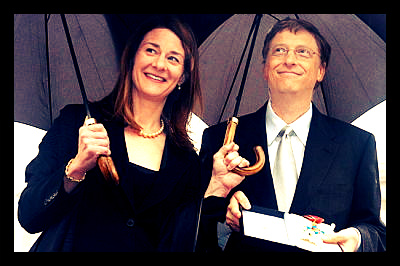
At the beginning of this year, there was a huge reaction to the 2014 Annual Gates Foundation letter as Bill Gates predicted the end of poverty by focusing on three myths about poverty. With that in mind, here is a look back at six end of poverty quotes from the foundation. Each quote demonstrates the hope and passion the Gates Foundation has in their mission to make the world a better place and demonstrates how tirelessly they will continue to work for the cause in the future.
1. In 2009, Gates states the observations he has made regarding the world’s economic crisis and his opinion about the wealth gap. In light of Oxfam’s recent report about the inequity between the rich and poor, it is clear that Gates believes the wealthy have a responsibility to help those who are less fortunate.
“I am impressed by individuals who continue to give generously even in these difficult times. I believe that the wealthy have a responsibility to invest in addressing inequity. This is especially true when the constraints on others are so great. Otherwise, we will come out of the economic downturn in a world that is even more unequal, with greater inequities in health and education. There is no reason to accept that, when we know how to make huge gains over the long term.”
2. In 2010, Gates highlights the importance of innovation as a way to help people out of poverty. He discusses the “bleak” outcomes that can be avoided when innovation becomes a priority and when people choose to believe in innovation as a solution.
“With vaccines, drugs and other improvements, health in poor countries will continue to get better, and people will choose to have smaller families. With better training, and access to markets, farmers in poor countries will be able to grow more food. The world will find clean ways to produce electricity at a lower cost, and more people will lift themselves out of poverty.”
3. In 2011, Gates made a compelling argument for the importance of foreign aid and the responsibility of society as a whole to take care of its people, as this will produce a more stable, healthier and better world. During the year, Gates focused on providing vaccines by working with pharmaceutical companies, like GAVI, who raised over $3 billion and saved millions of lives.
“I believe it is the rich world’s enlightened self-interest to continue investing in foreign aid. If societies can’t provide for people’s basic health, if they can’t feed and educate people, then their populations and problems will grow and the world will be a less stable place. Whether you believe it a moral imperative or in the rich world’s enlightened self-image, securing the conditions that will lead to a healthy, prosperous future for everyone is a goal I believe we all share.”
4. In 2012, Gates showed his dedication to helping the poor become self-sufficient, especially in terms of the foundation’s global development and global health programs.
“The world faces a clear choice. If we invest relatively modest amounts, many more poor farmers will be able to feed their families. If we don’t, one in seven people will continue living needlessly on the edge of starvation. My annual letter this year is an argument for making the choice to keep on helping extremely poor people build self-sufficiency.”
5. In 2013, Gates looked forward to the continued innovation and success in making the lives of the poor even better.
“The lives of the poorest have improved more rapidly in the last 15 years than ever before, yet I am optimistic that we will do even better in the next 15 years. After all, human knowledge is increasing.”
6. And finally in 2014, Gates calls all who want to join him in changing the world. He, furthermore, predicts that there will not be any more poor nations by 2035, the year that Gates will turn 80.
“We all have the chance to create a world where extreme poverty is the exception rather than the rule, and where all children have the same chance to thrive, no matter where they’re born. For those of us who believe in the value of every human life, there isn’t any more inspiring work under way in the world today.”
– Julie Guacci
Sources: Gates Foundation: Annual Letter 2009, Forbes: Gates’ Life’s Goal, Gates Foundation: Conclusion, Forbes: Gates’ Second Coming, Gates Foundation: Annual Letter 2013, Gates Foundation: Annual Letter 2012, Gates Foundation: Annual Letter 2011, Gates Foundation: Annual Letter 2010
Photo: Gates Foundation

10 Nursery Rhymes from Around the World
No matter the continent, nursery rhymes are the soundtrack to childhood. Their purposes vary, from soothing a child to sleep, to singing loudly on the playground to learning the ABCs. They are important tools to teach kids about nature, family and social practices. At any age, rhymes are fun to recite and provide a sense of innocence and playfulness that is too often robbed by economic and social hardships. More importantly, they show that children are children, no matter where they are born. Here are a few popular verses from cultures across the globe:
United States:
A-tisket, a-tasket
A green and yellow basket
I sent a letter to my love
And on the way I dropped it
I dropped it, I dropped it
Yes, on the way I dropped it
A little boy picked it up
And put it in his pocket
Kenya:
A tree planted on the riverbank
Look at its leaves
Playing with the wind
Even us, let’s play with the wind
Lesotho:
An elephant
Had a very long nose!
He went to take a mouse
He went to take a lizard
He tied them to a tree
Bolivia:
I have a doll dressed in blue,
Little white shoes and her lace shawl
I took her for a stroll, she got sick
I have her in bed in a lot of pain
Then I called the doctor and he prescribed me
A little prescription that cured her
Haiti:
Uncle Bouki, Uncle Bouki,
Are you sleeping? Are you sleeping?
Get up to play the drum, get up to play the drum
Ding, ding, dong! Ding, ding, dong!
Romania:
The stone bridge broke down,
The water came and took it down!
We’ll build another one,
Another one that will last and is even more beautiful!
We’ll build another one,
Another one that will last and is even more beautiful!
Greece:
Our kind grandmother
Has chickens in her yard
Chickens and chicks
Geese and Goslings
Our kind grandmother
Has a sewing machine
And sews and patches
Our grandfather’s pants
Sri Lanka:
In this orange tree, there are many ripe oranges
And branches hanging down.
Two oranges are enough for my sister and me.
We are not naughty children
Who pick all the oranges.
Turkey:
Sound of the birds all over the lowland
Everybody feels admiration for it
The honeybees settle on the flowers
The sweet lambs are looking for some grass
The leaves on the green trees
All these fragrant and fresh soils
French Polynesia:
Sleep baby
Mommy is at the reef
Daddy is in the valley
Looking for bananas
To make cooked bananas for baby
These nursery rhymes expose the beautiful similarities and variances of childhood in different cultures and show how each country approaches educational development through music.
– Stefanie Doucette
Sources: New York Times, Mama Lisa’s World
Photo: Fun Links Daily
5 Facts About Hunger in Rwanda
The Republic of Rwanda is a small sovereign state in the Eastern part of Central Africa. Rwanda ranked at 166 of 187 countries on the UNDP Human Development Index in 2011. Rwanda also has the highest population density in the region with 416 people per square kilometer.
Low income, limited natural resources, and food and water insecurity pose a problem for citizens in Rwanda every day. In the years following the Rwandan Genocide in 1994, international rebuilding efforts have been on the ground trying to make sustainable changes to alleviate some of the hunger and water issues.
Here are five facts that explain the state of hunger in Rwanda and how it may change in the coming years:
Even though there is a lot of strain on the country today, organizations have been working with the government to address one of Rwanda’s major problems: food insecurity. Agriculture was the country’s main sector before the genocide, and since then, major efforts have been made to make it profitable one more.
Updating the agricultural practices is what the World Food Programme credits with directly reducing the number of food insecure people.
The country hopes that with the reliance on agricultural programs it will improve its GDP to US$900 by the year 2020, up US$380 from its current GDP. Rwanda was also the first country to sign the Comprehensive Africa Agriculture Development Programme (CAADP), meaning that addressing malnutrition and food insecurity is one of the government’s main priorities.
Even though Rwanda still has a long way to go, the government has been taking steps in the right direction that could provide a template for other countries in the region to follow.
– Colleen Eckvahl
Sources: World Food Programme, World Vision
Photo: Rising Continent
4 Issues Contributing to Malnutrition in the DRC
Kinshasa, DR Congo
The second largest country in Africa and is located in the middle of the continent. Since the 1990’s the country has been in a state of political unrest and civil war which is the cause of many of the other problems in the region, such as disease, food insecurity, human rights violations, and violence against women.
Here are four issues that contribute to nearly 6.3 million people remaining food insecure and over half of the children under the age of 5 classified as malnourished in the DR Congo:
– Colleen Eckvahl
Sources: The International Campaign to Stop Rape and Gender Violence in Conflict , WFP, WHO
Photo: This is Africa
Typhoon Recovery in the Philippines: 100 Days
It’s been more than 100 days after the devastating Typhoon Haiyan hit the Philippines and recovery efforts are still underway for those who have been displaced from their homes.
The storm, one of the most powerful ever recorded, hit the archipelago on November 8th, killing nearly 6,000 people and displacing 4.1 million.
A government-led recovery effort, known as the Strategic Response Plan (SRP), was launched following the typhoon. The plan covers the next twelve months and requires $788 million, of which 45% has already been received.
Along with these typhoon recovery efforts, the United Nations and its affiliated partners have helped to provide food, medicine, water, and sanitation and hygiene assistance to those affected. Tents and tarpaulins have been distributed to approximately 500,000 families, but many more still remain without shelter.
UN Humanitarian Coordinator for the Philippines, Luiza Carvalho notes that, “the need for durable shelter for millions of people whose homes were damaged or destroyed is critical.”
In Tacloban, a city of 250,000, major typhoon recovery efforts have been underway to pump money back into the local economies. Coconut farmers and fishermen represent the backbone of the economy in this area but their livelihoods have been severely threatened by the storm. In response, the UN development programme has recently implemented both short-term and long-term plans to help farmers get back on their feet.
Oxfam has noted that the Filipino government has been slow to deliver funds for agricultural and reconstruction support.
Thanks to generous donor contributions, great things have been achieved in the relief phase of the recovery effort. In the coming weeks, it is critical that the international community continues to provide support to those whose lives have been devastated by Typhoon Haiyan.
In a recent UN statement, Carvalho noted, “the Filipino people should be commended for the pace of progress that we have seen in the first 100 days. But we cannot afford to be complacent.”
– Mollie O’Brien
Sources: The Guardian, UN
Photo: Aljazeera
Conditions for Garment Workers in Bangladesh
When people buy from brands like Nike and shop at stores like H&M and Gap, they do not pay much attention to how the products arrived at the stores. In many cases, these clothing products are produced in sweatshops in developing countries like Bangladesh, Cambodia, and Indonesia. Almost half of the population in Bangladesh lives off of less than a dollar a day.
Garment workers in Bangladesh toil day after day under extremely harsh conditions for low wages, sometimes handling dangerous chemicals with their bare hands and inhaling toxic fumes due to poor ventilation in many factories.
In April of 2013, an eight story building in Bangladesh called Rana Plaza collapsed leaving over 100 dead and over 2,000 injured.
The poor conditions of the factory itself and the lack of safety precautions taken to ensure its workers’ well-being were neglected and therefore led to the collapse. In addition to this incident, there has been a history of factory mishaps over the past couple of years in Bangladesh. In November of 2012, the Tazreen garment factory in Bangladesh caught fire and killed 112 of its workers.
At this time, the factory was producing goods for Walmart.
Besides the incidents themselves, it is also important to focus on the working conditions and the violations of human rights that happen daily in factories like these. According to the Institute for Global Labor and Human Rights, workers in the Tazreen factory work 72-81 hours per week. Their salary depends on their sewing skill; senior sewing operators earn at minimum 23 cents per hour and junior sewing operators earn 21 to 22 cents an hour.
As a majority of the workers are women, abuse is common and some are even denied maternity leave — blatant violations of human rights that have been occurring for years. Even after one tragedy, further precautions are not taken to ensure the safety of the workers.
An article from the Daily Mail accounts a Canadian journalist who worked undercover in Bangladesh and witnessed the atrocities of one of the smaller garment factories. She reported that when she first arrived at the sweatshop, a nine-year-old girl named Meem was in charge of training her.
The article also noted that there were “no fire extinguishers, only one exit – the front door – and little more than a hole in the ground, down a rat-infested hall, for the toilet.” These accounts present the harsh reality for many garment workers in Bangladesh.
Violations of human rights are happening elsewhere too—most recently in Cambodia. Workers there have started protesting in the city Phnom Penh for higher wages.
Sometimes people take things for granted because they are easily accessible. Organizations like the Clean Clothes Campaign have been established to spread awareness of this issue and to help those who have been detained for protesting for higher wages and better conditions. By not purchasing products from companies who outsource their work unfairly to other countries, a better future can be created for garment workers whose human rights have been violated.
– Kenneth W. Kliesner
Sources: BBC News, The New York Times 1, The New York Times 2, The Epoch Times
Photo: Demotix
Holocaust and the Power of Memory
At 110 years of age, Alice Herz-Sommer lived longer than most and had experienced something that a diminishing number of people living the world today may claim: surviving the Holocaust.
As the oldest known survivor of the Holocaust, for the past 70 years Herz-Sommer has served as a living reminder of the perils of hubris and inaction — specifically, for the nations who failed to act when reports of Adolf Hilter’s ethnic cleansing plans first came to light.
Alongside her husband and son, Herz-Sommer was imprisoned in 1943 at Theresiendstadt, a concentration camp in Terezin, Czech Republic. Two years later, she and her son were among those released from the camp after the Soviet army liberated the camp.
Of the estimated 140,000 sent there, fewer than 20,000 remained alive by the war’s end.
These numbers don’t inform the reader of Herz-Sommer’s accomplished piano skills nor do they tell us about Herz-Sommer staged concerts at the concentration camp, an activity that enlivened both herself and her fellow inmates.
We have all learned about World War II. We have studied how Adolf Hitler warred against the allied forces and nearly conquered Europe. We have listened to lectures about his efforts to cleanse his empire of Jews, homosexuals, the Roma and Sinti, the disabled, blacks, Jehovah’s Witnesses and other targeted groups.
Herz-Sommer’s reminded us of the human experience behind a man-made tragedy. History may be compressed into facts and statistics, but she, herself, could not.
Since WWII, more genocides have occurred, some more publicly than others. The Bosnian and Rwandan genocides occurred within the past 3o years while the more recent burning of Kiev, the ethnic cleansing of Muslims in the Central African Republic, and the millions of Syrian refugees fleeing the civil war, all illustrate conflicts plaguing the world today.
The death of one of the few remaining Holocaust survivors should serve as a stark warning that even the most horrific crimes against humanity will eventually fade away into the annals of history.
While the irreparable erosion of memory and experience is inevitable, preserving an international consciousness of these crimes is an inalienable human obligation. By doing so, such an effort will both memorialize the victims and survivors of the past and help to safeguard potential victims in the future.
– Emily Bajet
Sources: New York Times, oas.org, Al Jazeera
Photo: Daily Mail
U.S. and Russia Clash Over Ukraine
In a Cold War-style competition between the U.S. and Russia, Ukraine’s ousting of President Viktor Yanukovych insinuates that the West, for now, holds the upper hand. Yet saying so could fuel the Russian fire to turn back the current state of affairs.
The conflict began when Yanukovych refused to sign a free-trade agreement between Ukraine and the E.U., instead leaning on inevitable trade ties with its Russian counterpart to the East. Many Ukrainians did not see the appeal. On February 21, in response to violent protests and backlash, Yanukovych gave up responsibility for his country.
Purporting to support a peaceful transition in Ukraine, President Barack Obama and senior officials discussed the situation with Russian President Vladimir Putin and his aides. The main effort emphasized a multibillion-dollar aid package for Ukraine with the International Monetary Fund. Various governments in the European Union support this endeavor, or at least intend to contribute economically to peace in Ukraine.
Ultimately, the goal is to keep Russia from sending troops into the country. Interference by Russia in order to restore a pro-Russian government in Ukraine would be detrimental to all parties involved. United States national security advisor Susan Rice emphasized on an episode of Meet the Press that Russian interference “would be a grave mistake.” Likewise, British Foreign Secretary William Hague stressed the importance of persuading “Russia that this need not be a zero sum game.”
The U.S. and Russia, according to Rice, share hopes for a unified, independent Ukraine that is capable of exercising freedom amongst its people. Obama and Putin jointly aim to see the agreement of February 21 carried out in peaceful terms. Constitutional reforms, near-term elections and a government to bring together the unified desires of the Ukrainian people shall be implemented in due process. These efforts shall reflect “the will of the Ukrainian people and the interests of the United States and Europe,” said Rice.
While Rice did not mention Russian interests, one might hope that continued violence is not among them. Perhaps diplomacy can win this war.
– Jaclyn Stutz
Sources: Businessweek, Foreign Policy, New York Times, Wall Street Journal
Photo: BASIC
Akon Lighting Africa Project
Every day, 600 million Africans live in the dark with no access to electricity, which is making it difficult for students to read, clinics to properly store vaccines and businesses to operate outside of natural light hours.
The energy crisis in Africa, particularly in the Sub-Saharan countries, leaves many people in poverty. In a place where work stops when the sun goes down, it is hard to advance in the workplace, which is making employment opportunities scarce. And, when power is available, it is often unreliable and can cause power outages.
Senegalese pop-star Akon, in partnership with Give1 Project and Africa Development Solutions Global Corporation, aims to give electricity to one million households in nine West and Central African countries by the end of 2014.
The Akon Lighting Africa project involves installing solar equipment in rural households in Senegal, Mali, Guinea Conakry, Gambia, Burkina Faso, Equatorial Guinea, Gabon, Congo and the Ivory Coast.
Originally from Senegal, Akon, whose real name is Aliaune Badera Thiam, is on tour of the beneficiary countries to meet with presidents and leaders.
“We wanted to focus the project on rural areas because we often forget that our parents in these remote areas need electricity,” Akon was quoted saying after meeting Burkinabe President Blaise Campore.
The project also aims to improve education quality and sustainable infrastructure. Improved electricity would lengthen hours of education, allowing students the opportunity to succeed.
He started a charity in Africa that aims to empower youth by promoting health and education. The Konfidence Foundation concentrates its efforts in Senegal and West Africa, but Akon hopes the foundation will serve as an international platform to empower individuals, communities and nations.
– Haley Sklut
Sources: Africa Review, World Bank, Konfidence
Photo: Trace
Establishment of Six Federal Regions in Yemen
In recent years, the nation of Yemen has been mired in strife, partially due to the ousted president Ali Abdullah Saleh and Al-Qaeda factions within the country. The National Dialogue Conference established by the current president, President Abdrabbuh Mansour Hadi, not only led to Saleh’s departure in 2012, but also aimed to eradicate the territorial strife created by a centralized government.
The establishment of six federal regions in Yemen (Aden, Hadramawt, Saba, Janad, Azal and Tahama) created a sense of equality.
With their own political autonomy and a fair distribution of the oil resources in Yemen, the southern states of Aden and Hadramawt can profess egalitarian footing with the other four northern regions. The former capital of Sana’a will remain neutral; the port city of Aden will maintain its own level of autonomy.
Despite agreement from all delegates to create the six federations, southern secessionists are still displeased.
The possibility of the north arresting the oil reserves instills fears among southern separatists. Yemen’s political past stems from Saleh’s forced centralization of both the southern and northern regions in 1994 despite an initial union with the north in 1990.
After independence from the British in 1967, the southern region of Yemen remained independent laced with Marxist ideology.
An impoverished nation, Yemen has a dearth of food supplies. The Global Food Fund donated $36 million in order to raise food initiatives ranging from livestock to agriculture. The four-year plan aims to change the lives of small-scale farmers in rural region: 31 percent of these rural farmers produce a mere 10 percent of the amount of food they need.
From research to supply to guidance to construction, the initiative proposed by the Yemeni Ministry of Agriculture aims to combat malnutrition. The initiative includes better irrigation, high-quality seeds and land development to facilitate farming methods.
Among struggles with food security, Yemen reported that 2.5 million children do not continue their education. Beyond education, the Yemeni population is vulnerable to high infant and maternal mortality rates as well as infectious diseases.
With a hopefully better political climate, the government can focus on the undernourished Yemeni population, with reports that 46 percent of the population survived on scarce food supply in 2012.
Whether the formation of the six federal regions will placate external political figures also remains to be seen.
– Miles Abadilla
Sources: Al-Jazeera, Al-Shorfa, BBC, Thomson Reuters
Photo: Alarabiya
6 Gates Foundation End of Poverty Quotes
At the beginning of this year, there was a huge reaction to the 2014 Annual Gates Foundation letter as Bill Gates predicted the end of poverty by focusing on three myths about poverty. With that in mind, here is a look back at six end of poverty quotes from the foundation. Each quote demonstrates the hope and passion the Gates Foundation has in their mission to make the world a better place and demonstrates how tirelessly they will continue to work for the cause in the future.
1. In 2009, Gates states the observations he has made regarding the world’s economic crisis and his opinion about the wealth gap. In light of Oxfam’s recent report about the inequity between the rich and poor, it is clear that Gates believes the wealthy have a responsibility to help those who are less fortunate.
“I am impressed by individuals who continue to give generously even in these difficult times. I believe that the wealthy have a responsibility to invest in addressing inequity. This is especially true when the constraints on others are so great. Otherwise, we will come out of the economic downturn in a world that is even more unequal, with greater inequities in health and education. There is no reason to accept that, when we know how to make huge gains over the long term.”
2. In 2010, Gates highlights the importance of innovation as a way to help people out of poverty. He discusses the “bleak” outcomes that can be avoided when innovation becomes a priority and when people choose to believe in innovation as a solution.
“With vaccines, drugs and other improvements, health in poor countries will continue to get better, and people will choose to have smaller families. With better training, and access to markets, farmers in poor countries will be able to grow more food. The world will find clean ways to produce electricity at a lower cost, and more people will lift themselves out of poverty.”
3. In 2011, Gates made a compelling argument for the importance of foreign aid and the responsibility of society as a whole to take care of its people, as this will produce a more stable, healthier and better world. During the year, Gates focused on providing vaccines by working with pharmaceutical companies, like GAVI, who raised over $3 billion and saved millions of lives.
“I believe it is the rich world’s enlightened self-interest to continue investing in foreign aid. If societies can’t provide for people’s basic health, if they can’t feed and educate people, then their populations and problems will grow and the world will be a less stable place. Whether you believe it a moral imperative or in the rich world’s enlightened self-image, securing the conditions that will lead to a healthy, prosperous future for everyone is a goal I believe we all share.”
4. In 2012, Gates showed his dedication to helping the poor become self-sufficient, especially in terms of the foundation’s global development and global health programs.
“The world faces a clear choice. If we invest relatively modest amounts, many more poor farmers will be able to feed their families. If we don’t, one in seven people will continue living needlessly on the edge of starvation. My annual letter this year is an argument for making the choice to keep on helping extremely poor people build self-sufficiency.”
5. In 2013, Gates looked forward to the continued innovation and success in making the lives of the poor even better.
“The lives of the poorest have improved more rapidly in the last 15 years than ever before, yet I am optimistic that we will do even better in the next 15 years. After all, human knowledge is increasing.”
6. And finally in 2014, Gates calls all who want to join him in changing the world. He, furthermore, predicts that there will not be any more poor nations by 2035, the year that Gates will turn 80.
“We all have the chance to create a world where extreme poverty is the exception rather than the rule, and where all children have the same chance to thrive, no matter where they’re born. For those of us who believe in the value of every human life, there isn’t any more inspiring work under way in the world today.”
– Julie Guacci
Sources: Gates Foundation: Annual Letter 2009, Forbes: Gates’ Life’s Goal, Gates Foundation: Conclusion, Forbes: Gates’ Second Coming, Gates Foundation: Annual Letter 2013, Gates Foundation: Annual Letter 2012, Gates Foundation: Annual Letter 2011, Gates Foundation: Annual Letter 2010
Photo: Gates Foundation