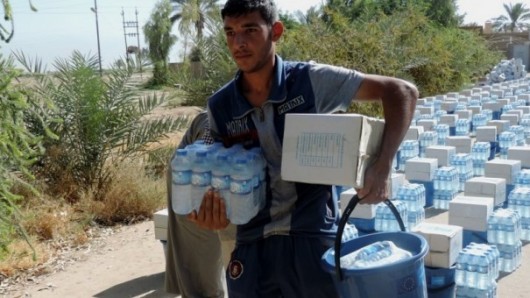
 Cholera outbreaks are not altogether uncommon in Iraq. The bacterial infection is endemic to the region and reported cases usually spike every two to three years around November. Due to this regularity, the Iraqi Ministry of Health has developed a multidimensional approach to combating these outbreaks—but this year has been different.
An unprecedented at-risk population has emerged, as more than 250,000 Syrian refugees have fled their homes to Iraq at the same time that Iraqis are becoming internally displaced by the ongoing conflict with ISIS in the north. Funding has been diverted away from municipal services to pay for defense, and authorities have been unable to fully address community wells that have been contaminated by sewage from flood drainage.
More than 2,000 cases of cholera have been reported over the last three months, including six that have been fatal. One in five of these cases affect young children, and many are being diagnosed in the 62-refugee and Internally Displaced Person camps across the country.
Health officials may also face being inundated with additional patients due to the millions of Shi’ite Muslims expected to make their pilgrimage to Iraq in observance of Arbaeen, a ritual marking the end of mourning over the death of Hussein. When these travelers return home, there is a good chance they will take the bacteria with them, and this will compound an outbreak that has already spread to Syria, Kuwait and Bahrain.
“There is, unfortunately, a high risk that cholera will reach more areas affecting marginalized and displaced children, women and their families, in particular,” UNICEF Representative in Iraq, Peter Hawkins, said. In response, the Health Ministry, UNICEF and the World Health Organization are ramping up their campaigns to vaccinate refugees, treat patients and educate communities on practices that will reduce the risk of transmission.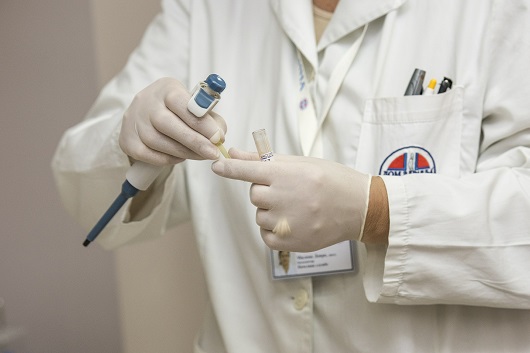
In late October, health officials trained 1,300 vaccinators and 650 social mobilizers to carry out a first-phase vaccination deployment. Since early November, more than 91 percent of targeted Syrian refugees received the oral vaccine and will receive a second dose by the end of December. The second round will guard against cholera for at least five years. It was a desperately needed victory for Iraq, but the World Health Organization stressed that vaccinations should not divert attention from other prevention measures.
“We need to intensify health promotion and education to help communities protect themselves,” WHO Representative, Atlaf Musani, said.
To that end, UNICEF has supported a massive public education campaign. Cholera prevention methods are being sent out on social media, in text messages, by volunteers taking pamphlets door to door and on billboards in affected areas. People are being urged to use water only from protected sources and to get seen by a doctor as soon as symptoms of cholera present themselves.
Primary school children at a refugee camp in Dohuk were taken from regular classes to learn how to properly wash their hands and blow their noses. Officials are hoping that by reaching students, the information will get back to families as well. “Families can protect themselves in simple ways,” Hawkins said.
For communities already infected, or at risk of infection, health officials and UNICEF have undertaken an aggressive treatment campaign. Bottled water has been distributed to 37,000 people, community wells capable of serving 15,000 people have been built, 820,000 packets of rehydration salts are being given out and 3.1 million water treatment tablets will reach households across the country. Some schools have even delayed the beginning of classes for at least a month.
As with most humanitarian missions, the fight against Cholera outbreaks in Iraq is being hampered by a limited budget. If UNICEF is to continue supporting the Iraqi government, a $12.7 million funding gap will need to be filled. For the most vulnerable patients, this funding will mean life or death.
– Ron Minard
Sources: WHO, Reuters, UN, UNICEF
Photo: Islamic Relief, Pixabay

Health Education for Women Improves in Southern Asia
Non-governmental organizations (NGOs) across southern Asia have developed programs in line with the new United Nations Sustainable Development Goals (SDGs) on health education for women.
SDG #3 aims to ensure healthy lives and promote well-being for all ages, and SDG #5 aims to achieve gender equality and empower all women and girls.
In Bangalore, India, mDhil, an online medical resource center, has developed social media campaigns that provide important health education for women. The organization has created a variety of videos that inform women about topics such as menstruation, pregnancy and hormones. mDhil content reaches over 2.5 million people each month.
These videos are available in many local languages, are easily accessible and can be viewed in private. In a survey, mDhil found that 60 percent of women prefer watching videos about intimate health issues rather than visiting a doctor.
Because most doctors offering healthcare for women were male, most women did not feel comfortable discussing family planning or reproductive health with them.
mDhil is empowering girls and women by giving them the information to better understand their bodies and make choices to better their health.
In Bangladesh, the HERHealth project aims to educate female factory workers on their health. Women employed in large factories tend to come from low-income backgrounds and work in unsafe, unhealthy conditions.
Using peer educators, HERHealth raises awareness on common diseases such as anemia and reproductive tract infections. Their health education for women even includes family members and communities of the female factory workers. Reportedly, this has resulted in decreasing cases of cholera.
The quality of work from factories involved with HERHealth has improved because the female workers are less likely to miss work due to injury or sickness. The impact of HERHealth is also met with factory managers asking for the same program for male workers.
In Ho Chi Minh City, Vietnam, the first Human Milk Human Babies Bank opened, allowing mothers to share their extra milk. The milk bank provides mothers the opportunity to give milk to other mothers who do not have enough milk to feed their own babies.
The founder of the bank, Trinh Tuan, also started a Youtube channel called the Journey of Breastmilk to allow women to share maternal and childcare knowledge.
NGOs in the global south are working towards the SDGs, particularly health education for women, and are making a difference using peer training, technology and sharing strategies and knowledge.
– Marie Helene Ngom
Sources: URB, Huffington Post, UN
Photo: Google Images
Water and Sanitation for Nicaraguans
The Nicaraguan urban poor have a long-standing history of lacking access to basic services, such as water and sanitation. In the capital city, Managua, the Greater Managua Water and Sanitation Project (PRASMA) was devised to create new water and sanitation infrastructure throughout the city.
This includes a system of low-cost sewage networks designed to target the poor regions of Managua. Although the PRASMA was a solid start, city officials realized that more was needed if they hoped to achieve their goal of reaching universal piped water connectivity.
The Ministry of Finance and Public Credit (MHCP) reached out to the World Bank for funding to create the Nicaraguan Water and Sewerage Enterprise (ENACAL) in order to expand 15,798 water and 19,716 sewer connections to some of the poorest households.
Before ENACAL was launched, only 26.5 percent of households had access to piped water. Only 1.2 percent had in-house toilets. The majority of the population, more than 72 percent, used latrines. The remaining portion of the population concerned city officials the most, with more than 26 percent lacking access to any sanitation services.
Among the poorest neighborhoods, it was not uncommon to see raw sewage running down the streets. In other impoverished neighborhoods, even for those connected to piped-in water, service was less than reliable. Some households received water as infrequently as two hours per day.
Since collecting $20 million in credit and $20 million in grant money from the World Bank to get ENACAL operational, the project has improved service reliability for 161,896 Nicaraguans as well as increasing the overall financial sustainability of its operations.
The World Bank reported a little less than half of the money was used to expand and add additional infrastructure. The remainder of the funds were used to optimize technical efficiency and strengthen institutional activities.
Moving forward, ENACAL is developing the Master Plan for Operational Efficiency in Managua. This focuses on non-revenue water reduction and the optimization of energy efficiency.
With the assistance in the funding of $300 million from the World Bank and other international donors, continued improvements under the Program for Human Water and Sanitation will take place over the course of the next 15 years.
Thus far, ENACAL has benefited 62,295 residents and improved the percentage of households with access to water for 16 or more hours a day to 72 percent.
– Claire Colby
Sources: Central America Data, World Bank
Photo: University of Colorado Boulder
CEO of the Global Poverty Project Receives Humanitarian Award
Hugh Evans, CEO and co-founder of the Global Poverty Project, received the Humanitarian Award at the 12th annual Billboard Touring Awards on November 19 for his efforts to end extreme poverty.
The award show was established in 2004 and is sponsored by Billboard Magazine to honor the top entertainment artists and professionals, as well as recognize box office and entertainment achievements.
The Billboard Touring Awards honor the industry’s top achievers in categories including Top Festival, Top Arena, Top Manager and Top Comedy Tour.
Founded in 2008, the Global Poverty Project aims to connect everyone around the world using social media to express the need to end extreme poverty.
By joining the conversation, the Global Poverty Project believes it can grab the attention of government, businesses and NGO’s to restructure the systems and policies that are trapping people into poverty worldwide.
The Global Poverty Project began hosting the Global Citizens Festival in 2012 with the slogan, “We Are Not A Generation Of Bystanders.”
The annual festival in New York City brings both musicians and activists together and urges world leaders to make more contributions toward ending extreme poverty. Since launching the festival, the event has helped secure $1.3 billion commitments to help end extreme poverty.
“In an industry filled with people who are dedicated to helping others through the power of music, Hugh Evans stands out for his ability to rally both artists and executives around the common cause of ending global poverty,” said Ray Waddell, executive director of Content & Programming for Touring & Live Entertainment at Billboard.
This past year, a crowd of 60,000 people filled Central Park with live performances from Beyoncé, Ed Sheeran, Coldplay and Pearl Jam. High-profile leaders and activists including First Lady Michelle Obama, Vice President Joe Biden, Hugh Jackman, Bill Gates and members of the UN General Assembly were also in attendance.
Through combined efforts, the European Commission closed the festival by pledging $530 million dollars to aid the Syrian refugee crisis.
As the Global Poverty Project continues to gain activists, Evans shows the world that extreme poverty can end by 2030. “No movement is about an individual,” said Evans of his organization’s mission. “It’s about an amazing group of people coming together from different backgrounds.”
– Alexandra Korman
Sources: Billboard, Global Citizens
Photo: Flickr
CFHI and Omni Med Tackle Preventable Diseases in Uganda
Less than half of the population in Uganda has access to health care. In addition, the country suffers from a deficit of 1.5 million health workers. It is therefore not surprising that treatable diseases are the leading cause of death in Uganda.
The government created the Village Health Team program in 2001 to focus on the lack of health workers. The joint program “Community Health Workers & Global Health” will be based in Uganda’s Mukono District, 13 miles from the capital Kampala. The Child Family Health International organization offers global health education programs that “broaden students’ perspective on global health.”
Child Family Health International (CFHI) is partnering with Omni Med to expand health care capacity from rural to central Uganda. This expansion will improve Omni Med’s training and surveillance of Village Health Team and allow participants to assist the locally-led capacity building and quality assurance.
Omni Med began its work in Uganda in 2008 and has since trained over 1,200 community health workers and established protected water sources and cookstoves as well as distributing insecticide-treated nets. These teams include health educators in rural villages who make a big difference in the health of the world’s poorest people.
Village Health Teams are elected by local villagers and tasked with educating locals with preventative health information, referring sick people to health care centers and tracking health trends for Uganda’s Ministry of Health.
Child Family Health International Global Health Scholars, also known as participants, will assist the Village Health Teams in providing locals in rural Mukono with the best preventative tool: knowledge.
Scholars will accompany the teams on their home visits, train and maintain the team’s health knowledge by teaching in quarterly meetings and aiding in other Omni Med local activities.
“We believe strongly that it is not enough to feel good about what we do–we have to measure the impact we make, and then adjust our programs based on the data,” president and founder of Omni Med, Dr. Ed O’Neil Jr said.
– Marie Helene Ngom
Sources: PRweb, CFHI
Photo: Flickr
Lottie Moon: A Southern Belle
Why do citizens in the poorest states give the most to charity? When it comes to statewide charitable funds, this question seems to arise time and time again. As for the reason – research has suggested the answer lies in religion.
In 2013, Southern Baptists gave approximately $153,000 to the International Foreign Mission Board through the Lottie Moon Christmas Offering. Each Christmas, Southern Baptists participate in this tradition through donations. Who is Lottie Moon, and how does she continue to fight global poverty?
Charlotte Digges “Lottie” Moon was born on Dec. 12, 1840, to a wealthy Virginia family. She cherished education and became the first woman to obtain a master’s degree from a southern college. Around age 18, she became a Christian and desperately desired to become involved with foreign mission work. At the time, this field was closed to single women.
Moon’s sister, Edmonia, began writing to the secretary of the Foreign Baptist Foreign Mission Board, Henry Tupper. Surprisingly, he agreed to let them help, and in 1873 at age 32, Moon and her sister arrived in Tengchow, China.
Moon wasn’t there simply to teach her religion, she was a reformist. She taught school and was a strong advocate for women. Moon fought ardently against the women’s practice of foot binding. In foot binding, a woman’s toes are forced to curl down into her heel, producing a crescent shape. Even though foot binding was a symbol of the elite, it was painful and harmful to the body.
Even though many other missionaries fled, Moon remained in China during the Russo-Japanese War of 1904-1905. Starvation surrounded her, so she took in children and animals, even refusing to eat if they could not.
She wrote home suggesting a week of prayer and offerings be set aside for missions during Christmas. People responded and the Women’s Missionary Union was born. The union is alive and productive in the South today; it collects more than $20 million annually for Southern Baptist mission work overseas.
Eventually, Moon herself fell ill. She did not want to leave China, but her colleagues sent her home on a ship. She died in 1912 on Christmas Eve, and there are conflicting stories about her exact cause of death.
Nevertheless, Lottie Moon has become a beloved friend of Southern Baptists and a martyr among missionaries. Sandra Spears, a Southern Baptist from Mississippi, said she learned about Lottie Moon as a child and has given to the cause for more than 50 years. It’s a tradition.
It should be noted that even though the donations received for the Lottie Moon Christmas Offering are designed for mission work, they aren’t solely spent on building churches and supporting missionaries. Some of the work could be considered “humanitarian” as the missionaries provide meals, medical resources and a host of other critical needs that exist in developing countries.
A 7-year-old boy who was growing up Southern Baptist in the Deep South asked his mother, “When does Lottie Moon ever get paid off?” A humorous question from a child, but when it comes to lifting others out of poverty and giving to help others, the possibilities seem endless.
– Dana McLemore
Sources: BDC Online, History’s Women, The Pathway, Cornell University
Photo: Wikimedia
Millennium Development Goals Successes
While the Millennium Development Goals have had many successes, some goals have not been reached. World leaders have come together once again to decide on the new long-term sustainability goals, building on the past successes.
According to the UN, The Sustainable Development Goals, “will break fresh ground with ambition on inequalities, economic growth, decent jobs, cities and human settlements, industrialization, energy, climate change, sustainable consumption and production, peace and justice.”
– Drusilla Gibbs
Sources: The Guardian, UN
Photo: Flickr
Combating Cholera Outbreaks in Iraq
An unprecedented at-risk population has emerged, as more than 250,000 Syrian refugees have fled their homes to Iraq at the same time that Iraqis are becoming internally displaced by the ongoing conflict with ISIS in the north. Funding has been diverted away from municipal services to pay for defense, and authorities have been unable to fully address community wells that have been contaminated by sewage from flood drainage.
More than 2,000 cases of cholera have been reported over the last three months, including six that have been fatal. One in five of these cases affect young children, and many are being diagnosed in the 62-refugee and Internally Displaced Person camps across the country.
Health officials may also face being inundated with additional patients due to the millions of Shi’ite Muslims expected to make their pilgrimage to Iraq in observance of Arbaeen, a ritual marking the end of mourning over the death of Hussein. When these travelers return home, there is a good chance they will take the bacteria with them, and this will compound an outbreak that has already spread to Syria, Kuwait and Bahrain.
“There is, unfortunately, a high risk that cholera will reach more areas affecting marginalized and displaced children, women and their families, in particular,” UNICEF Representative in Iraq, Peter Hawkins, said. In response, the Health Ministry, UNICEF and the World Health Organization are ramping up their campaigns to vaccinate refugees, treat patients and educate communities on practices that will reduce the risk of transmission.
In late October, health officials trained 1,300 vaccinators and 650 social mobilizers to carry out a first-phase vaccination deployment. Since early November, more than 91 percent of targeted Syrian refugees received the oral vaccine and will receive a second dose by the end of December. The second round will guard against cholera for at least five years. It was a desperately needed victory for Iraq, but the World Health Organization stressed that vaccinations should not divert attention from other prevention measures.
“We need to intensify health promotion and education to help communities protect themselves,” WHO Representative, Atlaf Musani, said.
To that end, UNICEF has supported a massive public education campaign. Cholera prevention methods are being sent out on social media, in text messages, by volunteers taking pamphlets door to door and on billboards in affected areas. People are being urged to use water only from protected sources and to get seen by a doctor as soon as symptoms of cholera present themselves.
Primary school children at a refugee camp in Dohuk were taken from regular classes to learn how to properly wash their hands and blow their noses. Officials are hoping that by reaching students, the information will get back to families as well. “Families can protect themselves in simple ways,” Hawkins said.
For communities already infected, or at risk of infection, health officials and UNICEF have undertaken an aggressive treatment campaign. Bottled water has been distributed to 37,000 people, community wells capable of serving 15,000 people have been built, 820,000 packets of rehydration salts are being given out and 3.1 million water treatment tablets will reach households across the country. Some schools have even delayed the beginning of classes for at least a month.
As with most humanitarian missions, the fight against Cholera outbreaks in Iraq is being hampered by a limited budget. If UNICEF is to continue supporting the Iraqi government, a $12.7 million funding gap will need to be filled. For the most vulnerable patients, this funding will mean life or death.
– Ron Minard
Sources: WHO, Reuters, UN, UNICEF
Photo: Islamic Relief, Pixabay
President Zuma: Free College Education is Possible
Jacob Zuma, South Africa’s president, said that free college education in South Africa could become a possibility in the future.
In a recent interview for Bloomberg Business, President Zuma said, “It’s possible, but it’s not a question you can do overnight. You’ve got to be able to have the resources.”
President Zuma spoke out about the possibility for free college education in South Africa after the recent Fees Must Fall protest over South African universities’ increase in tuition and student costs. Students protested near Zuma’s offices in Pretoria by throwing stones at buildings and starting fires on the lawn outside the buildings.
Student enrollment in South Africa’s universities has doubled to nearly 1 million since the end of the apartheid, and the government wants that number to grow to 1.6 million by 2030. However, only about 5 percent of South African families can afford to comfortably pay their children’s university fees.
The South African Institute of Race Relations has analyzed whether it would be possible to provide free college education in South Africa. The Institute suggests that it is possible if the government can adjust its spending priorities.
Right now the spending level on universities in South Africa is around 0.8 percent of the country’s Gross Domestic Product, which comes to around 25 billion rands.
In order to make tertiary education free, an additional 71 billion rands is required. The South African Institute of Race Relations believes that such levels of funding are possible if government spending is adjusted.
The Institute found that if the state’s wage bill were to be cut by just 5 percent, it would give 22 billion rands toward universities. If military and defense were cut by 25 percent, this would send another 10 billion rands to universities. Finally, cutting off all subsidies to parastatals and other entities would deliver around 45 billion rands per year. These cuts total 77 billion rands.
According to The South African Institute of Race Relations, “our figures and estimates are deeply conservative and yet they suggest that fully subsidized undergraduate education is affordable for all students currently attending universities.”
Prioritizing government spending could make a free college education in South Africa a strong possibility, but it will take time and support from the South African government.
– Jordan Connell
Sources: Bloomberg Business, Daily Maverick, IB Times
Photo: Wikimedia
Results of the Millennium Development Goals
According to the United Nations Development Programme (UNDP), “the eight Millennium Development Goals (MDGs) form a blueprint agreed to by all the world’s countries and all the world’s leading development institutions. They have galvanized unprecedented efforts to meet the needs of the world’s poorest.”
Now that 2015 is coming to an end, the world is evaluating the success of the MDGs. While the overall targets were not met, significant progress has been made toward achieving several of the stated goals.
The official report declares, “The 15-year effort to achieve the eight aspirational goals set out in the Millennium Declaration in 2000 was largely successful across the globe, while acknowledging shortfalls that remain. The data and analysis presented in the report show that with targeted interventions, sound strategies, adequate resources and political will, even the poorest can make progress.”
In terms of fighting poverty, the MDGs produced the largest and most successful anti-poverty movement so far in the world’s history. With every country focused on the effort, the results have been impressive and inspirational.
For example, looking closer at the goal of education: “Primary school enrollment figures have shown an impressive rise, but the goal of achieving universal primary education has just been missed, with the net enrollment rate increasing from 83 percent in 2000 to 91 percent this year,” according to The Guardian.
Each target area received similar improvements. But the biggest result that has come from the MDGs is a determination to succeed in ensuring sustainability for future generations of the world’s citizens. Since the conclusion of the MDGs, countries have regrouped and pushed on into phase two: the Sustainable Development Goals (SDGs).
The UN has caught hold of the vision and is pressing forward. “The United Nations is… defining Sustainable Development Goals as part a new sustainable development agenda that must finish the job and leave no one behind.”
– Katherine Martin
Sources: UNDP 1, UNDP 2, The Guardian, UN
Photo: Pixabay
Cambodia Children for Change
After the genocide, families’ structures were left fragmented and splintered. The disruption of the family unit left little hope or vision of the future. Many families in Cambodia chose to have their children earn income to help sustain the family as opposed to attending school.
These children are at high risk of exploitation. The Children for Change in Cambodia organization is dedicated to helping children who have been exploited, are being exploited or who are at a high risk for being exploited. It has created programs, as well as classes and services designed to encourage success for this demographic.
The Children for Change is a nonprofit organization in Phnom Penh that serves to heal historical wounds through the use of education and exposure to opportunities.
The school sits on the outskirts of Phnom Penh in one of the red light districts. It is a small and community-based organization that strives to help children in the most vulnerable areas.
The school offers various programs unique to the area. Program Design, Academic Bridge to Success, Vocational training and Program Assessment are examples of programs specially designed to enhance the academic experience for students.
The Children for Change in Cambodia also conducts social action projects. These assist students in giving back to their communities. The purpose is to emphasize the importance of community, to instill pride in their communities and to learn from community leaders and other role models.
In Cambodia, primary schools have the most students, followed by the lower secondary and upper secondary schools. Private and traditional schools segregate by age. This serves as a further deterrent for older kids to start school when they are not considered the proper age.
The Children for Change, Cambodia welcomes students of all ages and all levels. All of the classes have multiple ages. The ages of the students range from five to 16 years of age. Classes are based upon the level of education of the students.
In addition, the organization has emergency services for their students in need. For example, they give temporary housing to students when it is no longer safe to go home or to those who are experiencing homelessness.
Those that need emergency housing are not uprooted from school or familiar surroundings. This is important because many of the students have had transient lifestyles. The organization is sensitive to the unique needs of the population it serves.
The Children for Change, Cambodia provides educational services and social support to young students that are at high risk of trafficking. Quality education and skill-building techniques increase the likelihood of excelling in society.
– Erika Wright
Sources: Cultural Quest, The Children for Change, Cambodia, Time
Photo: Flickr