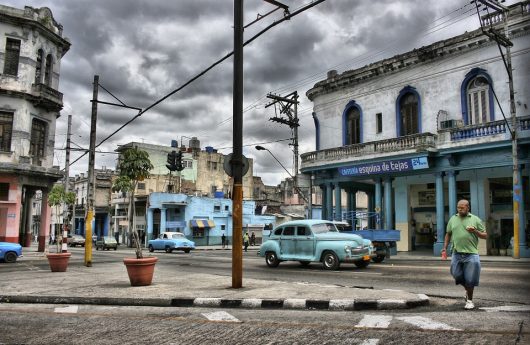
“The changes in Cuba are for more socialism,” reads a sign in Havana. As relations between the United States and Cuba become warmer, this statement reflects how the U.S. aid package to Cuba should strive to protect its notable accomplishments in human development.
An improved U.S. aid package to Cuba is essential, and with it must come certain qualifications and stipulations that benefit both the U.S. and Cuba.
But what exactly should Americans look for in the next set of policy changes toward the island nation? Here are three attributes to support for an improved U.S. aid package to Cuba.
1. Lifting restrictions on U.S.-backed NGOs
It is true that Cuba boasts one of the lowest rates of extreme poverty in the world—1.5 percent in 2006. But despite this achievement, the island still suffers from food insecurity.
With an average monthly income of $20, even a typical Cuban government employee cannot afford meat daily. Milk, cheese or ice cream are reserved as weekly treats, and an aging population means that Cuba will struggle to meet more specific nutritional requirements in the future.
Yet many NGOs, especially those from Europe, must bypass subsidiaries in the United States and look elsewhere for funding. Major funding partners such as the World Bank, IMF and Inter-American Development Bank are blocked due to American veto powers in these institutions. These restrictions limit capacity-building in the agricultural sector.
In the words of one Cuban teacher, this is all too clear: “People want to leave Cuba just because they are hungry.”
2. Funding for Collective Enterprise
Cubans love to share, and one of the ways the island recovered from the fall of the Soviet Union was through its collective (public-private) business. In fact, the number of small to medium-sized firms has grown to roughly half a million since Raul Castro took office.
Raul has also implemented other changes. Private and hybrid firms can now sell services to each other and to government entities. New credit lines are being issued with unlimited ceilings, and decreases in the value of welfare and food subsidies are motivating Cubans to try entrepreneurship.
For instance, at Bella II Beauty in Havana, one esthetician is now making $42 per month instead of the $14 while under government control. Her business is one such worker cooperative.
“The inspector would come and the products that weren’t from here,” she says, “I had to hide them.”
Under the collective business model, workers can now streamline operations to increase profits, with each having say in their decision-making.
To add to this, the Cuban government is cutting back on expenses, as its banks are unable to provide more than $40 in loans to individual citizens. The Brookings Institution estimates that over 500,000 civil service jobs will be terminated in coming years to halt the bloating of public sector employment.
An improved U.S. aid package to Cuba would, therefore, support economic cooperatives with training, technical expertise, and financial resources to continue their growth.
3. Support for the Housing Sector
Every three days in Havana, at least two buildings collapse on average. This statistic sums up the state of Cuban housing: a cramped, expensive and decaying affair.
Over 85 percent of Cubans own their homes thanks to transfer measures that turned renters into owners during the revolution. But there are 11.2 million residents living in 3.9 million homes. This means that Cubans often live with not only their partners, but also their parents and grandparents.
Government estimates indicate that more than 500,000 additional housing units are required to meet demand, but construction is lagging. In order to reach that goal within eight years, the government would need to build 70,000 units per year, compared to its current yield of 16,000.
This is another opportunity for NGOs to offer properly trained labor and grants, especially since mortgages are illegal in Cuba to prevent real-estate speculation. In the words of prize-winning jurist Rodolfo Fernandez, “Housing is for living in, not for making a living from.”
An improved U.S. aid package to Cuba would preserve these unique advances by finding a middle ground between full-fledged capitalism and the more regulated (think: France) vision held by the island’s citizens.
– Alfredo Cumerma
Photo: Pixabay

Three Attributes for an Improved U.S. Aid Package to Cuba
“The changes in Cuba are for more socialism,” reads a sign in Havana. As relations between the United States and Cuba become warmer, this statement reflects how the U.S. aid package to Cuba should strive to protect its notable accomplishments in human development.
An improved U.S. aid package to Cuba is essential, and with it must come certain qualifications and stipulations that benefit both the U.S. and Cuba.
But what exactly should Americans look for in the next set of policy changes toward the island nation? Here are three attributes to support for an improved U.S. aid package to Cuba.
1. Lifting restrictions on U.S.-backed NGOs
It is true that Cuba boasts one of the lowest rates of extreme poverty in the world—1.5 percent in 2006. But despite this achievement, the island still suffers from food insecurity.
With an average monthly income of $20, even a typical Cuban government employee cannot afford meat daily. Milk, cheese or ice cream are reserved as weekly treats, and an aging population means that Cuba will struggle to meet more specific nutritional requirements in the future.
Yet many NGOs, especially those from Europe, must bypass subsidiaries in the United States and look elsewhere for funding. Major funding partners such as the World Bank, IMF and Inter-American Development Bank are blocked due to American veto powers in these institutions. These restrictions limit capacity-building in the agricultural sector.
In the words of one Cuban teacher, this is all too clear: “People want to leave Cuba just because they are hungry.”
2. Funding for Collective Enterprise
Cubans love to share, and one of the ways the island recovered from the fall of the Soviet Union was through its collective (public-private) business. In fact, the number of small to medium-sized firms has grown to roughly half a million since Raul Castro took office.
Raul has also implemented other changes. Private and hybrid firms can now sell services to each other and to government entities. New credit lines are being issued with unlimited ceilings, and decreases in the value of welfare and food subsidies are motivating Cubans to try entrepreneurship.
For instance, at Bella II Beauty in Havana, one esthetician is now making $42 per month instead of the $14 while under government control. Her business is one such worker cooperative.
“The inspector would come and the products that weren’t from here,” she says, “I had to hide them.”
Under the collective business model, workers can now streamline operations to increase profits, with each having say in their decision-making.
To add to this, the Cuban government is cutting back on expenses, as its banks are unable to provide more than $40 in loans to individual citizens. The Brookings Institution estimates that over 500,000 civil service jobs will be terminated in coming years to halt the bloating of public sector employment.
An improved U.S. aid package to Cuba would, therefore, support economic cooperatives with training, technical expertise, and financial resources to continue their growth.
3. Support for the Housing Sector
Every three days in Havana, at least two buildings collapse on average. This statistic sums up the state of Cuban housing: a cramped, expensive and decaying affair.
Over 85 percent of Cubans own their homes thanks to transfer measures that turned renters into owners during the revolution. But there are 11.2 million residents living in 3.9 million homes. This means that Cubans often live with not only their partners, but also their parents and grandparents.
Government estimates indicate that more than 500,000 additional housing units are required to meet demand, but construction is lagging. In order to reach that goal within eight years, the government would need to build 70,000 units per year, compared to its current yield of 16,000.
This is another opportunity for NGOs to offer properly trained labor and grants, especially since mortgages are illegal in Cuba to prevent real-estate speculation. In the words of prize-winning jurist Rodolfo Fernandez, “Housing is for living in, not for making a living from.”
An improved U.S. aid package to Cuba would preserve these unique advances by finding a middle ground between full-fledged capitalism and the more regulated (think: France) vision held by the island’s citizens.
– Alfredo Cumerma
Photo: Pixabay
Why the Cycle? 10 Facts on Global Poverty
As the World Food Programme says, “The poor are hungry and their hunger traps them in poverty.” The number of people living in the world in extreme poverty does continue to decrease, but the number is still incredibly high.
Poverty creates a cycle, where the poorest people are unable to access quality education or health services, and these people continue to be affected by malnutrition and disease. However, there has been a significant reduction in the state of poverty throughout the last decades. Here are ten facts on global poverty:
Numbers are hardly a way to sum up the real-time suffering that people who live in poverty face everyday, but the facts on global poverty do create a framework of awareness, seriousness, and hope around a situation that isn’t quantifiable.
– Amanda Panella
Photo: Pixabay
Addressing Poverty in Mongolia Through Government Initiatives
Poverty in Mongolia is rapidly decreasing in urban centers despite being one of the most sparsely populated nations. Mongolia, which sits between Russia and China, saw double-digit economic growth within the past three years.
The nation ranked 90 under the High Human Development category on the U.N.’s Human Development Index, which may be due to the implementation of a fiercely ambitious development strategy in 2015.
Mongolia’s considerable economic growth can be attributed to progressive reforms the nation began in recent years. Women hold almost 15 percent of Mongolia’s Parliamentary seats.
According to the Global Gender Gap Report of 2015 by the World Economic Forum, Mongolia ranks 56, making it one of the best in its region.
The Mongolian government also instituted the Green Development Strategy, various laws in 2014 that increased regulation of minerals (the nation’s largest export).
The Green Development Strategy makes eliminating extreme poverty in Mongolia a chief priority by addressing the unequal distribution of wealth.
The Law on Glass Account is another aspect of Mongolia’s development strategy that places a focus on the preservation of cultural heritage and budget transparency.
Poverty in Mongolia is a fairly recent trend. Poverty first increased when Russia abruptly closed and dismantled its factories and stopped providing financial assistance.
Mongolians were not prepared to move to a market-based economy. Poverty began to rise as a mass of rural populations migrated to the capital, Ulaanbaatar.
Mongolia is one of the more proactive nations working to eliminating extreme poverty. China, Russia and Mongolia recently signed a trilateral economic partnership agreement in Tashkent, Uzbekistan, during the 11th meeting of the Shanghai Cooperation Organization. The three nations will be involved in more than 30 economic boosting projects.
Mongolian Minister of Foreign Affairs Lundeg Purevsuren released a statement calling the nations’ newfound cooperation a representation of “a new era of economic opportunity for Mongolia, which will continue to capitalize on its strategic location as an intermediary between East Asia and Europe.”
– Veronica Ung-Kono
Photo: Pixabay
New Budget Emphasizes Security, Youth and Education in Kenya
Kenya’s new budget for the 2016–2017 financial year was revealed in parliament recently. The budget emphasizes security and defense, youth resources, public works, and improved education in Kenya.
With Sh124 billion state funds going towards the Defense Ministry, security is by far the biggest priority in the new budget. This is possibly a response to the gruesome terrorist attacks perpetrated by the Somali terrorist group Al-Shabaab last year.
The money will go towards modernizing the military and police forces, with an emphasis on strengthening police to prevent future terrorism.
A significant portion of the new budget will go towards Kenyan youth programs. The youth are by far the nation’s largest demographic as people under the age of 24 make up 60% of the country’s population.
While public education in Kenya has improved in recent years, youth unemployment has remained at 17% since 2010. This is a concern for such a young country. Recognizing this, the Kenyatta administration has put an additional Sh21 billion towards the National Youth Service initiative.
Education in Kenya also saw a major bonus from the new budget. Approximately 24% of children in Kenya are child laborers, despite the relatively high literacy rate.
A new Sh19 billion was allocated for education in the new budget. According to the Treasury Secretary, the money will go towards making the youth “employable by preparing them for the job market and contributing to nation building.”
The new budget also funds free maternal healthcare and several new public works projects. Kenya is still a largely rural country, with three-quarters of the country reliant on agriculture. For that reason, the budget allocates Sh20 Billion for the ongoing irrigation projects. The hope is that improving agriculture can get people off of subsistence farming and alleviate poverty.
Despite the numerous problems that the new budget seeks to address, Kenya has been improving significantly in recent years. The life expectancy has steadily increased since the early 2000s, and the HIV/AIDS prevalence rate has been decreasing since 1992, alongside steady GDP growth.
Both the World Bank and the International Monetary Fund project that Kenya will continue on the path to economic success.
– John English
Photo: Pixabay
Hunger in Honduras: World Bank and WFP Solutions
It is estimated that 1.5 million people will face hunger in Honduras at some point every year. Honduras is the third poorest country in Latin America and the Caribbean, with over 62% of the population living below the poverty line.
Rural areas of Honduras are even more susceptible to issues of hunger due to higher poverty levels and a lack of food security. Chronic malnutrition levels can reach up to 48.5% in the poorest rural areas.
According to the World Bank, Honduras is ranked ninth among countries with high-risk of mortality from exposure to two or more hazards. It is one of the most vulnerable countries to extreme weather conditions. Hunger in Honduras, therefore, is largely due to the reoccurrence of natural disasters such as flooding, drought, and hurricanes.
For small-scale subsistence farmers living in rural areas of Honduras, exposure to the disasters aforementioned can both decrease production and ruin crops and further prevent access to food and nutritional security.
Things, however, are looking up. Numerous global organizations, including the World Bank and World Food Programme (WFP), are initiating projects to alleviate Hunger in Honduras:
World Bank
The Corredor Seco Food Security Project is projected to lift 50,000 Hondurans out of poverty and reduce chronic malnutrition among children under the age of five by 20%. In order to achieve this goal, the World Bank is supporting small-scale farmers in one of the most drought-stricken areas of Honduras. The project will support the introduction of high-value crops, improve access to new markets, and increase food production.
In a recent press release, World Bank Representative in Honduras Giorgio Valentini stated, “This project is of vital importance because it aims at fighting poverty in rural areas, where most of the poor are concentrated, and to boost agriculture, one of the key sectors of the country’s economy.”
World Food Programme (WFP)
The School Meals Programme in Honduras is implemented in the poorest schools to provide funding for children’s meals and increase access to education. Thanks to such programs, 1.4 million Honduran students in over 17,500 preschool and primary schools are able to receive a meal. The Programme in Honduras is WFP’s third-largest school meal initiative worldwide.
In 2009, the School Meals Programme joined with WFP’s Purchase for Progress (P4P), which has been supporting agricultural production for small-scale farmers by connecting them to the local markets.
Two years later, nearly half of the maize and beans for the school meal rations were bought from smallholding farmers participating in P4P. In turn, the farmers’ yearly income was estimated to have increased by $500 and their crop yields by 50-80%.
With the support of global organizations like the World Bank and the World Food Programme, farmers increase crop production, children receive adequate nutrition, while poverty and hunger in Honduras continue to decrease.
– Kristyn Rohrer
Photo: Flickr
Inheriting Poverty and How Education Can Break the Cycle
Thanks to the global push kick-started by the U.N.’s Sustainable Development Goals to eradicate poverty by 2030, 1 billion fewer people live in extreme poverty than 20 years ago. However, the high probability of inheriting poverty is a major obstacle in the effort to cultivate a poverty-free generation.
According to Eurostat, the transmission of poverty is higher than the transmission of being able to rise above poverty, with transmission rates of 68.9 percent and 55.9 percent respectively.
While having low-income parents and experiencing material deprivation play a significant role in determining poverty transmission, complex social and health conditions are also leading causes of lowered investment in children’s futures and, consequently, higher child poverty rates.
Inheriting poverty is particularly common in the developing world where high fertility rates and infant mortality rates lead to lower investment in children’s health and education, according to a report by Save the Children U.K.
Additionally, the immediate economic pressures on low-income households often lead to reliance on children to leave school and enter the labor force at an early age. As a result, attaining higher education is devalued which further contributes to the cycle of poverty and low academic achievement.
Currently, half of all countries have no data on child poverty but looking at primary school enrollment may be the key to identifying those most at-risk of inheriting poverty.
In one survey of primary school enrollment in Bangladesh, researchers found that nearly one-fifth of all children had not enrolled in school at all — the majority of which consisted of children from poor households.
Boys from low-income households were the most at-risk of leaving school early or not entering at all due to the perception of school as an indulgence that is only afforded by the very young and “those whose labor is of little alternative value,” according to Save the Children U.K.
Beyond Bangladesh, analyzing enrollment rates is a useful indicator of child poverty that can be applied globally to allocate education resources in regions that need them most.
A parent’s level of education also has a strong influence over their children’s highest level of education. According to Eurostat, the transmission of a low level of education is 34.2 percent, 59.2 percent for a medium level and 63.4 percent for a high level.
Although the transmission rate of a low level of education is the smallest of the three education levels, respondents in the studies that had a low level of education were more likely to have also had parents with a low level of education (34.2 percent) in contrast to those who had parents with a high level of education (3.4 percent).
Increasing parental income may be one solution to lowering the transmission of low educational attainment. Research by Barnardos reveals that for every 1 percent increase in a parent’s income, their child’s math and reading scores increase by 4 percent.
Ensuring equitable and free access to education is the next step to breaking the cycle of inherited poverty. The economic benefits of guaranteeing children from low-income households access to education far outweigh the cost of having an educated population.
As UNICEF aptly stated in a 2012 report, “a commitment to protecting children from poverty is, therefore, more than a slogan or a routine inclusion in a political manifesto; it is the hallmark of a civilized society.”
– Daniela Sarabia
Photo: Pixabay
Spanish Sketches: An Overview of Poverty in Spain
Both the unemployment and poverty rates in Spain currently stand at approximately 21%, with the majority of the impoverished and unemployed concentrated in southern Spain. Regions of northern Spain, especially the Basque Country, have much lower poverty rates due to being a hub for major aeronautic and energy industries.
The stark divide between Spain’s wealthier northern provinces and poorer southern regions has exacerbated the inequality in the distribution of resources and wealth, creating unstable conditions despite Spain’s improving economy.
Poverty in Spain impacts children below the age of 16 more than any other age group, including the elderly. In 2013, one in three Spanish children lived in poverty or were at risk of social exclusion. The average percentage of children living in poverty in the European Union (EU) is 27.6% while Spain tops the EU average at 32.6%, according to the Guardian.
Spain’s high child poverty rate is best explained by budget cuts to child spending in response to Spain’s Great Recession that began in 2008 and persisted until 2015. The Spanish government cut child spending by 15% in 2010, which negatively impacted the quality of education and access to educational resources in Spain. Subsequently, Spain’s school dropout rate reached 24% in 2015, the highest in the EU.
To uplift underprivileged children from poverty in Spain, members of the Spanish Alliance for Investing in Children (SAIC) strive to improve the quality of Spain’s educational system in addition to providing health and child development services in resource-poor communities.
Save the Children Spain, a member of the SAIC, believes that the risk of child poverty is strongly linked to a child’s level of education and that of their parents. In a recent report, Save the Children Spain proposes that public policy should reflect the needs of Spain’s children including increased access to education, health services, sports, cultural activities and everything that contributes to interpersonal development.
Poverty in Spain Facts
Increasing the quality of and access to education also has the potential to gradually reduce Spain’s dismal unemployment rate. However, a manifesto drafted by 100 economists suggests immediate policy reforms that could temper Spain’s volatile labor market–the root of Spain’s rising unemployment rate.
Historically, Spanish workers have had rigid, open-ended labor contracts, particularly during the dictatorship of Francisco Franco. Under Franco, workers who were laid off received compensation amounting to 60 days of pay for each year they worked. Currently, Spanish employers must offer 33 days of severance pay for every year worked for their permanent employees.
In 1984, the use of temporary contracts became a popular way for companies to avoid the responsibility of expensive worker’s compensation. Temporary contracts typically last a maximum of two years and offer low salaries, little protection and low layoff pay (about eight days of pay per year worked). In 2015, 92% of the 15.4 million labor contracts signed in Spain were temporary and one in four contracts were for seven days or less, according to Fortune Magazine.
Under the skewed structure of Spain’s economy, there is too much leeway for companies to exploit temporary workers. Thus, the Manifesto of the 100 Economists aims to protect working Spaniards from high job turnover rates by eliminating the duality of the labor market and having all workers under one contract.
The proposed contract would adjust Spain’s layoff pay to incentivize employers to invest in permanent employees while ensuring that workers receive proper compensation. The authors of the manifesto also suggest that training centered on gaining marketable skills be provided for the long-term unemployed so that they can re-enter the labor market with confidence in their skills and in their protection under new labor laws.
While permanent reforms to address the causes and effects of poverty in Spain remain pending, members of the SAIC and labor reform activists continue to lay the foundation for a more stable Spain.
– Daniela N. Sarabia
Photo: Flickr
Successful Campaigns in the Slums of Africa
Slums of Africa such as Nima, Kroo Bay, Kibera and others collectively house more than 60 percent of the urbanized population who continue to live in absolute poverty.
Moreover, countries like Egypt, Somalia and Libya have become the epicenter of turbulence over the years with extremist organizations gaining momentum. As a result, many families have had to flee in search of better conditions, but what they find is far from satisfactory.
According to a statement by Newsvision, South Africa in particular has failed to cope with the pressure of rural to urban migration. This problem can lead to adverse effects on economically active individuals in Africa.
An analysis conducted by Newcastle University in 17 government schools in Tanzania has highlighted that many gifted children living in the slums of Africa are unable to reach their full potential.
However, over the years individuals like Brian Mutebi have made the futures of thousands of schoolgirls secure. His campaign ‘Let Girls Be’ provides opportunities such as scholarships and training.
This past May, U.N. Habitat released the ‘World Cities Report.’ This accentuates their New Urban Agenda, a spearhead for many social and economic developments in major developing countries, to be adopted by October.
U.N. Habitat has also become active in relocating countless refugees in South Sudan in their initiative ‘Housing for Peace.’ They have been victims of slavery and abuse, and living in the camps and slums has only aggravated this further.
Additionally, the international relations that have been fostered by countries in East Africa have lead to the forging of a steadfast bond with South Korea.
President Park Geun-hye’s recent visit coincided with the provision of numerous aid programs in the form of health, hygiene and education services to various slums of Africa by the Korean International Cooperative Agency (KOICA). Not only will this initiative strengthen the flow of Foreign Direct Investment (FDI) between the countries, but it is also a symbol of cooperation and diplomacy.
The Department of Rural Development and Land Reform (DRDLR) has engaged in a number of land and rural reform programs to ensure that rural South Africans benefit from the same human rights as anybody else. These reforms center around such items as de-racialisation of the rural economy and fair, equal-opportunity land allocation.
Finally, the World Bank has supported the improvement of feeding programs in Sub-Saharan countries. As governments and people come to realize the importance of self-sufficiency, the chance to alleviate absolute poverty in the slums of Africa becomes a hopeful possibility.
– Shivani Ekkanath
Photo: Flickr
Volunteers Address Major Diseases in the Dominican Republic
Hepatitis and typhoid fever are major diseases in the Dominican Republic, which occur as a result of contact or consumption of contaminated food and water. According to the CIA World Factbook, mortality rates for typhoid fever can reach as high as 20 percent if left untreated.
The zika virus and malaria, two major diseases in the Dominican Republic, are also a major concern for the Caribbean nation. On January 23, 2016, the National IHR Focal Point for the Dominican Republic recorded 10 cases of Zika, eight of which were acquired locally and the other two imported from El Salvador.
In response, public health authorities continue to educate citizens about the risks.
Many individuals infected with the zika virus and malaria only experience mild symptoms that last for a few days to a week, such as fever, rash, joint and muscle pain, headache and conjunctivitis.
However, Zika poses a much more severe threat to pregnant women, who can pass the virus to their fetus, leading to potential birth defects like microcephaly, as well as hearing deficits and impaired growth.
Though no other cases have been reported in the country since, it is still important that citizens take precautions to avoid infection.
Since the outbreak, participants from the International Student Volunteers (ISV) program and Seattle-based organization Education Across Borders have focused their efforts on reducing the risk of the Zika virus and malaria.
ISV launched its unique international travel program in 2002, and more than 30,000 people have participated since then.
Volunteers from the Seattle Preparatory School spent the beginning of their summer lending a hand to the third world country. While partaking in these trips, individuals learn to convert compassion into action for the common good.
Seattle Preparatory students helped prevent further spread of the virus by supplying mosquito nets that will help hundreds of Dominicans in the affected areas. Along with providing aid in the form of physical resources, volunteers brought energy and readiness to the neighborhood worksite.
The Borgen Project had the opportunity to interview rising senior Olivia Smith who visited a poor town outside the city of Santiago called Franco Bido with her travel group. While there, the group helped to build a home for one family in need.
On her experience, Smith states, “My eyes were opened after coming face to face with the problems they deal with everyday and I realized just how much giving my time and assistance helps them. Although I was only there for five days, I built unforgettable relationships with the community. Our efforts toward constructing an additional bathroom or shower will go a long way in a place where different diseases are so easily transmitted.”
Smith also mentioned that many individuals do not have access to mosquito nets, making it harder to steer clear of bites.
While major diseases in the Dominican Republic continue to affect citizens and travelers, groups like ISV and Education Across Borders continue to implement solutions and strive to leave a lasting impact on the communities in need.
– Mikaela Frigillana
Photo: Education Across Borders
How Migrants Can Help Prevent Future Poverty in Germany
When one thinks of Germany, poverty doesn’t usually come to mind. But there are indications that poverty in Germany is a looming threat for the country of over 80 million. The influx of migrants in the past couple of years may provide a solution for the country’s low-wage labor market and the aging population.
Germany’s Economic and Social Problems are Manifold
In May 2016, the country’s Federal Employment Agency reported that one in seven children under the age of 15 were living on government long-term unemployment benefits in 2015. In some states, like Berlin and Bremen, the figure was one in three. The total number stood at 1.54 million and represented an increase of 30,000 compared with 2014.
Sabine Zimmermann, a Left Party member of the German parliament, recently argued that the issue is systemic. She also said that it lies with the country’s slack labor market. Germany’s labor market offers few jobs and low wages.
Similarly, the Bertelsmann Foundation, the largest private foundation in Germany, published a study in October 2015 which revealed that 19.4% of Germans under the age of 18 are at risk for poverty and social exclusion. This is the case because even though the country’s youth unemployment rate, at 7.7%, is the lowest in Europe, 40% of young people toil at low-wage service industry jobs.
Daniel Schraad-Tischler, one of the co-authors of the study, wrote that the current state of the German labor market has serious implications for the future of the welfare state. The government, he concluded, needs to create opportunities for young people to move to higher-paying professions.
Remove Employment Restrictions for Foreign-Born Citizens
Rather than being a burden on German society, migrants may encourage German businesses to invest at home and create jobs. Schraad-Tischler is not the only one pointing to migrants as a measure to address widespread poverty in Germany.
Christian Dürr, a German politician belonging to the center-right Free Democratic Party, wrote in a Huffington Post article that migrants will help bridge Germany’s sustainability gap.
This concept measures the amount of money needed to sustain future payments promised by the government. In 2013, Germany’s was 237% of its GDP, which translates to nearly 6.5 billion euros.
The Sustainability Gap is a Result of Changing Demographics
Germany’s population is aging at the same time as it is shrinking. This means that government expenditures on health care and pensions are on the rise. But fewer and fewer people are putting money into the system.
Eventually, this would force the government to divert money from education and infrastructure in order to finance this deficit. As a result, many people would fall into poverty due to lack of future opportunities.
With the help of migration, however, the gap can be reduced to 217%, according to research that Dürr cited.
It is true that the gains made from migration will be modest. In addition, the government needs to pass a few necessary laws. It is also true that migration alone cannot resolve the country’s economic problems. Migrants, however, can help slow the advance of poverty in Germany by easing demographic pressures and catering to labor market demands.
– Philip Katz
Photo: Flickr