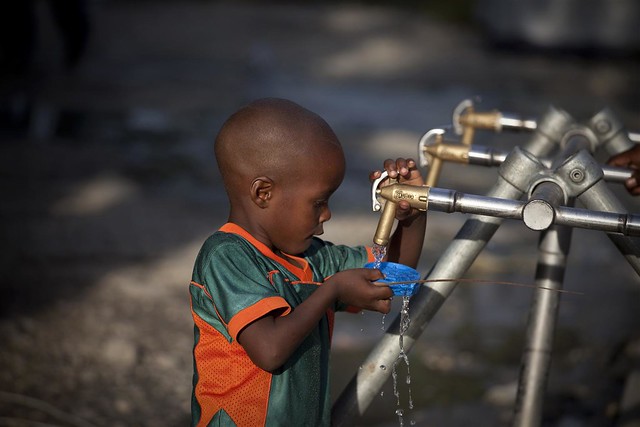
 The water quality in Haiti is in desperate need of improvement. The World Bank hopes to increase access to clean water because “[it] not only saves lives, but [it] also [helps] reduce poverty and improve the livelihood opportunities of these communities,” reports Mary Barton-Dock of the World Bank Special Envoy.
The lack of proper sanitation and unsafe water quality in Haiti fosters the spread of disease. For example, a cholera epidemic ensued after the 2010 earthquake in Haiti, and 8,700 lives have been lost since. Although diagnosed cases of cholera have decreased, heavy rains in the early months of 2015 brought a surge of new cases.
Stand pipes or water points with hand pumps are the main systems used for water transportation in Haiti. Due to lack of funding, many of these water systems are no longer in service. Thankfully, the World Bank found a way to improve the situation by funding a program located in the southern region of Haiti. This global organization built professional operators whose main purpose is to maintain many of the water supply systems.
Over 60,000 people have benefited from these system improvements. The program also helped train community health workers and medical personnel, as well as strengthening the country by making it more self-sustaining.
The Board of Directors of the World Bank also authorized a $50 million grant from the International Development Association (IDA). “The Sustainable Rural and Small Towns Water and Sanitation project aims to save lives by preventing cholera and waterborne diseases in high prevalence zones, and strengthen the capacity of local agencies to deliver water and sanitation services in rural areas and small towns.” This grant will help nearly 300,000 people gain access to potable water and proper sanitation.
This project will also be linked to a ten-year, government-supported Cholera Elimination Plan. This long-term plan will save thousands of Haitian kids from waterborne, disease-related deaths. Benito Dumay, the Director General of the National Water and Sanitation Directorate, understands how essential healthy water quality is for Haiti, and is determined for the project to succeed.
Water is a catalyst for life, and now thousands of Haitians will be able to access this life-saving liquid for the first time. The World Bank reached out to the U.N., the U.N.’s development partners and the Haitian Government to collectively discuss the financing gap and what they learned about fighting cholera.
The Borgen Project has also done a great deal of work at the political level when it comes to advocating for clean water and sanitation. This nonprofit helped build support for the Water for the World Act. The organization also met with hundreds of Congressional offices, equating to 410 meetings, to discuss activism regarding water-quality programs.
Between 2009 and 2014, The Borgen Project helped mobilize thousands of Americans to email and call their congressional leaders in support of the Water for the World legislation. The bill was passed in December 2014, and millions of people gained first-time access to potable water and appropriate sanitation.
As numerous organizations fight the battle for water quality in Haiti and around the world, their tremendous progress makes the future of water quality that much clearer.
– Terry J. Halloran
Photo: Flickr

South Korean Foreign Aid: Former Recipient Now a Major Donor
South Korea, a country which used to rely heavily on foreign aid, is now giving its own. The increasing prominence of South Korean foreign aid is proof that the impact of U.S. foreign aid extends well beyond the period during which it gives.
On July 5, 2016, South Korea’s Ministry of Foreign Affairs greenlighted $21 million in projects aimed at helping refugees in Africa and improving health care across the continent. The money will come from a 1,000 won ($0.87) solidarity tax on airline tickets for outbound international flights.
The air ticket levy is not the only source of funding for South Korean foreign aid. According to the Australian Institute of International Affairs, the country has donated a total of $1.8 billion in official development assistance (ODA) as of 2016, equivalent to 0.14 percent of its gross national income.
South Korea kicked off its donations with a $25 million contribution in 1987, the same year it became a democracy. In 2010, only 23 years after it became a donor, the country became a member of the Development Assistance Committee (DAC) of the Organization for Economic Co-operation and Development (OECD). It remains the only country on the DAC that had been a recipient of development assistance.
It is hard to imagine that South Korea, which is now the world’s 11th largest economy and leads the globe in innovation, was at one time among the world’s poorest countries.
In 1960, the country’s per capita income stood at $70. Adjusted for purchasing power parity, South Korea’s GDP per capita in 1960 was still a dismal $1,420. In fact, according to a case study by the Embassy of the United States in Seoul, it was only ahead of one-third of the countries in sub-Saharan Africa.
South Korea started receiving U.S. foreign assistance in 1952, which was meant to assist the war-torn country on the path to recovery. It was entirely dependent on the United States for food supplies in the following ten years, and USAID missions continued through the 1970s.
The recent increase in South Korean foreign aid is proof of the lasting impact of U.S. development assistance. An initial injection of foreign aid in a country will multiply itself down the line as that country develops and becomes self-sufficient.
When John F. Kennedy became president in 1961, he specifically called for “aid to end aid” and to “help people help themselves” concerning South Korea. More than fifty years later, South Korea not only no longer requires assistance from the U.S. but is now making its mark as a donor of foreign aid.
– Philip Katz
Photo: Flickr
Voice of Wisdom: The Elders Speak Up About El Niño
In response to the El Niño weather phenomenon, The Elders have asked that world leaders take initiative in filling the $2.5 billion gap in funding. This funding is necessary to alleviate the global effects of El Niño on poorer communities.
The Elders and Their Cause
The Elders are a group of activists and advocates brought together by Nelson Mandela in 2007. They work together, using their influence and experience, to promote human rights, peace and justice on a global scale. Their attention has turned toward the problem of human-induced climate change due to the effects of the El Niño weather event. This year brought the strongest El Niño yet, which led to numerous droughts and severe flooding in many areas.
While the weather pattern itself is over for the year, the aftermath is still very much present and widespread. A lack of water in many areas caused extensive crop loss and increased food prices. Food shortages are running rampant in eastern and southern Africa as over 26 million children lack food security and one million suffer from severe malnutrition. Food shortages, however, are not the only concern. El Niño also warms bodies of water, which in turn contributes to the spread of the Zika virus, a virus transmitted by the Aedes aegypti mosquito.
All of the issues associated with El Niño could lead to mass migration as communities are forced out of their regions by uninhabitable weather and poor health conditions.
Aid Options
The Elders have recommended two steps that governments can take to aid victims of El Niño. The first step is to financially assist governments of climate-vulnerable countries by developing contingency plans and creating safety measures in the event of another climate-related crisis. The second step is to create and agree upon a “concrete road map” at the United Nations Climate Conference. This road map will hopefully lead to funding the $100 billion annual commitment to climate action in developing countries by the year 2020.
The current climate crisis requires immediate aid but The Elders believe that El Niño also needs a long-term response.
Kofi Annan, chair of The Elders, addressed the most recent El Niño event in a letter to all world leaders. “I am confident that your country will play its part in ensuring that the world’s most vulnerable people are protected now and into the future,” said Annan.
This sentiment reverberates to those struggling through El Niño’s devastation and serves as a reminder that global solutions require global support.
– Jordan R. Little
Photo: Flickr
Wind Turbines: New Direction for Paris Agreement
With the objective of mitigating greenhouse gas emissions and fostering sustainable development, the Paris Agreement was developed to reduce carbon emission levels globally. The agreement was opened for signature on 22 April 2016 where 175 countries signed the global action plan at a ceremony in New York.
However, countries must engage in ratification to complete the pledge. Only 19 countries have ratified the Paris Agreement. Ratification involves undertaking economy-wide absolute emission reduction targets and enhancing their mitigating efforts to reduce carbon emission.
The agreement moved forward after 55 countries that account for approximately 55 percent of global emissions ratified it. U.S. and China have both agreed to ratify the Paris Agreement this year. Underdeveloped countries and small islands qualify for ratification by developing and preparing strategies for low greenhouse emissions reflecting their circumstances.
With the latest hopes to replace oil with wind turbines to lower greenhouse gasses, John Coequyt, director of the Sierra Club’s federal and international climate campaigns, declared that the Paris agreement included “all the core elements that the environmental community wanted.” Countries that have pledged to the agreement are solely responsible for their emission level as the agreement seeks to limit global warming to 2°C by the year 2020.
The Paris Agreement has also contributed to the boost in wind turbine sales which has proven to be a lucrative venture. “The COP21 agreement will provide the basis for additional public support and financing in growth regions, which should offset this development in the longer term,” said Moody’s Managing Director of Corporate Finance, Matthias Hellstern
The EU and other developing countries have agreed to continue to support environmentally friendly practices and positive impacts on climate change. The Paris Agreement has paved the way for wind turbines to be the main source of energy for developing countries and the solution to curbing high urban pollution levels.
– Shanique Wright
Photo: Flickr
UN Report Shows Malnutrition Hurts Ghana’s Economy
The report argues that Ghana’s government must make nutrition more of a priority in national development planning in order to improve food security.
Chronic malnutrition and stunting afflicts 19 percent of Ghana’s population and is responsible for 24 percent of all child mortality cases. Some areas face more hunger than others as 30 percent of children under five in Ghana’s northern region are stunted. Stunting occurs when adolescents are severely deprived of critical nutrients, such as proteins and minerals, while in the womb or during the first two years of life. According to the report, 37 percent of Ghana’s adult population suffered from stunting as children.
Malnutrition and stunting have significant long-term consequences on individual development and Ghana’s economy. Chronic health and food insecurity have resulted in higher health care expenses, additional burdens on the national education system and lower productivity by Ghana’s workforce.
The effects of stunting are also felt in Ghana’s educational system. Children who are underfed are more likely to miss, repeat classes and drop out of school. The report estimates that of the current working population aged 20 to 64, 72 percent of people who were stunted as a child completed primary school compared to 80 percent of those who were not stunted.
The report further says that repeating grades “increases the demand that the education system must meet, with the resulting costs in infrastructure, equipment, human resources and educational input.” In 2012, the 19,720 students who repeated a grade cost Ghana’s education system approximately $12.85 million.
Malnutrition also limits adults’ ability to work and contribute to Ghana’s economy. In manual work, such as agriculture, people affected by stunting lack the strength necessary to match the production and efficiency of individuals who are healthier. Non-manual workers who are stunted also produce less output because they received fewer years of schooling than people who were adequately nourished as children.
The U.N. recommends that the government invest more in nutrition policies and interventions to boost the overall health of Ghanaians. Better coordination among national agencies is necessary to create a more concerted approach to providing citizens with better nourishment.
The report notes that forging partnerships with private organizations and non-state actors will help the government “accelerate the development and implementation of malnutrition prevention strategies.”
Health officials can also raise more awareness about ways that people can improve their nutrition and health.
– Sam Turken
Photo: Flickr
10 Facts About Eritrean Refugees: Effaced and Displaced
These refugees fled a country that operates on a system of invasive state control and extreme repression that consistently borders on human rights abuse. In a nation with few freedoms, it is not hard to understand why so many citizens have fled to other countries.
Here are 10 facts about Eritrean Refugees and the actions done to assist them:
Reducing the number of Eritreans fleeing to the EU does not address the root of the cause. Refugees will continue to take unprecedented risks in their journey across the Mediterranean until political change occurs in Eritrea.
The above 10 facts about Eritrean Refugees are by no means exhaustive but provide insight to the current conditions of these displaced individuals.
The U.N. Commission of Inquiry on Human Rights calls Eritrea “an institution where slavery-like practices are routine,” exposing the corruption and abuses that cause so many refugees to be displaced. One can only hope that the Eritreans’ time as refugees will be limited and future change for their country is on the horizon.
– Amanda Panella
Photo: Flickr
The Biofortification of Bananas through Banana 21
Banana 21 is a project funded by the Bill and Melinda Gates Foundation to combat micronutrient deficiency in Uganda. The project aims to increase the biofortification of bananas. Bananas are one of the staple foods of the world, but they lack essential vitamins. According to the World Health Organization, micronutrient deficiencies are one of the biggest problems in the developing world.
In Uganda, over one third of women and children are vitamin A deficient. Vitamin A deficiency is the leading cause of preventable blindness in children. It also weakens the immune system, making children more susceptible to an early death from common illnesses or infectious diseases.
Vitamin A deficiency is prevalent in areas where starches are the main source of calories. Foods like cooked bananas, maize and rice lack important vitamins and minerals. Developing countries have fewer resources to harvest diverse foods. More nutritious items like fruits and eggs are often too expensive to purchase or difficult to come by.
According to the World Bank, Uganda loses $145 million to vitamin and mineral deficiencies every year. These deficiencies increase the strain on the health care system, and the patients’ lost productivity also costs the nation heavily.
One of the Grand Challenges in Global Health is to decrease micronutrient deficiencies in Uganda. In 2005, The Bill and Melinda Gates Foundation funded Australian university scientists and national Uganda researchers to add Vitamin A to Uganda’s staple food. The Banana 21 Project is also a part of Bill and Melinda Gate’s Global Development Program.
Through modern biotechnology, Banana 21 develops varieties of Uganda’s East African highland cooking bananas with high levels of pro-Vitamin A. Banana 21 plans to complete research by 2021. Uganda must first review and authorize the new banana varieties before production begins.
Banana 21 is also working on projects to aid disease control and improve drought tolerance.
In Uganda, bananas serve as an important part of the nation’s diet. They are perennial crops and can endure long dry periods where others may wither completely. As rainfall becomes more unpredictable due to climate change, ensuring that they can successfully remain a significant source of food is essential to Uganda’s future food security.
Uganda has experienced significant economic progress and poverty reduction in recent years. Consequently, addressing malnutrition through the development of agriculture is a crucial step forward.
It is important to add nutrients to an already widely grown, eaten and valued food. Increasing the level of nutrients in bananas is crucial to increasing the health of women and children in East Africa.
– Erica Rawles
Photo: Pixabay
Nonprofit Aims to Increase Women’s Land Rights in India
Rajesh Prabhakar Patil of the Impatient Optimists agrees with Melinda Gates that data is generally sexist, meaning there is often more research about men than women. He also believes that there is an urban bias — individuals living in rural areas are often excluded from studies.
This means that it can be especially difficult to find information about the plight of rural women. Patil, along with the nonprofit Landesa, seeks to change and gather more information about women’s land rights in India.
The Plight for Women’s Rights
Patil’s passion for women’s land rights in India stems from his personal belief that “land can provide [women] with a powerful tool to fight poverty — [the ability] to create opportunity.”
In rural India, one in 10 families includes a “dispossessed woman” who cannot own property. This could be a woman who is disabled, divorced, widowed or otherwise unable to live independently due to the stipulations regarding land rights for women.
Sometimes, women who are dependent upon their family, but are caught in dysfunctional relationships, cannot escape abuse due to their inability to purchase land and property that could serve as a refuge.
The lack of data regarding rural women in India can have a negative impact on women and their families. The government of the state of Odisha introduced a policy to give government-owned land to rural families in 2005. Unfortunately, due to a lack of documentation, many rural women were not considered as recipients for the program.
Landesa
Landesa, a nonprofit supported by the Gates Foundation, aims to find and assist women in India and other parts of the world who seek land ownership.
The organization conducts field research and works with local government officials to identify women and families in need of land. In India alone, 1,105,000 families have benefited from Landesa’s work.
According to Landesa’s website, an estimated 18 million families are both poor and landless in India. Their goal is to provide land to these women and lift their families out of poverty. The organization has been working with government leaders from various Indian states since 2000.
“What women do need is to be counted and to have programs responsive to their existence and their needs,” said Patil in a June 2016 post.
Patil appears optimistic about Landesa’s work on increasing women’s land rights in India. Rural women’s quality of life and access to opportunity may see an increase if they’re given the right to own land.
– Carrie Robinson
Photo: Flickr
10 Facts About Democratic Republic of the Congo Refugees
According to the BBC, the Democratic Republic of the Congo (DRC) has suffered from political instability, insecurity and violence since its independence in 1960. As a result, the country hosts a considerable amount of Democratic Republic of the Congo refugees.
From 1997 to 2003, the country experienced a violent civil war. In addition, the Congolese army fought Rwandan forces and rebel groups near the Rwandan border. Multiple armed groups continue to fight among themselves and with the government for control of the resource-rich eastern provinces.
The extreme level of violence and human rights abuses in the eastern DRC have caused thousands to flee the area. Here are 10 facts about Democratic Republic of the Congo refugees:
In order to improve the living conditions of Democratic Republic of the Congo, refugees need additional aid in countries like Rwanda, Burundi and Uganda. Host countries must continue to provide (and improve) education and employment opportunities.
Furthermore, as in Uganda’s refugee settlements, Democratic Republic of the Congo refugees need the means and the training that will allow them to provide for themselves in times of employment scarcity. Consequently, this will reduce refugees’ dependence on foreign aid. It will also increase their ability to integrate and improve their standards of living.
– Christina Egerstrom
Photo: Flickr
Stronger Anti-Poverty Efforts for Disadvantaged Children
The United Nations International Children’s Emergency Fund (UNICEF) warned that 69 million disadvantaged children under the age of five will die of preventable causes by 2030 unless countries strengthen their anti-poverty efforts.
The World’s Children
UNICEF’s annual flagship report, the “State of the World’s Children 2016,” said that based on current trends, 167 million adolescents will live in poverty and 750 million women will have been married as children by 2030.
Despite recent advances in reducing global poverty, the report reflected the increasing risk that the world’s most disadvantaged face and the need for governments and aid organizations to do more to tackle inequality.
Many countries in the West were unwilling to accept millions of refugees and migrants fleeing poverty and conflict, mostly in the Middle East and Africa, around the time the 172-page report was released.
In a foreword to the report, Anthony Lake, the executive director of UNICEF said that inequities are shaping the survival rates of poor children and “perpetuat[ing] intergenerational cycles of disadvantage and inequity that undermine the stability of societies.”
Progress is Progress, but We Need More
The report acknowledged that progress was made to expand development and improve the plight of the world’s poor. Extreme poverty and global under-five mortality rates have been nearly halved since the 1990s and boys and girls attend primary school in equal numbers in 129 countries.
However, the report noted the benefits of anti-poverty efforts have been unequal and limited in many developing areas around the world.
Children born to uneducated mothers are three times more likely to die before the age of five than those born to women with secondary education in sub-Saharan Africa and Southeast Asia. Girls who grow up in extreme poverty are also twice as likely to be married as children than girls from the wealthiest neighborhoods.
Nearly half of the 69 million disadvantaged children projected to perish from preventable causes will reside in sub-Saharan Africa where 247 children live in multidimensional poverty.
The report also found that insufficient access to quality education is still prevalent. Between 2010 and 2013, development assistance for basic education declined by 11%.
The number of children who do not attend school has also increased since 2011 and almost two in five adolescents who do finish primary school have not learned to read, write or do basic arithmetic.
The report recommended an increase in the investment of youth and education in order to guarantee a better future for the world’s children. According to UNICEF, cash transfers have helped children stay in school longer and each additional year of education that a child receives can increase his or her adult earnings by 10%.
Disadvantaged children need strengthened anti-poverty efforts for increased access to education, disease prevention and lower mortality rates — tasks that the global community can help accomplish.
– Sam Turken
Photo: Flickr
Improving Water Quality in Haiti Benefits Thousands
The lack of proper sanitation and unsafe water quality in Haiti fosters the spread of disease. For example, a cholera epidemic ensued after the 2010 earthquake in Haiti, and 8,700 lives have been lost since. Although diagnosed cases of cholera have decreased, heavy rains in the early months of 2015 brought a surge of new cases.
Stand pipes or water points with hand pumps are the main systems used for water transportation in Haiti. Due to lack of funding, many of these water systems are no longer in service. Thankfully, the World Bank found a way to improve the situation by funding a program located in the southern region of Haiti. This global organization built professional operators whose main purpose is to maintain many of the water supply systems.
Over 60,000 people have benefited from these system improvements. The program also helped train community health workers and medical personnel, as well as strengthening the country by making it more self-sustaining.
The Board of Directors of the World Bank also authorized a $50 million grant from the International Development Association (IDA). “The Sustainable Rural and Small Towns Water and Sanitation project aims to save lives by preventing cholera and waterborne diseases in high prevalence zones, and strengthen the capacity of local agencies to deliver water and sanitation services in rural areas and small towns.” This grant will help nearly 300,000 people gain access to potable water and proper sanitation.
This project will also be linked to a ten-year, government-supported Cholera Elimination Plan. This long-term plan will save thousands of Haitian kids from waterborne, disease-related deaths. Benito Dumay, the Director General of the National Water and Sanitation Directorate, understands how essential healthy water quality is for Haiti, and is determined for the project to succeed.
Water is a catalyst for life, and now thousands of Haitians will be able to access this life-saving liquid for the first time. The World Bank reached out to the U.N., the U.N.’s development partners and the Haitian Government to collectively discuss the financing gap and what they learned about fighting cholera.
The Borgen Project has also done a great deal of work at the political level when it comes to advocating for clean water and sanitation. This nonprofit helped build support for the Water for the World Act. The organization also met with hundreds of Congressional offices, equating to 410 meetings, to discuss activism regarding water-quality programs.
Between 2009 and 2014, The Borgen Project helped mobilize thousands of Americans to email and call their congressional leaders in support of the Water for the World legislation. The bill was passed in December 2014, and millions of people gained first-time access to potable water and appropriate sanitation.
As numerous organizations fight the battle for water quality in Haiti and around the world, their tremendous progress makes the future of water quality that much clearer.
– Terry J. Halloran
Photo: Flickr