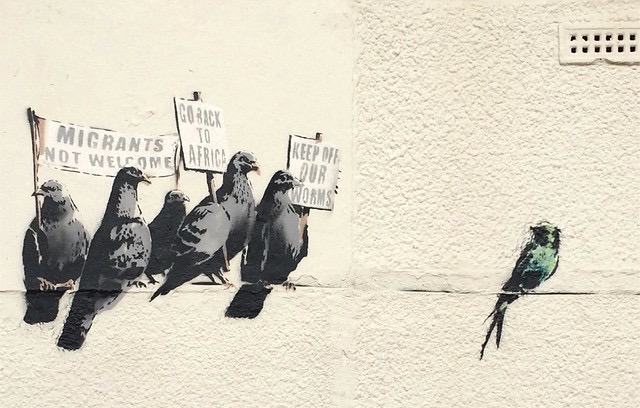
 Art has a history of inspiring social change, creating awareness and questioning human nature. The public can infer artists’ thoughts on immigration and social issues through their work.
Approximately 227,316 migrants have entered Europe and 2,920 were reported dead or missing on Mediterranean and African routes in 2016, according to the International Organization for Migration.
Three elite artists have brought issues surrounding immigration to the forefront as tensions continue to increase around the world.
Doris Salcedo
In 2007, Colombian artist Doris Salcedo changed the floor of the Tate modern with her installation piece, Shibboleth. The work is a 548-foot long crack that began very thin and steadily grew wider, ultimately splitting the entire gallery in two.
The crack represents the experience of being an immigrant in Europe and the segregation and discrimination that accompanies it. A wire mesh lines the inside of the crack’s walls, replicating a chain wire fence, which is a common divider along borders.
The name, Shibboleth, holds much significance. It is a word that distinguishes a specific class or social group of those who belong from those who do not belong.
Shibboleth changed the museum space itself, forcing a disruption in the gallery that visitors had to become used to. The piece illustrates in an abstract, but unavoidably literal way, the racism and hatred that divides Europe.
Ai Weiwei
Chinese artist Ai Weiwei created an installation on the Konzerthaus Berlin for the Cinema for Peace Gala on February 15, 2016. He wrapped each of the buildings six columns with over 14,000 life jackets that were salvaged from refugees entering Europe.
This artists’ thoughts on immigration are hard to ignore — the life jacket installation acknowledged the thousands of lives lost in the past year and reminded us of the hardships undergone by those trying to reach safety.
Ai is also known for his political activism. The artist closed his “Ruptures” exhibition in Copenhagen to protest Denmark’s new laws that deter refugees from seeking asylum in January 2016.
Banksy
The elusive Banksy has also contributed to the ongoing migration discussion with powerful pieces that appeared recently.
One of Banksy’s pieces depicts a girl from Les Misérables emerging from tear gas with a torn French flag in the background. This mural followed reports of French officials entering the camp with tear gas to drive out refugees. The Quick Response (QR) code in the bottom left corner of the mural links to a video of the police raids at the Calais Camp.
The Calais Refugee Camp, also known as “The Jungle,” holds about 7,000 refugees, according to the BBC. Banksy donated wood and supplies from his closed Dismaland “bemusement park” to help build shelters at the refugee camp. The materials were used to build 12 accommodations, a playground and a community center.
Another Banksy mural surfaced on the wall of a tunnel in the Calais Refugee Camp in December 2015. The piece portrays former Apple CEO Steve Jobs carrying an early Apple computer in one hand and holding a bag over his shoulder.
Banksy makes it clear through his work that artists’ thoughts on immigration can make the refugee issue a worldwide conversation.
Highlighting Jobs’ origin as the son of a Syrian migrant, Banksy reminded viewers that, “Apple is the world’s most profitable company, [one that] pays over $7 billion a year in taxes — and it only exists because they allowed in a young man from Homs.”
His statement stands in stark contrast to the popular opinion that accepting refugees will have a negative impact on a country’s economy.
Banksy’s recent murals are part of a new series centered on Europe’s treatment of refugees in the current migration crisis.
Each of the pieces by Salcedo, Ai and Banksy show how artists’ thoughts on immigration can be used as a powerful tool for social awareness. At a critical time of forced movement and migration around the world, an artist’s striking representation of current events and issues promotes empathy and critical thought.
– Erica Rawles
Photo: Flickr

Protect Against Zika: Can New Trends in Vaccinations Help?
These novel prevention and intervention procedures could change the way that the public health field addresses epidemics, namely viruses.
Leading the pack with the first grant, biotech company Inovio received approval from the Food and Drug Administration to conduct an experimental Zika vaccine trial on humans. They have already been able to prevent the virus from taking hold in monkeys, and Harvard Medical School reports developing two successful Zika vaccines that have shown promise in mice.
Although many companies and institutions are gunning to be the first, funding can be problematic. President Obama said that a Zika vaccine could be produced relatively quickly should Congress provide a budget for it. Democrats struck down a bill allotting 1.1 billion dollars to research for the vaccine because of tacked-on, unrelated political moves. The president attributed the denial of the bill to typical politics.
Despite this setback, new technology still allows for research to be conducted by private institutions. A relatively recent bit of tech called DNA vaccination now allows current Zika researchers to develop effective vaccines. This form of the shot only contains a fraction of the viral DNA, as opposed to an entire viral unit, allowing the production of these treatments to be more cost-effective and less dangerous.
In the past, one pitfall for researchers was the potency of the vaccine. This type of shot has to enter a cell in order to take hold (unusual in the world of vaccines), so it became necessary to invent new delivery technologies. Now, an electric shock may replace the classic puncture-style injection– a development claimed by Inovio.
So, can new trends in vaccinations help protect against Zika? Researchers hope to have a successful answer and vaccine in mass production by 2018.
– Connor Borden
Photo: Pixabay
Solving the Energy Poverty Crisis, One Windmill at a Time
According to Sri Mulyani Indrawati, Managing Director of the World Bank, energy poverty implies that “poor people are the least likely to have access to power, and they are more likely to remain poor if they stay unconnected.” The key to solving energy poverty likely lies in the choice of power, with renewable resources being both the cheaper and environmentally cleaner option.
Misconceptions of Renewable Energy
The term renewable energy often conjures up images of developed, wealthy nations experimenting with different resources while using the most modern, up-to-date technology. However, renewable energy is now spreading to the farthest corners of the earth, achieving goals of environmental and economic sustainability. Renewable energy is often thought of as a luxury, but in some parts of the world, it has become a necessary way of life.
According to World Bank data, a large number of poor countries rank as some of the top users for renewable energy. Joining the ranks of eco-friendly Albania, Paraguay and Iceland are Kenya, Zambia, Mozambique and many other African countries. Falling at number 16, three-quarters of Kenya’s electricity production is derived from renewable resources, especially hydropower. In fact, developed countries, in general, lagged behind poorer countries in their use of renewable resources.
Renewable Resources: Budget and Environmentally Friendly
Utilizing renewable resources to create energy is not only environmentally friendly but also budget-friendly for many communities. The U.S. based nonprofit EarthSpark recently set up a solar microgrid in Haiti, which is an affordable energy solution for homes and businesses. Microgrid users pay for the service in advance, ensuring that customers only use the energy that they are able to afford.
Another benefit of renewable energy is that new technology often brings along new employment opportunities. In Haiti, 109 entrepreneurs were trained to work with and market microgrid technologies.
Countries still bypassing the usage of renewable resources for coal need to realize that solving energy poverty requires, as Huffington Post writer Edward Cavanough notes, the “pragmatic use of local and sustainable energy sources to meet immediate and long-term demand while fostering sustainable growth.” Renewable resources are the energy of the future, and it’s in the world’s best fiscal and environmental interest to utilize them.
– Carrie Robinson
Photo: Flickr
5 Things To Know about Poverty in Samoa
5 Things to Know About Poverty in Samoa
The number of impoverished individuals in such a stable economy such as Samoa is quite rare. To end poverty in Samoa, especially for those living in rural areas, new jobs and better farming techniques must be implemented. If the island works together, one day Samoa’s economic gap will narrow and create a much better future for their population.
– Bella Chaffey
Photo: Flickr
Room for Improvement: Reducing Poverty in Malaysia
The Southeast Asian nation of Malaysia is not a desperately poor country. Poverty in Malaysia is fairly low — the percentage of citizens at or below the national poverty line was 0.6 percent in 2014. Life expectancy and the infant mortality rate are about the same as in the U.S. and the GDP is growing.
Reducing poverty in Malaysia has come a long way since 1990 when the United Nations introduced the Millennium Development Goals. The first goal for the U.N. — to halve the number of people living on less than $1.25 a day by 2015 — was reached in Malaysia.
However, Malaysia has significant poverty and income inequality lurking just below the surface. While extreme poverty in Malaysia (income of less than $1.25 per day) is down to less than one percent, more than 25 percent of the population lives on less than $5 per day. Furthermore, about 60 percent of Malaysian families live on less than $1600 a month according to Al Jazeera.
About 20 million of the 30 million people in Malaysia live on the peninsula and approximately 72 percent of the population is urban.
The area in the need of the most support is the rural sector of Sabah on the island of Borneo. Borneo is a large island shared by Malaysia, Brunei and Indonesia so migration around the island is common.
The country is now home to about 2 million immigrants due to migration and recent political turmoil in neighboring Thailand. At this time there is no process for asylum seekers in Malaysia.
Both legal and illegal immigrants are known to be treated harshly and do not receive government support. It is imperative for the Malaysian government to address the needs of migrants as they make up over 10 percent of the population.
Malaysia also has relatively high levels of income inequality. The GINI index measures how much income levels deviate from totally equal distribution. Malaysia places higher than most countries, including all of its neighboring countries and the United States, with a GINI index of 46.2.
Malaysia stands out among its surroundings despite these problems. Nations like Laos, Myanmar and the Philippines all hover around a 25 percent poverty rate and an infant mortality rate that is between three and seven times higher than Malaysia.
Malaysia is also the only country among them with a functional and robust social welfare system. It is clear that further steps must be taken but remarkable progress has been made to reduce poverty in Malaysia in the past few decades.
– John English
Photo: Flickr
3 Artists’ Thoughts on Immigration: Salcedo, Ai and Banksy
Approximately 227,316 migrants have entered Europe and 2,920 were reported dead or missing on Mediterranean and African routes in 2016, according to the International Organization for Migration.
Three elite artists have brought issues surrounding immigration to the forefront as tensions continue to increase around the world.
Doris Salcedo
In 2007, Colombian artist Doris Salcedo changed the floor of the Tate modern with her installation piece, Shibboleth. The work is a 548-foot long crack that began very thin and steadily grew wider, ultimately splitting the entire gallery in two.
The crack represents the experience of being an immigrant in Europe and the segregation and discrimination that accompanies it. A wire mesh lines the inside of the crack’s walls, replicating a chain wire fence, which is a common divider along borders.
The name, Shibboleth, holds much significance. It is a word that distinguishes a specific class or social group of those who belong from those who do not belong.
Shibboleth changed the museum space itself, forcing a disruption in the gallery that visitors had to become used to. The piece illustrates in an abstract, but unavoidably literal way, the racism and hatred that divides Europe.
Ai Weiwei
Chinese artist Ai Weiwei created an installation on the Konzerthaus Berlin for the Cinema for Peace Gala on February 15, 2016. He wrapped each of the buildings six columns with over 14,000 life jackets that were salvaged from refugees entering Europe.
This artists’ thoughts on immigration are hard to ignore — the life jacket installation acknowledged the thousands of lives lost in the past year and reminded us of the hardships undergone by those trying to reach safety.
Ai is also known for his political activism. The artist closed his “Ruptures” exhibition in Copenhagen to protest Denmark’s new laws that deter refugees from seeking asylum in January 2016.
Banksy
The elusive Banksy has also contributed to the ongoing migration discussion with powerful pieces that appeared recently.
One of Banksy’s pieces depicts a girl from Les Misérables emerging from tear gas with a torn French flag in the background. This mural followed reports of French officials entering the camp with tear gas to drive out refugees. The Quick Response (QR) code in the bottom left corner of the mural links to a video of the police raids at the Calais Camp.
The Calais Refugee Camp, also known as “The Jungle,” holds about 7,000 refugees, according to the BBC. Banksy donated wood and supplies from his closed Dismaland “bemusement park” to help build shelters at the refugee camp. The materials were used to build 12 accommodations, a playground and a community center.
Another Banksy mural surfaced on the wall of a tunnel in the Calais Refugee Camp in December 2015. The piece portrays former Apple CEO Steve Jobs carrying an early Apple computer in one hand and holding a bag over his shoulder.
Banksy makes it clear through his work that artists’ thoughts on immigration can make the refugee issue a worldwide conversation.
Highlighting Jobs’ origin as the son of a Syrian migrant, Banksy reminded viewers that, “Apple is the world’s most profitable company, [one that] pays over $7 billion a year in taxes — and it only exists because they allowed in a young man from Homs.”
His statement stands in stark contrast to the popular opinion that accepting refugees will have a negative impact on a country’s economy.
Banksy’s recent murals are part of a new series centered on Europe’s treatment of refugees in the current migration crisis.
Each of the pieces by Salcedo, Ai and Banksy show how artists’ thoughts on immigration can be used as a powerful tool for social awareness. At a critical time of forced movement and migration around the world, an artist’s striking representation of current events and issues promotes empathy and critical thought.
– Erica Rawles
Photo: Flickr
10 Important and Interesting Facts About Refugees in Turkey
10 Facts About Turkey’s Refugee Population
A thwarted coup attempt in Turkey on July 15, 2016 generated concern as to the possible implications it could have on the EU-Turkey deal agreed to in March to end erratic migration from Turkey to the EU.
Prior to the coup attempt, there were EU concerns going forward with the deal. This unease may now be heightened due to the internal disquiet occurring presently in the country.
– Heidi Grossman
Photo: Flickr
Amazon Inspire Seeks to Empower Educators Around the World
Marketed towards K-12 educators around the world, Amazon Inspire has tens of thousands of free online resources, such as lesson plans and apps available for download. Educators around the world can browse the site by subject matter or grade level, and teachers can download and edit lesson plans to better fit their own personalized courses.
Other features of Amazon Inspire that distinguish it from other educational resource databases include:
Earlier in 2016, Amazon also signed a multi-million dollar deal with New York City public schools to help provide more digital books to the schools’ students. This agreement indicates how Amazon is no stranger to the power of funding education and programs that will contribute to making education more accessible to all students and teachers, regardless of location.
These free resources will help teachers in a multitude of ways. Not only will Amazon’s provisions help educators transition into an ever-more digital age of teaching, but they will do so without having to pay an exorbitant amount of money or spend ludicrous amounts of time searching Google for free scholarly resources.
However, since Amazon Inspire is an online resource, countries with limited or no Internet cannot benefit from its resources. While Amazon Inspire is a great site, it is important to remember that not all countries are as privileged to have nationwide Internet coverage as the United States. There is great potential in this field to not only connect more teachers to students but to connect and educate more people globally.
– Bayley McComb
Photo: Flickr
A Year in Review: UN Forum on Sustainable Development
The HLFP replaced the Commission on Sustainable Development in 2013 and meets every four years under the U.N. General Assembly and under the Economic and Social Council (ECOSOC) during other years.
According to the Sustainable Development Knowledge Platform, the goals of the Forum include to guide the execution of the Sustainable Development Goals (SDGs), give suggestions about the 2030 Agenda, incorporate and apply science and international experiences and track the SDG.
The President of the ECOSOC, Oh Joon, stated that the Forum also aims to focus on the national ownership of the SDGS and incorporating the Goals into development plans.
Among its many objectives, the Forum will review the 2030 Agenda and the SDGs with help from reviewers from 22 countries across the world. The President of ECOSOC stated that the reviews are part of the new ways that the Forum works to secure that the world achieves the 2030 Agenda amidst changing global conditions.
The Forum will also take into account the inaugural report entitled “Progress towards the Sustainable Development Goals” presented by Wu Hongbo, U.N. Under-Secretary-General for ECOSOC. The document is the first real report of the progress of the 17 SDGs.
As Wu said in an interview, eliminating poverty is both “the greatest global challenge” and a “requirement for sustainable development” that the Forum aims to address with improved methodology.
Although the HLPF is just one event among the many that it will take to create a sustainable, poverty-free world, the deliberations of the Forum are a crucial first step to continual progress.
– Addie Pazzynski
Photo: Flickr.
Five Facts about Poverty In Burundi
From 1993 to 2006 a catastrophic civil war engulfed Burundi, amassing a death toll of over 300,000, leaving the country in shambles. 10 years after the official end of the war, Burundi is still trying to get back up on its feet. Following the war, poverty in Burundi increased from 48 to 67 percent of the population. Being ranked as the second most impoverished country in the world, Burundians face a tremendous amount of hardships day after day. Here are five crucial facts to better understand poverty in Burundi:
It is easy to look away from the struggles Burundians face in their day-to-day lives, but they should not continue to suffer while the world turns a blind eye. The civil war may have happened 10 years ago, but this does not mean Burundi is a lost cause. If anything, this country’s situation should open the eyes of individuals throughout the world and spur them into action in order to properly assist and guide Burundians into a much brighter future. With the outside assistance, poverty in Burundi is something that can be overcome.
– Bella Chaffey
Photo: Flickr
Poverty in the Philippines: Facts and Figures
Poverty in the Philippines is widespread. The Republic of the Philippines is a country of 7,107 islands in the western Pacific Ocean. It is located in Southeast Asia and struggles to reduce high poverty rates. The United Nations (U.N.) reports that the Republic of the Philippines has one of the highest poverty rates in Asia despite a steady decline in recent years.
The country is rich in natural resources and biodiversity because of its close proximity to the equator; however, it is prone to earthquakes and storms, making it the third most disaster-prone country in the world.
The Philippines’ poverty level is also tied to uncontrolled population growth. According to the U.N., the Philippines “rapid population growth has exacerbated poverty and has fueled rapid urban population growth, overseas labor migration, and unprecedented environmental degradation.”
Philippine Poverty Stats
The Philippine Statistics Authority (PSA) released its latest poverty incidence update on March 18, 2016. The statistics, which account for the first semester of 2015, contain data collected from the Family Income and Expenditure Survey (FIES) done in July 2015. This data shows that:
The food threshold is the minimum income needed to meet basic food requirements set by the Food and Nutrition Research Institute (FNRI). The poverty threshold is expanded to include basic non-food needs such as clothing, housing, transportation, health and education expenses.
The PSA includes these statistics in their reports and calculates how much income would be required for a family of five at subsistence level to pull themselves out of poverty.
In the first semester of 2015, the income gap for a family living in poverty in the Philippines is still 29 percent short of the threshold.
The Rural Poverty Portal reports that half of the poor in the Philippines live in rural areas. The poorest of the poor are the indigenous, landless laborers, fishermen, small farmers, mountain folk and women.
Deforestation, depleted fisheries and unproductive farmland are major problems for these peoples. Illiteracy and lack of educational opportunities are also critical issues.
The Republic of the Philippines made great strides in poverty reduction in recent years, but as with most countries, they still have much to improve upon.
– Rhonda Marrone
Photo: Flickr