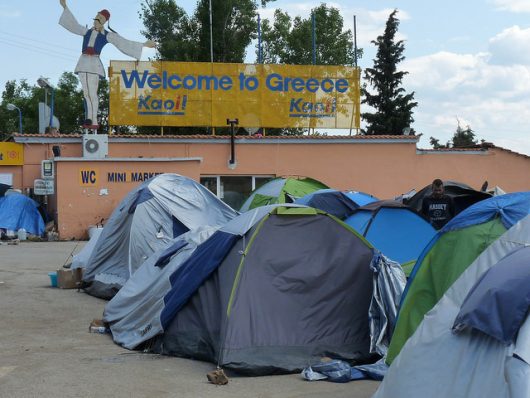
As thousands of refugees in Greece continue to remain trapped in the country after an agreement closing the borders, American veterans are volunteering again to provide medical care. The agreement between the Turkey and the E.U. went into effect March 20th, leaving refugees already in the country unable to travel back to Turkey or continue on to Europe.
According to the U.N., there are 42,000 refugees located on the mainland of Greece, with another 8,000 spread across the Greek islands. Grouped in crowded camps by Greek officials, the asylum-seekers face overflowing toilets, lack of health care, poor food, violence and open harassment of women.
Many are housed in makeshift shelters in abandoned buildings. Though the country’s borders are officially closed to refugees, many still attempt to flee to Europe, with 3,000 having died or gone missing in attempted water-crossings from Turkey 2016 alone.
Team Rubicon
In response, many non-governmental organizations (NGOs) mobilized to help refugees stranded in Greece. One of them is Team Rubicon: a crisis-response organization founded by two marines in 2010 to provide aid to earthquake-stricken Haitians. Since its inception, the group evolved into an organization capable of deploying response teams around the world.
Now boasting leaders such as retired General Stanley McChrystal on its Board of Directors and retired General David Petraeus on its Board of Advisors, the veterans’ organization is active in all 50 states and around the world. Operating in small teams of current service members, veterans and civilian emergency workers, Team Rubicon deploys to disaster areas that may be difficult for larger organizations to reach.
The Borgen Project had the opportunity to interview Matt Pelak, the International Operations Chief for Team Rubicon who noted that since July, Team Rubicon has provided “primary and emergency medical care to a camp of about 200 at-risk refugees including pregnant women and unaccompanied children.”
The camp, established by the Radcliffe Foundation at a disused textile factory along Greece’s northern border, provides a reprieve from the crowded and dangerous conditions at many refugee sites.
Pelak asserted that Team Rubicon decided to deploy to Greece after assessing and concluding that the economic and emergency response capacity in the country was overwhelmed. The deluge of refugees are fleeing violence in Iraq, Syria, Afghanistan and elsewhere in the Middle East.
The Team Rubicon medical specialists have made efforts to send smaller mobile teams to surrounding camps as well, providing free medical care to the refugees they are able to see.
Though they are coordinating their efforts with a slew of other NGOs and the U.N., Pelak recognized that there are simply too many refugees in Greece for the current medical resources allocated. “The medical care [we provide] can be the first in months or years for many refugees,” he said.
The Struggles of Resettlement
Efforts to resettle the asylum seekers are underway, but so far only about 1,700 have been allowed to officially relocate to E.U. countries willing to take them in. Those that arrived after March 20th are supposed to be sent back to Turkey, but the Greek government has only deported 500 so far.
The refugees in Greece who arrived before the deadline will have to wait until the government can make a ruling on their applications for asylum. Considering the number of refugees and the variety of languages spoken among them, the process may take some time. Talking about the masses stranded in Greece, Pelak urged people around the world to “Support NGOs that provide aid on the ground and strongly consider taking in refugees by pressuring lawmakers.”
– Will Sweger
Photo: Flickr

US House Passes Digital GAP Act
The Digital Gap Act, a key bill advocated for by The Borgen Project has passed in the House of Representatives. The Digital Global Access Policy (GAP) Act (H.R. 5537) passed on September 7 with bipartisan support, championed by House Republican Chair Cathy McMorris Rodgers (R-WA), House Foreign Affairs Committee Chairman Ed Royce (R-CA), Ranking Member Eliot Engel (D-NY) and Congresswoman Grace Meng (D-NY).
The bill, introduced in June 2016, targets the percentage of world’s population without internet access. If enacted, the Digital GAP Act would promote mobile or broadband internet access to at least 1.5 billion of the 4.2 billion people without internet access by 2020. Nearly 75 percent of those living offline reside in only 20 countries and are predominantly low-income, female, elderly, illiterate and rural populations.
The bill requires the Department of State, USAID and the Peace Corps to make integrated efforts to promote first-time internet access across developing countries. To do so, the Digital GAP Act supports internet deployment, capacity building, and build-once approaches by standardizing the inclusion of broadband conduit pipes as part of sewer, power transmission facilities, rail, pipeline, bridge, tunnel and road projects.
By leveraging support from international agencies, the legislation aims to promote gender-equitable internet access and protect human rights online, including the freedoms of speech, assembly, association, religion and the right to privacy.
The bill would further require the President to report to Congress on not only the progress of his internet access policy but also on the partnerships between federal agencies to provide access and develop infrastructure.
To accomplish these goals, the Congressional Budget Office (CBO) estimates that the implementation of the Digital GAP Act would cost less than $500,000 between the years 2017 and 2021.
Upon the introduction of the bill into Congress, McMorris Rodgers stated, “Access to the same technology which powers the American economy is critical to empowering developing countries. By promoting internet access around the world and modernizing our approach to humanitarian and International development programs, we will be taking an important step towards closing the digital divide holding so many people back, and improving global economic security.”
Earlier this week, McMorris Rodgers expressed her enthusiasm towards the passing of the bill, adding, “Modernizing our international aid prerogatives to reflect the 21st-century world we all live in is crucial as we look to get more of the developing world online.”
Overall, the Digital GAP Act seeks to end the digital divide by providing equitable and affordable internet access which could be the catalyst for a myriad of positive changes in resource-poor communities by spurring economic growth and job creation, reducing poverty and gender inequality as well as improving health education.
The Borgen Project has advocated for the passing of this legislation in recent months and will continue to stress global internet access as an important tool in the fight against poverty as the bill progresses to the Senate.
-Anna O’Toole
Photo: Flickr
Nine African Poverty Facts You Probably Didn’t Know
Despite various obstacles, the African continent is seeing major progress in poverty-related areas. Africa is more than its struggle with distressing circumstances, and today its global importance is quickly growing. Here are the latest African poverty facts that you should know:
These African poverty facts demonstrate the prevalence of both poverty and progress and prove that, although many improvements are still needed, the future of Africa is not bleak. Africa’s prospects are encouraging and overall, with continued support, success is ultimately attainable.
– Kristina Evans
Photo: Prezi
Amid Greek Refugee Crisis, American Veterans Serve Again
As thousands of refugees in Greece continue to remain trapped in the country after an agreement closing the borders, American veterans are volunteering again to provide medical care. The agreement between the Turkey and the E.U. went into effect March 20th, leaving refugees already in the country unable to travel back to Turkey or continue on to Europe.
According to the U.N., there are 42,000 refugees located on the mainland of Greece, with another 8,000 spread across the Greek islands. Grouped in crowded camps by Greek officials, the asylum-seekers face overflowing toilets, lack of health care, poor food, violence and open harassment of women.
Many are housed in makeshift shelters in abandoned buildings. Though the country’s borders are officially closed to refugees, many still attempt to flee to Europe, with 3,000 having died or gone missing in attempted water-crossings from Turkey 2016 alone.
Team Rubicon
In response, many non-governmental organizations (NGOs) mobilized to help refugees stranded in Greece. One of them is Team Rubicon: a crisis-response organization founded by two marines in 2010 to provide aid to earthquake-stricken Haitians. Since its inception, the group evolved into an organization capable of deploying response teams around the world.
Now boasting leaders such as retired General Stanley McChrystal on its Board of Directors and retired General David Petraeus on its Board of Advisors, the veterans’ organization is active in all 50 states and around the world. Operating in small teams of current service members, veterans and civilian emergency workers, Team Rubicon deploys to disaster areas that may be difficult for larger organizations to reach.
The Borgen Project had the opportunity to interview Matt Pelak, the International Operations Chief for Team Rubicon who noted that since July, Team Rubicon has provided “primary and emergency medical care to a camp of about 200 at-risk refugees including pregnant women and unaccompanied children.”
The camp, established by the Radcliffe Foundation at a disused textile factory along Greece’s northern border, provides a reprieve from the crowded and dangerous conditions at many refugee sites.
Pelak asserted that Team Rubicon decided to deploy to Greece after assessing and concluding that the economic and emergency response capacity in the country was overwhelmed. The deluge of refugees are fleeing violence in Iraq, Syria, Afghanistan and elsewhere in the Middle East.
The Team Rubicon medical specialists have made efforts to send smaller mobile teams to surrounding camps as well, providing free medical care to the refugees they are able to see.
Though they are coordinating their efforts with a slew of other NGOs and the U.N., Pelak recognized that there are simply too many refugees in Greece for the current medical resources allocated. “The medical care [we provide] can be the first in months or years for many refugees,” he said.
The Struggles of Resettlement
Efforts to resettle the asylum seekers are underway, but so far only about 1,700 have been allowed to officially relocate to E.U. countries willing to take them in. Those that arrived after March 20th are supposed to be sent back to Turkey, but the Greek government has only deported 500 so far.
The refugees in Greece who arrived before the deadline will have to wait until the government can make a ruling on their applications for asylum. Considering the number of refugees and the variety of languages spoken among them, the process may take some time. Talking about the masses stranded in Greece, Pelak urged people around the world to “Support NGOs that provide aid on the ground and strongly consider taking in refugees by pressuring lawmakers.”
– Will Sweger
Photo: Flickr
10 Facts About Sudan Refugees
Historically, Sudan has been the site of great conflict and famine since the mid-twentieth century. As a result, a constant outflow of refugees streamed into neighboring countries and all around the world. Here are ten significant facts about these Sudan refugees.
10 Facts about Sudan Refugees
These facts about Sudan refugees are not all-encompassing, but they do offer great insight into the critical Sudanese refugee situation. Fortunately, there’s hope that current peace talks in South Sudan may help stabilize the region, despite the failure of previous regimes to put an end to Sudanese violence.
In the meantime, the UNHCR and refugee-hosting first world countries continue to be an ally for the huge numbers of displaced Sudanese.
– John English
Photo: Flickr
The Compassion Experience: Awareness for Global Poverty
The Compassion Experience is a unique take on raising awareness for global poverty while simultaneously alleviating children out of poverty. Compassion International is providing a first-hand look at the daily lives of the global poor through their interactive Compassion Experience.
The Compassion Experience is an exhibit currently touring the country, hosted by Compassion International, a non-profit organization that provides opportunities for child sponsorship to help lift children out of poverty. Operating since 1952, Compassion has grown from aiding 35 children in South Korea to helping millions of children worldwide become healthy adults.
Compassion’s Accomplishments
The organization also accepts one-time donations to do things such as build a well, provide literacy classes, and cover the neonatal care of a pregnant woman. The Experience is meant to build upon these goals by allowing for a better understanding of the daily difficulties imposed by poverty.
To Lynnelle, an Ohio-based volunteer who has worked with the organization for over 20 years, the work Compassion is doing through their interactive experience is invaluable.
In an interview, she explained, “We talk about [global poverty] all the time, but we don’t have any idea what people in the rest of the world go through.” Raising awareness for global poverty needs to be more than just words, and Compassion knows how to do just that.
A Day in a Compassion Exhibit
The exhibit itself operates out of a large, climate-controlled tent and series of trailers. An audio tour chronicles the lives of three children whose lives have been changed by Compassion, highlighting the positive effects sponsorship has had for them. In the Compassion Experience’s Mentor, Ohio location, these children were Olive, from Uganda; Carlos, from Guatemala; and Kiwi, from the Philippines.
In Olive’s case, Compassion provided for treatment for her tuberculosis and then, once healthy, helped her return to school. She eventually received a volleyball scholarship in the United States, where she went on to earn a master’s degree in social work. She now works for the same organization that changed her life.
The Compassion Experience provides human faces and compelling narratives that demonstrate the daily realities of those living in poverty. Lynnelle described her visit to Rwanda, where she saw those living conditions first hand: a small, closet-sized room and no running water.
However, thanks to the efficacy of foreign aid and organizations such as Compassion International, things are changing. The Gates Foundation cites that the percentage of poor people around the world has dropped by more than half since 1980, with countries such as Brazil and India more than quadrupling their real income per person.
According to Bill Gates in his 2014 Annual Letter, children who have been lifted up out of poverty, “do more than merely survive. They go to school and eventually work, and over time they make their countries more self-sufficient.” Raising awareness for global poverty and increasing levels of activism is a necessity for all countries, not an option.
Lynnelle put it much more simply.
“This to me,” she said, “is changing the world.”
– Sabrina Santos
Photo: The Compassion Experience
Donations from Billionaires: The Key to Ending Global Poverty?
According to the Brookings Institute, in some developing nations the help of the richest billionaire in the country would be enough to drastically reduce poverty. This model is based on the respective billionaire donating at least half of their fortune.
For example, the generosity of just one billionaire would probably be enough to boost the economy of the tiny African country of Swaziland. If this model were applied in Swaziland, Colombia and Georgia, poverty within these struggling countries would be nearly eradicated.
It is worth noting that this ideology would not work in the same way in every country. While the poverty rate will always fall with donations from billionaires, the amount would vary. Some countries in Africa may be harder to impact significantly due to “the depth of poverty” and high prices on the continent.
The Brookings Institute model not only looks at potential donations from the richest billionaire in a country, but in places with multiple billionaires they could collaborate and work together to reduce poverty. The more donations from billionaires that are received, the more people who will rise above the global poverty line.
Bill Gates’ Giving Pledge, which encourages billionaires to give away much of their earnings to charity, follows a similar model. Facebook creator Mark Zuckerberg also pledged to donate 99 percent of his income to poverty reducing efforts and other charitable campaigns.
In addition to donating, billionaires may also be wise to invest in poor nations, as a boost in the economy of the country would likely cause a major increase in the number of consumers of foreign goods and services. Stronger economies result in an increased number of markets.
If billionaires around the world chip in to boost their local economies, the global wealth gap will decrease as the amount of consumption.
– Carrie Robinson
Photo: Flickr
Advancing Peace Talks: Where are the Female Peacekeepers?
Nearly 16 years ago, in response to the disproportionate amount of violence against women in countries enduring post-war conflicts, the U.N. adopted resolution 1325. The resolution targets the issue that when countries that have achieved reform, the post-war conflicts frequently bring more violence, specifically more violence toward women.
The U.N. Security Council resolution 1325 calls for the inclusion of women in all efforts maintaining and promoting peace and security. Even though the likelihood of achieving peace increases when female peacekeepers are included in the discussion, women living in countries that are at war often remain ignored.
Research has confirmed that women are a significant influence in promoting peace. Also, humanitarian efforts are more effective with women’s participation. The inclusion of female peacekeepers yields stronger protection efforts for U.N. peacekeepers, contributes to the implementation of peace talks, and accelerates economic recovery.
Experience has shown the inclusion of women in U.N. peacekeeping missions elicits more trust in communities and result in peace operations that are more customarily fit to a communities’ protection needs. Peace negotiations recommended by women are more likely to be accepted and retained.
However, women in countries where terrorism and extremism are prevalent face disparity, and the fragile state contexts affect their rights. Women often are forced into marriage, forced to engage in sexually based crimes prohibited to get an education or get a job or even engage in public life.
Despite the strides made by the U.N. to integrate women into the peace-building agenda to combat these problems, there has not been much progress since the resolution was first adopted by countries in 2000. There have been reports of incidents wherein U.N. peacekeepers preserved sexual violence and stood by as women were raped. The inclusion of women in peacekeeping operations could diminish the chances of this occurring.
In order to better serve women, the individuals most affected by post-war conflicts, there must be women within the peacekeeping force. Having female peacekeepers who can understand the difficulties and threats women face will better enable the effort to ensure safety. Thus, enforcing a concrete number of women to be included in peace operations is a way to hold U.N. peacekeeping operations accountable.
Although war impacts all, women can address this issue and improve conditions for women more so than men, yet women continue to be excluded from peace talks. 55 countries have adopted national strategies to implement the resolution, and an additional 10 have pledged to do so.
It is still up in the air whether these countries’ political wills for the inclusion of women in peace talks be translated into political action. In order for U.N. peacekeepers to actually fulfill their political wills, it would be accommodating for them to provide a target number of female peacekeepers to include in their peacekeeping operations.
– Kayla Mehl
Photo: Flickr
10 Facts About Poverty in Uzbekistan
Uzbekistan, formally known as the Republic of Uzbekistan, is a landlocked country in Central Asia. It is widely recognized for its beautiful mosques, stunning historical architecture and vibrant cultural heritage. The country has a rich history as a key stop along the ancient Silk Road, which has left a lasting legacy in its cities, such as Samarkand, Bukhara and Khiva.
Poverty in Uzbekistan is dropping. Though rarely making headlines, the country has seen sustained economic growth in the past several years. This progress is attributed to various reforms and investments aimed at modernizing the economy and improving living standards. If trends continue, Uzbekistan is expected to become a successful, developed country free from extreme poverty in the near future. Below are 10 facts about poverty in Uzbekistan and the progress made to alleviate it.
With steady growth and economic improvements, Uzbekistan has positioned itself to become a successful, developed nation in the near future. As these improvements continue, poverty in Uzbekistan is anticipated to decline and living standards will significantly improve across the country.
– Sara Christensen
Photo: Flickr
Updated: June 06, 2024
Top 5 Facts About Poverty in Haiti
In 2010, Haiti was struck by what has been called the strongest earthquake since 1770. The 7.0 mW quake with aftershocks ranging from 4.2 to 5.9 affected at least three million people and increased poverty in Haiti. But in the last three years, the world at large has turned away from the struggle of the Haitian people to focus on newer problems. The fact remains, though, that aid is still needed. Below are leading facts you should know about poverty in Haiti.
Top 5 Facts About Poverty in Haiti
It is easy to put the continued suffering of Haiti out of one’s mind when other world disasters have since risen to the forefront, but that does not mean that Haiti stopped warranting the world’s attention. The earthquake may have happened almost four years ago, but the people there are still greatly in need of assistance and guidance.
– Chelsea Evans
Sources: Fox News, P81 Haiti Relief, Fox Business
Photo: Flickr
New Deal Promotes Peace Necessary for Development
One way that governments have attempted to address these issues is through the New Deal for Engagement in Fragile States, signed by over 40 countries at the Fourth High-Level Forum on Aid Effectiveness in Busan, Korea in 2011. The New Deal promotes peace in the hopes that increased societal stability will lead to development.
In 2014, then-UN General Assembly President John Ashe said that “stability and peace are essential enablers of sustainable development, just as violence is one of its greatest obstacles.”
In accordance with the idea that peace and development are inextricably linked, the New Deal established Five Peacebuilding and Statebuilding Goals (PSGs) that both strong and fragile states committed to pursuing in states with weak institutions: legitimate and inclusive politics, justice, security, revenue and services and economic foundations.
The project was based upon the notion that civil society, development partners and government can work together for development. For the last five years, the New Deal worked on how to better integrate civil society into the peace-building process as a central actor, rather than one on the periphery. As a framework, the New Deal promotes peace and can be used by countries as a means to effectively implement sustainable development.
Unfortunately, while lofty in ideals, the implementation of the PSGs and the New Deal has had mixed levels of success. As each country faces different types and levels of fragility, integrating New Deal policies with existing frameworks can be difficult; and, assessing that fragility requires comprehensive engagement with the population.
Additionally, the technocratic tendencies of the New Deal could oftentimes hamper dialogue and meaningful participation of civil society.
While yet imperfect, commitment to the New Deal remains strong, as countries realize the necessity to address peace and development in conjunction with one another. Therefore, societies cannot experience growth and development without a responsive and resilient state.
For the 1.4 billion people who live in fragile states today, there is still much work that remains to be done. The building of stable institutions requires time, political capital, prolonged commitment and country leadership. In the context of the New Deal, peace and development must be pursued, in conjunction with one another, in order to establish stable institutions and resilient growth.
– Adam Gonzalez
Photo: Flickr