• Link to X
  • Link to Facebook
  • Link to Instagram
  • Link to TikTok
  • Link to Youtube
  • About
    • About Us
      • President
      • Board of Directors
      • Board of Advisors
      • Financials
      • Our Methodology
      • Success Tracker
      • Contact
  • Act Now
    • 30 Ways to Help
      • Email Congress
      • Call Congress
      • Volunteer
      • Courses & Certificates
      • Be a Donor
    • Internships
      • In-Office Internships
      • Remote Internships
    • Legislation
      • Politics 101
  • The Blog
  • The Podcast
  • Magazine
  • Donate
  • Click to open the search input field Click to open the search input field Search
  • Menu Menu

Archive for category: Foreign Aid

Foreign aid coverage and information.

Foreign Aid

Charity Vs Investment: The Two Faces of Foreign Aid

The type of foreign aid and methods advocated for by congressional leaders vary. Nonetheless, the impulse of doing something in the face of crises is still there. However, it is not all good news. Of the wealthiest countries, the United States still ranks towards the bottom in terms of the percentage of their national budget allocated to foreign assistance.

Recent studies suggest that foreign aid faces significant challenges, especially due to the mainstream view of it as a charitable act. Following this approach to gather funding or support for foreign aid can indeed be counterproductive, and even harmful.

In a comparison study about what motivates large versus small donors, Economists Dean Karlan and Daniel Wood found that usually large donors are motivated to increase their donation when presented with the broader impact of a foreign aid initiative.

On the other hand, small donors did not pay much attention to the evidence of impact, but actually increased their donation when they were presented with individual stories that appealed to their emotions.

Karlan and Wood’s study illustrates an issue that extends to the entirety of the aid system: “the view of aid as pennies in the box.” Focusing attention on the act of giving, rather than the actual results of foreign aid takes away from the big picture.

A shift towards viewing foreign aid as an investment would be highly beneficial, there is enough evidence to suggest that this kind of investment pays off. In recent years, the flow of foreign assistance in the form of development aid and emergency relief have helped over 500 million people lift themselves out of poverty. What is more, foreign aid sponsored programs have brought basic education to millions of children in poor countries, and reduced child mortality by over 20 percent.

The benefits of foreign aid are not only visible in the results achieved abroad, but they usually find their way back to the donor nations. Industrialized countries greatly benefit from increased global stability, both in economic and security terms. Foreign aid should be taken seriously as an investment opportunity that provides dividend, sometimes in the long term, but dividends nevertheless.

– Sahar Abi Hassan

Sources: Telegraph
Photo: Economist

July 20, 2014
https://borgenproject.org/wp-content/uploads/borgen-project-logo.svg 0 0 Borgen Project https://borgenproject.org/wp-content/uploads/borgen-project-logo.svg Borgen Project2014-07-20 10:18:442024-12-13 17:51:04Charity Vs Investment: The Two Faces of Foreign Aid
Advocacy, Foreign Aid, USAID

Seven Questions to Ask About Foreign Aid

1. Why does the U.S. give foreign aid?

The U.S. gives aid for several reasons: economic interests, national security and American values. Economically, aid builds trading partners and supports the demand for U.S. goods. For national security, U.S. aid can sustain efforts to reduce injustice and poverty, which can contribute to instability and social tensions. Providing aid can also validate the kindness of the American people, advance democracy and human rights and build a better world.

2. What types of U.S. assistance does it include?

Foreign aid is a very comprehensive term. It incorporates several types of assistance, from the international affairs budget to poverty-focused assistance. The international affairs budget includes the resources to finance U.S. endeavors abroad. For example, it provides funds for USAID and the Department of State’s diplomatic costs and expenses that are sustained in protecting the interests of U.S. citizens and businesses abroad. In addition to helping people in poor countries, this aid provides money to allies for strategic purposes. Poverty-focused assistance concentrates on promoting economic growth and providing services like education and health care.

3. How much does the U.S. government spend on poverty-reducing foreign aid?

The U.S. government spends around $80 per taxpayer on foreign aid. To put that into perspective, compare that number to what Americans spend on other items: $204 per person on soft drinks, the $126 per person on lawn care and $101 per person on candy.

4. What is Americans’ understanding of how much the U.S. spends on this aid?

Americans think the U.S. spends more money on foreign aid than Medicare and Social Security – as much as 30 percent. However, only 0.7 percent of the U.S. federal budget is spent on poverty-focused foreign aid.

5. How can we ensure development aid is not wasted by corrupt governments?

Most poverty-reducing foreign aid is not actually provided directly to foreign governments. Around 85 percent goes through NGOs and U.S.-based government contractors. It may actually force governments to increase transparency and accountability.

6. What is the U.S. doing to make this kind of aid more effective?

The U.S. is doing many things to make foreign aid more efficient, such as defining aid’s purpose, modernizing USAID, developing new models of providing aid and making it more transparent. In 2010, President Obama put forth the first U.S. Global Development Policy which clarifies that the main purpose of U.S. development aid is to pursue global economic growth to fight global poverty. For modernizing USAID, USAID Forward is a new reform agenda that is working to make USAID more efficient, transparent and accountable. President Bush introduced the Millennium Challenge Corporation (MCC) during his presidency. MCC is a “United States foreign aid agency that is applying a new philosophy towards foreign aid.” The MCC model demands that countries to meet criteria in three areas: investments in people, economic freedom and good governance.

7. How can the U.S. improve it to better fight poverty?

There are a few ways. The United States could focus aid more on combating poverty worldwide, provide more transparent information about their foreign aid and give more aid to effective local leaders.

– Colleen Moore

Sources: Alliance for Peace Building, Oxfam America, The Borgen Project
Photo: The Spectator

July 18, 2014
https://borgenproject.org/wp-content/uploads/borgen-project-logo.svg 0 0 Borgen Project https://borgenproject.org/wp-content/uploads/borgen-project-logo.svg Borgen Project2014-07-18 04:00:442024-05-27 09:18:29Seven Questions to Ask About Foreign Aid
Foreign Aid, Health

UN Votes to Send Aid to Syrian Rebels

On July 14, the United Nations Security Council voted unanimously to send cross-border humanitarian aid to areas of Syria controlled by Syrian rebels in desperate need of food and medicine. This decision was made despite strong objections from the Syrian government.

The vote came out 15 to 0, meaning that all members of the U.N. Security Council agreed on this decision. The unanimity is notably rare in U.N. council meetings.

Approximately 10.8 million Syrians—nearly half of the country’s population—are in need of food, medicine and other supplies due to Syria’s on-going war. This is a huge increase from about one million citizens in 2011. And nearly half of these people live in rebel-held areas.

The conflict in Syria has thus far left 150,000 people dead, and created widespread instability in the country. U.N. officials refer to this situation as one of the world’s biggest humanitarian disasters.

Until now, nearly 90 percent of aid from the U.N. Security Council was appropriated for those in government-controlled regions. The new initiative will bring aid to an additional 1.3 million people in need.

Russia and China threatened to veto the resolution, resulting in a weaker compromise than many Western nations had hoped for, according to the BBC’s Nick Bryant. The Syrian government also warned the U.N. that it would consider such resolutions a violation of national sovereignty.

Prior to this vote, aid going to Syria first went through the nation’s capital of Damascus, on President Bashar al-Assad’s orders. This meant that Assad gained control of all aid coming in. Many believed this aid was used as leverage against the rebel efforts, since very little of it ever made it to their held regions.

U.N. ambassador from Luxembourg, Sylvie Lucas, said that Assad’s denial of supplies to rebel-controlled regions was the main reason the resolution came about.

She said that under the new resolution, “the consent of the Syrian government will no longer be necessary.”

The new resolution authorizes U.N. agencies and other aid organizations to send humanitarian assistance using routes across four conflict border lines in Turkey, Jordan and Iraq. These routes will allow the U.N. to monitor aid shipments in these three countries before they are sent across the Syrian border. These routes will come in addition to those previously used for aid.

Nongovernmental organizations such as Save the Children and Oxfam welcomed the resolution, and will likely assist the U.N. in carrying it out.

Bashar al Jaafari, Syria’s U.N. ambassador, was strongly opposed to the measure. He was invited to attend the vote, and was sharply critical of the resolution, citing Syria’s efforts to accommodate international relief. He also stated that Turkey, Saudi Arabia and Qatar—countries advocating humanitarian access—were in large part responsible for empowering Islamic extremists destabilizing Syria and Iraq.

“First and foremost, terrorism must stop for the humanitarian situation in Syria to improve,” he said.

Despite opposition and warning from Syrian government officials, humanitarian assistance in rebel-held areas will be implemented in the near future.

– Paige Frazier

Sources: BBC, The New York Times, CBC News
Photo: NPR

July 16, 2014
https://borgenproject.org/wp-content/uploads/borgen-project-logo.svg 0 0 Borgen Project https://borgenproject.org/wp-content/uploads/borgen-project-logo.svg Borgen Project2014-07-16 12:00:342024-05-27 09:18:41UN Votes to Send Aid to Syrian Rebels
Foreign Aid, Global Poverty

U.S. Threatens to Pull Aid from Afghanistan

aid from afghanistan
Preliminary results of the Afghan election, reported by the Afghan Independent Election Commission on Monday July 7, threaten to create further chaos in the country. The situation prompted U.S. Secretary of State John Kerry to warn on Tuesday that “Any action to take power by extralegal means will cost Afghanistan the financial and security support of the U.S. and the international community.”

The results declared Ashraf Ghani in the lead of his opponent Abdullah Abdullah, sparking demonstrations from both parties claiming the elections to be marred by fraud. Repeated statements from election officials that the results are not final have done little to quench the protests.

Mr. Abdullah’s camp has spent the days since the reporting of the preliminary results building support for a parallel government. Claims that the election was engineered by Mr. Ghani, the election officials and current President Hamid Karzai have been made by allies of Mr. Abdullah.

“From this moment on, we announce our own legitimate government led by Abdullah Abdullah,” writes Atta Mohammed Noor, governor of Balkh Province, on Facebook.

Mr. Abdullah himself has urged his supporters to wait before taking action. He addressed a gathering of his leading supporters on Tuesday: “We are the winner of this round of elections without any doubt. I ask you to give me a few days to consult and speak.” This speech was delivered after a portrait of Hamid Karzai was torn down by his supporters while they cried: “Death to Karzai.”

The preliminary results threatens to inflame festering ethnic tensions. Mr. Ghani and many of his supporters are Pashtun, the majority-ethnic group that has historically been in power. In contrast, Mr. Abdullah derives his support from the Tajik ethnic group, which has been historically marginalized. Mr. Abdullah and his supporters feel they may never see political power, unless they take it by force.

Financial Times quotes Kate Clark, a senior analyst at the Afghanistan Analyst Network: “the election has thrown up ‘a lot of combustible material’ that both candidates had stopped just short of lighting.”

President Obama has personally phoned both candidates, telling them explicitly that violence or illegal action will cause the U.S. to withdraw all aid from Afghanistan. While both President Obama and Secretary Kerry have voiced their support for a thorough election audit, the threat of rescinding support makes clear the U.S.’s position on any action taken by either side outside the limits of the law.

The U.S. has been a strong financial and security backer for the Afghan government. The United States Agency for International Development is one of the agencies working to improve conditions in Afghanistan. In aggregate, since 2002, USAID has spent $13 billion on programs in the country. Economic growth has stabilized at nine percent per year, eight million children are enrolled in school—including 2.9 million girls—and 60 percent of the population lives within access of health services, since the fall of the Taliban.

U.S. aid is vital to the survival of a country where 50 percent of the population lives in poverty and 7.5 million are food insecure.

“America does have a stake in Afghanistan—and Afghanistan still needs America,” Kate Clark sums up the situation.

— Julianne O’Connor

Sources: First Post, The New York Times, Financial Times
Photo: Afghanistan Study Group

July 14, 2014
https://borgenproject.org/wp-content/uploads/borgen-project-logo.svg 0 0 Borgen Project https://borgenproject.org/wp-content/uploads/borgen-project-logo.svg Borgen Project2014-07-14 13:09:072024-05-27 09:18:25U.S. Threatens to Pull Aid from Afghanistan
Foreign Aid

What if we spent 28 Percent of GDP on Foreign Aid?

Over half of the U.S. population believes that about 28 percent of the federal budget is dedicated to foreign aid. The reality is that the U.S. foreign affairs budget is only 1 percent of the national budget. What would it look like if these misguided beliefs were true?

In a study by the Kaiser Foundation, people were asked to define whether the U.S. spends too much, too little or about the right amount on foreign aid. Their answers were 61 percent, 13 percent and 18 percent, respectively. However, when they were asked to vote on the same question, after hearing that it was actually only close to 1 percent, their responses changed to 30 percent, 28 percent and 31 percent respectively.

The results imply that the average American has difficulty assessing a correct estimate of monetary allocation by the government, largely due to the large magnitudes of these sums. Let us consider this, the U.S. national budget for last year was $3.45 trillion, and at 1 percen,t the foreign aid budget comes up to $34.5 billion. For some, hearing that the U.S. spends billions of dollars on foreign aid, it is very unlikely they would place their estimate close to one percent.

While one can be frustrated by the gap between perception and reality, Dylan Matthews at The Washington Post, posed the question what if we actually allocated what people estimated on foreign aid spending? What if we spent 28 percent of the national budget on foreign aid?

Using the estimated 28 percent the average American believes is allocated to foreign aid spending, according to the Congressional Budget Office latest projection the 2015 national budget is to be close to $3.77 trillion, America would be putting approximately $1.1 trillion toward foreign aid, which translates into a foreign assistance budget of $1.1 trillion.

With this amount of money, the possibilities of foreign aid would essentially be limitless. It could be used to improve and expand upon current education and health programs. It could be allocated as cash transfers to those who need it the most, and to those with the ability to invest in their communities and generate economic growth.

A newly released study by The World Bank shows that when people are given cash directly, it is spent on things they actually need, more so than when it comes through foreign aid workers. Also this would be a good way to cut through the red tape and corruption in developing nations.

Coming back to reality, this theoretical course of action would be very unpopular, especially for those in public office. But perhaps, continuing to educate people about the facts of foreign aid would help create better awareness. At the very least, this thought experiment serves to remind Americans of the reality behind foreign aid investment.

– Sahar Abi Hassan

Sources: The Washington Post, The Week
Photo: New Security Beat

July 12, 2014
https://borgenproject.org/wp-content/uploads/borgen-project-logo.svg 0 0 Borgen Project https://borgenproject.org/wp-content/uploads/borgen-project-logo.svg Borgen Project2014-07-12 08:00:452024-12-13 17:50:23What if we spent 28 Percent of GDP on Foreign Aid?
Education, Foreign Aid, Global Poverty

New Direction for Global Partnership for Education

Global partnership for education
The Global Partnership for Education met recently in Brussels hoping to not only raise $3.5 billion for education, but implement a new strategy in order to attract funding where it is needed most.

Funding raised at the meeting benefits the world’s children who are the least able to access a proper education.

The Global Partnership for Education’s mission is to “galvanize and coordinate a global effort to deliver a good, quality education to all girls and boys, prioritizing the poorest and most vulnerable.” Established in 2002, the Global Partnership for Education is comprised of close to 60 developing countries, donor governments, international organizations, the private sector, teachers and NGO groups.

Countries furthest from the Education for All and Millennium Development Goals are also places with fragile political stability. This is a problem, as Overseas Development Assistance is channeled primarily toward “good performers” who have records of effective governance. This logic comes in the assumption that investment in education is only wise once good governance has been established.

The Global Partnership for Education has adjusted its philosophy, however, emphasizing that investing in education now can strengthen governance in a country in the future.

This relationship is more than a theory. Brookings Institute has found evidence of the connection between universal education and good governance, finding an unmistakable relationship between the two. Brookings has gathered that education allows for improvement in three elements of governing: voice and accountability, control of corruption and political instability and violence.

Education promotes the development of an increasingly informed population, promoting citizens to hold their governments accountable. Education is necessary for citizens to both access and act on information. These skills come through not only literacy, but math and reasoning skills—all necessary ingredients to influence policy and reform.

Apart from raw skills, education socializes people, opening more opportunities for community conversation. Increasing levels of socialization may lead to a greater attachment between the culture and its nation state. With greater attachment to the homeland comes a greater expectation from citizens for honest governance. Strong government institutions are less likely to experience corruption and will hopefully give back to the education system with increasing levels of stability.

Education is also positive for levels of individual productivity, which in turn can create conditions for economic equality. Economic equality is associated with political stability and low levels of violence.

Because “education” is a broad term, it is imperative that the education provided to these marginalized children is the right kind of education, the kind that will have a positive effect on governance. In this way, the content must be quality rather than propaganda.

The Global Partnership for Education’s new strategy will ensure that children are getting the resources they need to be educated, without waiting on their governments to get their act together first. After all, children have the potential to grow up into positive influences with the potential to change the world.

– Caroline Logan

Sources: Brookings, Global Partnership
Sources: UNESCO

July 9, 2014
https://borgenproject.org/wp-content/uploads/borgen-project-logo.svg 0 0 Borgen Project https://borgenproject.org/wp-content/uploads/borgen-project-logo.svg Borgen Project2014-07-09 04:00:122024-05-27 09:17:54New Direction for Global Partnership for Education
Foreign Aid, Global Poverty, Refugees and Displaced Persons, War and Violence

Displaced Syrian Refugees Seek Safety

displaced syrian refugees
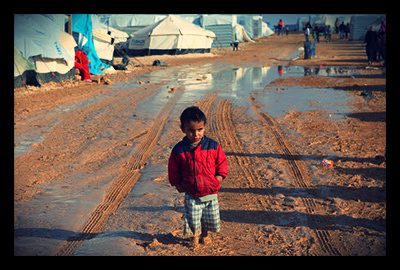
The violent blitzkriegs currently commanding Syria and Iraq are causing unfathomably grave circumstances-so many that it is impossible to convey their consequent terror and devastation. Among countless other results, is the widespread population displacement occurring throughout the region.

It is estimated that 2.8 million displaced Syrian refugees are currently residing in neighboring areas, such as northern Iraq, having been forced out of their native country due to the infamous civil war. This number significantly increases daily, as the violence continues to grow in breadth and magnitude. Over 9.3 million Syrian refugees have been displaced as a result of the conflict. Many refugees are living in camps and in host communities in the Kurdish, northern region of Iraq. In last August, alone, over 60,000 Syrian refugees arrived at these designated camps. In one record day that month, a whopping 10,000 refugees arrived. Initially, the Iraqi government accepted the refugees and accommodated their medical needs, in addition to providing shelter and work permits. However, the massive influx stretched the Iraqi accommodations, dramatically.

This is a growing humanitarian crisis that demands attention. An average of 100,000 Syrians are registering as official refugees, every month. The refugees often suffer from dehydration and diarrheal diseases as a result of scarce resources, poor nutrition, and unhygienic conditions. Among the millions are a considerable amount of children; the United Nations reported that, of the displaced, over 1.4 million are child refugees. These circumstances are inherently devastating and disorienting; for children it is particularly disrupting, as they are forced to pick up and leave, ending their educations in the process. The crowded conditions have been conducive to child outbreaks of polio and measles, threatening the children’s lives, as well as their safety and well-being.

Humanitarian group Mercy Corps has intervened on behalf of all the refugees, as well as the child refugees. They have been distributing necessary items, such as shelter materials and mattresses. They additionally built a playground for children and brought toys to an Arbat refugee camp, to ease the children’s traumatic transitions. World Vision is also helping to alleviate refugee strife; the group has been distributing personal sanitation supplies and clean water. They are providing education services for children in addition to creating Child-Friendly Spaces, which are designated areas in which children can play and unwind.

As the conflict continually unfolds in geographical conjunction with the current crises resulting from the ISIS presence, the amount of displaced refugees increases daily.

– Arielle Swett

Sources: MercyCorps, World Vision
Photo: UNHCR

July 5, 2014
https://borgenproject.org/wp-content/uploads/borgen-project-logo.svg 0 0 Borgen Project https://borgenproject.org/wp-content/uploads/borgen-project-logo.svg Borgen Project2014-07-05 04:00:232024-06-05 01:57:38Displaced Syrian Refugees Seek Safety
Foreign Aid, Global Poverty

Special Interests and the Food Aid Program

food aid program
In terms of volume, the United States is the largest international humanitarian donor. The U.S. contributed approximately $8 billion in emergency aid in the last five years. Yet, how efficiently is this funding being allocated, and are taxpayers getting their money’s worth?

According to Jared Pincin and Brian Brenberg, both professors at The King’s College, U.S. foreign aid works to benefit special interests and its full extent does not reach those who need it the most.

In their recent USA Today article, Pincin and Brenberg explain the relation between food aid and politically connected businesses. In their words, the reason for this is that food aid is “tied, which means that it must be sourced from U.S. producers and transported on U.S. ships.”

“Even though reforming such tied aid programs would help the needy and save money for U.S. taxpayers, Congress is unlikely to change the system. Foreign aid is a lucrative business for interest groups, which aggressively lobby political leaders for pieces of the foreign aid pie, i.e. contracts. Elected officials often reward these powerful industries or companies in exchange for help with re-election, sometimes even lobbying on their behalf.”

While this sounds like the works of shady operation, in Washington D.C. this practice is perfectly legal. Allocating funds in a way that benefits special interests ensures that the fundraising machine continues to operate without problems.

Through the food aid program, the U.S. buys produce and other farm commodities from U.S. farms. Then all this foodstuff is shipped to villages in poor countries in U.S. ships. While this practice greatly benefits U.S. corporations, indeed it has a negative impact on local farmers across the globe.

Since foodstuff can be obtained for free from an outside source, the market and therefore the incentive for local farmers to produce is nullified. This means that not only farmers in developing countries are loosing demand for their product, but they are not able to hire locals and expand their business, which curtails economic growth.

As Pincin and Brenberg conclude, foreign aid’s primary goal is to help those in need and not to pad the pockets of special interests. This is not to say that benefiting U.S. farmers and corporations is an entirely bad thing. But when foreign assistance funding is allocated based on who provides better fundraising, than the real needs of each program, it is not only a waste of taxpayer’s money, but it is a waste of world resources.

– Sahar Abi Hassan

Sources: Capitol Hill Daily, USA Today
Photo: Food for the Hungry

July 3, 2014
https://borgenproject.org/wp-content/uploads/borgen-project-logo.svg 0 0 Borgen Project https://borgenproject.org/wp-content/uploads/borgen-project-logo.svg Borgen Project2014-07-03 07:40:502024-06-04 03:01:21Special Interests and the Food Aid Program
Foreign Aid

Global Foreign Aid Reaches $22 Billion

foreign aid
The Development Initiatives research group reports that the total amount the world’s governments and private organizations spent on foreign assistance rose to $22 billion in 2013, the highest ever recorded. Private aid was $5.6 billion, an increase of over $1 billion from 2012, while government aid was $16.4 billion, about $3 billion higher than the amounts spent in the previous five years.

Most governments in developed countries considerably increased their international assistance spending last year. The United States in particular spent 18 percent more than it did in 2012 and contributed the most money of any country at $4.7 billion. Other countries, like Brazil and China, saw 97 percent and 84 percent drops in spending respectively, but most, including the United Kingdom, Japan, Canada and Germany, as well as the European Union governmental organizations, increased their foreign aid investments.

Why did governments increase their foreign aid spending so suddenly? Much of the aid increases occurred because of worsening violent conflicts and natural disasters around the globe. Much of the private aid increases went to help rebuild the Philippines after Typhoon Haiyan, while other aid went to help victims of clashes in South Sudan,the Central African Republic and Syria.

Syria in particular has received enormous support to help victims of the civil war. According to the World Bank, global aid to Syria increased from $335 million in 2011 to $1.67 billion in 2012, and that number continues to rise as more countries offer help. Turkey was the third-highest foreign aid donor after the U.S. and the UK because of its $1.6-billion effort to care for Syrian refugees. Even Kuwait, a small country not known for its foreign aid budget, raised so much money for Syria that its aid spending increased by 2,315 percent in 2013.

Despite this recent surge in funding, governments tended to concentrate their foreign aid spending on specific countries. The World Bank found that Afghanistan, the country receiving the most aid, got nearly $7 billion in 2012, but many countries in need received substantially less. “Just under a quarter of the total international humanitarian response went to the top five recipient countries, while other countries such as Nepal, Myanmar and Algeria continued to be de-prioritized,” said Dan Coppard, Development Initiatives’ director of research. World Bank data shows that Algeria received less than $200 million in 2012, while Nepal and Myanmar got less than $1 billion.

What does this new spending mean for long-term foreign aid policy? On one hand, it demonstrates that nations are willing to come together and offer help to suffering people. However, they responded to immediately visible natural disasters and conflicts, and there were many countries in need that received very little help. The desire to give foreign aid exists, but advocates must work to make issues requiring international development spending more visible and relevant to governments and their constituents.

– Ted Rappleye

Sources: The Guardian, The World Bank
Photo: NY Times

June 30, 2014
https://borgenproject.org/wp-content/uploads/borgen-project-logo.svg 0 0 Borgen Project https://borgenproject.org/wp-content/uploads/borgen-project-logo.svg Borgen Project2014-06-30 20:24:432024-05-26 23:58:28Global Foreign Aid Reaches $22 Billion
Foreign Aid, Global Poverty

Thailand Under Threat of US Aid Withdrawal

As of  June 24, the United States announced the possibility of reducing U.S. foreign aid to the Kingdom of Thailand in response to the repressive military junta.

Typically, Thailand receives about $10.5 million in security-based aid from the U.S., and Washington, D.C. recently cut off $4.7 million from their long-time ally.

Another sign of high tensions between the two nations is the suggested removal of U.S. regional major exercises out of Southeast Asia. Since 1980, Thailand and the U.S. have participated in Cobra Gold, one of the biggest military exercises that also influences relations, together with about 13,000 participants from around the Southeast Asia region. It has not been confirmed whether the exercises will go on or be stopped.

The chair of the House Foreign Affairs subcommittee on Asia, Representative Steve Chabot, acknowledged the possible dangers of continuing with the exercises, stating it “could clearly send the wrong message” to Thailand and other global figures “in light of the repressive nature” of the military junta currently puppeteering the nation.

Levels of unrest are also extremely high in Thailand at the moment due to the intense regime in which the constitution has been suspended. This forces many repressed people to find other, more combative ways, to express the dissent with the junta. Should the U.S. get too deeply involved by keeping the military exercise in Thailand this year, there is a threat of long-term expenses and involvement not accounted for by the U.S.

The U.S. is not the only world power to acknowledge the danger Thailand is facing. The European Union also commented in a statement on June 23 that they condemn the junta, stating that a credible government should form “as a matter of urgency, the legitimate democratic process and the Constitution, through credible and inclusive elections.” The response from Thai spokesperson, Sek Wannamethee, explains the disappointment felt by the lack of support from the E.U. for not viewing the coup from all angles and seeing the supposedly measured reasoning on the part of the military.

This military coup stands out from the previous ones experienced in Thailand before due to the oppressive measures taken and the sense of permanency it holds. Should this continue, it is likely that the U.S., as well as other nations, will withdraw more security-based funds as the junta continues their reign.

– Elena Lopez

Sources: Channel News Asia, Bangkok Post, Wall Street Journal
Photo: Flickr

June 30, 2014
https://borgenproject.org/wp-content/uploads/borgen-project-logo.svg 0 0 Borgen Project https://borgenproject.org/wp-content/uploads/borgen-project-logo.svg Borgen Project2014-06-30 20:23:192024-05-26 23:58:39Thailand Under Threat of US Aid Withdrawal
Page 49 of 61«‹4748495051›»

Get Smarter

  • Global Poverty 101
  • Global Poverty… The Good News
  • Global Poverty & U.S. Jobs
  • Global Poverty and National Security
  • Innovative Solutions to Poverty
  • Global Poverty & Aid FAQ’s
Search Search

Take Action

  • Call Congress
  • Email Congress
  • Donate
  • 30 Ways to Help
  • Volunteer Ops
  • Internships
  • Courses & Certificates
  • The Podcast
Borgen Project

“The Borgen Project is an incredible nonprofit organization that is addressing poverty and hunger and working towards ending them.”

-The Huffington Post

Inside The Borgen Project

  • Contact
  • About
  • Financials
  • President
  • Board of Directors
  • Board of Advisors

International Links

  • UK Email Parliament
  • UK Donate
  • Canada Email Parliament

Get Smarter

  • Global Poverty 101
  • Global Poverty… The Good News
  • Global Poverty & U.S. Jobs
  • Global Poverty and National Security
  • Innovative Solutions to Poverty
  • Global Poverty & Aid FAQ’s

Ways to Help

  • Call Congress
  • Email Congress
  • Donate
  • 30 Ways to Help
  • Volunteer Ops
  • Internships
  • Courses & Certificates
  • The Podcast
Scroll to top Scroll to top Scroll to top