• Link to X
  • Link to Facebook
  • Link to Instagram
  • Link to TikTok
  • Link to Youtube
  • About
    • About Us
      • President
      • Board of Directors
      • Board of Advisors
      • Financials
      • Our Methodology
      • Success Tracker
      • Contact
  • Act Now
    • 30 Ways to Help
      • Email Congress
      • Call Congress
      • Volunteer
      • Courses & Certificates
      • Be a Donor
    • Internships
      • In-Office Internships
      • Remote Internships
    • Legislation
      • Politics 101
  • The Blog
  • The Podcast
  • Magazine
  • Donate
  • Click to open the search input field Click to open the search input field Search
  • Menu Menu
Blog - Latest News
Foreign Aid, Global Poverty

Special Interests and the Food Aid Program
food aid program
In terms of volume, the United States is the largest international humanitarian donor. The U.S. contributed approximately $8 billion in emergency aid in the last five years. Yet, how efficiently is this funding being allocated, and are taxpayers getting their money’s worth?

According to Jared Pincin and Brian Brenberg, both professors at The King’s College, U.S. foreign aid works to benefit special interests and its full extent does not reach those who need it the most.

In their recent USA Today article, Pincin and Brenberg explain the relation between food aid and politically connected businesses. In their words, the reason for this is that food aid is “tied, which means that it must be sourced from U.S. producers and transported on U.S. ships.”

“Even though reforming such tied aid programs would help the needy and save money for U.S. taxpayers, Congress is unlikely to change the system. Foreign aid is a lucrative business for interest groups, which aggressively lobby political leaders for pieces of the foreign aid pie, i.e. contracts. Elected officials often reward these powerful industries or companies in exchange for help with re-election, sometimes even lobbying on their behalf.”

While this sounds like the works of shady operation, in Washington D.C. this practice is perfectly legal. Allocating funds in a way that benefits special interests ensures that the fundraising machine continues to operate without problems.

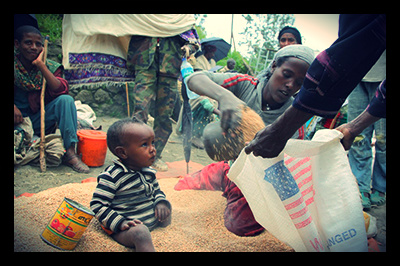
Through the food aid program, the U.S. buys produce and other farm commodities from U.S. farms. Then all this foodstuff is shipped to villages in poor countries in U.S. ships. While this practice greatly benefits U.S. corporations, indeed it has a negative impact on local farmers across the globe.

Since foodstuff can be obtained for free from an outside source, the market and therefore the incentive for local farmers to produce is nullified. This means that not only farmers in developing countries are loosing demand for their product, but they are not able to hire locals and expand their business, which curtails economic growth.

As Pincin and Brenberg conclude, foreign aid’s primary goal is to help those in need and not to pad the pockets of special interests. This is not to say that benefiting U.S. farmers and corporations is an entirely bad thing. But when foreign assistance funding is allocated based on who provides better fundraising, than the real needs of each program, it is not only a waste of taxpayer’s money, but it is a waste of world resources.

– Sahar Abi Hassan

Sources: Capitol Hill Daily, USA Today
Photo: Food for the Hungry

July 3, 2014
Share this entry
  • Share on Facebook
  • Share on X
  • Share on WhatsApp
  • Share on Pinterest
  • Share on LinkedIn
  • Share on Tumblr
  • Share on Vk
  • Share on Reddit
  • Share by Mail
https://borgenproject.org/wp-content/uploads/borgen-project-logo.svg 0 0 Borgen Project https://borgenproject.org/wp-content/uploads/borgen-project-logo.svg Borgen Project2014-07-03 07:40:502024-06-04 03:01:21Special Interests and the Food Aid Program

Get Smarter

  • Global Poverty 101
  • Global Poverty… The Good News
  • Global Poverty & U.S. Jobs
  • Global Poverty and National Security
  • Innovative Solutions to Poverty
  • Global Poverty & Aid FAQ’s
Search Search

Take Action

  • Call Congress
  • Email Congress
  • Donate
  • 30 Ways to Help
  • Volunteer Ops
  • Internships
  • Courses & Certificates
  • The Podcast
Borgen Project

“The Borgen Project is an incredible nonprofit organization that is addressing poverty and hunger and working towards ending them.”

-The Huffington Post

Inside The Borgen Project

  • Contact
  • About
  • Financials
  • President
  • Board of Directors
  • Board of Advisors

International Links

  • UK Email Parliament
  • UK Donate
  • Canada Email Parliament

Get Smarter

  • Global Poverty 101
  • Global Poverty… The Good News
  • Global Poverty & U.S. Jobs
  • Global Poverty and National Security
  • Innovative Solutions to Poverty
  • Global Poverty & Aid FAQ’s

Ways to Help

  • Call Congress
  • Email Congress
  • Donate
  • 30 Ways to Help
  • Volunteer Ops
  • Internships
  • Courses & Certificates
  • The Podcast
Link to: Malian Refugees Face Drought and Uncertainty Link to: Malian Refugees Face Drought and Uncertainty Malian Refugees Face Drought and Uncertainty Link to: Hunger in Zambia Leads to Agriculture Investments Link to: Hunger in Zambia Leads to Agriculture Investments Hunger in Zambia Leads to Agriculture Investments
Scroll to top Scroll to top Scroll to top