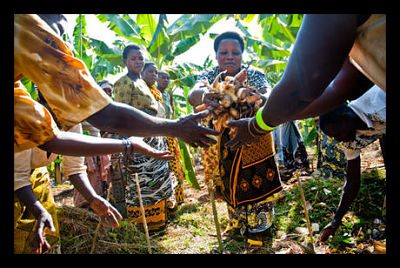
 The concept of crop insurance is a well-established practice in developed countries: in anticipation of natural disasters or other impediments to good crop yields, farmers purchase insurance to cover the cost of lost revenue.
Yet traditional agriculture insurance is either unavailable or overly expensive in many developing countries, leaving small-scale farmers, particularly women, vulnerable to natural disasters.
Nevertheless, recent expansions of index insurance programs, in particular the Global Index Insurance Facility, are enabling small-scale women farmers across Sub-Saharan Africa, Asia, the Pacific, Latin America and the Caribbean to adequately ensure their crops at affordable prices.
Unlike traditional insurance, index insurance “pays out benefits on the basis of a predetermined index for loss of assets and investments … without requiring the services of insurance claims assessors,” the World Bank reports.
More specifically, “a statistical index is developed before the start of the insurance period to measure deviations from normal for such parameters as rainfall, temperature, seismic activity, wind speed, crop yield or livestock mortality rates.”
Since 2009, GIIF, a program managed by the World Bank Group, has been leading and supporting index-insurance programs across the developing world. In collaboration with partners like MicroEnsure and Kilimo Salama (now ACRE), GIIF often aggregates farmers into groups and enrolls them into insurance programs—an approach both commercially feasible for insurers and empowering for women farmers.
Recent statistics indicate that women farmers in the developing world are at particular risk for agricultural instability. A recent study by the World Bank Group and the ONE Campaign found that although roughly half of the farmers in Sub-Saharan Africa are women, women farmers in Africa produce between 13 and 25 percent less than their male counterparts.
The World Bank Group and the ONE Campaign attributed this difference largely to women farmers’ lack of access to credit and other financial tools.
According to estimates by the Food and Agricultural Organization, if women farmers worldwide had the same access to resources as their male counterparts, “their yields could increase by as much as 30 percent, resulting in 150 million fewer people going hungry.”
GIIF’s index insurance programs are already reaping benefits in many developing countries. In Kenya, a payout initiated by the GIIF program during a drought kept thousands of women farmers in business, allowing them to purchase seeds and fertilizer for the next growing season.
In Haiti, a GIIF partner is offering weather index insurance to 70,000 clients, mostly women farmers who provide essential goods and services to communities.
The World Bank reports that overall, these index insurance programs have helped close the gender gap for farmers in the developing world—a critical step in fighting hunger, tackling malnutrition, and boosting global food security.
– Katrina Beedy
Sources: World Bank 1, World Bank 2
Photo: Siani

World Renew Tackles Global Poverty
From Asia to Uganda, World Renew, formerly known as The Christian Reformed World Relief Committee, is addressing the problems facing the most impoverished of communities all over the world. The name-change came in 2012 after the organization felt that that the work being done was growing larger and more significant. “The name better reflects who we are and what we are about as a trusted, established non-profit that is working to help eradicate the root causes of extreme global poverty through the renewal of relationships with God, neighbor, and the environment,” says World Renew’s Canadian director, Ida Mutoigo.
It is estimated that World Renew works with 1.86 million people who live in poverty in 35 different countries. This organization is known for its advocacy and quick responses to disasters like the 2011 earthquake in Japan or the conflict that currently exists in Syria. World Renew is also known for aiding with the systemic problems that affect the world’s poor. By focusing on things like AIDS, agriculture, literacy, health, the environment, sanitation and gender equality, the organization helps communities develop and thrive.
There are also unique programs where one can sponsor a refugee or “Free A Family,” where the charity works with a specific family with the help of a contributor’s donations and periodically gives the contributor updates on the family throughout the year. This program intends to provide a family with “nutritious food, clean water, improved health, and increased income.” Another interesting way World Renew helps is by providing materials for someone to throw his or her own “National Baby Shower,” an event where attendees can learn about child and maternal health.
World Renew also encourages individuals to create a campaign of their own by coming up with a “Passion Project.” In addition, there are 24 individual blogs on the World Renew website where volunteers focus posts updates on a specific country.
World Renew’s dedication to advocacy, disaster relief and community development has made change throughout the world. “Sometimes that change is as small as a baby chick, and sometimes it’s as big as community-wide peace-building and reconciliation between ethnic or religious groups,” says World Renew. Either way, its efforts have impacted the global poverty cause.
– Melissa Binns
Sources: Give.org, The Rapidian, World Renew
Education in Tuvalu: Past & Present
Tuvalu is one of the smallest and most remote countries on Earth. The total land area of the country is approximately 26 square kilometers, or comparatively 0.1 times the size of Washington, DC. Located in Oceania, the country is an island group consisting of nine coral atolls in the South Pacific Ocean with a population of 10,782.
Education System Restructure: Late 1990s
Prior to the restructuring of the education system in 1998, communities operated early childhood education and had no support from the government. Preschools were operated under a voluntary basis and teachers were poorly appointed and often untrained. Tuvalu also did not have the proper infrastructure to support schools.
When education in Tuvalu was restructured, the following five strategies were put in place: the government would provide financial assistance to all preschools; formal training would be offered to preschool teachers; new salaries would be granted to preschool teachers; funds for building preschool classrooms were secured by the government; and preschool education linked with the primary section would be provided for three year olds.
Tuvalu’s education system at the primary level was also restructured and revamped. Goals and targets contained in the Tuvalu National Education Policy Document included compulsory education for all Tuvaluan children between the ages of six and 15, redesigning and strengthening the administration of the education system, access to education and training for all, development of a national curriculum, as well as improvements to school buildings, teacher training and programs for students with special needs.
Many other improvements and goals were to be met following the restructuring of the system. Children were not the only focus of the reform—education for survival with reference to community life skills was also made available. The skills that adults were offered included secretarial skills (typing, computing, office skills, etc.), carpentry, pluming, engineering and home economics.
Additionally, strategies were put in place to improve the overall quality of life and standards of living. Basic housing, clothing, water, food and nutrition, access to health and education as well as the ability to participate in community life and cultural pursuits strengthened the communities of Tuvalu.
Tuvalu Today
Many of the strategies and Millennium Development Goals have improved conditions in Tuvalu. For example, Tuvalu’s youth literacy rate (ages 15-24) rose from 95 percent in 1991 to 98.6 percent in 2007. The percentage of cohorts reaching grade five also rose dramatically from 72.7 percent in 2000 to 91.2 percent in 2004.
According to the IMF, although cases of extreme poverty are rare, poverty in Tuvalu has risen in the last few years despite improvements in education. Given Tuvalu’s limited land area, poor soil and geographic isolation, it is difficult to create large private-sector employment opportunities domestically. Therefore, citizens of Tuvalu will need to better utilize overseas job opportunities, including seafarer employment and the temporary labor migration scheme in New Zealand.
Vocational training will need to be strengthened in order to enhance the competitiveness of Tuvaluans for these important sources of foreign exchange earnings and to reduce poverty.
– Eastin Shipman
Sources: International Council for Open and Distance Education, UNESCO 1, UNESCO 2, UNESCO 3, CIA Factbook,
IMF
Photo: UNESCO
Americas Relief Team
ART is a nonprofit organization that focuses on preparing, responding to and assisting those who would be affected by critical events. More specifically, ART focuses on disaster preparedness by conducting disaster prevention programs in urban centers and ports in Latin America. They focus on disaster response and aid by collaborating with partners to stage and deliver humanitarian aid after a crisis occurs, and finally they focus on humanitarian assistance to alleviate human suffering in the Americas.
ART accomplishes its mission of providing humanitarian logistics assistance by creating strategic agreements with key nonprofit and corporate partners—nearly 20 other influential organizations. SeaFreight Agencies is one of many of the companies that ART collaborated with. SeaFreight Agencies, teaming up with ART, provided excellent assistance to the Caribbean, especially Haiti, during the 2008 Hurricane season.
Backed by a good history, ART has been aiding the Americas for over a decade now. In 2004, ART responded to Tropical Storm Jeanne, which wreaked havoc on the Caribbean. The next year, they delivered millions of pounds of humanitarian assistance to the Caribbean region as a response to Hurricanes Charley, Frances and Ivan.
In 2010, 36 NGOs, along with ART, joined to create the largest long-term, single-country reconstruction project in Haiti as a response to the major earthquake that took place. Nearly 20 million pounds of humanitarian assistance was provided.
One of ART’s most recent developments is the Port Resiliency Project. PReP, started in 2013, will prepare airports and seaports in the Caribbean and Latin America to be more resilient in the face of natural disasters by applying the best practices learned from Hurricane Katrina and the earthquake in Haiti.
Hurricanes and natural disasters can extract many emotions from the human mind; depending on what type of person you are, you will do something different about it. Americas Relief Team prepares, responds and assists. Along with a conglomeration of teammates, ART aims to help alleviate the suffering found in the Americas.
– Erik Nelson
Sources: Americas Relief Team, Global Hand, SeaFreight Agencies
Photo: Family Now
Students Aim to End Global Poverty for Hult Prize
Hult International Business School, having partnered with former President Bill Clinton and the Clinton Global Initiative, held the first competition in 2010. The competition starts on a local/regional level with competitions being held in Boston, San Francisco, London, Dubai and Shanghai. Winners then go on to a six-week program packed with seminars on innovation and entrepreneurship called “The Hult Prize Accelerator.” Afterward, six teams go on to the Global Finals, where one team with an impactful idea is decided on as the best. The winning team then gets the opportunity to put their plans into action.
Last year, the issue to focus on was “non-communicable diseases in urban slums” such as diabetes or heart disease. A team of students from the Indian School of Business were declared the winners for their business concept “NanoHealth,” where a group of doctors receive a “Dox-in-Box,” a diagnostic tool that will help identify those at risk of disease. The goal is for NanoHealth to help up to 25 million people currently living in slums. Other finalists came from the University of Pennsylvania, MIT, HEC Paris, ESADE Business School and York University, and many of them are known to continue going forward with implanting their idea despite not winning.
The Hult Prize has been referred to as the “Nobel prize for students” by Muhammad Yunus, a winner of the Nobel Peace Prize.
“If you can create a real business, the beginning of a prototype, you can change the world,” he said.
This year’s winner will be decided on at the Clinton Global Initiative annual meeting in the fall.
– Melissa Binns
Sources: Huffington Post, Hult Prize, New York Times
Photo: NPR
The Responsibility to Protect, Evidence from Syria
The Responsibility to Protect includes the responsibility to prevent, react and rebuild. To prevent includes addressing both the root causes and direct causes of internal conflict and other man-made crises putting populations at risk. The responsibility to react describes the duty of either the state or international community to utilize coercive measures like sanctions and international prosecution, and military intervention as a last resort in response to situations with dire humanitarian consequences. The responsibility to rebuild includes providing full assistance with recovery, reconstruction and reconciliation, usually after a military intervention.
There are six criteria for military intervention: just cause, right intention, last resort, proportional means, reasonable prospects and right authority. Military intervention is difficult to justify, not only because of the criteria for intervention, but due to state sovereignty and United Nations Security Council vetoes. The conflict in Syria demonstrates the difficulty of implementing R2P and humanitarian intervention.
In addition to issues of sovereignty between the governments, the lack of cohesive intervention from the beginning has contributed to the conflict significantly, for early attempts at intervention were neither swift nor effective. Due to the humanitarian situation, a UNSC Resolution or unilateral intervention justification would have proven legitimate in regard to the International Convention on Human Rights and the Responsibility to Protect, for the Assad regime was not being held accountable for the mass atrocities being committed within his territory. In addition to a lack of UNSC approval, the Chinese and Russian veto of the transfer of the case to the ICC has proven a hindrance to the international capacity to alleviate the conflict and further promotes the proxy war debate.
The lack of international capacity to alleviate the conflict in Syria has illuminated several tensions for the Responsibility to Protect and the future of humanitarian intervention. The conflict further demonstrates how R2P continues to be dependent on national interests, rather than the presence of “atrocities that shock the conscience.” The international community ought to acknowledge their mistake for not intervening in Syria in pursuit of assuring this non-intervention is a deviation from the norm to protect rather than implementation of a new precedent in order to restore the legitimacy of the Responsibility to Protect and humanitarian intervention.
– Neti Gupta
Sources: Stand, Responsibility to Protect, Global Center2p
Photo: Global Solutions
Index Insurance Reaps Benefits for Female Farmers
Yet traditional agriculture insurance is either unavailable or overly expensive in many developing countries, leaving small-scale farmers, particularly women, vulnerable to natural disasters.
Nevertheless, recent expansions of index insurance programs, in particular the Global Index Insurance Facility, are enabling small-scale women farmers across Sub-Saharan Africa, Asia, the Pacific, Latin America and the Caribbean to adequately ensure their crops at affordable prices.
Unlike traditional insurance, index insurance “pays out benefits on the basis of a predetermined index for loss of assets and investments … without requiring the services of insurance claims assessors,” the World Bank reports.
More specifically, “a statistical index is developed before the start of the insurance period to measure deviations from normal for such parameters as rainfall, temperature, seismic activity, wind speed, crop yield or livestock mortality rates.”
Since 2009, GIIF, a program managed by the World Bank Group, has been leading and supporting index-insurance programs across the developing world. In collaboration with partners like MicroEnsure and Kilimo Salama (now ACRE), GIIF often aggregates farmers into groups and enrolls them into insurance programs—an approach both commercially feasible for insurers and empowering for women farmers.
Recent statistics indicate that women farmers in the developing world are at particular risk for agricultural instability. A recent study by the World Bank Group and the ONE Campaign found that although roughly half of the farmers in Sub-Saharan Africa are women, women farmers in Africa produce between 13 and 25 percent less than their male counterparts.
The World Bank Group and the ONE Campaign attributed this difference largely to women farmers’ lack of access to credit and other financial tools.
According to estimates by the Food and Agricultural Organization, if women farmers worldwide had the same access to resources as their male counterparts, “their yields could increase by as much as 30 percent, resulting in 150 million fewer people going hungry.”
GIIF’s index insurance programs are already reaping benefits in many developing countries. In Kenya, a payout initiated by the GIIF program during a drought kept thousands of women farmers in business, allowing them to purchase seeds and fertilizer for the next growing season.
In Haiti, a GIIF partner is offering weather index insurance to 70,000 clients, mostly women farmers who provide essential goods and services to communities.
The World Bank reports that overall, these index insurance programs have helped close the gender gap for farmers in the developing world—a critical step in fighting hunger, tackling malnutrition, and boosting global food security.
– Katrina Beedy
Sources: World Bank 1, World Bank 2
Photo: Siani
Improving Indonesia’s Infrastructure
Improving Indonesia’s infrastructure could have long-term benefits that could help people affected by poverty. According to the Copenhagen Consensus Center, anywhere between 10 to 50 percent of crops are wasted while traveling from the farm to consumers. If there was a way to make this number smaller by a mere 10 percent, prices could be reduced; if prices are reduced, 60 million fewer people would go hungry.
President Widodo plans to invest in infrastructure by scrapping subsidies on fuel and providing subsidies for farmers to use on fertilizer and seeds. He also wants to improve irrigation systems for farmers, improve roads and land and provide more forms of communication. In the long run, this can improve overall food distribution.
This tactic has been proven effective in the past.
“Indonesia experienced rapid agricultural growth in the 1970s and 1980s together with reductions in malnutrition and poverty,” Mark W. Rosegrant, director of the Environment and Production Technology Division at the International Food Policy Research Institute, said.
Rosegrant was also involved in the Copenhagen Consensus Center study. “This growth and improvements in food security were significantly driven by increasing investments in rural infrastructure and in agricultural research and development,” he said.
Rosegrant and others behind the Copenhagen Consensus study are suggesting that there are even better ways for President Widodo to reach his goal. The study concluded that it would also be beneficial for President Widodo to invest in agricultural research along with infrastructure. Even if only $6 billion is devoted toward researching how to increase crop yields, the result could be 79 million fewer hungry people around the globe.
President Widodo is hopeful that improving power plants and rural roads will help the people of Indonesia and around-the-world significantly. This is excellent news, and perhaps President Widodo will look into the benefits of agricultural research and save even more lives.
– Melissa Binns
Sources: The Australian Business Review, The Wall Street Journal
Photo: MTCP2
Ghana Climate Innovation Center Sponsors Clean Tech
In early March, twenty Ghanaian start-up companies completed the first national boot camp designed to promote “local entrepreneurship and innovation in clean technologies.” The boot camp, sponsored by the new Ghana Climate Innovation Center, aimed to highlight Ghanaian entrepreneurs who have been active in developing locally feasible solutions to global climate change.
If current climate trends persist, experts predict dire consequences for Ghana’s economy, people and overall development. According to the World Bank’s report, “Economics of Adaptation to Climate Change” and Ghana’s National Climate Change Policy Framework, crop yields “are predicted to decline by 7% by 2050 due to higher temperatures.”
Meanwhile, the reports predict that sea levels are expected to rise over one meter over the course of the 21st century, “causing the erosion of 1,120 square kilometers of land.”
The boot camp followed a rigorous nation-wide application process overseen by the World Bank and its global grant program Information for Development, the sponsors of the Ghana Climate Innovation Center. According to the World Bank, only the companies with the “highest level of innovation, technical expertise, and potential for commercial success” were invited to the boot camp.
The boot camp participants are pioneers in some of Ghana’s most prosperous green technology sectors, including biofuels, solar energy and waste and water management.
The boot camp represents the first project for the Ghana Climate Innovation Center, a newly implemented institute that draws support from the World Bank, InfoDev, and the Danish International Development Cooperation Agency.
In the future, the GCIC hopes to “assist more than 20,000 households to increase resiliency to climate change through improved access to potable water, availability of clean energy, and more sustainable agriculture techniques.”
– Katrina Beedy
Sources: InfoDev 1, InfoDev 2, World Bank
Photo: Green Ghanaian
Drug Counterfeiting in Nigeria
Drug counterfeiting is not just a developing world problem. In 2005, the U.S. Attorney’s Office of Missouri indicted three businesses for a 42 million dollar conspiracy to sell counterfeit, smuggled and misbranded Lipitor, a mainstream cholesterol lowering drug. The FDA had to recall 18 million Lipitor tablets which is one of its largest recalls related to counterfeiting.
In Nigeria, this is a particularly big problem. This Day Live reports that in 1989, over 150 children died due to diethylene glycol present in fake paracetamol syrup. The problem reached such a high level, that sale of Nigerian-manufactured products was banned in other African countries. The National Agency for Food and Drug Administration and Control Nigeria, or NAFDAC, website continues to be filled with reports on recent impounding and destruction of fake drugs and public alert notification on drug recalls. A report on March 5 on the destruction of N500 million, approximately 2.5 million dollars, worth of fake drugs in Anambra state, was immediately followed by a March 6 report on the impounding of N270 million in counterfeit medication.
NAFDAC is employing many strategies to curb the problem including control at points of entry, inspecting manufacturing plants in producing countries and employing foreign analysts to certify drugs before exportation from India, China and Egypt. Under the leadership of the late Prof. Dora Akunyili, NAFDAC came down hard on counterfeiters and corrupt officers. Due to NAFDAC’s efforts, the incidence of fake drugs has dropped by 90 percent since 2001 and the ban on Nigerian-manufactured drugs has been lifted.
Yet the problem persists. The New York Times reports that in 2008, 84 children died after consuming fake teething mixture in Nigeria. In a recent interview with CNBC Africa, Dr. Bell Ihua, COO of NOIPolls, says 18 percent of Nigerians believe they have been a victim of fake pharmaceuticals. A whopping 70 percent worry that counterfeiting is rampant. This means that 70 percent of people actually worry that a drug they are consuming could be fake. A large proportion of victims only know they have consumed fake drugs when they have an adverse reaction.
Public awareness is a large obstacle. High illiteracy and low exposure makes it hard for the public to be on their guard. NAFDAC broadcasts short messages and jingles on the radio to educate and warn the public. Novel solutions are now slowly entering the field. Ashifi Gogo, a Ghana based enterprise, allows customers to scratch off labels inside the pill box and text the code to get a verification of drug quality. Of course, the system is not foolproof as counterfeiters can make fake labels. More campaigns and programs to educate the public will aid this effort. The involvement of community leaders can bring this down to the grassroots level where such programs really need to create an impact.
– Mithila Rajagopal
Sources: Africa Renewal, CNBC Africa, FDA, NAFDAC, New York Times, ThisDayLive, WHO 1, WHO 2, WHO 3
Photo: Code Wit
AGOA: Strengthening Economic Relations
The act was initially set to expire in 2008, but President George W. Bush signed the AGOA Acceleration Act of 2004, which extended AGOA to 2015. The Act’s apparel special provision, which permits lesser-developed countries to use foreign fabric for their garment exports, was to expire in September 2007.
However, legislation passed by Congress in December 2006 extended it through 2012.
The legislation authorized the President of the United States to determine which sub-Saharan African countries would be eligible for AGOA on an annual basis. The eligibility criteria was to improve labor rights and movement toward a market-based economy. Each year, the president evaluates the sub-Saharan African countries and determines which countries should remain eligible.
Currently, there are 44 African countries eligible with AGOA.
What are the benefits of AGOA for African countries?
AGOA provides trade preferences for quota and duty-free entry into the United States for certain goods, expanding the benefits under the Generalized System of Preferences, or GSP, program.
AGOA expanded market access for textile and apparel goods into the United States for eligible countries, though many other goods are also included. This resulted in the growth of an apparel industry in southern Africa, and created hundreds of thousands of jobs.
In addition to growth in the textile and apparel industry, some AGOA countries have begun to export new products to the United States, such as cut flowers, horticultural products, automotives and steel.
;Agricultural products is a promising area for AGOA trade; however, much work needs to be done to assist African countries in meeting U.S. sanitary and phytosanitary standards.
What are the benefits of AGOA for US firms?
By creating tangible incentives for African countries to implement economic and commercial reform policies, AGOA contributes to better market opportunities and stronger commercial partners in Africa for U.S. companies. The Act strengthens commercial ties between Africa and the United States, while it helps to integrate Africa into the global economy.
U.S. firms may find new opportunities in privatizations of African state-owned enterprises or in partnership with African companies in infrastructure projects.
– Alaina Grote
Sources: AGOA, International Trade Administration
Photo: Financial Mail