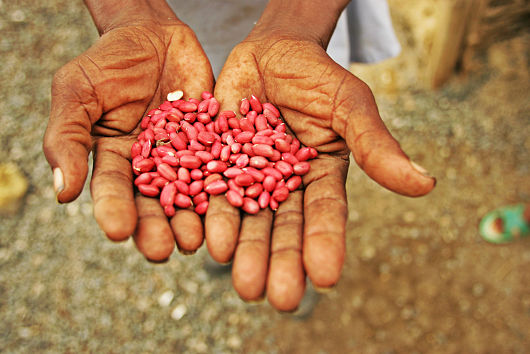
A recent collaboration among the Food and Agriculture Organization of the United Nations, the International Fund for Agricultural Development, or IFAD, and the World Food Programme yielded a publication titled, “The State of Food Insecurity in the World.” This document analyzes the current statistics regarding the number and location of the world’s hungry and these ten statistics reflect the most updated state of the world’s hungry populations.
1. There are 795 million people around the world who are undernourished, down by 167 million in the last decade.
According to the publication, 780 million people out of the 795 million are located in underdeveloped regions, namely Sub-Saharan Africa and Southern Asia, two areas in which severe hunger is most prevalent.
2. WFP estimates that $3.2 billion is needed each year to feed all 66 million hungry school-age children.
Hunger is one of the leading causes of death in developing countries, particularly in young children under the age of 5. Increasing the U.S. foreign aid budget could drastically improve the lives of millions of hungry children.
3. About 1.3 billion tons of food, roughly one-third of all food produced, is wasted.
When all of this food is not consumed, the one in eight people in the world who go hungry every day are stripped of the chance to get a life-saving meal.
4. This year, 29 countries have achieved the World Food Summit’s goal to halve the number of undernourished people in their populations.
The countries who reached this goal: Angola, Armenia, Azerbaijan, Brazil, Cameroon, Chile, China, Cuba, Djibouti, Dominican Republic, Gabon, Georgia, Ghana, Guyana, Kuwait, Kyrgyzstan, Mali, Myanmar, Nicaragua, Oman, Peru, Saint Vincent and the Grenadines, Samoa, São Tomé and Príncipe, Thailand, Turkmenistan, Uruguay, Venezuela and Vietnam.
5. More than 80 percent of the world’s most food-insecure people live in countries prone to natural disasters with high levels of environmental degradation.
Areas that are likely to have hurricanes, floods, earthquakes and other destructive events are consequently more prone to collapsed cities, destroyed farmlands and polluted water sources. These consequences directly impact the availability of food in these regions.
6. A total of 72 developing countries out of 129, or more than half the countries monitored, have reached the Millennium Development Goal 1c hunger target.
The MDG relating to hunger takes into account both the prevalence of undernourishment in the specified country, as well as the proportion of underweight children under the age of 5. According to the FAO report, “In many countries that have failed to reach the international hunger targets, natural and human-induced disasters or political instability have resulted in protracted crises with increased vulnerability and food insecurity of large parts of the population. In such contexts, measures to protect vulnerable population groups and improve livelihoods have been difficult to implement or [are] ineffective.”
7. Western Asia and Sub-Saharan Africa are the only two regions in the world where the number of hungry people has increased since the 1990 study by the WFP, according to “The State of Food Insecurity in the World.”
In Western Asia, there were eight million people undernourished in 1990, and this number has increased to 19 million this year. In Sub-Saharan Africa, the number of undernourished people has increased from 176 million in 1990 to 220 million in 2015.
8. Poor nutrition causes nearly half (45 percent) of deaths in children under 5, or 3.1 million children each year.
It is estimated that nearly 8,000 of these deaths are tied to hunger. Approximately one child dies every 10 seconds.
9. Nearly one in every five people survive on less than $1.25 a day.
Approximately 80 percent of this small amount is used to buy food for an entire family. This leaves very little room for buying other necessities such as health care, clothes and shelter.
10. The main cause of hunger is poverty.
According to The Hunger Project, “Poverty, food prices and hunger are inextricably linked. Poverty causes hunger. Not every poor person is hungry, but almost all hungry people are poor. Millions live with hunger and malnourishment because they simply cannot afford to buy enough food, cannot afford nutritious foods or cannot afford the farming supplies they need to grow enough good food of their own. Hunger can be viewed as a dimension of extreme poverty. It is often called the most severe and critical manifestation of poverty.”
– Hanna Darroll
Sources: Food and Agricultural Organization, World Food Programme 1, World Food Programme 2, World Food Programme 3, 30 Hour Famine, The Hunger Project
Photo: Cross Catholic Field Blog

Geographic Challenges Lead to Malnutrition in Tuvalu
In the last leg of their Diamond Jubilee Tour of 2012, the Duke and Duchess of Cambridge [Kate Middleton and William Young] made a stop at the island of Tuvalu, joining them in their tribal dances among other activities. Tuvalu is located in the southwestern part of the Pacific Ocean near Australia, is the second smallest country in the world at only ten square miles in area, and is a country rarely discussed in the media.
Taiwanese eco-artist Vincent Huang will soon be unveiling the very first “floating pavilion” there, a pool crossed by walkways. The symbolism behind this pavilion, based on the rising sea levels and ever-changing climate, offers insight to one of the many geographical challenges that the country has faced, which has led to economic instability. According to Huang: “Tuvalu is the smallest national pavilion but we’re dealing with the biggest global crisis. I believe that most people have never heard about Tuvalu but it’s an iconic victim in terms of climate crisis.”
However, the climate crisis in itself is only part of the problem. Tuvalunans rely heavily on foreign aid in the form of imported food products because of a lack of a fresh water supply and poor soil quality. They find themselves less and less able to purchase the food due to rising prices, falling remittances and loss of jobs. In sum: climate change with rising sea levels, little access to fresh water, soil lacking in nutrients, pollution, and climate change along with an inability to afford the necessary imported food has led to malnutrition.
According to UNICEF Pacific Social Policy Specifist Reiko Yoshihara-Miskelly: “malnutrition, in earlier age, it has a long-lasting effect, given that brain development in early childhood could be crucial for children’s later performance in schools and life.” In fact, 1.6 percent of children under five years old suffer from malnutrition in a nation of only about eleven thousand total in population.
However, UNICEF is working to alleviate this problem not just in Tuvalu, but worldwide through a project entitled The Power of Nutrition. Released on the sixteenth of April, the goal of this project is to access $1 billion through partnerships with philanthropic associations through a trust fund with the World Bank Group for the purpose of child nutrition. Learn more at powerofnutrition.org.
– Anna Brailow
Sources: BBC, Daily Mail, Knoema, The Power of Nutrition, Radio Australia, UNICEF
Photo: Mirror
FAO Partners with Wholesale Markets
On May 28 of this year, the United Nations Food and Agriculture Organization signed an agreement with the World Union of Wholesale Markets designed to reduce food waste and improve food security for the world’s urban poor.
According to the FAO, about one third of food produced for human consumption each year is lost or wasted. It estimates that over 40% of root crops, fruits and vegetables are lost or wasted, along with 35% of fish, 30% of cereals and 20% of meat and dairy products. This figure tallies up to an estimated 1.3 billion tons of food with an economic value of $1 trillion. These losses are quickly becoming concentrated in cities, where over half of the world’s population lives. Moreover, this figure will increase by 2050, as two-thirds of the people on earth are expected to live in cities.
Getting food to the urban poor is a novel challenge. Many low-income families live in “food deserts,” areas where there is no easy access to food, much less fresh food.
Eugenia Serova, head of the FAO’s Agro-Industry Division, said in a press release, “more efficient wholesale markets, and overall urban market outlets, can result in more affordable means to reach the city poor with healthy food.”
According to Ms. Serova, this new agreement is as much about learning how to deal with the future as it is about handling the challenges of the present: “If close to 90 percent of the expected increase in the global urban population in the next two decades will take place in cities in Africa and Asia, it makes much sense to build solid knowledge on how to strengthen urban market systems.”
WUWM has agreed to work with the FAO to tackle these challenges with an eye toward sustainability and inclusiveness.
Donald Darnall, a member of the board of directors of WUWM, said, “Some 60 percent of wholesale markets we’ve surveyed said managing food waste was their number-one challenge for the next five years . . . Our markets are embracing ‘good practices’ to reduce waste and we see this as an opportunity to develop improved waste management strategies and share solutions.”
The two agencies hope to develop a set of better practices for wholesale markets in urban settings. The goal is a more efficient flow of information and a dramatic reduction in food waste and loss. The partnership also hopes to improve producers’ access to markets, make food handling safer and more consistent and eliminate urban food deserts.
WUWM is connected to wholesale marketers in 43 countries, giving it access to an enormous amount of data. With this much data and expertise at their disposal, the FAO and WUWM are well on their way to finding new methods of improving efficiency, ensuring better quality of produce and ultimately cutting waste.
– Marina Middleton
Sources: UN News Centre, World Union of Wholesale Markets Seattle Pi Food and Agriculture Organization of the UN Food and Agriculture Organization of the UN
Photo: Flickr
10 Shocking World Hunger Statistics
A recent collaboration among the Food and Agriculture Organization of the United Nations, the International Fund for Agricultural Development, or IFAD, and the World Food Programme yielded a publication titled, “The State of Food Insecurity in the World.” This document analyzes the current statistics regarding the number and location of the world’s hungry and these ten statistics reflect the most updated state of the world’s hungry populations.
1. There are 795 million people around the world who are undernourished, down by 167 million in the last decade.
According to the publication, 780 million people out of the 795 million are located in underdeveloped regions, namely Sub-Saharan Africa and Southern Asia, two areas in which severe hunger is most prevalent.
2. WFP estimates that $3.2 billion is needed each year to feed all 66 million hungry school-age children.
Hunger is one of the leading causes of death in developing countries, particularly in young children under the age of 5. Increasing the U.S. foreign aid budget could drastically improve the lives of millions of hungry children.
3. About 1.3 billion tons of food, roughly one-third of all food produced, is wasted.
When all of this food is not consumed, the one in eight people in the world who go hungry every day are stripped of the chance to get a life-saving meal.
4. This year, 29 countries have achieved the World Food Summit’s goal to halve the number of undernourished people in their populations.
The countries who reached this goal: Angola, Armenia, Azerbaijan, Brazil, Cameroon, Chile, China, Cuba, Djibouti, Dominican Republic, Gabon, Georgia, Ghana, Guyana, Kuwait, Kyrgyzstan, Mali, Myanmar, Nicaragua, Oman, Peru, Saint Vincent and the Grenadines, Samoa, São Tomé and Príncipe, Thailand, Turkmenistan, Uruguay, Venezuela and Vietnam.
5. More than 80 percent of the world’s most food-insecure people live in countries prone to natural disasters with high levels of environmental degradation.
Areas that are likely to have hurricanes, floods, earthquakes and other destructive events are consequently more prone to collapsed cities, destroyed farmlands and polluted water sources. These consequences directly impact the availability of food in these regions.
6. A total of 72 developing countries out of 129, or more than half the countries monitored, have reached the Millennium Development Goal 1c hunger target.
The MDG relating to hunger takes into account both the prevalence of undernourishment in the specified country, as well as the proportion of underweight children under the age of 5. According to the FAO report, “In many countries that have failed to reach the international hunger targets, natural and human-induced disasters or political instability have resulted in protracted crises with increased vulnerability and food insecurity of large parts of the population. In such contexts, measures to protect vulnerable population groups and improve livelihoods have been difficult to implement or [are] ineffective.”
7. Western Asia and Sub-Saharan Africa are the only two regions in the world where the number of hungry people has increased since the 1990 study by the WFP, according to “The State of Food Insecurity in the World.”
In Western Asia, there were eight million people undernourished in 1990, and this number has increased to 19 million this year. In Sub-Saharan Africa, the number of undernourished people has increased from 176 million in 1990 to 220 million in 2015.
8. Poor nutrition causes nearly half (45 percent) of deaths in children under 5, or 3.1 million children each year.
It is estimated that nearly 8,000 of these deaths are tied to hunger. Approximately one child dies every 10 seconds.
9. Nearly one in every five people survive on less than $1.25 a day.
Approximately 80 percent of this small amount is used to buy food for an entire family. This leaves very little room for buying other necessities such as health care, clothes and shelter.
10. The main cause of hunger is poverty.
According to The Hunger Project, “Poverty, food prices and hunger are inextricably linked. Poverty causes hunger. Not every poor person is hungry, but almost all hungry people are poor. Millions live with hunger and malnourishment because they simply cannot afford to buy enough food, cannot afford nutritious foods or cannot afford the farming supplies they need to grow enough good food of their own. Hunger can be viewed as a dimension of extreme poverty. It is often called the most severe and critical manifestation of poverty.”
– Hanna Darroll
Sources: Food and Agricultural Organization, World Food Programme 1, World Food Programme 2, World Food Programme 3, 30 Hour Famine, The Hunger Project
Photo: Cross Catholic Field Blog
Self-Adjusting Glasses Provide a Vision for the Future
The lack of productivity caused by poor eyesight costs the developing world $269 billion per year according to the World Health Organizations. Other estimates put the number as high as $700 billion.
Poor eyesight makes living in the developing world considerably burdensome. It is much more difficult to hold down a job, accidents are more frequent and even life expectancies are significantly lower.
To bring about worldwide, long-term economic development, affordable eye care must be brought to the 517 million people in developing countries with both impaired vision and a lack of the means to correct it. For this reason, in the past few years, great strides have been made in promoting affordable eye care in the developing world.
Self-adjustable eyewear is a potential solution to this problem. Low priced and easy to use, they provide a solution to over 80 percent of those with vision problems in the developing world, though they cannot yet provide a solution to astigmatism and similar conditions.
One company providing such a service is Eyejusters. Eyejusters bring high quality eyewear to the developing world for a low cost using something known as “Slide Lens.” Able to tackle both near and long-sightedness, though Eyejusters tends to focus on reading glasses, Slidelens glasses allow the individual to adjust them through the turning of a screw.
Self-adjustable eyeglasses can be provided for an extremely low price. Dutch glasses maker, “The Focus on Vision Foundation,” is able to produce a pair of glasses for just $4 a pair, while the average North American pair of prescription eyeglasses is $350.
British company Ad Specs has been selling its brand of self-adjustable eyewear in the developing world for $19 a pair. All of these companies are using technology to bring low-cost solutions to problems which, in the developing world, have a very high cost.
Self-adjustable glasses provide a major fix to the problem of poor eyesight in the developing world. Fixing this problem can significantly improve the economic well-being, health and life expectancy of millions.
– Andrew Michaels
Sources: Forbes, Gizmag New York Times Eyejusters Global Eyesight
Photo: Business Opportunities
Understanding Foreign Aid
Foreign aid is a broad term that defines the assistance of one country to another, usually a developed country helping another nation. This assistance can be monetary or otherwise and can be intended for many different purposes or reasons.
The origins of foreign aid in the United States stem from the Marshall Plan and the U.S. assisting Europe in its post-World War II recovery. More recently, the United States Agency for International Development’s stated mission is to help fledgling democracies and end extreme poverty.
Most people in the U.S. believe that foreign aid is substantially higher than its actual value, which is equivalent to or lower than one percent of the federal budget. The money sent to other countries as aid is fairly small for the U.S., yet it is capable of producing a host of benefits for the recipient countries.
Humanitarian assistance is the most common reason for giving foreign aid. The recent earthquake in Nepal triggered a response by USAID whose contribution of over $47 million have been used to help with disaster relief in the region. Other reasons for humanitarian-related aid include extreme poverty, hunger and the effort to improve global health by fighting preventable, communicable diseases that are common in the developing world.
Infrastructural development is a commonly cited purpose for aid dollars. China, for example, has been investing heavily on infrastructure in Africa, including a $15 million aid deal with Sierra Leone for fiber optics installations. This investment is only one example of how aid is used to build communications, transportation, medical and other critical infrastructure in order to help facilitate economic growth and development.
Aid earmarked for education assists countries while preparing them to be more independent. Aid programs often focus primarily on improving access to education, which can be a limiting factor for education’s effectiveness. These programs also target teachers’ training in order to improve the quality and impact of the education being provided. Building human capital by establishing skills such as basic literacy cannot be underestimated.
In the past eight years, the European Union Commission has invested well over four billion euros in improving education and literacy in multiple developing countries. They were able to put at least nine million children into schools and train hundreds of thousands of teachers in order to improve standards of education. Rudimentary reading and writing skills that are taken for granted in developed countries can change the lives of those in developing countries where literacy rates are low. Literacy can be thought of as a gateway toward further human capital and economic development.
Foreign aid can also be motivated by strategic and geopolitical forces. Helping other countries can leverage support for the gifting nation or help build strong relationships in a certain region.
Israel received the most foreign aid from the U.S. in its 2012 fiscal year. Though Israel does not face the same low literacy rates or high levels of poverty as countries in Africa, there are strong geopolitical motivations that have led to this phenomenon. In addition, five of the top ten recipients of aid in the same year were from the Middle East. Some states in the region are rife with war and turmoil. As a result, the U.S. provides foreign aid to help these states recover from the damages of war or to aid in creating and sustaining stability across the region as a whole.
Developed countries are in a position to help those in foreign countries who are in need of assistance. Foreign aid is an essential and fairly pain-free way for developed countries to fight against global poverty and support global health, education and peace.
– Martin Yim
Sources: USAID 1, RAND, Washington Post, Aid Data, USAID 2, European Commission, ABC News USAID
Photo: Georgetown Public Policy Review
ILO Report on Global Job Insecurity
A recent report by the International Labor Organization shows that only one-fourth of the world’s workers have stable contracts. The organization’s main annual report covers more than 180 countries and over 84 percent of the workforce.
The remaining three-quarters are employed informally, illegally, on a temporary basis, with short-term contracts, through unpaid family work or are self-employed, said the ILO’s World Employment Social Outlook 2015 report titled, “The Changing Nature of Jobs.”
Among workers who earn salaries, only 42 percent have permanent contracts.
The finding revealed a clear shift away from reliable full-time jobs to an increase in short-term contracts and irregular hours. The standard model of full-time work is becoming less and less representative of today’s global job market.
This worldwide trend of moving away from more permanent employment risks “perpetuating a vicious circle of weak global demand and slow job creation” that has strongly affected many countries since the 2008 crisis, ILO said. This decline of steady jobs is accompanied by soaring global unemployment. Last year, 201 million people found themselves jobless, 30 million more than before the 2008 financial crisis.
There is some variation between countries and income levels. In higher-income countries, more than three-quarters of workers are employed on permanent contracts, although less than two-thirds of those are full time, the ILO report said. In middle-income countries, almost 72 percent of workers are employed without a contract and in 13 low-income countries with available data, only 5.7 percent.
The permanence level of the employment is closely tied to income, with permanent workers earning significantly more than non-permanent ones, creating a nearly unbreakable cycle.
Many of these workers find themselves in dire poverty, with nearly one-fourth last year living on and supporting their families on less than $2 a day. What’s more, 10 percent of the global workforce lived on earnings of less than $1.25.
Nonetheless, these numbers show vast improvement from 20 years ago, when half of the world’s workers lived well below the $2 poverty line threshold.
“In some cases, non-standard forms of work can help people get a foothold into the job market. But these emerging trends are also a reflection of the widespread insecurity,” said Guy Ryder, ILO’s director-general.
– Alison Decker
Sources: The Guardian, Business Insider CNBC Business Standard
Photo: Flickr
Jobs for Refugees at a Socially-Minded Business
That number is increasing and will continue to grow in the coming year. In February 2015, the Office of Refugee Resettlement reported that 69,986 refugees came to the U.S. in 2014. The U.S., though, often does not have enough jobs for refugees that come into the country.
The reason for the rise in refugee amount is largely due to the crisis in Syria, which has displaced thousands. So far, about 647,000 people have been forced to flee the region.
The Syrian conflict has been called the largest migration by a single group of people since 1999 when war in Kosovo resulted in the displacement of more than 867,000 people.
The United Nations’ High Commission for Refugees releases an annual report on the total amount of people driven from their homeland. In June 2013, it was at 45.2 million people. This was the highest ever in recorded history.
The five countries most impacted by wars are Afghanistan, Somalia, Iraq, Syria and Sudan. In fact, these countries were the source of 55% of all refugees in 2013.
In the 2012 report, nearly half of the population of refugees were female, and about 46% were children aged 18 or younger.
In Lancaster, Pennsylvania, Srirupa Dasgupta owns a socially-minded restaurant. Beginning at first as a catering company in 2010, the restaurant opened in April 2014. Dasgupta wanted to create a place where refugees and other marginalized people could find jobs.
“I realized that Lancaster has a large refugee population,” says Dasgupta, “These women had the skills to get a job and had jobs in their country but they couldn’t get past the language barrier in this country.”
She saw that, hired as cooks, women did not have to read the recipes because they had curated them on their own. Currently, she has three regular employees that are each paid $14.50 per hour, which is twice the amount of minimum wage in Pennsylvania.
Dasgupta came to the U.S. from India to attend college in Massachusetts. Her grandparents fled Bangladesh in 1947 and their struggle, along with many others she has come across, inspired her to start her business.
“Upohar’s lead chef is Rachel Bunkete who grew up in the Democratic Republic of the Congo. She left her home in order to escape political, ethnic and religious conflicts in 2008, but was forced to do so without her husband and three children. Ever since she was allowed to come to the U.S., she has been working toward being reunited with her family.
Another chef, Tulsha Chauwan, fled Bhutan with her family and lived in refugee camps in Nepal for year before they were allowed to settle in the U.S.
Upohar, the name of the restaurant, is the Bengali word for ‘gift’.
So far, Dasgupta has yet to yield any profit from her restaurant, but she is thrilled just knowing that she has made a difference in the lives of those involved.
– Lillian Sickler
Sources: NPR, Upohar, Lancaster Online, International Rescue Committee, U.S. Department of State, The Guardian, Office of Refugee Settlement
Photo: Flickr
Biodiversity and Sustainability
The World Bank has invested millions to end deforestation as this has a strong influence on the emission of greenhouse gases. The World Bank’s Amazon Region Protected Areas program, or ARPA, keeps forests in Brazil safe from being destroyed. “The program has helped protect around 70 million hectares of rainforest…with a 37% decrease in deforestation between 2004 and 2009,” according to the World Bank.
The World Bank also works closely to protect wildlife and oceans. The loss of biodiversity has influenced the organization’s investment of millions into many countries. In Honduras, the World Bank has protected a species of hummingbirds by stopping the construction of certain roadways. In Namibia, the organization has invested $4.9 million “to help establish a strong platform for governance of the coastal land and seascape and for development of a National Policy on Coastal Management.”
The U.N.’s sustainable development goals find that biodiversity is crucial. “Protecting ecosystems and ensuring access to ecosystem services by poor and vulnerable groups are essential to eradicating extreme poverty and hunger,” U.N. Secretary-General Ban Ki-moon said. The U.N. brings awareness to these issues by celebrating the International Day for Biological Diversity on May 22.
Another way the U.N. is taking action is by tackling proper energy use. Utilizing wind energy and solar power eliminates greenhouse gases and pollution. “Powering the Future We Want offers a grant in the amount of one million U.S. dollars to fund future capacity development activities in energy for sustainable development,” according to the U.N. Together, these programs will bring the world closer to creating a sustainable world.
– Kimberly Quitzon
Sources: The World Bank, Shanghai Daily UN Department of Economic and Social Affairs
Photo: Marty’s Market
Education Continues in Sudanese Refugee Camps
South Sudan is a country that has been torn apart by war and internal conflict for over 20 years, having only brief interludes of peace. The violence continues today, pushing many people to flee to nearby countries like Uganda and Kenya. However, the violence disrupts more than just daily lives. Over one million South Sudanese children do not attend primary school. Many have fled to Sudanese refugee camps where an education is not offered, and for those who stayed, the conditions are too dangerous to hold or attend classes.
Sources: UNICEF, Project Education Sudan, NPR, UNHCR, World Bank
Photo: Flickr
NASA Technology Helps Nepal Victims
Rescuers in Nepal are using NASA technology to find survivors buried under piles of rubble.
A new piece of equipment, known as FINDER, detects very slight movements under piles of debris. By using low-powered microwave signals, the suitcase-sized device can find heartbeats and signs of breathing, even when the victims are unconscious. So far, four men have been rescued from the ruins of collapsed buildings thanks to FINDER.
This is the first real-world application of the device, which was effective in detecting heartbeats through 30 feet of rubble in testing. The technology uses an algorithm similar to one developed by NASA to monitor orbiting space satellites. The device is sensitive enough to distinguish between humans, animals and machines, making it valuable in post-disaster situations.
Considering the severity of the disaster, such devices are certainly needed. The 8.1 magnitude earthquake, known as the Gorkha earthquake, has killed more than 8,000 people and injured many more. The quake was rated as “Extreme” on the Mercalli intensity scale and caused an avalanche on Mount Everest that killed 19 people. Rescue efforts have been hindered by over 120 aftershocks, which are expected to continue for months, if not years.
Gorkha was the worst earthquake to hit the region in nearly a century. Most victims died in Nepal, though hundreds were also killed or injured in India, China and Bangladesh.
Earthquakes are especially disastrous for the world’s poor, who often live in substandard and unhealthy conditions. When disasters strike, rescue services are inadequate and access to healthcare is restricted. Buildings in poorer countries may be overcrowded and may not be built with safety or earthquake resistance in mind. Damage is less likely to be repaired.
Small, landlocked Nepal is one of the world’s poorest and least developed countries. The United Nations estimates at least 25 percent of Nepalese live below the poverty line. Literacy rates are low with nearly half of women reported as illiterate. Most of the population is rural and most roads are graveled or earthen.
In addition to poverty, the remote and hazardous terrain of Nepal hinders rescue efforts. International aid and innovations in technology are both needed to assist those affected by the disaster.
Alongside FINDER, a few other innovative technologies have been included in rescue efforts in Nepal. The online, crowd-sourced mapping group OpenStreetMap organized over 4,000 remote volunteers to assist rescuers in their efforts. Meanwhile, drones have seen significant use by reporters and photojournalists recording the earthquake’s extensive damage.
– Kevin Mclaughlin
Sources: The Guardian, LA Times, NASA, JPL, NCBI, United Nations, Wired
Photo: Engadget