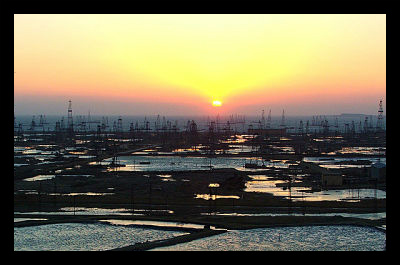
Since 2005, the Baku-Tbilisi-Ceyhan pipeline has brought Azerbaijan a newfound prosperity, but the money from the oil windfall is still tightly concentrated, and inequality remains a huge issue. Even with the enormous bounty from the pipeline, it is still a struggle for the average Azerbaijani to make a living.
Azerbaijan, a former member of the USSR, is home to some of the richest people around the Caspian Sea. Despite its lack of universities, public services, or manufacturing sectors, it has a plentiful supply of oil.
This is the first time in centuries that Azerbaijan has had a lucky break in geopolitics. It has been occupied by Cyrus the Great, Alexander the Great, the Seljuks, the Mongols, the Persians, the Russians, the Ottomans and, finally, the Soviets over the centuries. Now, finally, Azerbaijan has a chance of controlling its own destiny. Between 2006 and 2008, Azerbaijan’s economy grew at an annual average rate of 28 percent, the fastest in the world.
Many would argue that Azerbaijan is not spending its new money wisely. Instead of overhauling its creaking social security system, or investing in schools, it is building sports stadiums and luxury mega-developments. Gulnara Suleymanova, an impoverished mother living in the shadow of Azerbaijan’s brand-new stadium, built especially for the European Games, said that she can barely afford to feed her children, let alone provide them with an educated and treatment for their health problems.
“They build sports complexes, construct roads, but who benefits from them? Why don’t they help children? Why don’t they think that there are small children, sick and poor people living in this country? Why don’t they help them?” she asks.
Huge undertakings like the stadium and the mega-development can be argued to have some merit, as the publicity from the games and the over-the-top extravagance of the mega-developments can signal to investors that the country’s government supports growth. They serve as a kind of international billboard, advertising a friendly business climate to anyone who wants to build anything spectacular.
That being said, experts at USAID have said that Azerbaijan must diversify its economy if it wants to maintain a high rate of growth. Right now, there is too much emphasis on the extraction-sector and not enough focus on other sectors, or on investments for the future. Without movement into other sectors, a failure in the oil supply could send Azerbaijan back into an agrarian economy.
Azerbaijan used to rely primarily on its exports of pomegranates and hazelnuts to make money, but even high-worth crops like these are subject to droughts, floods, blights, and other events outside of the country’s control. USAID hopes to help Azerbaijan achieve a diverse and sustainable economy, with much less inequality than is present now.
If USAID succeeds, Azerbaijan may be able to mold its new-found wealth into a well-rounded and diverse economy.
– Marina Middleton
Sources: USAID, Doing Business, New York Times, Massispost, The Guardian
Photo: Flickr

Malnutrition in Mauritania
Though the shores are teeming with fish, childhood malnutrition in Mauritania persists.
According to UNICEF, 20 percent of the country’s children under five are underweight. Another 22.5 percent of children exhibited signs of stunting, an inhibition of growth caused by chronic malnutrition. Wasting, a deterioration of fat and muscle due to acute malnutrition, was seen in 12.2 percent of children.
Mauritania ranks 27th in the world for under-five mortality, with a rate of 84 per 1000 births. Thirty-four percent of children are born with a low birth weight of less than 2500 grams.
Professor and nutrition expert Michael Golden stated in a 2012 interview with UNICEF that malnutrition is often caused by a combination of poverty, low social mobility and poor medical services. “What is needed now is to focus on health services research – how to deliver services effectively to poor people in places like Mauritania,” Golden said. “We need to maximize the efficiency of small numbers of staff who are not always well trained.”
One of the world’s poorest countries, Mauritania is known for its slave trade. Though slavery was outlawed in 1981, there were no criminal penalties for slave owners until 2007 and the practice is still widespread.
Mauritania’s economy relies mostly on agriculture, fishing and mining in lieu of industry. Very little of Mauritania’s land is arable and the country suffers from recurring droughts. Overfishing by foreigners has hurt its economy.
The country continues to be home to nearly 50,000 refugees fleeing neighboring Mali. In 2012, war broke out between the Malian government, Tuareg rebels and Islamic extremists. The region remains volatile and refugees are reluctant to return.
According to the U.N.’s Standing Committee on Nutrition, malnutrition is the single largest contributor to disease. It is especially dangerous for young children, who need a proper diet to develop. Without necessary vitamins and minerals, children may suffer from stunted physical and mental development.
Malnutrition is both a cause and symptom of global poverty. In countries where families consist of many children, it may not be possible to feed all of them. Those who are malnourished may struggle to work and mothers are often unable to breastfeed. As stunted children typically earn less as adults, malnutrition is a major factor in the cycle of poverty.
– Kevin Mclaughlin
Sources: CIA, UNICEF 1, UNICEF 2, UNICEF 3
Photo: Flickr
6 Global Health Internships in Seattle
These global health internships are not only an opportunity to learn, they’re also an opportunity for you to make change locally and reach globally. Here are six global health internships in Seattle to make these upcoming winter months feel better:
1. The Borgen Project
The Borgen Project works at the political level to bring greater attention to global health. View the organizations latest ops.
2. Washington Global Health Alliance
Since 2007, WGHA has activated every sector in the region to advance global health equity. WGHA makes an impact through mobilizing the dynamic global health sector, advocating and educating lawmakers about its vital role in our economy and cultivating global health leaders through innovative partnerships. These are the core objectives that make WGHA one of the world’s most dynamic centers for global health innovation.
3. Global Partnerships
GP is a 501(c)3 nonprofit impact investor that strives to pioneer and invest in sustainable solutions that help impoverished people earn a living. They are currently invested in 46 microfinance institutions, social businesses and cooperatives in Latin America and the Caribbean with a focus surrounding four impact areas: health services, rural livelihoods, green technology and micro-entrepreneurship. Across these impact areas, women comprise 77 percent of the people GP’s partners serve as they continue to empower women to improve their livelihoods.
4. Community Alliance for Global Justice
This grassroots, community-based organization calls for global justice everywhere, seeking to educate and mobilize individuals who want to strengthen local economies. The CAGJ consists of three programs: the Food Justice Project, AGRA Watch and Trade Justice. Here volunteers can harness their skills to transform unjust trade and agricultural policies imposed by corporations and to build solidarity across diverse movements that embody social justice and sustainability.
5. One By One
One by One is committed to restoring the health and dignity of women with obstetric fistula by helping to create safe conditions needed for women to give birth. In addition to providing preventative measures that lead to safe childbirth choices for families through education and advocacy, One by One partners with local organizations to develop community-based outreach efforts, surgical repair services and rehabilitation/training programs that allow women who have suffered with fistula to fully heal and to fully reintegrate back into their community.
6. Global Health Internship at the Seattle Biomedical Research Institute
This is a competitive internship that provides an opportunity for three highly qualified undergraduates to spend the summer working alongside some of the best scientists in the world. For a period of 10 weeks, interns will aid in specific research projects in their designated SBRI scientific program. Training with chemicals, biological materials and scientific equipment will be given prior to working in the laboratory. This internship is a great opportunity for students interested in biosciences as a career to get their foot in the door and to network with some of the best in the field. You must be an undergraduate junior or senior in the following academic school year to be eligible.
– Chelsee Yee
Sources: PATH, Washington Global Health Alliance, Global Partnerships, Seattle Global Justice, Fight Fistula, Haverford University, Global Health Washington
Photo: Flickr
The 20 Most Impoverished Countries
The term “Third World” is often used to describe the impoverished nations across the globe. According to Business Insider, the following list represents the 20 most impoverished developing countries from lowest to highest by GDP per capita:
Eighteen of these countries are in Africa. The widespread famine and war that have plagued the continent for decades, along with the hardships resulting from several nations’ recent independence from colonial European powers have all contributed to the poverty endured in the country.
Of the numerous conditions that perpetuate poverty within the countries listed above, three factors dominate: drought, political instability and failure to harness resources.
What Creates Impoverished Countries
Water shortage has long been cited as one of the leading contributors to poverty. Severe droughts afflict nearly every third world nation on this list, causing a domino effect of failed crops, health concerns and further impoverishment.
Governmental instability prolongs poverty by fragmenting nations. Lack of political security and centrality undermine every inferior structure within the national hierarchy. Corruption, dictatorships and military rule impede economic development by institutionalizing instability and failing to address the issues that arise from poverty.
Although some of these countries contain valuable resources, few third world nations possess the capital to develop proper infrastructure. This results in an inability to exploit these assets or yield any profit from them.
The three poorest countries in the world, The Democratic Republic of Congo, Zimbabwe and Burundi, all have a GDP per capita of $400 or less, according to Business Insider. This is less than one one-hundredth of the United States’ GDP per capita.
So what’s the good news? There are tangible solutions to these three problems, and several developing countries are already beginning to pursue them.
Rwanda, rich with minerals and having received external aid after the genocide, shows signs of hope. Guinea and the Central African Republic show promise as well, if they can advance their industries and attain political stability. The Togolese Republic, working to repair its relationship with the international community and improve productivity through market privatization and foreign donor support, is experiencing some economic progress.
External contributors, such as the United Nations and non-governmental organizations, are supporting industry development and helping lay the groundwork for business in third world countries. Local governments are slowly shifting from military leadership to democracy. The progression of technology is creating more efficient ways to grow crops and utilize existing water sources.
The third world countries listed above are still far from escaping the bondage of poverty. Their greatest setbacks are their limited means for improving their conditions. But with the intervention and assistance of external powers, the improvement of infrastructure and the development of autonomous governments, there is potential for progress.
– Zoe Smith
Sources: Business Insider, One World Nations, The World Bank
Photo: World Knowing
Poverty in Ghana’s Largest City
Ghana is the only country in Sub-Saharan Africa that has met the Millennium Development Goal of reducing extreme poverty in half by 2015, and it is also among the most developed countries in the region.
According to the World Bank Group, 24.3 percent of Ghana’s population is living below the poverty line, down from 31.9 percent in 2005. Even with substantial developments, there still remain certain challenges that hinder progress in Ghana. Similar to many nations in the developing world, poverty in Ghana is largely due to social and economic inequalities among its citizens. Ghana’s economic growth has also slowed down significantly over the past few years, affecting many cities across the region including the capital of Accra. According to the World Bank Group, the gross domestic product (GDP) declined from 7.3 percent in 2013 to an estimated 4.2 percent in 2014. The slowed growth was a result of inflation and a fall in currency, which has also impacted many areas in the region such as Accra.
Accra, the capital of Ghana, is considered one of the largest cities in the country. The country has an estimated population of more than 2 million people and holds approximately 10 percent of Ghana’s entire population. Although Ghana’s economic progress has slowed down, its capital is still a leading force in the nation. For example, Accra has among the lowest poverty rates in the country when compared to other cities in the region.
The city serves as the focal point for the region’s economic development, with the service industry employing over 530,000 people. However, the city also has a high unemployment rate with approximately 12.2 percent of the population, amounting to 114,198 people, reportedly unemployed. This is a contributing factor to Ghana’s urban poverty. The population dwelling within the city relies heavily on employment and income, both of which are critical sources for sufficient livelihoods. In turn, high food prices and income inequalities further impact urban poverty in Accra.
Apart from city dwellers, poverty permeates a significant amount of rural areas in Accra. There are 79 communities within Accra including Ga Mashie, James Town, Chorkor and Nima, identified as three of the most high poverty communities in the region. The indigenous populations found throughout Accra are some of the most vulnerable. For example, communities in areas like Ga, which had initially derived its livelihood from farming and fishing, are now considered to be among the poorest in the region. Additionally, households headed by women within these communities experience significantly higher poverty rates.
The reason why Accra still has a large percentage of the population living below the poverty line is partly due to the lack of information provided about these communities. It is difficult to focus on an area with need when not enough information or knowledge is being conveyed; as a result, progress in the area has been hindered.
Even with all the challenges Ghana has been facing, it is still one of the most developed countries in the region. Urban and rural poverty resulting from social and political inequalities are reason enough for concern, even as Accra remains one of the more stable and developed cities in the region. With a more focused post-2015 development framework that addresses the social and economic inequalities in Ghana, the region can continue progressing.
– Nada Sewidan
Sources: World Bank, IPA, UNICEF, Action 2015
Photo: Two Years in Ghana
Solar Suitcase Saves Lives in Developing Countries
Childbirth can present risks anywhere in the world. However, in developing countries, giving birth can often be lethal for both mother and child. The most common causes of infant mortality include infections, premature birth, or birth asphyxia, while maternal deaths are usually the result of severe bleeding or high blood pressure during pregnancy. Effective care before, during, and after childbirth is necessary to treat such complications, but many areas lack the basic resources to provide such care.
In 2008, Dr. Laura Satchel traveled to Nigeria to research possible methods of lowering the country’s maternal death rate, which currently stands at 630 deaths per 100,000 births. Nigeria also has the 10th highest infant mortality rate in the world, with 74.09 deaths per 1,000 births. While working in state hospitals, Satchel realized that many of these deaths were not simply due to illness, but unreliable electricity interfering with the doctors’ ability to treat their patients. Nighttime deliveries were often illuminated only by candlelight, cesarean sections were frequently cancelled or conducted by flashlight, and patients were forced to wait days for life-saving procedures that could not be performed without electricity. This resulted in many deaths from treatable conditions.
Satchel’s goal was to come up with an affordable solution. She contacted her husband, Hal Aronson, a solar energy educator in Berkeley, California. Aronson began designing an off-grid solar electric system, specifically intended for use in maternity wards and labor rooms. This resulted in the development of the Solar Suitcase.
The Solar Suitcase is a bright yellow pack containing high efficiency LED medical lighting, a universal cell phone charger, a battery charger, and outlets for 12V DC devices. The maternity kit also includes a fetal Doppler. The suitcase is designed to last between 10 and 20 years, only requiring a battery change every two years. When Nigerian health clinics began receiving the suitcases, doctors were immediately able to charge headlamps and walkie-talkies while they waited for larger solar installations at their facilities.
In 2009, Satchel and Aronson founded the non-profit organization We Care Solar, aiming to improve the design of the Solar Suitcase and distribute them to more clinics in need. In 2014 alone, the suitcases are estimated to have served 256,800 mothers. As of November 2014, approximately 900 suitcases had been distributed to 25 countries worldwide, from Sierra Leone to Malawi.
Although the suitcases are primarily used in maternal health clinics, they have also saved lives in the wake of natural disasters. We Care Solar sent the device to Haiti after the 2010 earthquake at the request of medical relief teams.
Currently, the organization is in the process of sending 100 suitcases to Nepal, where thousands of pregnant women are in need of medical care following the recent string of earthquakes. In the coming months, We Care Solar plans on expanding its programs in Ethiopia, Tanzania and the Philippines. In a world where mothers and newborns die each day from preventable causes, devices like the Solar Suitcase provide doctors with the tools they need to give women and their children a chance at life.
– Jane Harkness
Sources: CIA 1, CIA 2, Huffington Post, Issuu, We Care Solar, WHO 1, WHO 2
Photo: Flickr
Malnutrition in Malaysia
Malnutrition in Malaysia is two-fold: there are many children who are underweight and suffer from malnutrition, while a good percentage of the population is obese.
Malaysia has seen significant economic progress and continues to develop substantially. According to the World Bank Group, the country’s economic growth is estimated to progress by seven percent every 25 years, and has virtually succeeded in eliminating poverty in the region. The amount of households living beneath poverty lines decreased from 50 percent to less than 1.0 percent since the 1960s. Currently, the country is under a program called the New Economic Model, launched years prior, which aims to achieve the goal of high income status by 2020. The program also ensures that the progress made during this period is sustainable.
Although Malaysia is experiencing a great deal of prosperity, there still seems to be a prevailing concern regarding malnutrition in the country. There still remain pockets of places and people living below poverty lines with high income inequalities. These pockets contribute to the malnutrition issue in Malaysia.
There are currently 30 million people living in Malaysia, and of those 30 million, 9.5 million are children. Among the population, 17. 2 percent or approximately 400,000 children are stunted, while 12.5 percent are underweight. On the other hand, 44 percent of the population is overweight, while an estimated 15 percent is considered obese, according to the National Heath ad Morbidity Survey. The total number of people with obesity exceeds that of any other country in Southeast Asia. These two issues are causing a significant divide in the realm of malnutrition within the country.
In regards to undernourishment in Malaysia, there has been a slight decrease in mortality rates among children under five years of age. According to National Health Statistics, the mortality rate dropped in 2010 from 8.4 per 1,000 people to 8.1 in 2013. Rural areas in Malaysia continue to have a high rate of malnourished children, especially in indigenous regions. More specifically, malnutrition in Orang Asli is among the more prevalent areas, according to a recent status report by the Children’s Rights Coalition in Malaysia.
In indigenous regions, lack of access to clean water, land and food contribute to malnutrition. Additionally, communicable diseases passed on as a result of poor sanitation also cause underweight and malnourished children.
The problem of malnutrition in Malaysia has been previously addressed in a failed attempt to rehabilitate malnourished children. The project did not reach its target in the allotted time because of corruption by officials. The program was essentially launched to provide baskets filled with vitamins and essential food items to households living under the poverty line.
Malnutrition in Asia, especially in Malaysia, is among one of the biggest problems the region is facing. Despite Malaysia’s economic prosperity and affluent resources, there is still a high percentage of malnourished households suffering from food insecurity. The high obesity rate along with the amount of malnourished people living in Malaysia sheds light on the inequalities that exist within the country, inequalities that reflect the great divide between the rich and poor.
– Nada Sewidan
Sources: WHO, UNICEF, The World Bank 1, The World Bank 2
Photo: Southeast Asia Globe
Azerbaijan’s Oil Money – What Will it Do With it?
Since 2005, the Baku-Tbilisi-Ceyhan pipeline has brought Azerbaijan a newfound prosperity, but the money from the oil windfall is still tightly concentrated, and inequality remains a huge issue. Even with the enormous bounty from the pipeline, it is still a struggle for the average Azerbaijani to make a living.
Azerbaijan, a former member of the USSR, is home to some of the richest people around the Caspian Sea. Despite its lack of universities, public services, or manufacturing sectors, it has a plentiful supply of oil.
This is the first time in centuries that Azerbaijan has had a lucky break in geopolitics. It has been occupied by Cyrus the Great, Alexander the Great, the Seljuks, the Mongols, the Persians, the Russians, the Ottomans and, finally, the Soviets over the centuries. Now, finally, Azerbaijan has a chance of controlling its own destiny. Between 2006 and 2008, Azerbaijan’s economy grew at an annual average rate of 28 percent, the fastest in the world.
Many would argue that Azerbaijan is not spending its new money wisely. Instead of overhauling its creaking social security system, or investing in schools, it is building sports stadiums and luxury mega-developments. Gulnara Suleymanova, an impoverished mother living in the shadow of Azerbaijan’s brand-new stadium, built especially for the European Games, said that she can barely afford to feed her children, let alone provide them with an educated and treatment for their health problems.
“They build sports complexes, construct roads, but who benefits from them? Why don’t they help children? Why don’t they think that there are small children, sick and poor people living in this country? Why don’t they help them?” she asks.
Huge undertakings like the stadium and the mega-development can be argued to have some merit, as the publicity from the games and the over-the-top extravagance of the mega-developments can signal to investors that the country’s government supports growth. They serve as a kind of international billboard, advertising a friendly business climate to anyone who wants to build anything spectacular.
That being said, experts at USAID have said that Azerbaijan must diversify its economy if it wants to maintain a high rate of growth. Right now, there is too much emphasis on the extraction-sector and not enough focus on other sectors, or on investments for the future. Without movement into other sectors, a failure in the oil supply could send Azerbaijan back into an agrarian economy.
Azerbaijan used to rely primarily on its exports of pomegranates and hazelnuts to make money, but even high-worth crops like these are subject to droughts, floods, blights, and other events outside of the country’s control. USAID hopes to help Azerbaijan achieve a diverse and sustainable economy, with much less inequality than is present now.
If USAID succeeds, Azerbaijan may be able to mold its new-found wealth into a well-rounded and diverse economy.
– Marina Middleton
Sources: USAID, Doing Business, New York Times, Massispost, The Guardian
Photo: Flickr
Poverty in Lahore, Pakistan
Pakistan is among the nations in the developing world that has made substantial progress in poverty reduction. The amount of people living in extreme poverty has gone down considerably over the years and continues to decrease today. What drives poverty reduction in Pakistan, especially in large areas such as Lahore, is income growth. Through a combination of support programs and reforms, as well as income equality, Pakistan was able to translate income growth to poverty reduction.
According to the World Bank Group, there are over 50 million less people living in poverty in present day Pakistan than there were in 1991. Additionally, the percent of people living on less than a dollar and a quarter a day fell from 66.5 percent to 12.7 percent. However, although extreme poverty in the region has been reduced, there is still over half of the population living under two dollars a day. Despite progress made in Pakistan, there still remains a high number of Pakistanis in poverty and many more who are vulnerable to falling back into poverty, especially in large cities such as Lahore.
Lahore, a large region in Pakistan, is considered to be one of the most populated urban areas in the world and is one of the largest cities in the Islamic world. According to Index Mundi, as of January 2015, Lahore has an estimated 10 million people living in the region. The size of the region poses a bilateral problem; on the one hand, Lahore’s population and size contributes to its wealth and prosperity, while on the other hand, with a large city comes overpopulation and underdevelopment. Large cities such as Lahore often have another side to their urban development: the underdevelopment of parts of the region called the slums. Similar to the slums in various parts of India, Indonesia and Kenya, slums in Lahore are densely populated with areas lacking in basic necessities such as clean water, electricity, security and health care.
In Lahore, 30 percent of the region is considered to fall into the category of slums; however, the percentage does not take into account the amount of unregistered slum neighborhoods in the city. These slums are formed by low income communities that do not have the means to live in proper housing in the city, and they are a byproduct of over population, economic, political and social inequalities as well government intervention. Slums in Lahore are also a consequence of people moving from rural areas around Pakistan to the city in hopes of attaining a better life. The reality, however, reveals that many who move into the city have a difficult time securing employment, and eventually settle in the slum communities as a result. Health care, education, and basics such as sanitation and electricity, are extremely limited in the slums of Lahore and further contribute to low living conditions.
A solution that can bring poverty rates down in Lahore is to have more government involvement through political laws and reforms that pay special attention to these areas. More government interference and aid to counteract inequalities can be the beginning of reducing poverty in the slums of Lahore.
– Nada Sewidan
Sources: The World Bank, TribuneAcademia.edu
Photo: Pakistan Defence
Review of Senate Hearing on Global Health
Earlier this month, the U.S. State and Foreign Operations Senate Subcommittee held a hearing on global health. The purpose of this hearing was to determine the role of U.S. leadership in the global health community as well as the type of approach it should take.
During the hearing, Grammy award-winning founder of the Elton John AIDS Foundation, Sir Elton John, and NY Times best-selling author and controversial California pastor, Dr. Rick Warren, voiced their opinions on the subject. Although these men are of different sexual orientations and come from different areas of the world, both are dedicated to eliminating preventable diseases that seem to be caused by extreme poverty.
At the hearing, Dr. Warren urged the Senate to approach the global health epidemic with new eyes. By highlighting the fact that a minimal amount of the national budget goes to foreign assistance, Dr. Warren told lawmakers to cultivate “the right kind of foreign assistance” so terrorism will be deterred for the next generation in a cost-effective manner.
Dr. Warren also encouraged the Senate to forge a new partnership with NGOs and religious organizations so that less stable countries can be guaranteed a continuous support system until these preventable diseases are eradicated from the Earth.
With 1 percent of the national budget going to foreign aid, Dr. Warren argues that more could be allotted to foreign aid so that the U.S. could better cultivate relations with foreign countries by changing its approach to funding. So often, the U.S. fails to provide long-lasting and substantial aid to foreign countries. By respecting the “culture and history of the country it aims to support” and targeting “the upstream causes of ill-health” like poverty, the U.S. can change its approach and make a greater impact.
While Dr. Warren highlighted a different approach to solving the problem of global health, Sir Elton John focused on a specific disease to which he feels personally connected.
Motivated by the despair he saw many sub-Saharan Africans suffering through, Sir John provided a “dignified death to more than 800,000 men, women, and children” as well as food, shelter and education to orphans.
Since the 1990s, Sir Elton John has focused on helping Africans grapple with the effects of HIV/AIDS. This disease that can be transmitted with the exchange of bodily fluids is rampant throughout the African continent due to impoverished conditions in communities.
At the hearing, John urged world leaders to de-stigmatize AIDS. Historically, HIV/AIDS has been seen by mainstream citizens as a part of the LGBTQI community. Because of that, many leaders view this disease as preventable by nature of sexual orientation. This stigmatizes those with the disease and makes it difficult to get proper treatment and preventable measures.
– Erin Logan
Sources: C-SPAN, Senate.gov
Photo: ABCNews
Water Billboards: Turning Humidity Into Potable Water
Receiving only a half-inch of precipitation annually, the 7.6 million residents of Lima, Peru are in the midst of a serious water shortage. One point two million Limans do not have running water at all, and 700,000 people have no access to clean water for drinking or bathing. With advanced climate change affecting the natural water sources of the Andes, engineers from Peru’s University of Engineering and Technology (UTEC) have turned to science, and specifically water billboards, for an answer.
Like a magician pulls a rabbit from a hat, they’ve figured out a way to pull water from thin air.
The process of scientific magic occurs inside a billboard in Lima’s Bujama District, erected by a group of UTEC engineers in partnership with marketers from the Mayo Publicidad ad agency. The billboard takes advantage of Lima’s high degree of humidity, nearly 90 percent in the summer months, and transforms this moisture into usable water.
When moist air hits the billboard, five condensers cool it and convert it into liquid form. The newly created water goes through reverse-osmosis purification and then flows into a 20-liner storage tank at the billboard’s base. The filtration system is simple and straightforward, though not entirely self-sufficient, because it uses electricity from Lima’s power lines.
Active for 3 months, the billboard has had a significant effect. It has produced nearly 2,500 gallons of water, averaging 26 gallons a day. According to the UTEC engineers involved, this is equivalent to the water consumption of hundreds of families per month.
Efforts have been made in the past to magically pull water from the air. Most notably Eole, a French company, installed a wind turbine in Abu Dhabi that was said to generate more than 370 gallons of water a day. The commercial launch of this technology, however, came at too high of a price.
That’s the genius of UTEC’s water billboard – if the technology expands, it will be inexpensive to install thanks to funding from advertisers. The inaugural billboard costs only $1,200 to construct, and advertises both UTEC and the technology itself. UTEC has not gone unrewarded, since the erection of the billboard enrollment has substantially increased. It hopes that companies will see UTEC’s own results and seek to advertise on water billboards themselves.
It is unclear whether more billboards like this one will be installed throughout Lima, but UTEC’s water billboard has successfully started new discussions about providing clean water. Advertising can be more than a commercial tool; it has potential as an effective method of helping those in need.
– Katie Pickle
Sources: Popular Mechanics, Time
Photo: Fast Coexist