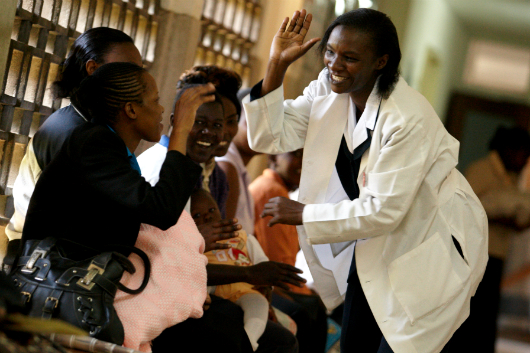
Thinking of becoming an international aid worker? Concerned about world issues like human rights, sustainability, agriculture, industrial development and natural disasters? Want to help people around the globe who need healthcare, housing, sanitation, education and relief from natural disasters?
Thousands of people with such noble ideals and ambitions are at work in developing countries. Their paths to working abroad were probably quite varied and more horizontal than vertical for a number of years before they headed overseas. Here is some other essential information to consider before planning a career as an international aid, development or humanitarian worker.
The first step is earning a degree. Like any other job, it should be in a field of strong interest that builds knowledge and develops talents and skills. The subjects most relevant to international aid work are sociology, social policy, human rights, languages, economics, sanitation and logistics. Workers with degrees in medicine, nursing, healthcare and water engineering are currently in high demand.
After earning a degree (in fact, more importantly than having a degree), one must acquire relevant experience. In reality, it is the most viable entry path to these highly competitive jobs. Because it is a catch 22—needing experience to acquire a job but needing a job to acquire experience—many beginners start as volunteers or interns in charities, nonprofits, and volunteer or nongovernmental organizations. Obviously, self-funding is necessary at this stage.
These experiences provide the training needed to move up because most organizations do not have the funding to provide extensive training programs. However, Oxfam International and the United Nations are two organizations that do provide structured internships and graduate development programs.
Once some experience has been acquired, next steps vary greatly. It is necessary to be open to changing career paths, as development needs change. Some typical work activities at this phase include hands-on project management, conducting needs assessments and organizing fundraising.
It may be that an advanced degree or some short courses will provide the necessary skills to progressing on the path to a desired position. For example, engineers, health care workers and disaster relief workers require advanced degrees and special skills. The same is true for people in microfinance and logistics. It is equally necessary to change organizations often in a horizontal or zigzag path in order to gain varied and relevant experiences.
After 10 to 15 years, it becomes possible to work in a higher level capacity. In this phase, consulting, general leadership development, policy and strategy development, or budget control are some of the possible responsibilities. These positions, whether domestic or international, are highly competitive, but they usually allow longer commitments and require less mobility.
No matter the degree, skills or experiences needed to become an international aid worker, it is also essential to begin with certain personality traits. These characteristics include: willingness to work more than 40 hours a week on a somewhat unpredictable schedule, ability to communicate with a variety of people, capacity to work under pressure and willingness to travel and live in basic conditions.
Working in the international aid field has its ups and downs like any other field. However, the entry and career paths are very different. International aid workers are among the most intelligent, skilled, resourceful and hardworking people in the world. They also have the satisfaction of knowing that the world is a better place because of the work that they do.
– Janet Quinn
Sources: All About Careers 1, Prospects 1, All About Careers 2, Prospects 2, All About Careers 3, Prospects 3, Humanitarian Jobs
Photo: One

Global Hunger Affects Fewer than 800 Million People
Currently, the number of people who face hunger is around 750 million people. The number of people living in hunger has been reduced by about 167 million people in the past 10 years. In the past year alone, the number of hungry people dropped by 10 million people.
This is incredible progress!
One of the main focuses of the Millennium Development Goals is to eradicate global hunger. Global hunger has dropped considerably, and this is a moment to recognize all that has been accomplished.
In South America, less than five percent of the population faces hunger. The number of hungry people has dropped by 50% in the past 25 years. Central and South East Asia, as well as Northern Africa, have seen a drop in the number of hungry individuals.
However, 44 percent of countries did not accomplish the Millennium Development Goal of reducing hunger by 50 percent in the last 15 years. South Asia still has 281 million people who suffer from hunger. In Sub-Saharan Africa, 23 percent of people do not get enough food.
Political instability in Sub-Saharan Africa may contribute to why hunger is still a problem. Twenty-four countries in Africa are currently experiencing food crises. This number is up from the 12 countries who were experiencing food crises in 1990.
Recently, bountiful food harvests and low oil prices have made the price of food drop considerably. These factors could have played a role in why hunger has been dropping.
Beyond economic growth, countries also have to focus on inclusive growth. For example, social investments, such as cash transfer programs, employment projects, food distribution schemes, healthcare and education could all reduce the number of hungry people.
Food is a basic necessity. It is extraordinary news that global hunger has dropped below 800 million. We need to continue to prioritize eradicating world hunger. If we continue progressing in this way, it is conceivable that world hunger could be eliminated.
– Ella Cady
Sources: Reuters, Deseret News,
Photo: Flickr
Disappearing “Poverty” in Britain
Poverty in Britain is quickly being removed from the country’s list of social reforms. Instead of new policies or legal changes sweeping the United Kingdom, poverty is being struck from Great Britain’s dictionary and being substituted with a much more stern response from the government. The very definition of “poverty” in Britain has become the focal point in this new era of British government.
An article published on July 2, by Britain’s flagship newspaper The Guardian, highlighted this new outlook by British Prime Minister, David Cameron. An excerpt from the article reads, “As an issue, poverty is to vanish, no longer a target or a word in the Conservative lexicon. Other things will be targeted instead – worklessness, family breakdown, addictions, debt and educational success. In doublespeak, the very meaning of the word poverty disappears when to be poor no longer means to lack money. To be poor will from now on mean to fail, to be poor apologies for human beings, people in error, in need of correction not cash.” Essentially, those in poverty are there because of a lack of work ethic to rise above the country’s poverty line.
The shift in attitude stems from the British government’s decision to focus primarily on attacking low national income to combat widespread poverty. While initially seen as a government abandoning a particular demographic, British officials maintain that this new direction will benefit the country the most in the foreseeable future.
An article by the Belfast Telegraph reported on the new approach to Britain’s economic issues. The article says, “the plan is to replace Labour’s Child Poverty Act, which established a duty for governments to eradicate the problem by 2020, with new legislation that will instead require ministers to report regularly on measures affecting a child’s life chances.” This reform aims to analyze data more carefully and make changes based on external factors affecting child poverty in Britain.
By making it a priority to target things such as unemployment, drug use and family breakdown, Britain’s government can effectively coordinate an appropriate response to nationwide poverty.
– Diego Alejandro Catala
Sources: The Guardian, Belfast Telegraph
Photo: The Independent
UK Government Set to Scrap Child Poverty Act as Rates Stay Consistent
Secretary of State for Work and Pensions, Iain Duncan Smith, announced this past week that the U.K. government will be scrapping its Child Poverty Act. The act, which promised to end child poverty in the United Kingdom by 2020, is being terminated after a recent report stated that current child poverty levels are “unacceptably high.”
Smith has stated that the government will be replacing the act with new perspectives on how to view child poverty, chiefly by changing its definition altogether.
The original act defined child poverty as a child living in a household with an income below 60% of the country’s average. Smith has spoken out against this definition, calling it “deeply flawed” as well as “a poor test of whether children’s lives are genuinely improving.”
Duncan’s new plan defines child poverty by “levels of educational attainment, worklessness and addiction,” as opposed to “relative material disadvantage,” according to The Guardian.
This news prefaces a large cut in tax credits to be introduced in the July 8, 2015 budget as a means to reduce the welfare budget. These cuts make the original 2020 goal all the more unobtainable.
The commission that oversaw the act, the Child Poverty and Social Mobility Commission, will be renamed to simply the Social Mobility Commission.
“We want to eradicate child poverty. This is not a departure from that proposal,” Smith said. “What we want to do is to ensure, however, that we do this by changing the long-term life chances of those who live in the poorest families.”
– Alexander Jones
Sources: BBC, The Guardian 1, The Guardian 2
Photo: The Guardian
The Youth of Yemen Promote Peace
Yemen has been through a whole lot in the past few years. While political unrest has plagued the nation for years, in the recent months, the country has been dealing with ongoing airstrikes.
“Some days it’s calm, and some days it’s not. It’s so unpredictable. Right now, we’re on day four with no electricity. When it does come on, it will only be one for an hour,” Hana reports. At 26-year-old, Hana is a youth assistant project manager for the Foundation for Peace project.
The project was founded in 2012 by the Cooperative for Assistance and Relief Everywhere (CARE), with the goal of teaching members of the community to effectively prevent and resolve conflicts. They focus on women and youth that typically do not have the opportunity to be influential or participate in dialogue.
So far, 560 youth, women, and local community leaders have received training. In addition, CARE has provided 15 water tanks for poor neighborhoods.
Many people in the country do not have nearby access to water sources and have to walk for miles every day. The limited amount of water sometimes results in clashes within communities.
In the past, wealthy business owners and merchants have paid for trucks to bring water to the poor. However, the trucks wasted a lot of water since they did not offer an effective method of collection. To rectify this inefficiency, the water tanks that CARE installed are permanent. They allow for people to obtain water with ease and less conflict.
Airstrikes and a naval blockade, however, have been preventing essential supplies, such as fuel and food, from reaching Yemen. Because of the lack of fuel, prices have soared and the cost to ride the bus has doubled. Service has also become undependable and people have switched to riding bikes for transportation.
The closure of many Yemeni schools poses another issue. Yemen has a very large population of young people and the majority of them are unemployed and out of school. This leaves them susceptible to recruitment into dangerous militant groups.
Yet, Yemen’s youth are finding ways to stay out of trouble and bring about dramatic change. For example, they initiate groups that spread awareness about issues like women’s rights. Women are fighting for the right to ride bicycles, which is traditionally not allowed in Yemen.
They turn destroyed buildings and windows into art and paint messages of peace all over their cities. Young people are passionate about promoting peace and developing their nation.
The United Nations Development Program gives out a yearly National Award for the Best Innovative Small Business Plan to Yemeni youth. Young people are able to submit smart business ideas for a chance to make their ideas into an entrepreneurship opportunity.
The goal of the award is to kick start the motivation and genius of Yemen’s youth, as well as generate new opportunities for employment. With the award, young people start their own businesses to contribute to their community and the nation’s developing economy.
The youth’s ability to take their lives and future into their own hands also grants them a hearty amount of satisfaction and self-esteem. There are five winners chosen who each are given $20,000 and support from the UNDP while executing their idea.
At the moment, Yemen receives funding from organizations like CARE. But even without aid in the future, the youth hope to keep inspiring progress and peace.
– Lillian Sickler
Sources: CARE, Yemen Innovation And Creativity Award, The Globalist
Photo: Care
How to Become an International Aid Worker
Thinking of becoming an international aid worker? Concerned about world issues like human rights, sustainability, agriculture, industrial development and natural disasters? Want to help people around the globe who need healthcare, housing, sanitation, education and relief from natural disasters?
Thousands of people with such noble ideals and ambitions are at work in developing countries. Their paths to working abroad were probably quite varied and more horizontal than vertical for a number of years before they headed overseas. Here is some other essential information to consider before planning a career as an international aid, development or humanitarian worker.
The first step is earning a degree. Like any other job, it should be in a field of strong interest that builds knowledge and develops talents and skills. The subjects most relevant to international aid work are sociology, social policy, human rights, languages, economics, sanitation and logistics. Workers with degrees in medicine, nursing, healthcare and water engineering are currently in high demand.
After earning a degree (in fact, more importantly than having a degree), one must acquire relevant experience. In reality, it is the most viable entry path to these highly competitive jobs. Because it is a catch 22—needing experience to acquire a job but needing a job to acquire experience—many beginners start as volunteers or interns in charities, nonprofits, and volunteer or nongovernmental organizations. Obviously, self-funding is necessary at this stage.
These experiences provide the training needed to move up because most organizations do not have the funding to provide extensive training programs. However, Oxfam International and the United Nations are two organizations that do provide structured internships and graduate development programs.
Once some experience has been acquired, next steps vary greatly. It is necessary to be open to changing career paths, as development needs change. Some typical work activities at this phase include hands-on project management, conducting needs assessments and organizing fundraising.
It may be that an advanced degree or some short courses will provide the necessary skills to progressing on the path to a desired position. For example, engineers, health care workers and disaster relief workers require advanced degrees and special skills. The same is true for people in microfinance and logistics. It is equally necessary to change organizations often in a horizontal or zigzag path in order to gain varied and relevant experiences.
After 10 to 15 years, it becomes possible to work in a higher level capacity. In this phase, consulting, general leadership development, policy and strategy development, or budget control are some of the possible responsibilities. These positions, whether domestic or international, are highly competitive, but they usually allow longer commitments and require less mobility.
No matter the degree, skills or experiences needed to become an international aid worker, it is also essential to begin with certain personality traits. These characteristics include: willingness to work more than 40 hours a week on a somewhat unpredictable schedule, ability to communicate with a variety of people, capacity to work under pressure and willingness to travel and live in basic conditions.
Working in the international aid field has its ups and downs like any other field. However, the entry and career paths are very different. International aid workers are among the most intelligent, skilled, resourceful and hardworking people in the world. They also have the satisfaction of knowing that the world is a better place because of the work that they do.
– Janet Quinn
Sources: All About Careers 1, Prospects 1, All About Careers 2, Prospects 2, All About Careers 3, Prospects 3, Humanitarian Jobs
Photo: One
The Mediterranean Migrant Crisis
At the start of July 2015, plans were announced for Britain to spend more than 300 million pounds in international aid, which is targeted towards Syria and the Sahel Region of Africa and includes countries such as South Sudan, Sudan, the Central African Republic and Nigeria. The money is supposed to help stabilize the lives of people in those regions in order to relieve the Mediterranean migrant crisis by reducing the influx of migrants traveling to the European Union, especially to Italy and Greece.
As the Washington Post states, migrants flee from their home countries to Europe because of poverty, civil war, violence and political instability. The largest number of migrants by boats are Syrians, who are attempting to flee from a civil war which has left over 200,000 dead and more than 4 million displaced. The second greatest number of refugees comes from Eritrea, which is suffering from economic issues, a repressive government and forced conscription. A large number of migrants also come from Libya, Mali and Nigeria.
As of May 2015, the U.N. estimated that over 60,000 migrants crossed over the Mediterranean Sea since the start of 2015, and another 1,800 died during the crossing.
The journey across the Mediterranean by boat is very perilous, and migrants cross because they have no other choice. They normally pay a smuggler who forces them into an old and unreliable boat (sometimes at gunpoint) and often leaves the boat halfway across the Mediterranean, relying on rescue teams from Italy and other E.U. countries to get the migrants safely to shore.
Some blame the rescue teams for the influx of immigrants. While it is true that large numbers of people attempt the dangerous journey across the Mediterranean in order to migrate into Europe — there were 220,000 unauthorized immigrants in Europe in 2014 — the rescue teams are not to blame for the large numbers of people attempting the crossing. Since Italy shut down its Mare Nostrum rescue program last October, numbers of migrants trying to cross the Mediterranean remained about the same. However, the death toll jumped dramatically. From January to April 2014, only 96 died while crossing the Mediterranean, compared to 1,500 during the first four months of 2015.
Nevertheless, some are still convinced that rescue teams are responsible for the higher number of people attempting to cross the Mediterranean, and the situation has led to the rise of the far-right in Europe, especially in Italy and France, where levels of anti-immigrant rhetoric are high.
In reality, migrants only try to cross the Mediterranean because they do not have another choice. As one migrant put it, “We are between hell and the deep blue sea.”
Britain hopes that the money it is adding to the international aid budget will help lower the number of migrants by increasing political stability in regions that are suffering. However, even if Britain’s plan works, it is still unsure what will happen to those who have already migrated to Europe. There were plans to relocate 40,000 Italian and Greek refugees to other parts of Europe, but those plans appear to have stalled due to anti-immigrant sentiments.
– Ashrita Rau
Sources: Express, The Guardian, Washington Post, The Independent, The Atlantic
Photo: The Guardian
What Hillary Clinton Means For Women’s Health Worldwide
In April of this year, Hillary Clinton announced her candidacy for president. As a strong democratic nominee with a lot of political capital, she has the power to raise big money and advocate for issues on her platform.
According to her website and her voting record, she is an advocate for small business and defining America’s core values. Many see her as a strong candidate for the election next year.
However, unlike her last campaign, Clinton seems to be focusing more on women’s issues.
In 1995, Clinton gave a speech in Beijing entitled, “Women’s Rights Are Human Rights” to the U.N.’s Fourth World Conference on Women. At the time, Clinton was First Lady of the United States. In the speech, Clinton spoke of the continual rape of women during armed conflicts and the act of silencing women and girls around the world. She declared that women’s rights must now be seen as human rights and solved.
Since the 90’s, Clinton has seemed to not focus on women’s issues or place them at the focal point of her 2008 election.
However, this round, she seems to be doing the opposite. Before announcing her candidacy in a speech at Georgetown, Clinton told the audience that women’s rights are not only a responsibility for women, but also men.
At her first major campaign event in June of this year, Clinton seemed to emphasize her support for women’s issues. She supports a women’s right to choose and have easier access to contraceptives.
Clinton has proved herself to be an advocate for women domestically, but what about abroad?
Clinton does not seem to shy away from economic aid to developing countries. In 2012, Clinton visited Africa, promising U.S. assistance to revitalize African economies. Although many attacked her for attaching so many contingencies onto the package, she does want to help.
Combining her commitment to providing assistance to impoverished nations and her advocacy for women’s rights, she would be a tremendous help to women’s health abroad.
Under her watch, we could see a real attempt to repeal the Helms amendment and provide access to family planning tools. Because of her commitment to women domestically, she would support women’s access to education abroad.
Although the campaign trail is long, her commitment to women and impoverished nations would mean great things for women being affected by the lack of access to a proper education, birth control and water.
– Erin Logan
Sources: Hillary Clinton, American Rhetoric, The Guardian, Slate, LA Times, New York Magazine
Photo: Illinois Review
How Malawi’s Male Champion Model Program is Fighting HIV
Worldwide, 34 million people are living with HIV, including 3.3 million children. In the African nation of Malawi, 910,000 citizens out of a population of 15.9 million have HIV. Around 170,000 are children, and children account for 16,000 new infections annually. It is the leading cause of death among adults in Malawi and contributes to the country’s low life expectancy of 54.8 years.
Each year, thousands of babies in Malawi contract HIV through mother-child transmission. This can occur during pregnancy, labor, delivery or breastfeeding. Children with HIV get sick more often and more severely than children without HIV, and they struggle to fight common pediatric infections. In developing countries, they have a higher risk for tuberculosis, diarrhea and respiratory illnesses, all of which can be a death sentence if they lack access to effective healthcare.
A baby born to a mother who is HIV positive has a 15% to 45% chance of contracting HIV if there is no medical intervention. However, this rate drops to 5% with intervention. Malawi’s Ministry of Health must encourage expecting parents to get tested before the mother gives birth in order to provide appropriate care and prevent the baby from contracting HIV.
In 2012, the Ministry of Health worked with UNICEF to launch the Male Champion Model (MCM) program. Before the MCM, it was incredibly rare for men to be involved in their wives’ healthcare, even if she was pregnant. Furthermore, many women avoided being tested for HIV out of fear of being abandoned by their husbands or discriminated against in society if the results were positive. The MCM trains “male motivators” to reach out to other men in their communities to encourage them to accompany their wives to get tested.
So far, the program has trained 3,400 “motivators” in six districts of Malawi. They visit households in their villages each day to discuss the importance of HIV testing with couples. Now it is increasingly common for couples to get tested together, and in one year, the country has seen a huge jump, from 0% to 86%, in men participating in antenatal services. When women know their status, their healthcare providers can give them anti-retroviral drugs to reduce the risk of transmitting HIV to their child.
Over the past decade, Malawi’s government has focused on decreasing the nation’s HIV rates, and the MCM is just one part of these efforts. They have expanded voluntary HIV testing and counseling, promoted condom use, increased the distribution of condoms, started a mass media campaign to raise awareness about prevention and educating young people about HIV.
These initiatives have led to some progress. In 2003, 14% of the population had HIV, and by 2011 that number had dropped to 10%. Also in 2003, 100,000 new infections were occurring annually, but that number had dropped to 46,000 new infections by 2010. Clearly, there is still a long way to go toward stamping out HIV in Malawi, but the MCM program has spared many children from the struggles of surviving with HIV.
– Jane Harkness
Sources: Avert, Elizabeth Glaser Pediatrics Foundation, Huffington Post, NAM, UNICEF, WHO
Photo: UNICEF
How Foreign Aid Wins Hearts, Reduces Extremism
On June 2, 2015, Iraqi Prime Minister Heider Al-Abadi spoke to an international coalition of over 20 countries in Paris in a bid to refresh the coalition’s strategy on combating violent extremists such as the self-proclaimed Islamic State, or ISIS.
The Iraqi leader requested more foreign aid, specifically intelligence and weapons, and blamed Western nations for not doing enough to stop foreign fighters from joining ISIS.
The next day, at a United Nations forum discussing the role of the media in combating terrorism, U.N. Under-Secretary-General for Political Affairs, Jeffrey Feltman said, “Groups like ISIS succeed because they offer young people opportunities to engage with their peers and provide a space where they can bond over their grievances, hopes and deeply held desire for a world that is just and fair.”
The fighting that has raged throughout Iraq has left many families desolute and has taken a tremendous toll on children. According to the UNICEF, violations against children has increased by 75% over the last year. This includes abduction and the recruitment of child soldiers.
Missing amidst the talks of military and media foreign aid strategies to combat ISIS is the lack of humanitarian aid investments for displaced Iraqis. U.N. officials warn that millions of Iraqis caught between ISIS and the Iraqi Army could be without food or shelter over the next six months unless $497 million is raised in emergency funds.
As if the current demands are not hard-pressing, on June 23, the World Health Organization has asked for an additional $60 million to prevent 77 healthcare clinics from shutting down. The lack of water and soaring temperatures have led to a rise in dehydration among displaced Iraqis. With desperation mounting, Iraqis are looking for alternatives to extremist groups to find support. However, these alternatives often do not exist.
The National Bureau of Economic Research (NBER) has shown that when the Iraqi government provides service provisions across the socioeconomic spectrum, there is a reduction in violent insurgency. According to the NBER, a 10% increase in labor-related spending generated a 15% to 20% decline in labor-intensive violence in Iraq. As the violence decreases, social and economic stability ensues.
Unfortunately, according to the Organization for Economic Co-operation and Development, official development assistance to the poorest countries fell by 8% between 2013 and 2014, excluding debt relief nations where the figures are higher at 16%. Iraq oversaw a spike in violence over that same period of time.
Providing intelligence and weapons may help to slow down ISIS. However, continued foreign aid investments into social and economic programs in Iraq and Syria are needed to ultimately reduce global threats.
If the international community does not supply the necessary foreign aid to Iraq, if people are not fed and do not have their basic health needs met, they will have no choice but to turn to ISIS, a group ready to supply them with work and food. This outcome would be catastrophic for the Iraqi government as well as the United States and our allies.
– Adnan Khalid
Sources: National Bureau of Economic Research 1, National Bureau of Economic Research 2, The Guardian, The Organization for Economic Co-operation and Development, UN 1, UN 2, UNICEF, Wall Street Journal
Photo: NY Post
Effects of Gender Relations in Textbooks
The effort to educate the world’s poor is making strides with the United Nation’s new commitment to education, as well as the resourcefulness of people who see a need for their communities. The U.N. proposes that 90% of children have been reached. However, the majority of students are boys and many children who do not attend school are girls.
Getting to school is not the only challenge for girls. Part of the problem are the curricula’s textbooks that depict gender inequality. This is evident in countries like Thailand, Pakistan, Bengal and Kenya.
The stories, images or examples either do not include women or describe them in submissive, traditional roles like cleaning, cooking and serving men. The men are depicted as the ones who hold positions as political leaders, drivers, teachers or doctors. Often, history books leave out influential women in history or do not accurately portray the lives of women. For example, a Thai book shows only a man receiving a land title, when in reality a large portion of the women hold their own land titles. While these biases are subtle, studies have shown that they still reinforce negative stereotypes of women.
Rae Blumberg, who has done extensive research on gender relations in textbooks, insists that “When girls don’t see themselves in textbooks, they’re less likely to envision themselves doing great things.” There are already low percentages of women working in government and leadership positions in these poor nations. The textbooks only “reinforce, legitimate and reproduce patriarchal gender systems” that keep women out of these positions.
The lack of accurate portrayals of women in these positions can discourage young girls from getting an education or trying hard in class. However, educating women and young girls is the key to raising communities out of poverty. For instance, by keeping young girls in school, child marriage can be reduced. There are links between education and lower birth rates and birth mortality. Education can also protect children from diseases and malnutrition through the provision of health information, such as prevention techniques. With an education, girls can make a living and be positive contributors to their community, the economy and their family.
It is important to keep young girls in school. While changing cultural norms that prevent girls from attending school will take time, addressing bias in textbooks is a reasonable start. By replacing the textbooks or having conversations about the bias, more girls can succeed in getting an education that will hopefully eliminate gender biases.
– Katherine Hewitt
Sources: The Guardian, Manushi-India.org NPR, UNESCO Reuters Blogs
Photo: Fabius Maximus