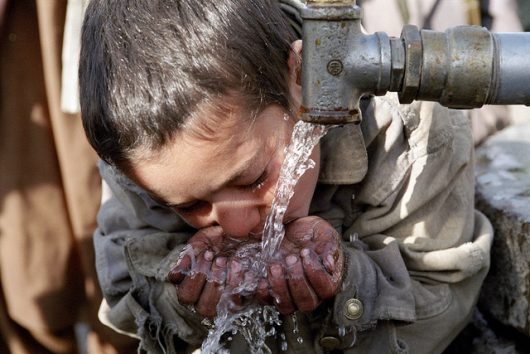
Water is a basic necessity for all life–it must be safe and clean for use. For the people of Afghanistan, water that is safe and clean is especially hard to come by. Fortunately, poor water quality in Afghanistan is a problem that both a global organization and its Afghan partners are working to resolve.
After more than a decade of armed conflict and neglect, Afghanistan has a problem with getting sanitary water to its people. The country of 32.5 million people gets its water from rivers and underground supply, which is reliant on rainfall and snow.
In recent years, climate change has caused a reduction in precipitation, resulting in a drop in water levels of six meters.
Other major obstacles stand in the way of improving the water quality in Afghanistan. Not only is there less water, but the water that is available is contaminated. In most major cities, underground water supplies have been compromised, due to the lack of canalization, proper waste management and proper waste disposal.
In big cities, hospitals commonly bury their waste underground or leave it above ground. Medical waste can contain poisons and infectious inhabitants, seeping into the underground water supply over time.
However, change is underway to improve this dire situation.
The Improvement of Water Quality in Afghanistan
Domestically, the Afghan Urban Water Supply and Sewerage Corporation has been working for the last 30 years constructing 40,000 clean water posts, with access for one million people. But, the Afghanis cannot do it alone. Much work is still to be done to meet all water needs in Afghanistan.
External help is underway from GIZ, a German company that specializes in developing solutions to global problems. With the backing of the German Federal Ministry for Economic Cooperation and Development, GIZ is making great strides.
In collaboration with the Afghan Urban Water Supply and Sewerage Corporation, GIZ has developed and is implementing a massive plan to decentralize and overhaul the Afghani water infrastructure. They will work with and train Afghani workers to complete the project and independently maintain it, also creating a sanitation and management program for water in Afghanistan.
Between 2011 and 2013, GIZ trained around 2,000 employees from the institutions involved. As a result, they are now able to better perform the work necessary improve water quality in Afghanistan.
Now that the workforce has been trained, substantial progress is being seen.
From 2007 to 2013, the number of households with a newly connected water supply in Kunduz, a major city in northeastern Afghanistan, rose from 370 to 7,700. This represents about 75 percent of Kunduz’s population. Kunduz is only one example of a trend spreading around the country.
Currently, newly constructed water infrastructure is not only becoming self-sufficient, but also now has the ability to self-fund more growth. In 2012, the Afghani government introduced a water tariff, which significantly increased the income of the water infrastructure. In some cities, Afghanis are willing and able to pay for their new access to clean water.
Since then, in the major cities of Kabul, Harat and Kunduz, the proportion of water that is paid for has risen greatly. As a result, the cities of Herat, Kunduz and Mazar-e Sharif have built and are operating six new wastewater plants. Big change is taking place for the better.
Not long ago, the majority of Afghanis were desperate for clean water. Today, with the help and intervention of Germany, the major components that led to the water problem in Afghanistan are on the way to being improved. The work being done is changing lives, communities and cities across Afghanistan.
– Steven Jenkins
Photo: Flickr

How Quinoa Production Helps Alleviate Poverty in Peru
Prior to quinoa’s surge in popularity, few Americans had heard of this South American grain. U.S. imports alone quadrupled between 2006 and 2010 as quinoa’s virtues of versatility and high protein content spread.
Negative Speculations
Unbeknownst to the public, quinoa production had a direct impact on the levels of poverty in Peru. So, soon after quinoa “took off,” a slew of inflammatory articles in 2013 reprimanded quinoa consumers for raising the demand and price of the nutritious food, which restricted access for poor Andean people.
Poverty in Peru and Bolivia affects over 50 percent of people in the Andean region. Many suffer from lack of education, food insecurity, poor health care and a life expectancy 20 years lower than people in Lima.
Due to conditions in this region, “foreign quinoa consumption is keeping locals from a staple grain” is a serious accusation. However, the popularity of this protein-rich food has provided many economic benefits for the area. A NPR study showed how living conditions drastically improved for people in the Andes during the boom in quinoa sales.
In 2013, the Guardian published an inflammatory article called, “Can Vegans Stomach the Unpalatable Truth About Quinoa?” claiming that fame has driven the prices so high that locals can no longer afford it. The argument seemed sound as poverty in Peru is a major issue. It seemed though, that the Guardian brought up a touchy subject–droves of articles then began cropping up both defending and debunking this argument.
Positive Effects
The good news is that quinoa prices are still within reach for Peruvians. A recent article from NPR explains two different studies focusing on the super grain: one found that the people in quinoa-growing regions, farmer or otherwise, experienced an economic flourishing that favored farmers and generally overcame any additional quinoa costs; the second study focused on quinoa consumption in the Puno region where 80 percent of Peruvian quinoa is grown.
The author of the second study, a Berkeley graduate student, discovered that people in the Puno region consumed a similar amount of the grain without cutting any valuable nutrients from their diets.
While quinoa is culturally important, it is not a staple crop like rice or maize. On average, only between 0.5 and 4 percent of an average Peruvian family’s budget is spent on quinoa–thus the extra cost is not debilitating. In fact, quite the opposite of debilitation occurred: domestic quinoa consumption tripled in 2013.
While the positive economic effects continue to boost the region, there are reasonable concerns about the sustainability or longevity of quinoa production. Demand has caused farmers to decrease the amount of quinoa varieties grown, as well as reduce llama farming which used to provide fertilizer.
Degradation of soil and biodiversity are also risks of extensive quinoa production. Unfortunately, quinoa’s popularity also attracts competitors, and as other countries began to grow the super grain and supply increases, Peruvian demand falls. Prices are sinking, which is great for frugal, health conscious shoppers but very concerning for Bolivian quinoa farmers.
Sustaining Success
While unclear how long benefits will last, quinoa’s popularity proves extremely beneficial towards alleviating rural poverty in Peru and Bolivia. In order to extend the grain’s benefits, some organizations are trying to encourage the sale of more varieties of quinoa to conserve biodiversity and renew interest in South American grown grains.
On the positive side, quinoa has provided some temporary relief for those facing poverty in Peru.
– Jeanette I. Burke
Photo: Pixabay
The Truth about Poverty in Tunisia
In June 2016, the International Monetary Fund’s (IMF) online magazine announced that the organization has approved a four-year, $2.9 billion loan program to help alleviate poverty in Tunisia.
Continued Struggles Post-Revolution
This news may come as a shock to some people. The IMF gave financial assistance in the form of a Stand-By Arrangement following the 2010 Tunisian Revolution, and the North African country is considered to be one of the few successes that emerged from the Arab Spring.
While Tunisia has come a long way both politically and economically, the country is still plagued by high unemployment and a lagging private sector.
According to IMF Survey, 15 percent of Tunisia’s population and 35 percent of its youth, are unemployed, contributing greatly to poverty in Tunisia. Civil society representatives, speaking with World Bank Group President Jim Yong Kim during his visit in May, claimed that only 27 percent of the country has access to finance due to strict rules on foreign transactions.
Joblessness and lack of opportunities has produced lackluster economic growth and low government approval ratings. The World Bank reported that only twenty percent of young Tunisians in urban areas trust the government. The figure is ten percent for the countryside.
Regional disparities are also a problem; while the national unemployment rate is high, it is even higher in regions far from the coast. In southwest Tunisia, 26.1 percent of people were unemployed in 2015, according to Tunisia’s National Statistics Institute.
Where unemployment goes, poverty follows. A 2014 World Bank report revealed that the poverty rate in central Tunisia was four times higher than the national average; as high as 30 percent in certain areas.
All of these factors combine to produce a significant number of disgruntled youth that extremist groups seek to recruit.
IMF to Counter Terrorism
According to a Voice of America article published on June 6, 2016, over 7,000 people in the country have become fighters for the Islamic State and other jihadist groups. The reason, cited by many, is that the government has failed to integrate a youth population that is in a process of soul-searching, following the democratic uprising of 2010 that lasted into 2011.
In order curb this terrorist threat, which has major security implications for the region and the world at large, economic development and poverty reduction are key. The new IMF program aims to do exactly that.
In an interview with IMF Survey, IMF Mission Chief for Tunisia Amine Mati stated that by injecting more money, the $2.9 billion loan would help maintain the overall stability of the country’s economy.
As civil society representatives and young Tunisian entrepreneurs have made clear, labor market, private sector and structural reforms are also needed. According to Mati, the program will also assist government efforts in creating a more dynamic economy and ensuring growth is distributed across the country.
Tunisia has great potential. Its democratic government is committed to solving the country’s problems. Foreign aid will help accelerate the progress already made in reducing poverty in Tunisia.
– Philip Katz
Photo: Pixabay
Female Equality: #WhatIReallyReallyWant for Women’s Rights
Project Anyone and The Global Goals for Sustainable Development have teamed up to recreate the Class Spice Girls song “Wannabe,” this time with girls’ and women’s rights in mind. In this version, the females who sing the chorus of, “Tell me what you want, what you really really want,” respond with a global request: female equality. The viral video has produced a widespread social media campaign, and the organizations behind it hope to take the campaign’s findings to the attention of the United Nations (UN).
The video portrays girls and women around the world, recreating the song while background buildings and signs display requests in response to the chorus. “End Violence Against Women,” one sign responds as the singers echo, “Tell me what you want.” Quality education for all girls, end child marriage and equal pay for equal work are among the other responses in the video.
The video ends with a platform for continuing the campaign on social media, asking women and girls to share photos of their own requests on various social media platforms, so that the needs expressed by the global female community can be shared with policymakers.
Female Equality: Essential for the World
Actress Emma Watson, the UN Women Goodwill Ambassador, weighed in via Twitter, sharing “#WhatIReallyReallyWant is to see Goal 5 – Gender Equality achieved @theGlobalGoals.” Her international work to promote gender equality over the past several years has made Watson an important voice in promoting women’s rights.
Project Everyone is an organization which works to promote the accomplishment of the Sustainable Development Goals. The Sustainable Development Goals include that which Watson singled out in her response to the campaign, Goal 5: “Achieve Gender Equality and Empower All Women and Girls.” Many of the other goals, which seek things like inclusive and quality education, also stand to enable the empowerment of girls and women.
The relationship between female empowerment and achieving sustainable development also works in the other direction. Gender equality and opportunities for women to be educated and contributing members of society is a key step in achieving goals like ending poverty, which is Sustainable Development Goal number one.
Global goals and Project Everyone’s “Wannabe” remake ends with a message and a call to action. “Girl Power has come a long way, let’s take it further,” comes upon the screen following the video.
The impact and scope of the #WhatIReallyReallyWant campaign represents a large step in the right direction towards eliminating gender inequality, gender violence and unequal access to education. The importance of empowering girls and women is far-reaching. The potential which is unlocked when female equality is promoted has a direct impact of achieving Sustainable Development Goal number one: “Ending poverty in all its forms everywhere.”
– Charlotte Bellomy
Photo: IBI Times
Top 10 Facts About Ending Hunger in Italy
In the past few years, remarkable progress has been made toward ending hunger in Italy and throughout Europe. However, there are still 836 million people living in poverty worldwide along with 795 million people struggling with chronic hunger.
By looking at Italy’s approach to addressing hunger and poverty–both domestically and internationally–the achievements and shortcomings of Italy’s social policy reveals the complexities of the fight to end global hunger by 2030.
10 Facts About Ending Hunger in Italy
– Daniela N. Sarabia
Photo: Pixabay
Poverty in Bolivia
According to UNICEF, poverty in Bolivia is among the worst in South America. Economic growth and opportunities to make a living are most commonly found in urban areas because the more citizens in a setting, the more consumers there are. This makes it difficult however for indigenous farmers, inhabitants of more remote areas with fewer people, to market their products and provide for their families.
For the vast majority of citizens in Bolivia, this proves to be a major issue: 60% of Bolivians live below the poverty line. In rural areas, the numbers are even more dramatic. Three out of every four people living in these areas suffer from poverty. Because of this, Bolivia the poorest country in South America.
One reason for the extreme poverty lies in the geography of Bolivia. Undeveloped roads and infrastructure make up a vast portion of the country, with a majority of the land inhabited by indigenous citizens. This makes it difficult for farmers living in these areas to market their products and travel to sell them, which in turn impacts their families and the communities they live in.
For the farmers of Bolivia, the recent visit by the World Bank’s President to the country represented a unique opportunity. The fact that Jim Yong Kim recognized the need for economic growth and food security was important to the rural citizens of the poorest South American country. A World Bank agreement with the Government of Bolivia plans to promote the Andean marketable products that the indigenous people have to offer. This will get the people of Bolivia involved in national markets, boosting job growth and the economy.
Bolivians are finally being given opportunities to make a living through improved economic stability and job growth.
– William Norris
Sources: Rural Poverty Portal, The World Bank
Photo: Bioversity International
8 Facts About Poverty in Jamaica
Jamaica has struggled with poverty, unemployment and crime for the past half century, but the nation has recently seen ambitious government economic policies bear fruit. Discussed below are the leading facts about poverty in Jamaica and their implications.
8 Facts about Poverty in Jamaica
Despite Jamaica’s history of poverty and some ongoing problems, economic forecasts for the country remain optimistic. It is possible that Jamaica will experience an economic resurgence and alleviate problems of unemployment and poverty in coming years.
– John English
Photo: Pixabay
Water Quality in Afghanistan
Water is a basic necessity for all life–it must be safe and clean for use. For the people of Afghanistan, water that is safe and clean is especially hard to come by. Fortunately, poor water quality in Afghanistan is a problem that both a global organization and its Afghan partners are working to resolve.
After more than a decade of armed conflict and neglect, Afghanistan has a problem with getting sanitary water to its people. The country of 32.5 million people gets its water from rivers and underground supply, which is reliant on rainfall and snow.
In recent years, climate change has caused a reduction in precipitation, resulting in a drop in water levels of six meters.
Other major obstacles stand in the way of improving the water quality in Afghanistan. Not only is there less water, but the water that is available is contaminated. In most major cities, underground water supplies have been compromised, due to the lack of canalization, proper waste management and proper waste disposal.
In big cities, hospitals commonly bury their waste underground or leave it above ground. Medical waste can contain poisons and infectious inhabitants, seeping into the underground water supply over time.
However, change is underway to improve this dire situation.
The Improvement of Water Quality in Afghanistan
Domestically, the Afghan Urban Water Supply and Sewerage Corporation has been working for the last 30 years constructing 40,000 clean water posts, with access for one million people. But, the Afghanis cannot do it alone. Much work is still to be done to meet all water needs in Afghanistan.
External help is underway from GIZ, a German company that specializes in developing solutions to global problems. With the backing of the German Federal Ministry for Economic Cooperation and Development, GIZ is making great strides.
In collaboration with the Afghan Urban Water Supply and Sewerage Corporation, GIZ has developed and is implementing a massive plan to decentralize and overhaul the Afghani water infrastructure. They will work with and train Afghani workers to complete the project and independently maintain it, also creating a sanitation and management program for water in Afghanistan.
Between 2011 and 2013, GIZ trained around 2,000 employees from the institutions involved. As a result, they are now able to better perform the work necessary improve water quality in Afghanistan.
Now that the workforce has been trained, substantial progress is being seen.
From 2007 to 2013, the number of households with a newly connected water supply in Kunduz, a major city in northeastern Afghanistan, rose from 370 to 7,700. This represents about 75 percent of Kunduz’s population. Kunduz is only one example of a trend spreading around the country.
Currently, newly constructed water infrastructure is not only becoming self-sufficient, but also now has the ability to self-fund more growth. In 2012, the Afghani government introduced a water tariff, which significantly increased the income of the water infrastructure. In some cities, Afghanis are willing and able to pay for their new access to clean water.
Since then, in the major cities of Kabul, Harat and Kunduz, the proportion of water that is paid for has risen greatly. As a result, the cities of Herat, Kunduz and Mazar-e Sharif have built and are operating six new wastewater plants. Big change is taking place for the better.
Not long ago, the majority of Afghanis were desperate for clean water. Today, with the help and intervention of Germany, the major components that led to the water problem in Afghanistan are on the way to being improved. The work being done is changing lives, communities and cities across Afghanistan.
– Steven Jenkins
Photo: Flickr
Five Facts About Children Born in Poverty
Five Facts About Children Born in Poverty
Poverty is a cyclical condition and education is crucial to ending chronic poverty. Children born to low-income families are statistically likely to remain impoverished due to a lack of education and opportunities.
The U.N. reports that between the years of 1994 and 2009, “Rural households where the household head had completed primary education were 16 percent less likely to be chronically poor.”
These promising statistics are the driving force behind government-led programs and NGOs to increase access to education.
– Saroja Koneru
Photo: Pixabay
Global Poverty and Foreign Aid: What Works
Despite various myths about global poverty and foreign aid, evidence supports the claim that foreign aid works well in the fight against poverty.
According to the Gates Foundation, there are currently more than one billion people worldwide living in extreme poverty. Foreign aid (when one country donates a portion of their resources to another) aims to lower that number.
However, many people subscribe to the belief that foreign aid is ineffective. They argue that corruption prevents resources from reaching the people who need it most. In addition, they assume that countries who receive foreign aid will grow to depend on it too much.
The Millennium Development Goals
Thankfully, the data suggests otherwise. The relationship between foreign aid and global poverty is a positive, effective one.
Perhaps some of the strongest examples of the effectiveness of foreign aid are the Millennium Development Goals.
These goals, proposed by the United Nations and ratified by all countries across the globe, aimed to:
“The MDGs helped to lift more than one billion people out of extreme poverty, to make inroads against hunger, to enable more girls to attend school than ever before and to protect our planet. They generated new and innovative partnerships, galvanized public opinion and showed the immense value of setting ambitious goals,” stated Ban Ki-moon, Secretary General of the United Nations, in the project’s 2015 annual report.
After the success of the MDGs, the U.N. introduced a set of followup goals in 2015. These new initiatives were called the Sustainable Development Goals and have a deadline set at 2030.
Global Food Security Act
In 2010, the United States shifted the focus of its foreign aid spending to small farmers across the globe through initiatives such as Feed the Future. The Global Food Security Act aims to build off of the Feed the Future Initiative by expanding investments in small farmers.
The hope is that these investments would aid families (especially women and children) lift themselves out of poverty. In addition, they would also simultaneously provide families access to cheap, nutritious food.
During an interview with Grist, Raj Shah, head of USAID, said that thanks to Feed the Future, they “are starting to see a rapid reduction in rural poverty, in the percentage of children who are stunted, and in the total number of people that don’t get 2,100 calories a day. Those are rough indicators of a large-scale transformation starting to occur.”
Domestic Benefits from Global Contributions
Despite strides made towards ending global poverty, less than 1% of the U.S. federal budget goes toward foreign aid.
In terms of foreign aid, nations can and should do more to help the world’s poor. Moral obligations aside, lifting people out of poverty also provides new economic markets for the U.S. and reduces national security risks.
– Sabrina Santos
Plan International’s Goals for Gender Equality
Plan International recently announced a multi-organizational partnership to help track the U.N.’s global goals for gender equality.
The goals for gender equality stem from the United Nation’s Sustainable Development Goals (SDGs). These goals, adopted in 2015, aim to vastly improve the living conditions around the world.
The central focus of this project is gender inequality. Plan International decided to collect relevant data and use it as a benchmark to determine the amount of progress.
Partner Organizations for Gender Equality
To do so, they partnered with several organizations. These include the International Women’s Health Coalition and KPGM. In addition, Plan International chose the ONE Campaign and Women Deliver.
Plan International chose these organizations because their previous work and values align with those of Plan. However, some organizations bring additional value to the table.
For instance, KPMG has a history of partnership building in the private sector. They also have a strong data tracking history with their Change Readiness Index. That index will be especially important in the project’s next few months.
The project’s first step is to sift through the data that already exists. They can then determine what is relevant to their goals for gender equality and what is not.
In an exclusive interview with Mary Bridger, the Engagement Manager for Plan’s SDG tracking initiative, she said, “We don’t feel that you can truly comprehend the realities for girls and women until you look beyond the quantitative data and find out what the lived realities for these individuals are (i.e. you can measure the geographic proximity of a school to girls, but until you ask them whether they feel safe on public transportation, you don’t know the true barriers).”
Prioritizing Gender Equality
For now, the project’s next goal is to work with their partners to push the scope of their research and develop the tools necessary to allow them to best capture those lived realities.
Bridger underscored the importance of this campaign when she said, “Plan International’s purpose is to work towards all children fulfilling their rights, focusing on excluded and vulnerable groups so that no-one is left behind. However, we have recognized the urgent need to prioritize girls as the most marginalized group whose rights are violated most.”
Plan International and their partner organizations all believe that meeting goals for gender equality will have a ripple effect within local communities and even worldwide.
– Sabrina Santos
Photo: Talent Culture