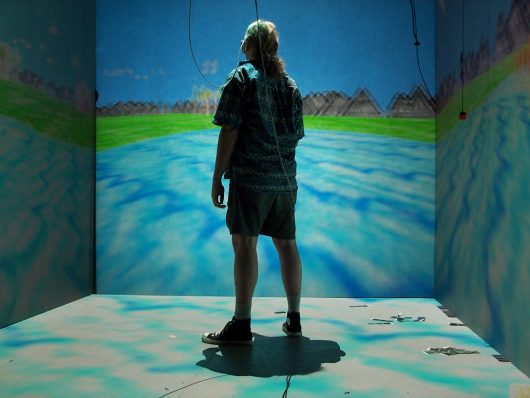
 For those in the developing world with scarce resources and limited access to computers and tablets, a number of innovations in education are creating exciting opportunities. One such innovation is the EON educational program — the next step in progressing developing countries.
EON Reality, which specializes in virtual reality (VR) and augmented reality (AR), is opening the first interactive digital center (IDC) on the African continent in Tshwane, South Africa.
The project is a collaborative effort between the software developer and Tshwane’s city government. It is part of the latter’s Tshwane Vision 2055, a plan which seeks to “break the cycle of generational poverty, inequality and underdevelopment.”
According to Dave Lockwood, the director of the new IDC, VR and AR remove language and literacy barriers to education because they show rather than tell. VR creates an artificial environment that users can move in. (The Oculus Rift, for example, is a VR headset). AR, on the other hand, modifies the existing environment by adding artificial sensory input, such as images or sound.
Lockwood believes that students would learn better and retain more information with the help of the EON educational program, and more specifically, VR and AR. Furthermore, content and applications can be created for both science education and vocational training, which are crucial for economic growth and development.
VR and AR, it seems, are poised to make a real change in the way in which education is delivered in Africa. The Tshwane IDC is an example of how educational technology can assist with government efforts to promote the development and improve services.
Across the Indian Ocean, a team from Carnegie Mellon University recently completed an experiment in “compassionate engineering” at the Mathru School for the Blind in Bangalore, India. The idea is to use existing technology with a focus on the people, allowing it to evolve to suit their needs.
As part of the project, students received low-cost braille tutors. M. Bernardine Dias, the Carnegie Mellon professor who led the case study, argues that electronic reading and writing aids such as these can go a long way in reducing poverty, because poverty is often concentrated among the disabled population.
A World Trade Organization study that she cited, for example, found that 90 percent of visually impaired people live in low-income households.
By combining virtual and augmented reality, the EON educational program is changing the way the world looks at education, one student at a time. Whether using cutting-edge devices or only putting old tools to new use, educational technology is helping alleviate poverty by catering to the needs of different people and the way they learn best.
– Philip Katz
Photo: Wikipedia

European Union Champions In Poverty Reduction Goals
However, poverty analysts feel that significant progress can still be made towards reducing the death rate of mothers during childbirth and expanding access to clean drinking water. Because of this, the EU has pledged to help support 79 impoverished nations by raising an additional €1 billion in aid.
One of the projects supported by this funding provides over 5,000 households in rural Timor-Leste access to safe drinking water. Much of the project has already been completed, and local communities in the area are thriving like never before.
Before the program was launched, only 57 percent of the population in this rural community had access to safe drinking water. Now over 26 community water systems have been implemented in the area with 5,950 people being granted clean water access. The EU program has also expanded toilet access from 35 to 65 percent in the Aileu District.
Ludivina, a 9-year-old girl from the Aileu District in rural Timor-Leste told the European Commission that because of the program, she was able to enjoy life as a child should.
“After I collected the water, I would go to school and feel tired in the classroom. But when I first heard that I didn’t have to collect water because of the water system with the pump, I was so happy! Now I have time to play with my friends, go to school and sing!” Ludivina said.
This program is just one many the EU hopes to continue with the additional funding. In the past three years, the EU has spent €56.2 billion on developmental aid.
Simon Maxwell, the chair of the European Think Tanks Group, speaks highly of the EU to The Guardian. However, he says that the EU still has room for reform on all aspects of its development and humanitarian policies.
Much of these reform ideas can and will be found in universities, research centers, think tanks, NGOs and the private sector. Therefore, engagement in the EU can not benefit only the organization, but the countries that participate in it as well.
“The more we invest in the EU, the more successful we are likely to be in our efforts to achieve the global goals. We have to believe in the power of collective action and in the possibilities the EU can offer,” says Maxwell.
There is still much work to be done according to EU supporters. But with participation and support, the EU can be an example to other countries of a framework for successfully achieving with human rights, peacebuilding and poverty reduction goals.
– Katie Grovatt
Photo: Pixabay
10 World Hunger Facts from the UN World Food Programme
Sixteen years ago, the world decided it was time to formally prioritize ending world hunger. The United Nations (U.N.) Millennium Development Goal One (MDG1) was to eradicate extreme poverty and hunger. MDG1, Target 1.C, was to “halve, between 1990 and 2015, the proportion of people who suffer from hunger.”
The U.N.’s target was largely met: the proportion of undernourished people in the world’s developing regions has fallen by almost half since 1990. But, there are still 795 million people hungry in the world and more than 90 million children under age five are underweight and malnourished. World hunger facts offer us insight into why this is still a problem in the world today.
According to the U.N. World Food Programme (WFP), there are two faces to world hunger and 10 crucial facts to understand. The two sides to world hunger are crises and chronic malnutrition. Emergencies such as wars and natural disasters “account for less than eight percent of hunger’s victims.”
Chronic hunger can continue with no end in sight with people living on less than the recommended 2,100 kilocalories daily intake of food. This chronic hunger accounts for mental disadvantages in adults, stunted growth in children and weakened immune systems.
10 World Hunger Facts from the U.N. World Food Programme
Just as there are more than 10 world hunger facts, so too are there many organizations working to combat world hunger. One group that is helping to end world hunger is The World Bank. The group has been working with other international groups by “investing in agriculture, creating jobs, expanding social safety nets, expanding nutrition programs that target children under two years of age, universalizing education, promoting gender equality and protecting vulnerable countries during crises.”
– Rhonda Marrone
Photo: Flickr
10 Facts Regarding Colombian Refugees
For over 50 years, guerilla soldiers, paramilitaries, drug cartels and the government’s armed forces have been fighting in Colombia creating waves of refugees. Though each group has different motivations, most are fighting to gain power and influence.
This internal fighting in Colombia has led to the displacement of many individuals across the country. Here are 10 facts about Colombian refugees.
Though many of these facts about Colombian refugees may be discouraging, the refugees have not been forgotten. Organizations are working to help them in their length endeavor, unfortunately, when a crisis is so large, it takes a lot of time and resources in order to effect change.
– Weston Northrop
Photo: Flickr
30 Years of Change: Coffee Market in Ethiopia Improving Lives
Ethiopia has spent the past 30 years moving forward from a famine of biblical proportions by expanding an unlikely market. The coffee market in Ethiopia has experienced recent growth, improving both the economy and the lives of people in coffee production.
Ethiopia is currently the fifth largest coffee producer in the world, with over two million coffee farmers. With close to half of its coffee production exported, the country contributes about nine percent of the world’s total coffee production.
However, Ethiopia’s past is marked by tragedy. In 1984, BBC reporters Michael Buerk and Mike Wooldridge brought the Western world’s attention to the “biblical famine” devastating the country. More than one million Ethiopians perished due to this tragedy, and over eight million were affected.
Coffee holds great social and cultural value in Ethiopia due to its significance in the economy. The recent growth in the coffee market in Ethiopia has helped over 15 million people who directly or indirectly derive their livelihoods off of coffee production, according to the USDA.
Duromina: Coffee Farmers Invest in Local Communities
A direct example of this is the success of a coffee cooperative in southwestern Ethiopia, which has received a premium price for its internationally sold coffee. The coffee cooperative is named, Duromina, which means “to improve their lives.”
Generations of farmers had been growing coffee in this area for generations, earning a meager income. But in 2010, over 100 local coffee farmers came together to form Duromina in order to improve their lives.
Duromina skyrocketed, making good money for all of its farmers. With the new income, the farmers decided to invest their money into their community.
The nearby river often swells, making it impossible to get to the nearest clinic from their community. To fix this problem, the farmers invested in a bridge so everyone could have access to the clinic at all times and would not hurt themselves trying to cross the flooded river. After building the bridge, the farmers then invested in their homes and their children’s future.
The transformation Ethiopia went through is evident not only within communities, but also in the copious amounts of lush green farmlands and forests where there were once drought-stricken dustbowls. Individuals who saw Ethiopia 30 years ago are astonished and inspired by the improvements, according to World Vision.
– Bella Chaffey
Photo: Flickr
10 Facts on Syrian Refugees
The Syrian refugee facts are startling. In the past few decades, there has been an enormous influx of migrants and refugees into the Mediterranean countries and other Western European countries due to numerous conflicts. Recently, the plight of Syrian refugees has captured the world’s attention.
The Syrian conflict began in March of 2011, when pro-democracy protests broke out in the streets. These protests were against the regime of the Syrian government and President Bashar al-Assad.
When supporters of the President and rebel groups began fighting each other, the protest evolved into a full-out civil war. By August of 2015, an estimated 250,000 people had died due to the violence.
Top Syrian Refugee Facts:
Many Syrian refugees suffer from the low quality of life and lack of resources in refugee camps. However, many countries and international groups around the world have worked hard to ameliorate the living conditions for these individuals.
Organizations such as the Karam Foundation and Project Amal ou Salaam focus on raising funds and providing programs or educational resources for children. Other groups, like Sunrise USA and Islamic Relief USA, work on getting necessities like food, clothing, trauma-care facilities and more.
As of May 31, 2015, the United States had given more than $3 billion in aid to Syria.
The Syrian War Crimes Accountability Act of 2015 (S.756) has passed the Senate and is under consideration in the House. This bill would call on the President to support efforts in Syria and force the Department of State to make Congress aware of various war crimes.
Efforts like this have increased awareness and accountability of the Syrian conflict. These actions ensure a quicker end to the violence and a hasty return home for Syrian refugees all over the world.
– Ashley Morefield
Photo: Flickr
Poverty in Russia: Unemployment is Low, but Poverty Remains High
The Russian economy has taken more than its fair share of hits in recent years, with poverty in Russia affecting nearly 20 million Russian citizens.
The stagnation of Russia’s economy has its roots in the low oil prices in recent years, as well as sanctions imposed by the West. Russia produces the most crude oil in the world, and energy is by far Russia’s largest market. However, oil prices have dropped heavily since 2014, from around $100 per barrel to $50.
The effect on the Russian economy has been severe: the economy shrank 3.7 percent in 2015. The economic tightening has increased the inflation rate to 12.9 percent, reducing the purchasing power of Russian companies. This makes it significantly more difficult for other markets to fill the gap the declining oil industry has left.
The inflation rate also adds to the burdens of the working class, with rubles buying less nowadays than just a few years ago.
According to one Russian woman, “When you get home and unpack your shopping bag, you realize you have barely bought anything.”
Poverty in Russia is not located in large cities like Moscow and Saint Petersburg. The majority of Russia’s poor live in small, single-industry towns with declining populations.
The Kremlin itself, not exempt from the economic downturn, is currently operating at a severe budget deficit. This deficit makes it difficult for the Russian government to offer anything but lip service to the populace in regards to the decline.
Nonetheless, President Vladimir Putin’s approval ratings remain at an incredibly high 83 percent. Many Russians are faithful to Putin; when he took office in 2000, poverty was at a dangerously low 29 percent.
Furthermore, despite Russia’s current economic troubles, the country has seen significant economic improvement in the past 15 years.
Prior to 2014, Russia’s poverty rate had been dropping several percentage points every year since 2004. In addition, its GDP growth rate was on par with India until 2009.
Perhaps most encouraging is that despite the recession, Russia’s unemployment rate remains at a mere 6 percent. The low unemployment rate suggests that if oil prices stabilize, poverty in Russia will see a rapid decline.
– John English
Photo: Flickr
6 Facts About Refugees in Central African Republic
The recent internal conflict in Central African Republic has prompted many of its citizens to flee to neighboring nations or safer places within the country. After settling into host communities, UNHCR (the United Nations refugee agency) has been able to provide assistance to the refugees and help them acclimate to new areas.
Here are six facts that you should know about refugees in the Central African Republic:
While UNHCR cannot provide the amount of assistance necessary, it has still been successful at helping refugees to acclimate to their host communities. As the internal conflict in the Central African Republic continues, foreign aid will continue to assist those who turn to host communities for refuge.
– Amanda Panella
Photo: Flickr
Eliminating Hunger In The Philippines: More Than Just Food Aid
Despite an increase in the rate of employment (by about 5 percent), poverty in the Philippines has seen relatively no improvement. The Philippine Statistics Authority (PSA) conducted research in order to guide policymakers in their efforts to alleviate hunger in the Philippines.
In 2015, 17.2 percent of the population lived under the poverty threshold.
Amado Parawan is the health and nutrition advisor for an organization called Save the Children. He recently urged Filipino presidential candidates to re-evaluate their methodologies to address hunger in the Philippines.
Parawan stated that feeding programs are really only a “band-aid solution” to solving the infection of hunger and malnutrition. In addition, he encouraged them to seek foreign aid and consult experts on globally accepted intervention policies.
His plea to candidates follows a recent initiative by Save the Children Philippines called the ‘Lahat Dapat’ campaign. This movement highlights the importance of healthcare in the prenatal and early stages of development for Filipino children.
Current foreign initiatives include the World Food Programme (WFP) of the U.N., which began their work in 1968. However, they had to reestablish their presence in 2006, after the government requested more aid in light of increasing armed conflict.
The program focuses on improving food insecurity and helping communities to build resilience in preparing for natural disasters. In addition, the program also emphasizes the importance of providing healthy meals for children in school.
Each school year, over 65,000 children in the areas of Lanao del Sur, Lanao del Norte and Maguindanao receive crucial nourishment school meals. Good nutrition then increases school retention rates, as well as the quality of the education children receive.
Additionally, Action Against Hunger works to eliminate hunger in the Philippines. Armed conflicts have displaced many Filipinos. One such area is Zamboanga, where efforts have been directed towards providing clean water, sanitation, and nutrition education.
The government of the Philippines is known for its $450-million conditional cash transfer program, Pantawid Pamilyang Pilipino Program. It also recently received a new financing package from the World Bank. This social safety net program helps to reduce the vulnerability of families to sudden economic difficulties. The money ensures that children receive ample nutrition and access to education. It also gives pregnant mothers access to regular health exams.
By assessing the methodologies that have been successful in other nations and modifying them to fit the Philippines’ unique needs, the partnership of the government and the international community established a successful food aid program.
The most important consideration when working to eliminate hunger in the Philippines is fostering independence. Humanitarian organizations and the governments involved will not only provide food, but they will also help families become self-sufficient.
If aid continues to be this sustainable and organizations continue to educate households about efficient and healthy lifestyles, Filipinos will develop their own economy and reduce hunger in the process.
– Veronica Ung-Kono
Photo: Rappler
The EON Educational Program Improves Developing Countries
EON Reality, which specializes in virtual reality (VR) and augmented reality (AR), is opening the first interactive digital center (IDC) on the African continent in Tshwane, South Africa.
The project is a collaborative effort between the software developer and Tshwane’s city government. It is part of the latter’s Tshwane Vision 2055, a plan which seeks to “break the cycle of generational poverty, inequality and underdevelopment.”
According to Dave Lockwood, the director of the new IDC, VR and AR remove language and literacy barriers to education because they show rather than tell. VR creates an artificial environment that users can move in. (The Oculus Rift, for example, is a VR headset). AR, on the other hand, modifies the existing environment by adding artificial sensory input, such as images or sound.
Lockwood believes that students would learn better and retain more information with the help of the EON educational program, and more specifically, VR and AR. Furthermore, content and applications can be created for both science education and vocational training, which are crucial for economic growth and development.
VR and AR, it seems, are poised to make a real change in the way in which education is delivered in Africa. The Tshwane IDC is an example of how educational technology can assist with government efforts to promote the development and improve services.
Across the Indian Ocean, a team from Carnegie Mellon University recently completed an experiment in “compassionate engineering” at the Mathru School for the Blind in Bangalore, India. The idea is to use existing technology with a focus on the people, allowing it to evolve to suit their needs.
As part of the project, students received low-cost braille tutors. M. Bernardine Dias, the Carnegie Mellon professor who led the case study, argues that electronic reading and writing aids such as these can go a long way in reducing poverty, because poverty is often concentrated among the disabled population.
A World Trade Organization study that she cited, for example, found that 90 percent of visually impaired people live in low-income households.
By combining virtual and augmented reality, the EON educational program is changing the way the world looks at education, one student at a time. Whether using cutting-edge devices or only putting old tools to new use, educational technology is helping alleviate poverty by catering to the needs of different people and the way they learn best.
– Philip Katz
Photo: Wikipedia
Education in Greece: Building a Foundation
Although the Greek government accepts new refugees it has no choice but to place these individuals in camps that, in many cases, do not meet humanitarian standards. The country strives to create a stable environment for these refugees, as it is estimated that the children have been out of school for an average of 1.5 years. This lack of schooling affects their potential as well as depriving them of a basic right to education, therefore education in Greece must be a priority.
With the help of volunteers, children are receiving an education through refugee schools located on campgrounds. Education in Greece, as well as many other countries besides, remains difficult for refugees to obtain.
Understanding the necessity for a learning system, the United Nations recently created a fund called “Education Cannot Wait.”
This fund aims to reach approximately 20 million refugee children who are currently denied a proper education. The European Union used money from this fund to create a pilot program on May 16, in order to begin language courses for the refugee children in Greece. These courses are currently in session to prepare children for the school year that commences in September.
Teachers will be assigned based on the language of the refugee children, which will include English, Greek and their native tongue. The Greek government plans to unveil this education program beginning in September. The Ministry of Education, responsible for running the education in Greece, began language courses beforehand to bridge the language gap that held some children back. The courses will assign two to three teachers to each 150-student classroom.
“The average length of time spent living as a refugee is now 17 years, meaning that millions of children and young people will miss out on some, it not all, of their education, severely diminishing their own future life chances and that of their families and communities,” said Tanya Steele, interim CEO of Save the Children.
Less than two percent of global humanitarian aid goes to education. Education, as the United Nations is realizing, is crucial in the long-term. Without education, studies show that children are at higher risk of crime and violence.
Schools carry the promise of opportunity and aspiration for the future. Education creates a solid foundation for the rebuilding of society for those displaced.
Education in Greece portrays how many other regions are striving to help refugees. Students here, as with many other refugee schools, are only given two days of schooling per week. With the help of the European Union and the United Nations, teachers hope to push for more educational opportunities, including a 5-day school week.
– AnnMarie Welser
Photo: Flickr