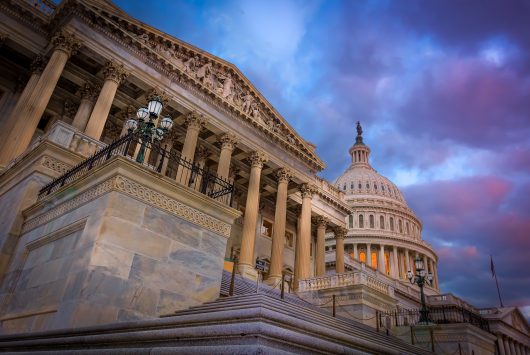
The American government provides avenues on how to remove a U.S. president from office. These are the three primary reasons: criminal activity, inability to perform presidential duties and lack of party and public popularity.
Criminal Activity
One way to remove a U.S. president from office is through impeachment and consecutive conviction. This method is intended to be implemented should the president commit a crime. The president has the same rights of due process as any other legal defendant, and therefore must be indicted of an actual crime, which involves violating a law that was passed prior to him committing the crime.
The impeachment process requires agreement between both legislative bodies. The House of Representatives requires a simple majority, more than 50% of the vote, to impeach. The Senate requires a two-thirds majority.
Congress has impeached two presidents in the nation’s history. Congress impeached the 17th president, Andrew Johnson, after he replaced Secretary of War Edwin M. Stanton with General Ulysses S. Grant because this violated the Tenure of Office Act.
Congress impeached the 42nd president Bill Clinton on charges of perjury and obstruction of justice following Clinton’s testimony of his extramarital affair during a sexual harassment lawsuit filed against him by Arkansas state employee Paula Jones.
Congress did not convict Johnson nor Clinton, however, and they remained in office.
Inability to Perform Presidential Duties
Another enumerated power which facilitates the removal of a U.S. president is the 25th Amendment to the Constitution. This amendment allows the president to voluntarily step aside if he feels he may be physically or emotionally unable to perform presidential duties.
The amendment states the president’s cabinet may transfer the powers of the president to the vice president as determined by a majority vote. If the president challenges this decision, Congress determines whether to restore the president to power. In the absence of a two-thirds vote in both houses, the president returns to power. Congress has never fully implemented this method of removal.
This provision of the 25th Amendment, implemented as a safeguard should the president become unable to fulfill his duties, works as a contingency if the president becomes incapacitated or unable to resign. This provision also applies if the president is captured or kidnapped and unable to act or if concerns arise that the president may not be mentally able to continue his term.
Lack of Party and Public Popularity
Last but not least, the president could be denied a second term in one of two ways: by the president’s own party, should it choose to nominate someone else in the next presidential election, or by voters who contribute to the president’s loss in the next election.
Since World War II, three U.S. presidents have lost the election for their second term: presidents Gerald Ford, Jimmy Carter and George H. W. Bush.
The government provides multiple avenues on how to remove a U.S. president from office. These account for the variety of circumstances which may warrant a removal.
– Casie Wilson
Photo: Flickr

The African Prisons Project
The African Prisons Project (APP) is an organization that works alongside prisoners in Africa in order to improve prison conditions, assist with legal counsel and educate inmates.
The African Prisons Project was founded in 2007. The organization works with both prisoners and prison staff in order to create a more humane and rehabilitation based approach to incarceration. The group focuses its work on four areas: leadership, access to health, life skills and access to justice.
The APP provides leadership training through its legal education program with the University of London. This is extremely useful to prisoners who are unable to afford legal representation. It has empowered many prisoners to work on their own cases and that of their fellow inmates.
The APP works to improve prison healthcare by providing classes on healthcare, offering clinical services and building health infrastructure. The group also provides human rights training to prisoners and prison staff in order to inform and empower both prisoners and staff members to protect human rights. In addition, the organization also works to facilitate dialogue between the officials and policy-makers who legislate prisons, and the staff and prisoners who are affected by these policies.
Their work is extremely helpful to inmates all across Africa, many of whom would never see a lawyer without it. Most prisons in Africa are 300% full, which leads to the spread of diseases and inevitable human rights violations. The APP’s work across these fields seeks to minimize these risks and other risks to prisoners. In Uganda, 11.3% of all prisoners are HIV positive. This is almost twice the national rate, and it makes the healthcare work that the APP does even more necessary.
The education that the group provides is also extremely valuable. At APP targeted prisons, 67.3% of all inmates are illiterate. Of these prisoners, four out of five cannot afford a lawyer. In Uganda and Kenya, this rate is 90%, and it is common for inmates to wait a decade for a trial.
The APP has made great strides in providing protection and education to these inmates. Their rehabilitative approach has been acknowledged by the United Nations Sustainable Solutions Summit, and the group hosted the first-ever TEDx conference to take place inside a prison in Africa. The group has succeeded in overturning 57 convictions, 12 death sentences and gotten 298 cases dismissed.
When they cannot get a conviction overturned, the APP finds other ways to improve prisoners’ lives. Sometimes, this is through a legal education. Other times, they help by providing musical instruments to prisoners or recording a CD for inmates on death row. The African Prisons Project embraces many different roles in their efforts to create a more rehabilitative approach to incarceration in Africa.
– Eva Kennedy
Photo: Flickr
Ten Facts About Laos Refugees
Laos is one of the poorest countries in Asia and one of the last remaining communist nations. The Indochina War, which lasted for over 20 years, displaced about a quarter of the entire population resulting in major refugee migration.
Top 10 Facts about Laos Refugees:
These 10 facts about Laos refugees are a useful starting point for learning about refugees, but every individual has a unique story. Meaningful understanding of Laos refugee problems only comes through building relationships with them.
– Rebecca Yu
Photo: Flickr
Water Quality in the Bahamas
New Providence, the most populated island in the Bahamas, uses about 11 million gallons of groundwater a day.
The Bahamas has been unable to meet the demands of the 11 million gallons of groundwater since the mid-1970s. This led to the emergence of barging water from North Andros due to strict rationing.
Rising sea levels are expected over the next several decades. This may create wetlands, which are freshwater resources that would provide the country’s means of water quality and survival. The method of desalting sea water by means of reverse osmosis is used to maintain a level of water quality in the Bahamas today. This suggests that water does not currently come from a supply of clean, fresh water sources.
The country is vulnerable to compromised freshwater from storm surges, which cause saltwater inundation in aquifers in many cases and threatens the country’s water quality.
A major concern of the water quality in the Bahamas is the proliferation of private shallow water wells, including domestic and hotel wells. Dangerous elements such as nitrates, pathogens and other substances compromise the groundwater quality when these wells are developed due to on-site sanitation. As a result, Bahamians are at great risk to contamination.
Water quality in the Bahamas is not up to standard, due to critical sanitary problems in the country. The main sources of the water contamination are from septic tanks, soakaways and pit latrines. These issues are all major risks to water quality in the Bahamas and the overall health of its citizens.
Due to over-abstraction, physical disturbance, point source pollution, solid waste disposal, disposal wells and septic tanks, the water quality in the Bahamas is threatened. The majority of Bahamians are encouraged to use bottled water, even though the Water & Sewerage Corporation practices desalination by reverse osmosis and the water satisfies both the World Health Organization and U.K. guidelines for chemical, physical and biological parameters.
– Rochelle R. Dean
Photo: Flickr
Global Education: The Kailash Satyarthi Children’s Foundation
In one year, more than 15 million child marriages occur, leaving one in 10 women married before age 15. There are 168 million children in the labor force, 85 million of whom are working in hazardous environments. More than one million children are trafficked, and 140 million children are sexually abused.
Kailash Satyarthi, Indian Nobel Peace Laureate, has advocated for ending global violence against children for more than 30 years. With his organization, The Kailash Satyarthi Children’s Foundation (KSCF), he hopes to end child exploitation. He won the Nobel Peace Prize in 2014 for his “struggle against the suppression of children and young people and for the right of all children to education.”
Satyarthi founded and chaired seven different organizations, including the KSCF. All of the organizations focus on rehabilitating children from different forms of slavery and exploitation. Satyarthi has successfully liberated more than 85,000 children.
The Kailash Satyarthi Children’s Foundation has two working locations — one in New Delhi, India and the other in Washington, D.C. While both locations work toward the same goals, the India location focuses more on direct action while the U.S. location provides outreach and engagement.
The organization bases its mission on two goals. First, governments, businesses and societies should create policies to ensure that children remain unharmed. Second, child labor and poverty should be permanently eradicated by providing good education. The KSCF specifies that, “An education cannot be considered a quality education unless it emphasizes children’s rights and empowerment.” By prioritizing prevention, protection and policy change, the KSCF works to end child exploitation.
Satyarthi speaks to the necessity for action in terms of laws and policies. He maintains that we have the power to end child exploitation, and that we can provide the world’s children with better lives and education.
In an article published by UNICEF last year, he wrote, “All children deserve a fair and equal start in life. They deserve freedom and a childhood. They deserve comprehensive, well-rounded, quality education. These have to be viewed not just as basic rights but as a means towards a more inclusive and sustainable society.” The Kailash Satyarthi Children’s Foundation works toward just that.
– Shannon Elder
Photo: Flickr
Entrepreneurs in Developing Countries: Top 15 States
Governments around the world have made it challenging for various countries to start businesses. However, there are many entrepreneurs who have overcome the obstacles of doing business in their countries in order to achieve their goals. Expert Market, an entrepreneurial consulting firm based in Texas, performed a study on the most determined entrepreneurs in developing countries by comparing the number of businesses created in a region to the challenges faced in that region to start businesses.
Botswana is a middle-income country in sub-Saharan Africa. It takes both men and women over twice the amount of time to register a firm in Botswana than it does in other countries in sub-Saharan Africa. Two of the other major challenges to doing business in Botswana are a lack of money and training.
Malta is a high-income country in the World Bank’s Middle East and North Africa region. It takes people almost a week longer to register firms in Malta than in other countries in the Middle East and North Africa.
Timor-Leste is a lower-middle-income country in the World Bank’s East Asia and Pacific region. Timor-Leste is a country that gained its independence in 2002 and has been working on developing stability and security in the region since 2008.
Gabon is an upper-middle-income country in the World Bank’s sub-Saharan Africa region. It takes almost double the amount of time for people to register firms in Gabon than it takes to register firms in the rest of sub-Saharan Africa.
It takes over three times as long to start a business in Sao Paolo, Brazil than in other average city cities in the World Bank’s Latin America and the Caribbean region. Two of the greatest challenges in starting a business in Brazil are corruption and bureaucracy. Brazilians have to go through many government agencies to start businesses. Corruption is a common problem for entrepreneurs in developing countries to deal with.
Belize is an upper-middle-income country in the World Bank’s Latin America and Caribbean region. It takes almost two more weeks to register firms in Belize than in other countries in the Latin America and Caribbean Region.
Antigua and Barbuda is a high-income country in the World Bank’s Latin America and Caribbean region. The nation’s biggest industry is tourism.
Bulgaria is an upper-middle-income country in the World Bank’s Europe and Central Asia region. It takes people over twice as long to register firms in Bulgaria as it does in other countries in Europe and Central Asia. Corruption is a major issue in Bulgaria.
Croatia is a high-income country in Europe. It takes people in Croatia twice the number of procedures to register firms than it does in other countries in Europe and Central Asia. Another major challenge in Croatia is that the economy in Croatia is still transitioning from a socialist economy with many paychecks coming from public monopolies or the government.
Suriname is an upper-middle-income country in the World Bank’s Latin America and Caribbean region. It is almost three times the cost to start a business in Suriname than in any other country in South America.
Vanuatu is a lower-middle-income country in the World Bank’s East Asia and Pacific region. It takes over twice the cost it takes to start businesses in other parts of the East Asia and Pacific region.
While many would not consider entrepreneurs in the United States to be as determined as entrepreneurs in developing countries, entrepreneurs in the United States face their own set of challenges. Entrepreneurs in the United States face many regulations and costs in order to start businesses.
South Africa is an upper-middle-income country. It takes 43 days for men and women to start a business in South Africa, and about 27 days in other parts of sub-Saharan Africa.
Uganda is a low-income country in the World Bank’s sub-Saharan African region. It takes Ugandan citizens almost twice the number of procedures than it takes the rest of the people in sub-Saharan Africa to register a firm.
Cyprus is a high-income country in the World Bank’s Europe and Central Asia region. It takes almost three times the amount of income per capita for people to start businesses in Cyprus than it does in other countries in the Europe and Central Asia region.
It may be difficult to start businesses in developing countries, but determined entrepreneurs in developing countries can make it happen.
– Jennifer Taggart
Photo: Flickr
Seven Facts About the Conquest of the Americas
Columbus sailed the ocean blue in 1492 — but the story of European “discovery” and subsequent conquest of the Americas is much more complex than a children’s nursery rhyme can convey. Although America today is seen as the land of the free and the brave, one must remember that the Americas were free and brave long before the clash of the “Old” and “New” worlds. Here are seven facts about the conquest of the Americas:
The meeting of two worlds came with both good and bad consequences. It is important to remember the consequences of the conquest of the Americas in order to move forward positively as a nation. With hope, future discoveries and explorations will lead to improved, rather than strained, relations.
– Mary Grace Costa
Photo: Flickr
How to Remove a US President from Office
The American government provides avenues on how to remove a U.S. president from office. These are the three primary reasons: criminal activity, inability to perform presidential duties and lack of party and public popularity.
Criminal Activity
One way to remove a U.S. president from office is through impeachment and consecutive conviction. This method is intended to be implemented should the president commit a crime. The president has the same rights of due process as any other legal defendant, and therefore must be indicted of an actual crime, which involves violating a law that was passed prior to him committing the crime.
The impeachment process requires agreement between both legislative bodies. The House of Representatives requires a simple majority, more than 50% of the vote, to impeach. The Senate requires a two-thirds majority.
Congress has impeached two presidents in the nation’s history. Congress impeached the 17th president, Andrew Johnson, after he replaced Secretary of War Edwin M. Stanton with General Ulysses S. Grant because this violated the Tenure of Office Act.
Congress impeached the 42nd president Bill Clinton on charges of perjury and obstruction of justice following Clinton’s testimony of his extramarital affair during a sexual harassment lawsuit filed against him by Arkansas state employee Paula Jones.
Congress did not convict Johnson nor Clinton, however, and they remained in office.
Inability to Perform Presidential Duties
Another enumerated power which facilitates the removal of a U.S. president is the 25th Amendment to the Constitution. This amendment allows the president to voluntarily step aside if he feels he may be physically or emotionally unable to perform presidential duties.
The amendment states the president’s cabinet may transfer the powers of the president to the vice president as determined by a majority vote. If the president challenges this decision, Congress determines whether to restore the president to power. In the absence of a two-thirds vote in both houses, the president returns to power. Congress has never fully implemented this method of removal.
This provision of the 25th Amendment, implemented as a safeguard should the president become unable to fulfill his duties, works as a contingency if the president becomes incapacitated or unable to resign. This provision also applies if the president is captured or kidnapped and unable to act or if concerns arise that the president may not be mentally able to continue his term.
Lack of Party and Public Popularity
Last but not least, the president could be denied a second term in one of two ways: by the president’s own party, should it choose to nominate someone else in the next presidential election, or by voters who contribute to the president’s loss in the next election.
Since World War II, three U.S. presidents have lost the election for their second term: presidents Gerald Ford, Jimmy Carter and George H. W. Bush.
The government provides multiple avenues on how to remove a U.S. president from office. These account for the variety of circumstances which may warrant a removal.
– Casie Wilson
Photo: Flickr
How Syrian Refugee Families Saved a Village in Germany
As hostility and division in Germany have grown over the course of entering the nation, one village has remained untouched by the discourse.
Golzow is a small, yet famous, village on the German-Polish border. Film fans know it by a 42-hour documentary filmed over five decades, The Children of Golzow. In spite of the film’s success, the population of Golzow has decreased by 12% — down to 835 people. By March 2015, the school of Golzow couldn’t reach the number of students needed to hold class and had to be closed.
Nevertheless, mayor Frank Schütz had the solution: invite Syrian refugee families with primary school-age children to join the community of Golzow and donate to them the now-empty apartments. By helping those in need, Golzow’s need would be fulfilled as well.
The first family who accepted the invitation brought six school-age children with them. This allowed the school of Golzow to exceed the number of students necessary to keep it open. The mother recalled her family’s arrival, describing, “Everyone came to welcome us here with flowers. [Golzow] is very open, it’s a very small village and the people are very beautiful.” As the Syrians found a home, the school and the town found new life.
Other Syrian refugee families have followed in their footsteps. In February 2016, Golzow welcomed its third Syrian refugee family. Halima, her husband, and her children were able to act as Golzow’s very own unofficial translators between Arabic and German.
Since 2015, more than one million refugees have sought asylum in Germany. Unfortunately, after experiencing violence and economic hardship, the climate of the culture towards Syrian refugees has begun to sour. Today, as the once-warmly welcoming Germany is paying asylum seekers to return to their countries, Golzow serves as a reminder that those who stay have a purpose.
– Brenna Yowell
Photo: Flickr
Ten Deadly Wars
There is sufficient evidence to suggest that war causes and exacerbates poverty. It results in damage to infrastructure, breaks up communities and leads to the injury and death of countless people. Here is a list of 10 deadly wars that did just that:
According to the World Development Report 2011: Conflict, Security and Development, “interstate and civil wars have declined since peaking in the early 1990s.” However, one in four people in this world still, “live in fragile and conflict-affected states or in countries with very high levels of criminal violence.” The 10 deadly wars listed here are an important part of history, but modern violence does not always come in the form of a typical war. Its consequences, though, are very much the same. It is essential for world leaders to recognize this change so they may effectively deal with the problem.
– Kristin Westad
Photo: Flickr
Averting Global Food Shortages with New Fertilizer
A team of scientists from Sri Lanka and the United Kingdom recently collaborated to study nanotechnology-based fertilizer delivery to crops. What they discovered has the potential to revolutionize farming worldwide, reduce environmental impact and mitigate future global food shortages.
The study, which was published in the Jan. 25, 2017 edition of American Chemical Society Nano (ACSNano), acknowledges that fertilizer prices in developing countries are substantial, and the costs often negatively impact food supply. Scientists determined that developing technology to reduce fertilizer costs was necessary, and began testing a trial fertilizer on rice farms in Sri Lanka.
The results were nothing short of impressive. Initial trials showed a 20% increase in production using about half the amount of fertilizer. These findings are a boon for future generations. The United Nation’s Food and Agriculture Organization estimates that crop production needs to increase by approximately 60% by 2050 in order to supply the world’s population and avoid global food shortages.
The Science Behind the Results
The scientists in this study didn’t reinvent the wheel. They focused their attention on urea, a common fertilizer. Although urea has been used for decades, it has major weaknesses. When urea comes in contact with water, it breaks down prematurely and cannot be efficiently absorbed by crops. Farmers then have to use more fertilizer — if they can afford it. Calling this issue a “major challenge for global agriculture” that “threatens future food security,” the team settled on a nanotechnology-based principle for fertilizer delivery. This method has wide applications in pharmaceutical delivery, and the scientists thought it showed promise.
The team combined Hydroxyapatite nanoparticles with urea to create nanohybrids. Then, they applied the mixture to crops at test farms. It pleased them to discover that the nanohybrid fertilizer decomposed the urea at a slower rate than urea alone. The scientists reported that they reduced the amount of fertilizer application by 50% while increasing crop yield by more than nine percent.
Larger Harvests with a Smaller Footprint
Money isn’t the only thing saved when nanohybrids are in play. Less fertilizer applied to crops means that less washes away into bodies of water, avoiding unnecessary pollution. Gehan Amaratunga, one of the scientists on the team, says “this goes a long way to reducing the environmental footprint of agriculture…It is a Green Revolution.”
– Gisele Dunn
Photo: Flickr