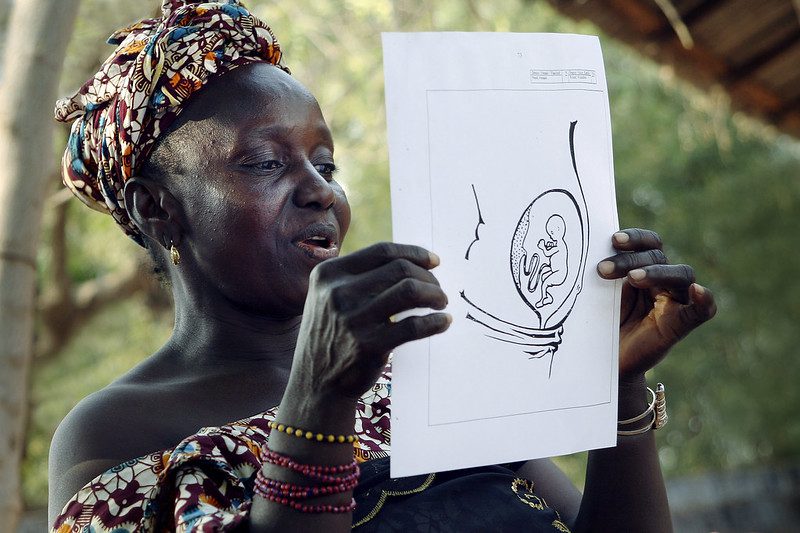
Maternal health continues to be a concern in developing countries around the world. Although overall maternal mortality decreased by 44 percent from 1990 to 2015, many nations still have a long way to go if the goal of fewer than 70 deaths per 100,000 live births is to be reached by 2030. Of note, despite improvements, the maternal mortality in The Gambia remains one of the highest in the world, with 706 maternal deaths per 100,000 live births.
Maternal mortality is a reflection of the disparities between the rich and the poor, with 94 percent of all maternal deaths occurring in developing countries. The fact that 50 percent of The Gambia’s population lives below the poverty line contributes to the high rates of maternal mortality in the nation.
A majority of the complications that lead to maternal deaths are preventable or treatable. However, either because the mother is giving birth outside of a health care facility or due to a lack of supplies or expertise, the necessary care is not always provided.
The main causes of maternal deaths are severe bleeding, infections, high blood pressure and delivery complications. Other deaths are caused by malaria, AIDS and other diseases.
Contributing Factors
In The Gambia, the national maternal mortality ratio decreased by 46 percent between 1995 and 2015. This can, in part, be attributed to an increase in antenatal care coverage, as 86.2 percent of Gambian women now receive antenatal care from a skilled health professional.
For deliveries, however, only 57.2 percent take place in the presence of a skilled health professional. Most women deliver at home with a traditional birth attendant; the main barriers to giving birth in a health care facility being insufficient time to travel and lack of transportation.
Maternal health in The Gambia is further complicated by social and cultural factors that contribute to pregnancy complications and the low percentage of women who give birth at a health facility or with a health professional. A study done in rural Gambia found that there were four interrelated factors that impacted maternal health:
- Pregnant women’s heavy workload
- The gendered division of labor
- Women’s inferior status in the household
- Limited access to and utilization of health care
Women in rural Gambia generally work alongside their husbands on farms, a fact that does not change even with pregnancy. Gambian women described being physically and emotionally exhausted from physical labor in the field and the house, noting that they did not get sufficient rest at any point during their pregnancy.
This is connected to the way labor is divided between men and women, as women often work longer hours than their husbands, regardless of whether they are pregnant or not. Social practices prevent men from doing certain household chores while their wives are pregnant to allow them to get more rest, which contributes to poor maternal health in The Gambia.
The activities that women continue to perform can also have negative impacts. Women noted that they had to fetch and carry water from long distances, pick groundnuts and cook with firewood, all of which are health risks for pregnant women.
Additionally, women have less control than their husbands, largely because they are economically dependent on them. Despite doing equal work in the field and more work in the house, women receive no financial benefits. This keeps them from becoming economically independent and forces them to rely on their husbands, giving their husbands more power.
As a result, many women who wanted to stop working could not unless their husbands allowed it. They also could not make certain decisions, including where to give birth, without the oversight of their husbands, contributing to a lack of utilization of health care facilities. As women are often required to work up until they give birth, their workload prevents them from being able to travel to a health care facility in time for delivery.
Improving maternal health in The Gambia, therefore, is connected to women’s autonomy. In addition to improving access to health care facilities and ensuring adequate supplies are available, work needs to be done to ensure that families are educated about the dangers of working during pregnancy and that women have the ability to make decisions for themselves about where to give birth.
Improvement Efforts
Other efforts are also important to decreasing maternal mortality in The Gambia. Within the last decade, the Horizons Trust Gambia and The Gambian Ministry of Health partnered with an organization called Soapbox to launch the Maternal Cleanliness Champions Initiative aimed at reducing infections from childbirth.
One of the main projects of this initiative is the distribution of Clean Birth Kits, which include soap, a clean blade and a clean plastic sheet to help ensure that expectant mothers have sanitary materials regardless of whether they are giving birth at a hospital or at home.
The Maternal Cleanliness Champions Initiative also worked to create a manual for cleanliness standards at health care facilities in The Gambia, adapting the manual to work with the local context of each hospital. The program also supported the training of facility staff to ensure that they knew how to adequately clean to prevent infections and other health complications.
These important efforts need to be combined with others to form a holistic approach to improving maternal health in The Gambia. Only coordinated efforts that are adapted to cultural and social contexts will be successful in significantly reducing maternal mortality in the nation.
– Sara Olk
Photo: Flickr

How Distrust Is Breeding Ebola
However, violence and distrust are increasing the risk of Ebola in Congo. This Ebola outbreak is the second worst outbreak in history and the solution is extremely complicated. Local militias in Congo have been burning down clinics and threatening physicians since January. Historically, residents have had to fear for their own safety and flee local armed extremist groups.
Distrust of Aid
Now, with the recent outbreak of Ebola, already vulnerable communities are experiencing a double layered threat of violence and disease. Reports show that the number of people infected with Ebola rises after violent conflicts. These areas are often unsafe for health workers, increasing the risk for Ebola to spread. Much of the violence pointed toward clinics and health workers stems from a widespread distrust of the government and foreign aid. This distrust is breeding Ebola, unnecessarily increasing the risk of contraction.
Despite these challenges, many international organizations are still trying to control the spread of Ebola in Congo and provide aid to those already infected. The World Health Organization reported 119 attacks on health workers. This has inspired international organizations to approach their methods for care differently. Aid workers are attempting to provide correct information to the population in Congo in order to debunk the propaganda being spread about the government and international aid. Often in public, health workers downplay their role to try and build trust within communities. The International Rescue Committee states, “Our staff has to lie about being doctors in order to treat people.”
Continued Support
The New Humanitarian is exploring why a deep distrust of government and foreign aid exists in Congo. Social media seems to be a large player in spreading misinformation. As such, 86 percent of adults surveyed in Beni and Butembo stated they do not believe that Ebola is real. Others believe Ebola is a method used by the government to destabilize certain areas. Similarly, many people fear treatment centers are making Ebola worse. Facebook and WhatsApp are major players in spreading this false information. The Ministry of Health has said they are working to monitor these pages and adapt local messages to make sure the truth is out there.
The control of Ebola is entirely possible through vaccines and prevention efforts. Instead, distrust is breeding Ebola in Congo as risk increases. Working to end this distrust and limit violence toward health workers through the spread of true information, is essential in stopping the spread of Ebola. The World Health Organization, the Center for Disease Control and other health agencies and organizations are working to provide more aid to those affected by Ebola, hoping to prevent spread beyond the region.
– Claire Bryan
Photo: Flickr
Letters of Hope: To Syria, With Love
Today in Syria
In January of 2018, Turkey launched an assault on Syria’s northern regions to push out Kurdish rebels in control of the area around Afrin. In April, the United States, Britain and France carried out multiple punitive strikes on Syrian targets in response to various claims of a chemical attack in Douma. Now in 2019, the future of the conflict and the ramifications of U.S. plans to withdraw troops from the nation remain unknown. In the face of such great uncertainty, Syria not only needs extensive aid in reconstructing the country but hope that there are still people who recognize Syrians’ humanity and distress.
The Letters of Hope Initiative
With over 12 million of their countrymen displaced and scattered, Syrian refugees need hope, acceptance and a kind word now more than ever. It is because of this need for connection among refugees and the outside world that the CARE Letters of Hope initiative was born. In 1945, 22 American organizations came together to assemble life-saving care packages to World War II survivors in danger of starvation; CARE was born. By May of 1946, 15,000 packages of U.S. Army surplus food parcels reached the harbor of Le Havre, France. These parcels were designed to provide one meal for 10 soldiers. $10 was enough to buy a CARE Package, which was received by its addressee overseas within four months.
More recently, in response to the Syrian crisis, CARE started sending a new kind of package: encouraging letters addressed to refugees. This project, named the Letters of Hope initiative, began in 2016 when the original WWII CARE Package recipients living in the U.S. started writing letters of support to Syrian children. By doing so, they started “bridging the great distance and circumstances that separated them.” That simple act inspired thousands across the globe to send their own letters that kept the movement alive and well to the modern day.
The Letters of Hope initiative has also started branching out into schools. Its website now provides downloadable junior-high classroom lessons with the aims to “build understanding, empathy and connections between American students and young refugees around the world.”
The Fledgling Fund
The Letters of Hope initiative is made possible in part by support from The Fledgling Fund. The Fledgling Fund is an organization that explores the impact that documentary films and other forms of visual storytelling have on social change and advocacy. By creating awareness of humanitarian crises through engaging content, the Fund is able to emotionally move an audience to action. In tandem, Letters of Hope and the Fledgling Fund are vying to tell a story of hope and compassion for Syria and other nations in need without excluding Syrians and other oppressed people from the narrative.
– Haley Hiday
Photo: Flickr
10 Facts About Hunger in Albania
10 Facts About Hunger in Albania
Since the ousting of the communist party in 1992, Albania has had an uphill battle against poverty and hunger. However, the years since then have seen the country make great strides in technological advancement and economic growth, both of which help it stay competitive in the European market and combat its hunger problem. There is still much for Albania to do, yet all indications from the Albanian government, EU and the global community, as well as these 10 facts about hunger in Albania, point to continued progress for this European nation.
– Staff Reports
Photo: Flickr
Updated: June 01, 2024
The 30/30 Project Makes Healthcare in Africa Possible
In 2014, musician Ryan Lewis, a member of the Macklemore and Ryan Lewis hip-hop duo, became the first to donate to the 30/30 Project, the project that he helped his mother, Julie, kickstart. As a thirty-year survivor of HIV, Julie Lewis designed the project with the goal of building thirty healthcare facilities worldwide. It is virtually impossible for people living in poverty to receive treatments, considering “Just one month’s supply of a typical antiretroviral drug costs more than the annual income of most Malawians.” But, these new facilities will give people access to treatments for life-threatening diseases like HIV/AIDS, tuberculosis, and malaria.
The Lewis family saw the injustice and pledged to make a positive change. After all, their motto for the project states, “Healthcare is a human right.”
Lewis and his musical partner, Macklemore, started an IndieGoGo campaign to raise $100,000. This went towards the first phase of the project, which is building a non-profit health center in Neno District, Malawi. The campaign exceeded its goal, raising over $150,000. So, the excess will be used for the next phase, which is a non-profit clinic in Kangundo, Kenya.
Dambe Health Center
Just like they promised, the 30/30 Project completed construction of the Dambe Health Center in the Neno District of Malawi in August 2015.
Partners in Health opened the clinic in March 2016. “This health center serves a community of 30,000 people…by addressing the need for free, basic primary care and lowering the barrier of access.” Since its launch four-and-a-half years ago, sixteen health care centers have been built. Six are currently under construction and eight are in the fundraising stage.
No Mom Left Behind
In addition to their main goal, the 30/30 Project launched its “No Mom Left Behind” campaign. The funds raised, build and maintain maternity wards in impoverished regions. Since 2017, they were able to build a new maternity ward and renovate a clinic in Togo, West Africa. For the 2019 fundraising year, donations will be used to construct a maternity ward in Kenya. It will offer HIV counseling, testing and medication, immunizations and family planning. The need for these services is high, as one in forty-two women die during childbirth. Sixty percent of women deliver their child at home, far from the helping hands of medical professionals. Construction on a nursing school in Uganda is already underway, with the hopes of training students to properly handle patients and any problems that may arise during childbirth.
As a family who has experienced the heartache associated with a loved one’s positive HIV diagnosis, the Lewises know how important it is to receive proper treatment. This is especially true for expectant mothers, who have a twenty-five percent chance of transmitting the disease to their baby. However, treatments could reduce that likelihood to less than two percent.
Ryan Lewis has made a splash in the music scene. Over the last five years, he has also made major strides in the world of philanthropy. Due to his generosity and perseverance, thousands of people in Africa and India are receiving life-saving treatments that they were previously unable to afford. With continued support, the 30/30 Project will help provide healthcare to many other underserved communities.
– Sareen Mekhitarian
Photo: Flickr
5 Organizations that Help Impoverished Women
5 Organizations that Help Impoverished Women
This organization develops plans to reduce poverty and the marginalization of women. For example, Credit Plus is a program that teaches women how to microfinance. For instance, how to save money or how to repay loans. WGEF provides women with credit that may otherwise not be accessible to them. WGEF also provides women with literacy programs, leadership development programs, agriculture training programs and more.
This organization believes education is key in providing women with the tools they need to gain access to independence and opportunities. The nonprofit, volunteer-run, U.S. organization works in Mali. This is because the country has one of the highest percentages of girls not in school in the world. Furthermore, 55 percent of girls in Mali are married before the age of 16.
Pathfinder campaigns for women’s sexual and reproductive health rights in 20 countries. They provide women resources for family planning; STD information and care; maternal health and more.
This nonprofit works to help women achieve economic freedom by giving support, professional attire and developmental tools. Dress for Success has helped more than 1 million women become self-sufficient. The organization works in 29 different countries, providing women with the resources and attire needed to secure professional jobs.
The organization fights for feminist futures by working toward ending violence against women. Additionally, the organization is dedicated to helping women recover from war. Madre has built clinics and counseling centers for women, children and LGBTQ people who have been victims of gender violence. For example, Madre partnered with Taller de Vida to provide art therapy to help girls who have experienced trauma as a result of rape during war in Columbia.
Why This Matters
With poverty as a contributing factor, women all over the globe experience a lack of independence, education, freedoms and opportunities. These five organizations that help impoverished women work to improve the lives of women all over the globe. Though many women have been helped, there’s still a long way to go in defeating gender inequality and achieving women’s rights globally.
– Jodie Filenius
Photo: Flickr
Top 10 Facts About Living Conditions in Trinidad and Tobago
North of the coast of Venezuela, Trinidad and Tobago is a wondrous country with elements that make the island unique. Living conditions in Trinidad and Tobago are bewildering due to its economic growth and the risks of HIV. There are many factors that affect living conditions on this island that make it whole. These are the top 10 facts about living conditions in Trinidad and Tobago.
Top 10 Facts About Living Conditions in Trinidad and Tobago
Trinidad and Tobago is experiencing great economic growth due to the vast amount of resources and has seen progress regarding education and health care but still see issues regarding diseases, housing and poverty. Although these may be factors that can affect the country negatively, Trinidad and Tobago have the potential to combat these elements to help the country thrive. These are the top 10 facts about living conditions in Trinidad and Tobago.
– Elijah Jackson
Photo: Flickr
Google’s Contribution to Fighting Extreme Poverty
Google and GiveDirectly
In 2012, Google granted $2.4 million to GiveDirectly. GiveDirectly is a nonprofit organization that transfers money to people in Kenya using “electronic monitoring and payment technology.” Recipients can receive money via personal cell phones or the cell phones GiveDirectly gives them.
GiveDirectly hopes for economic stimulation by increasing cash flow to impoverished individuals to create more expenditure on services and products. For example, NPR covered a GiveDirectly success story about a Kenyan man who used the money he received to buy a used motorcycle. With his motorcycle, he charges riders a fee similar to taxi services like Lyft or Uber as a source of income. This organization allows donors to fund individual living expenses instead of general predetermined expenses, giving recipients the freedom to purchase the specific items they need to financially benefit their family.
As of 2016, 36.1 percent of Kenya’s population lives on less than $1.90 per day. This statistic dropped from 46.8 percent in 2006 but Kenya is still far from eradicating poverty altogether. Google’s contribution to fighting extreme poverty allowed GiveDirectly to recreate its program in Uganda and East Africa, as well as research its economic, social and psychological impacts.
Google and StoryWeaver
A year later in 2013, Google funded $3.85 million to an India-based organization, StoryWeaver, as part of the $50 million initiative to close the global education gap. StoryWeaver is a free online educational resource targeting underprivileged areas. It is also a platform for authors, illustrators and translators to create stories for children. StoryWeaver makes books more available to children all over the world in their native languages at varying reading levels. The ability to read and write sets the foundation for further education and countries in poverty have a significantly lower literacy rate due to inadequate educational materials or resources.
Literacy rates in India logged in at 74.04 percent in 2011 compared to the average world literacy rate of 86.3 percent. As a result, StoryWeaver works to provide free reading material to communities in need. StoryWeaver has already garnered over two million reads and 13,000 stories in 175 languages. With Google’s help, StoryWeaver will be able to expand its platform and user base while increasing the production of stories.
Google emphasizes the importance of accessible educational materials and worldwide economic participation by supporting innovative national and global nonprofits. With its powerful influence, resources and platform, Google is in a strong position to establish positive changes and produce substantial outcomes. Google’s contribution to fighting extreme poverty began almost 14 years ago and its efforts continue to remain steadfast today.
– Angela Dong
Photo: Flickr
The Continued Fight to Improve Maternal Health in The Gambia
Maternal health continues to be a concern in developing countries around the world. Although overall maternal mortality decreased by 44 percent from 1990 to 2015, many nations still have a long way to go if the goal of fewer than 70 deaths per 100,000 live births is to be reached by 2030. Of note, despite improvements, the maternal mortality in The Gambia remains one of the highest in the world, with 706 maternal deaths per 100,000 live births.
Maternal mortality is a reflection of the disparities between the rich and the poor, with 94 percent of all maternal deaths occurring in developing countries. The fact that 50 percent of The Gambia’s population lives below the poverty line contributes to the high rates of maternal mortality in the nation.
A majority of the complications that lead to maternal deaths are preventable or treatable. However, either because the mother is giving birth outside of a health care facility or due to a lack of supplies or expertise, the necessary care is not always provided.
The main causes of maternal deaths are severe bleeding, infections, high blood pressure and delivery complications. Other deaths are caused by malaria, AIDS and other diseases.
Contributing Factors
In The Gambia, the national maternal mortality ratio decreased by 46 percent between 1995 and 2015. This can, in part, be attributed to an increase in antenatal care coverage, as 86.2 percent of Gambian women now receive antenatal care from a skilled health professional.
For deliveries, however, only 57.2 percent take place in the presence of a skilled health professional. Most women deliver at home with a traditional birth attendant; the main barriers to giving birth in a health care facility being insufficient time to travel and lack of transportation.
Maternal health in The Gambia is further complicated by social and cultural factors that contribute to pregnancy complications and the low percentage of women who give birth at a health facility or with a health professional. A study done in rural Gambia found that there were four interrelated factors that impacted maternal health:
Women in rural Gambia generally work alongside their husbands on farms, a fact that does not change even with pregnancy. Gambian women described being physically and emotionally exhausted from physical labor in the field and the house, noting that they did not get sufficient rest at any point during their pregnancy.
This is connected to the way labor is divided between men and women, as women often work longer hours than their husbands, regardless of whether they are pregnant or not. Social practices prevent men from doing certain household chores while their wives are pregnant to allow them to get more rest, which contributes to poor maternal health in The Gambia.
The activities that women continue to perform can also have negative impacts. Women noted that they had to fetch and carry water from long distances, pick groundnuts and cook with firewood, all of which are health risks for pregnant women.
Additionally, women have less control than their husbands, largely because they are economically dependent on them. Despite doing equal work in the field and more work in the house, women receive no financial benefits. This keeps them from becoming economically independent and forces them to rely on their husbands, giving their husbands more power.
As a result, many women who wanted to stop working could not unless their husbands allowed it. They also could not make certain decisions, including where to give birth, without the oversight of their husbands, contributing to a lack of utilization of health care facilities. As women are often required to work up until they give birth, their workload prevents them from being able to travel to a health care facility in time for delivery.
Improving maternal health in The Gambia, therefore, is connected to women’s autonomy. In addition to improving access to health care facilities and ensuring adequate supplies are available, work needs to be done to ensure that families are educated about the dangers of working during pregnancy and that women have the ability to make decisions for themselves about where to give birth.
Improvement Efforts
Other efforts are also important to decreasing maternal mortality in The Gambia. Within the last decade, the Horizons Trust Gambia and The Gambian Ministry of Health partnered with an organization called Soapbox to launch the Maternal Cleanliness Champions Initiative aimed at reducing infections from childbirth.
One of the main projects of this initiative is the distribution of Clean Birth Kits, which include soap, a clean blade and a clean plastic sheet to help ensure that expectant mothers have sanitary materials regardless of whether they are giving birth at a hospital or at home.
The Maternal Cleanliness Champions Initiative also worked to create a manual for cleanliness standards at health care facilities in The Gambia, adapting the manual to work with the local context of each hospital. The program also supported the training of facility staff to ensure that they knew how to adequately clean to prevent infections and other health complications.
These important efforts need to be combined with others to form a holistic approach to improving maternal health in The Gambia. Only coordinated efforts that are adapted to cultural and social contexts will be successful in significantly reducing maternal mortality in the nation.
– Sara Olk
Photo: Flickr
Strides in the Race for Vaccine Accessibility
Vaccines are second only to clean water in reducing the rate of infectious disease. Vaccines prevent about 6 million deaths every year, and those that have been in use for decades show a 99 percent decrease in the rates of people contracting those diseases. Unfortunately, vaccines are not affordable for many people living in poverty throughout the world, making them much more vulnerable to infectious disease. Several factors contribute to the current lack of vaccine accessibility in many parts of the developing world. However, there are also significant improvements that are being made in decreasing the financial gap between those who receive vaccinations and those who do not, helping make vaccines more accessible to everyone.
The Current Situation
The price of the vaccine doesn’t always reflect the cost: People in developing countries are not only paying for the cost of manufacturing the vaccine, but also for expensive shipping costs, refrigeration, tariffs on imports, and taxes on medical supplies. These additional costs are often much more than the cost of the actual vaccine, and they make what would otherwise be an affordable vaccine inaccessible to a lot of people.
Clinic visits cost money too: In addition to buying the vaccine with all of its fees piled on top, people also have to pay to visit a clinic to receive these vaccines. The hours of health clinics are often inconvenient as well, forcing people to forgo wages from work in order to see a doctor.
Many vaccines require multiple rounds: A lot of vaccines, such as RTSS for malaria, MMR for measles and the HPV vaccine require multiple rounds of vaccination in order to be effective. This simply compounds all of the other barriers to vaccine accessibility; those receiving the vaccine have to pay for treatment again as well as take time off of work to visit a clinic.
Doctors are few and far between: In many parts of the developing world, there are very few doctors, and these doctors are limited in the number of patients they can treat each day. Therefore, even if one can afford to pay for the vaccine and can make it to a clinic, there is no guarantee that they will be able to be seen by a doctor.
Improvements to Vaccine Accessibility
Local health centers’ capacities are being strengthened: Gavi, a non-governmental organization dedicated to providing vaccines to the developing world, is working to strengthen the capacity of existing health centers to deliver immunizations. Gavi is working to increase the proportion of people who are receiving a full cycle of vaccines rather than “dropping out” after the first dose by providing sustainable funding to health clinics across the developing world.
Foreign aid decreases the price of vaccines: Providing foreign aid specifically for vaccines decreases the cost to those receiving treatment, and in turn, spares families from having to pay far more for treatment if someone contracted an infectious disease. Foreign aid for vaccinations has the highest return on investment of any type of aid besides education.
People are going beyond wanting to vaccinate to actually vaccinating: The Poverty Action Lab at MIT is implementing research on how to motivate people from desiring to vaccinate to doing it. This research is increasing the numbers of people receiving preventative immunizations in the developing world and reducing the rates of disease.
Infrastructures to keep vaccines cold for cheaper: The governments of Ethiopia and Gambia have created cold chain infrastructures in order to reduce the cost of transporting vaccines that need to be refrigerated. These infrastructures are far from perfect, as some cold storage facilities in Ethiopia have not been kept as cold as they need to be in order to protect the vaccines.
However, progress is still being made in reducing the cost of vaccines and allowing them to be more accessible to those living in poverty. Gavi is working to implement more cold chain infrastructures in other countries in Sub-Saharan Africa.
Moving Forward
There is clearly still a long way to go in ensuring vaccine accessibility to everyone who needs it, but a lot of progress has been made in breaking down the current barriers to accessibility. Vaccines are much cheaper than the cost of treatment for those who have the diseases vaccines aim to prevent, and investing in vaccinations relieves the world’s poor of the additional burden of treatment costs. Vaccines are one of the greatest assets in our toolbox to fight poverty, and great strides are being made in the effort to make accessibility a reality.
– Macklyn Hutchison
Photo: Flickr
Justice for Iraqi Women
The status and protection of women remain a heated topic of discussion in international and national committees, particularly concerning justice for Iraqi women. Iraq‘s government is aware of the violations committed by its previous regime against certain civil community groups. As a result, Iraq’s government has strived to drastically change how they aid and support victimized and often impoverished groups. However, Iraq‘s strategy to reconcile these issues is unique. For example, China encourages its impoverished population to move to urbanized cities, and the United Kingdom encourages participation in its labor market. But Iraq seeks to acknowledge the voices of the victims.
In 2003, Iraq‘s government and the International Center for Transitional Justice partnered with the Human Rights Center of the University of California, Berkeley to create Iraqi Voices. Iraqi Voices is a report based on data collected from in-depth interviews and focus groups. This data represents different perspectives of the Iraqi population regarding transitional justice. There are seven main topics of focus represented in this report: past human rights abuses, justice and accountability, truth-seeking and remembrance, amnesty, vetting, reparations, and social reconstruction and reconciliation.
Hearing Women
Iraq is working to have women and girls meaningfully participate in all stages of decision making. Programs and organizations like the SEED Foundation have worked to ensure this justice for Iraqi women. In particular, the SEED Foundation works to empower and engage the voices of violence and trafficking victims in Iraq. As such, SEED Foundation leaders and activists encourage the meaningful participation of women in sustainable peace negotiations and conflict reconciliation. Through their efforts, the Iraqi Parliament now has a quota setting aside 25 percent of seats for women in provincial councils. By acknowledging these voices, the Iraqi government is helping seek justice for Iraqi women.
Moreover, Iraq has taken strides to bridge the gap between policymakers and victims when addressing the needs of local communities affected by ISIS. To do so, Iraq is considering partnering with or accepting assistance from other nations. While international policymakers seek justice for Iraqi victims, they fail to address the real concerns of affected communities. Instead, they often focus on prosecuting the perpetrators. But affected communities also have more immediate needs. Therefore, this partnership and assistance allow victims of affected communities to participate in prioritizing and creating appropriate policies. Efforts to ensure meaningful participation in Iraq‘s government thus bring about transitional justice. By addressing systemic failures, Iraq’s government brings justice to marginalized victims, including justice for Iraqi women.
Bringing Change
Ultimately, the changes implemented by the Iraqi government aid and empower impoverished and victimized groups, such as women. The inclusion of female voices in politics influences larger discussions affecting women and, as seen as Iraq, helps get justice for Iraqi women.
– Jordan Melinda Washington
Photo: Pixabay