• Link to X
  • Link to Facebook
  • Link to Instagram
  • Link to TikTok
  • Link to Youtube
  • About
    • About Us
      • President
      • Board of Directors
      • Board of Advisors
      • Financials
      • Our Methodology
      • Success Tracker
      • Contact
  • Act Now
    • 30 Ways to Help
      • Email Congress
      • Call Congress
      • Volunteer
      • Courses & Certificates
      • Be a Donor
    • Internships
      • In-Office Internships
      • Remote Internships
    • Legislation
      • Politics 101
  • The Blog
  • The Podcast
  • Magazine
  • Donate
  • Click to open the search input field Click to open the search input field Search
  • Menu Menu

Archive for category: USAID

Topics covering about USAID

Developing Countries, Foreign Aid, Global Poverty, USAID

15 Foreign Aid Statistics


The following 15 foreign aid statistics help to understand the topic of foreign assistance. Most Americans don’t know much about U.S. foreign aid. There are many misconceptions about what foreign aid is and how much of the federal budget goes to it each year. Here are 15 foreign aid statistics.

  1. The U.S. government states, “Foreign assistance is aid given by the United States to other countries to support global peace, security, and development efforts and provide humanitarian relief during times of crisis. It is a strategic, economic and moral imperative for the U.S. and vital to U.S. national security.”
  2. The first U.S. aid program was created in the aftermath of World War II.
  3. In 1961 Kennedy signed the Foreign Assistance Act which created The United States Agency for International Development (USAID).
  4. The Kaiser Family Foundation conducted a study in 2015 and found that most Americans thought the U.S. spends too much on foreign aid. Twenty-six percent was the guess for how much of the total federal budget goes towards it.
  5. Out of the total $4.15 trillion proposed budget for 2017 by Obama, $42.4 billion was set aside for foreign assistance.
  6. $25.6 billion was set for economic and development assistance. The top three countries receiving this aid are Afghanistan, Jordan and Kenya.
  7. Economic and development assistance includes many programs, the largest being Global Health Programs, Economic Support Fund, Development Assistance and Migration and Refugee Assistance.
  8. Within Global Health Programs, most of what the U.S. gives goes towards fighting HIV/AIDS.
  9. Some of the smaller programs falling under economic and development assistance include International Disaster Assistance, Food for Peace, Millennium Challenge and The Peace Corps.
  10. About $16.8 billion was budgeted for U.S. security assistance in 2017. The top three countries receiving this aid are Afghanistan, Israel and Egypt.
  11. The main programs falling under U.S. security assistance include Foreign Military Financing, Afghanistan Security Forces Fund and Coalition Support Funds.
  12. The U.S. spent more than $14 billion from the foreign aid budget on deliveries of arms sales in 2015. According to The Washington Post, “in terms of arms sales, [the United States] controls at least half of the global market.” The top three countries receiving these deliveries were Saudi Arabia, Australia and Iraq.
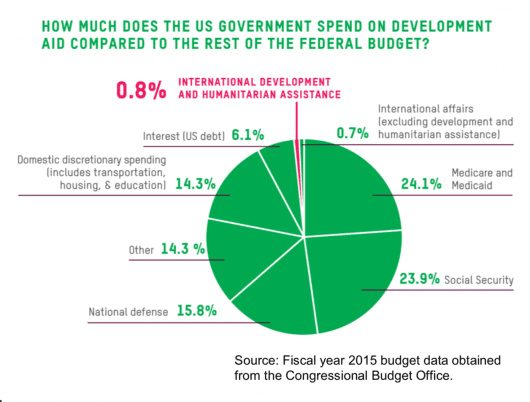
  13.  Less than one percent of the entire U.S. annual budget is spent on International Development and Humanitarian Assistance.
  14.  Oxfam says three changes to U.S. foreign aid would help make it more effective: “Focus first and foremost on fighting poverty. Recognize that local citizens and governments are in charge of their countries’ futures. Put more U.S. aid resources in their hands. Continue to provide more useful information about U.S. aid.”
  15. In an interview with NPR, Phyllis Pomerantz (public policy professor at Duke University) said, “On the one hand, you can say that the U.S. is the most generous because it is one of the biggest donators to foreign aid, but on the other hand, we have one of the lowest percentages of gross national income donated to foreign aid.”

These 15 foreign aid statistics help to better understand what U.S. foreign aid is, how much money goes where and what needs to be reworked as we look towards the future.

– Shannon Elder

Photo: Flickr

March 19, 2017
https://borgenproject.org/wp-content/uploads/borgen-project-logo.svg 0 0 Borgen Project https://borgenproject.org/wp-content/uploads/borgen-project-logo.svg Borgen Project2017-03-19 01:30:172024-06-05 04:10:4415 Foreign Aid Statistics
Global Poverty, Hunger, USAID

Feed the Future Initiative Fights Hunger in Bangladesh


Bangladesh, a primarily agricultural society, has been plagued by poverty and malnutrition for many years. The 2010 USAID-funded Feed the Future training program, however, has empowered farmers to increase their yields. The program has improved economic status and given the Bangladeshi people the means to fight back against hunger. This can particularly be seen in the life of Taroni Kanto Shikari, whose economic status improved to the point where he could send his son to school and his daughter to college.

Hunger and food insecurity continue to plague many Asian countries, and Bangladesh is no exception. The country has a population of 160 million. Over 40% of that population lives on less than one dollar per day and struggles with food insecurity. A stagnating economy, rising inflation and unpredictable natural disasters all contribute to hunger in Bangladesh. As the nation’s population grows, so does its rates of hunger and malnutrition.

Malnutrition is extremely prevalent in Bangladesh, particularly among children and pregnant women. In 2015, worldhunger.org reported that 51% of pregnant women in Bangladesh do not consume adequate amounts of vitamin A. The site also reported that over 40% of adolescent girls are iron deficient and anemic. Bangladesh also has a high wasting and stunting rate, both of which stem from malnutrition and can permanently inhibit a child’s growth.

Battling Hunger Through Education

In 2010, USAID began the Feed the Future initiative, an ongoing program that fights back against hunger and malnutrition. The program operates by equipping farmers with the tools and the knowledge to increase their crop yields. The initiative consists of training seminars to teach farmers in Bangladesh better farming techniques and to equip them with better seeds and fertilizers.

Feed the Future has been very effective towards fighting hunger in Bangladesh, as can be seen in the life of Taroni Kanto Shikari, a rice farmer from the southern region of Bangladesh. As a rice farmer, Taroni’s income is dependent upon his yield. After all, Taroni says, “Rice is our life, rice is everything.” In 2010, Taroni attended USAID agricultural training, where he learned how to increase his rice yields with better seeds, fertilizer and techniques.

As a result of Taroni’s USAID-training, his rice production practically doubled and has increased steadily by 18% each season. His rice now requires one-third less fertilizer, reducing his production costs. He is also able to produce more vegetables with these new techniques, significantly increasing nutrient intake for his family. Taroni’s income has dramatically increased, and he can now afford to send his daughter to medical school and buy a bicycle for his son to attend school.

Hunger and malnutrition in southern Asian countries such as Bangladesh are rising issues. The problem will continue to worsen as populations rise and natural disasters ravage the region. Initiatives such as USAID’s Feed the Future program, however, are operating in countries around the world to give farmers like Taroni the tools to fight back against hunger and malnutrition.

– Chasen Turk

Photo: Flickr

March 5, 2017
https://borgenproject.org/wp-content/uploads/borgen-project-logo.svg 0 0 Borgen Project https://borgenproject.org/wp-content/uploads/borgen-project-logo.svg Borgen Project2017-03-05 01:30:192024-12-13 17:56:47Feed the Future Initiative Fights Hunger in Bangladesh
Developing Countries, Food & Hunger, Food Aid, Global Poverty, USAID

USAID: Increasing Food Aid Through a Simple Bag

Food_AidAs humanitarian crises grow across the world, the U.S. Agency for International Development (USAID) is increasing food aid with one simple solution: bag redesigns.
Before getting into the solution, it is imperative to diagnose the problem first.

The world currently faces six qualified food emergencies, as stated by the World Food Program. Between civil wars and the environmental effects of the recent El Nino, civilians in Syria, Iraq, southern Africa, Nigeria, South Sudan and Yemen are all in dire need of food assistance. If lives are to be saved, agencies like USAID must increase food aid.

USAID is considered to be one of the world’s most significant food aid donors. Yearly, it donates around $1.5 billion in rice, sorghum and wheat to countries in need all around the world. These shipments are ordered to port in one of three chosen locations: Djibouti, Ethiopia or South Africa. However, under law, this food aid must be bought within the U.S. and half of all aid must be transported via U.S. ships. Realistically, this process takes around four to six months to ship. This donation process can be tedious and, in emergency situations when food is needed in less than a week (like the Haitian earthquake), deadly.

Not only this, but it is estimated that one percent of food donation cargo spoils along the way. While the percentage appears insignificant, the repercussions are fierce. One percent of USAID’s food donation is equivalent to 10,000 tons of food, costing up to $15 million. And so, when one percent spoils, an estimated 200,000 families will go hungry for an entire month. For some, one percent is the difference between life and death.

Alongside the U.S. Department of Agriculture, USAID sought out the Massachusetts Institute of Technology (MIT) to tackle this mission last year. MIT researchers will assess how food aid is packaged in present-day and then research alternative packaging systems that will both delay the food aid’s expiration and decrease the cost of making the package. Should they find an alternative, USAID and MIT could be responsible for increasing food aid around the world.

MIT is currently testing bags that will avoid water damage and slow insect infestation, two leading causes of food aid spoiling. Currently, these newly design bags are carrying $1.7 million worth of food aid to Djibouti and South Africa. Only time will tell if USAID and MIT have found success in the redesigns. Regardless, for 200,000 families, the world of food aid is growing a little brighter.

– Brenna Yowell

Photo: Flickr

February 13, 2017
https://borgenproject.org/wp-content/uploads/borgen-project-logo.svg 0 0 Borgen Project https://borgenproject.org/wp-content/uploads/borgen-project-logo.svg Borgen Project2017-02-13 01:30:292020-05-25 22:12:21USAID: Increasing Food Aid Through a Simple Bag
Technology, USAID

Mapping Roads in Tanzania Improves Healthcare

Mapping Roads in Tanzania Improves Healthcare and other Developments
Mapping roads in Tanzania will fuel economic growth and development as well as improve healthcare and response to natural disasters.

Like many developing countries, roads and cities in Tanzania were previously off the grid from GPS devices and Google services such as Street View. With no map data, it is difficult to deliver aid and supplies to communities in need. Lack of map data affects virtually all transit in a country, from farmers transporting food to markets to residents of cities finding routes that avoid traffic on their commute.

However, recent efforts from the U.S. Agency for International Development (USAID) and the World Bank have begun to put Tanzanian roads on the grid.

In an effort to improve how health supplies are delivered, USAID began mapping roads in Tanzania that connect more than 5,600 health centers. So far, more than 30,000 kilometers of roads have been mapped across the nation.

Previously, transporting medical supplies between these health centers and the communities that needed them was difficult because nearly half of Tanzania roads were not mapped online. This meant that if drivers did not know their delivery route, they had to rely on directions from locals. Drivers also did not know the road conditions or how long routes would take.

To map large amounts of roads quickly, USAID installed tracking devices on trucks from Tanzania’s medical stores department (MSD). USAID and MSD were able to determine the quickest routes possible to distribute medical supplies based on the data. The organizations also released the data to the public so all those looking to travel in Tanzania have access to the information.

The Ramani Huria community mapping group in the city of Dar es Salaam helped upload this data. The group has also begun mapping the streets of Dar es Salaam, where map data will become crucial to help the city better prepare and respond to natural disasters.

To map the city’s streets, local volunteers attach camera rigs to their vehicles and take pictures as they travel the streets. They can also use the Swedish app Mapillary to take photos as they walk or hitch rides around the city.

So far volunteers have helped map 300 miles of the project’s 2,000-mile goal. Images captured with Mapillary become 3D digital maps that show real-time data of Dar es Salaam.

Aside from the maps providing data about traffic and travel times, they can also be used to help locate areas that are in danger of flooding, develop plans to prepare for heavy floods and assess which routes can be taken to deliver aid in case of flooding.

Rising sea levels and heavy rainfall from March to May leave Tanzania prone to floods. Each year floods leave hundreds to thousands of Tanzanians homeless and cause many deaths. While the poverty rate is 28 percent, mapping roads in Tanzania will help combat some of the issues that lead to poverty.

– Cassie Lipp

Photo: Flickr

December 29, 2016
https://borgenproject.org/wp-content/uploads/borgen-project-logo.svg 0 0 Borgen Project https://borgenproject.org/wp-content/uploads/borgen-project-logo.svg Borgen Project2016-12-29 01:30:502024-12-13 17:56:24Mapping Roads in Tanzania Improves Healthcare
Foreign Aid, Global Poverty, USAID

The Five Best Ways USAID Helped Nigeria in 2016

The Five Best Ways USAID Helped Nigeria in 2016
As 2016 ends, USAID has announced encouraging news in regards to their long-time relationship with the country of Nigeria. Going forward, USAID plans to add $92 million to their humanitarian assistance program for the country. This move is symbolic of the year the two partners have shared; one rich with progress in support of refugees displaced and suffering from the Boko Haram insurgency. Here are five more ways USAID helped Nigeria in 2016:

  1. In November 2016, USAID and Chi Farms, which invests in emerging Nigerian economies by making use of local resources, partnered to add roughly 4,000 tons of catfish to the country’s water bodies. Part of USAID’s Feed the Future initiative, the two will also train 6,000 farmers and entrepreneurs in order to establish a more stable backbone for Nigeria’s economy.
  2. One of the most effective ways USAID helped Nigeria in 2016 was through its humanitarian assistance to those affected by the Boko Haram insurgency near the Lake Chad Basin. As of August 2016, more than 2 million people were internally displaced due to the conflict. USAID provides stability for refugees by administering such simple things as electronic vouchers, which cover things like food and household supplies in local shops – not only does the family benefit, but so does the local business. By August 2016, USAID had given $98 million in humanitarian aid to this region of Nigeria.
  3. In June 2016, USAID donated 160 metric tons of seeds to 6,000 Nigerian households, which they now estimate effects the lives of 60,000 internal refugees. Food insecurity has proven an endemic problem since the beginning of the conflict with Boko Haram, and this ambitious initiative lends a great deal of stability to families throughout the country that are now in control of their food supply. The donation of seeds also includes food packets to help sustain families as they await the harvest.
  4. USAID deployed a Disaster Assistance Response Team (DART) in November 2016 to confront increasingly dire food insecurity in areas affected by the conflict. A study conducted by the organization in October estimated that 20 to 50 percent of children in the past six months suffered from acute malnourishment. The humanitarian crisis currently puts 9.2 million in need of help, and the arrival of DART means assistance can spread to more people, and more quickly.
  5. Assisting with food security wasn’t the only way USAID helped Nigeria in 2016 – they also trained personnel to staff 44 private hospitals for family planning counseling and implementation. As part of their USAID SHOPS project (Strengthening Health Outcomes for the Private Sector), the organization worked to increase quality and accessible family planning services throughout Nigeria. Completed in 2016, the project ran for five years and reached six states, and also trained 115 pharmacists to provide counseling to families. As a result, local healthcare facilities are reporting an increase in the use of effective contraception.

Since 2015, the U.S. has been the largest donor to Nigeria, giving $291 million in the 2016 fiscal year toward humanitarian aid. With the incredible news of their upcoming $92 million increase, USAID has extended help to tens of thousands more people and strengthened a partnership that will continue to improve the lives of millions of Nigerians.

– Emily Marshall

Photo: Flickr

December 29, 2016
https://borgenproject.org/wp-content/uploads/borgen-project-logo.svg 0 0 Borgen Project https://borgenproject.org/wp-content/uploads/borgen-project-logo.svg Borgen Project2016-12-29 01:30:292024-12-13 17:56:24The Five Best Ways USAID Helped Nigeria in 2016
Education, Global Poverty, USAID

Notre Dame and USAID Team Up to Improve Education in Haiti

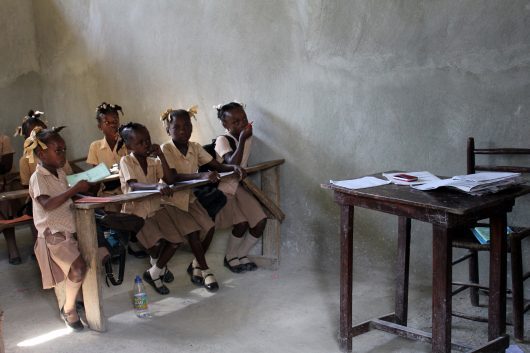
Notre Dame and USAID Team Up to Improve Education in HaitiFor many years, Haiti has not only been the poorest country in the Western Hemisphere, but also one of the most destitute in the world. Rocked by earthquakes, cholera epidemics and hurricanes over the past few years, the country has struggled to improve many facets of life for its citizens. As such, education in Haiti faces many obstacles, including teacher training, accessibility and funding.

Currently, almost 80 percent of teachers have not been exposed to the proper training prior to their tenure as educators, and half of those working in the country’s few public institutions lack basic teaching qualifications.

Public schools are almost non-existent in Haiti – almost 90 percent of establishments are run by religious organizations and non-government entities. Because these schools are private, they require tuition fees in order to operate, which is often a huge burden for families in a country where the average annual income is roughly $800.

More than half of all children do not attend school, and the development of education in Haiti must contend with the staggering fact that over half of Haitian adults are illiterate, and as many as 50 percent of second graders cannot read even one word.

However, in an effort to improve the quality of life for millions around the world, USAID has teamed up with 6 U.S. universities to develop innovative solutions to a variety of problems. By awarding over $3 million in grants to graduate students across the country, USAID has committed to improving the lives of people across the globe.

As part of this effort, the University of Notre Dame was awarded a grant in December 2012 to take on the challenge of literacy in Haiti. The grant will cover 150 schools and as many as 30,000 children and will work in tandem with the Haitian Catholic Church over the next four years. Additionally, USAID has partnered with Haiti’s Ministry of Education to the tune of $6.3 million to improve early-grade reading and writing skills.

The University of Notre Dame is certainly familiar with the daunting task of improving the lives of Haiti’s young students. In 2014, the university’s Alliance for Catholic Education (ACE) launched the “Read to Learn” initiative, aiming to reach 7,000 children in 52 schools by expanding Creole reading programs, the native language of 95 percent of Haitians.

Although recent years have been tumultuous and full of challenges for the country, its people remain resilient and dedicated to improving their communities and the lives of their children. With the help of organizations such as ACE and USAID that are committed to improving literacy and education in Haiti, students throughout the island have hope for better education and a brighter tomorrow.

– Emily Marshall

Photo: Flickr

December 20, 2016
https://borgenproject.org/wp-content/uploads/borgen-project-logo.svg 0 0 Borgen Project https://borgenproject.org/wp-content/uploads/borgen-project-logo.svg Borgen Project2016-12-20 01:30:372024-12-13 17:56:22Notre Dame and USAID Team Up to Improve Education in Haiti
Global Poverty, Poverty Reduction, USAID

USAID Leads the National Fight on Global Poverty

Global Poverty
As of 2013, 767 million men and women worldwide live under the global poverty line. Nearly 11 percent of the world’s population still struggle to make ends meet with less than $1.90 per person per day. According to recent World Bank statistics, much of this community is densely populated in sub-Saharan Africa. This region touts over half of the global impoverished community.

The U.S. Agency for International Development is one of the many organizations looking to make strides with this epidemic. Launched by the Foreign Assistance Act of 1961, USAID aims to lead the U.S. national effort to abolish socioeconomic inequality.

This agency has instituted multiple initiatives geared towards combating widespread global poverty. Most notably, the U.S. Global Initiative Lab, instituted in 2014, works in conjunction with prominent businesses and academic institutions to address preeminent wealth disparity issues through a wide network of pooled resources.

These cornerstone partnerships offer advanced research and development capabilities which would otherwise be unavailable to one single entity. The U.S. Global Initiative Lab has also recently sought to implement technological advances in these poverty-stricken communities. The Lab has labored to effectively reallocate funds to provide the necessary groundwork for these actions to take place.

One USAID administrator, Rajiv Shah, expresses optimism when discussing these changes in a 2014 interview with Time Magazine. “[…] if we could get and invent new seeds, new mobile technology, and open new data centers to help farmers connect their crop prices and understand weather variability, we can do something transformational […].”

In 2016, USAID requested a budget of $50.1 billion to carry out development activities. This lump sum included a $35.2 billion base request to directly support people and global health programs while bolstering American U.N. leadership.

In its Congressional budget justification, USAID recognized the need for “accountability, efficiency, and effectiveness in the use of taxpayer dollars.” Additionally, the agency directly pointed out the need for budget allocation to African programs.

This request specifically outlines the need to secure policies concerning democracy, education and economic growth. USAID points to democratic gains in Nigeria as well as political transitions throughout the continent as vital measures towards infrastructural improvement.

These initiatives illustrate a refreshing sense of awareness on the part of USAID. Blindly throwing money at an issue yields ineffective and temporary solutions. Dire situations require resilience and thoughtful action.

USAID’s mission statement calls for “democratic societies to realize their potential.” The organization does not look for immediate solutions to complicated problems. More accurately, USAID works to promote a stable environment which can cultivate economic prosperity for years to come.

USAID believes actions like theirs may go to “define the majority of the history written about our era.” Time will show the scope of the impact USAID can have in the fight against global poverty.

– Brady Rippon

Photo: Flickr

November 30, 2016
https://borgenproject.org/wp-content/uploads/borgen-project-logo.svg 0 0 Borgen Project https://borgenproject.org/wp-content/uploads/borgen-project-logo.svg Borgen Project2016-11-30 01:30:452024-12-13 17:56:11USAID Leads the National Fight on Global Poverty
USAID

Power Africa Initiative Has Potential to Generate More Progress

Power Africa Initiative
President Obama’s Power Africa Initiative is looking to solve a monster problem in sub-Saharan Africa, where two out of three people lack access to electricity. Power Africa suggests “ambitious but achievable” goals, including the creation of 60 million new electricity connections and 30,000 megawatts of new and cleaner power.

According to President Barack Obama, “Access to electricity is fundamental to opportunity.” With Power Africa, the U.S. is investing in Africa’s potential. Obama has brought together private and public organizations, political leaders and power generation experts with the goal of improving peoples’ quality of life and stimulating economic growth.

USAID’s goal with the Power Africa Initiative has been “to remove barriers that impede sustainable development.” A recent article in Bloomberg, however, claims that after three years, those barriers are still in place.

Writers Toluse Olorunnipa and Tope Alake cite evidence that Power Africa “has fallen well short of its goals, so far producing less than 5 percent of the new power generation it promised.” They highlight political dysfunction, policy bundling and economic hurdles as major obstacles to progress.

USAID, in collaboration with the U.S. Department of Energy, is aiming to implement policy and regulatory reforms, and the Department of Energy has partnered with the Clean Energy Solutions Center in the Power Africa Initiative to “help governments design and adopt policies and programs that support the deployment of clean energy technologies.”

With over 120 public and private partners, the Power Africa Initiative has the potential to make an enormous impact in the African continent, despite the bleak progress reported.

In September 2016, President Obama argued that progress is being made, citing successes involving “solar power and natural gas in Nigeria; off-grid energy in Tanzania; people in rural Rwanda gaining electricity.”

Obama went on to say that the global community must continue to invest in Africa’s youth in order to build upon the progress that has already been made. It may be that maximizing investment in Africa’s young people will “spur Africa’s energy revolution.”

As President-elect Donald Trump prepares to assume office, his choice of cabinet members is demonstrating a philosophical shift in foreign policy. It is uncertain at this point whether the incoming U.S. administration will continue to support international development projects such as Power Africa.

As long as funding continues, however, the initiative will continue to make an impact.

– Tim Devine

Photo: Flickr

November 29, 2016
https://borgenproject.org/wp-content/uploads/borgen-project-logo.svg 0 0 Borgen Project https://borgenproject.org/wp-content/uploads/borgen-project-logo.svg Borgen Project2016-11-29 01:30:052024-12-13 17:56:13Power Africa Initiative Has Potential to Generate More Progress
Aid, Aid Effectiveness & Reform, Global Poverty, USAID

Studies Find Americans Overestimate Foreign Aid Spending

Foreign Aid Spending
Much of what Americans believe about foreign aid spending is wrong. A recent Kaiser Family Foundation poll of 1,505 people found most couldn’t accurately place the percentage of its federal budget the U.S. spends on foreign aid. The average amount they guessed is 26 percent; the answer is less than 1 percent. Only one in every 20 people answered the question correctly.

Where do these misconceptions come from?

The U.S. spends more in net amount than any other country on foreign aid; the total came to some $32 billion in 2014. However, when looking at aid spending as a percentage of gross national income (GNI) , the amount the country and residents abroad take in as income, the U.S. spends a mere 0.19 percent of the wealth it receives each year in aid.

The American contribution falls flat behind larger benefactors like Sweden which donates 1.1 percent of its GNI, or Luxembourg at 1.07 percent and Norway at 0.99 percent.

The misconceptions of Americans regarding foreign aid are showing no signs of clearing up on their own. Another poll conducted by WorldPublicOpinion.org in 2010 found the median estimate Americans believe their country spent on foreign aid was 25 percent. When the poll asked them what would be an “appropriate” amount, the median answer was 10 percent.

These findings might even be humorous if so many people around the world weren’t living amid crushing levels of poverty. The erroneous views Americans hold of foreign aid spending have a direct impact on millions of people who struggle each day with hunger and a lack of economic opportunities.

Americans also host conflicting views regarding foreign aid based on their party affiliation. A survey conducted by yougov.com in 2016 revealed 49 percent of Americans identifying as Democrats believed U.S. aid should go to the poorest countries, while 59 percent of those identifying as Republicans believed aid should go to countries who support U.S. foreign policy.

Overall, 39 percent of Americans believed in aid for poor countries and 41 percent believed aid should be directed based on foreign policy support.

Our misconceptions of foreign aid influence how we think about the topic. In the Kaiser Family Foundation poll, 56 percent of those interviewed believed the U.S. spends too much on foreign aid.

However, when presented with the actual situation, namely the fact that the U.S. spends less than 1 percent of its $4 trillion federal budget on foreign aid, the poll found the number of Americans who think the U.S. is overspending on the aid dropped to 28 percent.

The wording of the questions also makes a difference. When the poll posed the question to Americans, “Do you think the U.S. is now spending too much, too little, or about the right amount on foreign aid?” 56 percent of respondents said too much.

However, when researchers modified the question to ask, “Do you think the U.S. is now spending too much, too little, or about the right amount in efforts to improve health for people in developing countries?” the percentage of those saying too much dropped to 28 percent.

Despite perceptions of corruption, elected officials tend to act in accordance with public opinion when faced with overwhelming support for spending measures. By dispelling the myths surrounding U.S. foreign aid spending, aid legislation will face less opposition as more Americans come forward to support it.

– Will Sweger

Photo: Flickr

November 26, 2016
https://borgenproject.org/wp-content/uploads/borgen-project-logo.svg 0 0 Borgen Project https://borgenproject.org/wp-content/uploads/borgen-project-logo.svg Borgen Project2016-11-26 01:30:462024-12-13 17:55:51Studies Find Americans Overestimate Foreign Aid Spending
Foreign Aid, Global Poverty, USAID

Three Top U.S. Disaster Relief Efforts

Top 3 USA Disaster Relief Efforts
When disaster strikes anywhere in the world, the Office of U.S. Foreign Disaster Assistance exercises their essential role in providing relief to those in need. Each year the OFDA responds to around 65 disasters in over 50 countries gaining funding and partnership from USAID and other government agencies. This important role that the United States plays in other countries has saved countless lives and aided in disaster relief for a plethora of countries and cultures across the globe. Three of the top efforts made by the OFDA in 2015 include the flooding in Burma Myanmar, a powerful earthquake in Nepal, and the outbreak of the Ebola Virus in West Africa.

Flooding in Myanmar (Burma)

Large amounts of flooding in Myanmar have forced around 500,000 people to flee their homes in search of safety. USAID was able to successfully supply $50 million in humanitarian funding for those affected. The USAID Office of Food for Peace is providing $8.4 million in emergency food assistance to combat the added struggle of malnutrition many are now facing. The OFDA’s $7.3 million funds health care, protection, shelter, water sanitation and basic hygiene needs. This money helps those still struggling in Myanmar as well as those who have fled the country and are forced to build new lives from the ground up.

Earthquake in Nepal

When a 7.8-magnitude earthquake shook Nepal in an area just north of Kathmandu, USAID sprung into action in a big way. Around 6 million people were affected, not only in Nepal but also reaching into China, India and Bangladesh. With more than 9,000 killed and another 25,000 injured, the U.S. supplied $130 million to help the survivors. Within hours of the earthquake hitting, a Disaster Assistance Response Team deployed to organize the disaster relief effort. The USAID hospital preparedness project worked with 11 major hospitals, the largest of which was successful in treating 700 patients and executing 300 surgeries within the first 24 hours after the quake.

Ebola Outbreak in West Africa

As of Oct. 9, 2015, there were 28,429 confirmed cases of Ebola with another 11,297 in estimated deaths from the disease. In order to contain the spread of the disease and help those afflicted with it, the U.S. was able to provide $2,320,249,091 to West Africa. The progress has been outstanding with the WHO reporting no new cases of the disease from Sept. 28 to Oct. 4. This marks the first time since March 2014 that a week has passed with no reported cases of Ebola. The achievement of this success came from the massive amount of aid that funded food security, health services, technology, economic crisis mitigation, global health security agenda and other functions of disaster relief.

– Aaron Walsh

Photo: Flickr

November 24, 2016
https://borgenproject.org/wp-content/uploads/borgen-project-logo.svg 0 0 Borgen Project https://borgenproject.org/wp-content/uploads/borgen-project-logo.svg Borgen Project2016-11-24 01:30:212024-05-27 23:54:12Three Top U.S. Disaster Relief Efforts
Page 22 of 33«‹2021222324›»

Get Smarter

  • Global Poverty 101
  • Global Poverty… The Good News
  • Global Poverty & U.S. Jobs
  • Global Poverty and National Security
  • Innovative Solutions to Poverty
  • Global Poverty & Aid FAQ’s
Search Search

Take Action

  • Call Congress
  • Email Congress
  • Donate
  • 30 Ways to Help
  • Volunteer Ops
  • Internships
  • Courses & Certificates
  • The Podcast
Borgen Project

“The Borgen Project is an incredible nonprofit organization that is addressing poverty and hunger and working towards ending them.”

-The Huffington Post

Inside The Borgen Project

  • Contact
  • About
  • Financials
  • President
  • Board of Directors
  • Board of Advisors

International Links

  • UK Email Parliament
  • UK Donate
  • Canada Email Parliament

Get Smarter

  • Global Poverty 101
  • Global Poverty… The Good News
  • Global Poverty & U.S. Jobs
  • Global Poverty and National Security
  • Innovative Solutions to Poverty
  • Global Poverty & Aid FAQ’s

Ways to Help

  • Call Congress
  • Email Congress
  • Donate
  • 30 Ways to Help
  • Volunteer Ops
  • Internships
  • Courses & Certificates
  • The Podcast
Scroll to top Scroll to top Scroll to top