• Link to X
  • Link to Facebook
  • Link to Instagram
  • Link to TikTok
  • Link to Youtube
  • About
    • About Us
      • President
      • Board of Directors
      • Board of Advisors
      • Financials
      • Our Methodology
      • Success Tracker
      • Contact
  • Act Now
    • 30 Ways to Help
      • Email Congress
      • Call Congress
      • Volunteer
      • Courses & Certificates
      • Be a Donor
    • Internships
      • In-Office Internships
      • Remote Internships
    • Legislation
      • Politics 101
  • The Blog
  • The Podcast
  • Magazine
  • Donate
  • Click to open the search input field Click to open the search input field Search
  • Menu Menu

Archive for category: Activism

Information and stories on social activism.

Activism, Advocacy, Nonprofit Organizations and NGOs

5 TED Talks in 5 Minutes

5 TED Talks in 5 MinutesTED Talks have become a breeding ground for ingenuity, passion, ideas and intelligence. A meeting place of the world’s best, bravest and most forward-thinking minds, TED talks offer the entire world the ability to listen and participate in the global conversation on how we better the world. Here, for those who have little time, are 5 Ted talks that offer a powerful punch of inspiration in less than 5 minutes.


Asher Hassan’s Message of Peace from Afghanistan – Asher Hassan

In this short but potent TED talk, Asher Hassan manages to obliterate our image of the now ravaged Pakistan as a place of poverty, misery and Islamic fundamentalism to show a hopeful, resilient and entirely human face to the country. Through a series of striking photographs, showing vendors selling bags, a displaced internal refugee child, spools of brightly colored rainbow spools of thread. Hassan’s subjects are the individuals who get lost in Pakistan sold to us by the media, and the ones who are most affected by our action or inaction in their country.


Selling Condoms in the Congo – Amy Lockwood

Amy Lockwood needs four minutes and seventeen seconds to illustrate an all-too-important phenomenon that causes aid programs to fail: not targeting efforts towards the group, but focusing on the feelings on the donor. In the Congo, sex workers use very few of the free condoms that aid agencies provide but would use the generic, priced ones sold. Lockwood, as a marketing professional, asked herself why. Her talk offers a simple but powerful tweak in the way we approach aid that could make a world of difference.


Photos That Changed the World – Jonathan Klein

The man at the head of Getty Images, the industry’s largest and most quality bank of photography and imagery, gives a short talk on the power of photographs in provoking action. Using iconic images from history like the Hindenburg explosion, ‘Kissing the War Goodbye’ and mass graves of the Holocaust to today’s most controversial photographs, such as torture in Abu Ghraib, military war injuries and slaughtered gorillas lying crucified on bamboo poles, Klein illustrated how a picture can be worth more than a thousand words in an age full of discourse and short on action.


Escaping the Khmer Rouge – Sophal Ear

Not a big ideas talk, but a heartfelt personal story, Sophal Ear speaks of his escape from Cambodia during the country’s horrific political turmoil. Today, Ear leads research on post-conflict countries and assists in the development, reinforcing the fact that refugees are more than statistics, but brave, resilient lives worth saving.


How I Built a Windmill – William Kamkwamba

One of the most inspiring talks on TED, this talk is a Q&A session with William Kamkwamba, from a small village in Malawi. At 14, he saw how to build a windmill in a library book. In his words, “I tried it, and I made it.” Prompted along by TED speaker, William’s unassuming ingenuity in attempting to improve his village’s access to electricity and water is heartwarming and incredible.

– Farahnaz Mohammed

Sources: TED
July 22, 2013
https://borgenproject.org/wp-content/uploads/borgen-project-logo.svg 0 0 Borgen Project https://borgenproject.org/wp-content/uploads/borgen-project-logo.svg Borgen Project2013-07-22 04:00:542020-07-06 23:13:545 TED Talks in 5 Minutes
Activism

Grand Challenges Explorations Initiatives

Gates_Grand_Challenges_Explorations_Initiatives
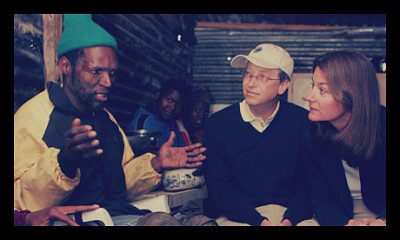
One of the most inventive programs created by the Bill and Melinda Gates Foundation is the Grand Challenges Explorations initiative. GCE is a grant program that encourages bold concepts designed to improve the lives of the world’s poorest people. In March, the foundation called for anyone with inventive ideas to apply for Round 11 of the initiative; 58 projects across 18 countries were accepted for funding.

This year, the Gates Foundation will invest $8.1 million in innovative ideas that will address global health and development problems. Each project will receive $100,000 to conduct their studies and experiments. Chris Wilson, director of Global Health Discovery and Translational Sciences at the Gates Foundation, said in a statement, “The impressive concepts from around the world…are pushing the envelope when it comes to innovation to tackle ongoing challenges for the poor using approaches ranging from agricultural development to communications for social good.”

One category potential recipients could submit their ideas under was “Labor Saving Innovations for Women Smallholder Farms.” Grantees will be working to find holistic solutions to boost productivity on smallholder farms. Some projects accepted for funding include:

  • Mobilized Solar-Powered Grain Driers that would double the storage life of harvested crops to reduce spoilage
  • Electric Multi-Crop Threshers that would enable farmers to thresh their crops faster and save hours of manual labor
  • Drip Irrigation Tubes, made from recycled plastic shopping bags, to be used by smallholder farmers in developing countries

A second topic for submission was “Aid is Working. Tell the World.” Inventors working in this field will seek new approaches to communications that would motivate wealthy nations to support foreign aid investment. A few of the projects in this category include:

  • The BeHere-BeThere Project, which will use location-based network applications and local retailers to connect consumers with aid projects
  • Mobilizing the Unheard Voices of Aid Recipients- a campaign to collect 10,000 personal narratives of aid recipients in rural India to be shared through social media sites
  • The Hactivating Development Aid project, which will develop a crowdsourcing program that would target young people around the world to educate them about global development challenges and solutions

Finally, GCE will also be awarding additional funding to projects that have showed promise from previous GCE rounds. These are more inventive initiatives and include:

  • Vaginal contraceptive gel that would use nanoparticles to inhibit the mobility of sperm tails
  • Acoustical Newborn Diagnostic Tool, a software-based diagnostic tool which analyzes a newborn’s cry to detect serious medical conditions
  • Production of more potent vaccines with increased heat stability to reduce the need for refrigerated storage
  • Development of a blood protein test for preeclampsia in pregnant women

Since its inception in 2008, GCE has funded over 800 grants in 52 nations. Applications for the next round of Grand Challenges Explorations will open up in September.

– Allana Welch

Sources: Gates Foundation, Gates Foundation – Media 
Photo: The Guardian

July 18, 2013
https://borgenproject.org/wp-content/uploads/borgen-project-logo.svg 0 0 Borgen Project https://borgenproject.org/wp-content/uploads/borgen-project-logo.svg Borgen Project2013-07-18 09:52:402014-03-05 15:02:59Grand Challenges Explorations Initiatives
Activism, Advocacy, Nonprofit Organizations and NGOs, War and Violence

Center for Civilians in Conflict

Center_for_Civilians_in_conflict
The Center for Civilians in Conflict is a non-profit organization that advocates for civilians threatened by armed conflicts around the world. The organization was founded in 2003 by Marla Ruzicka, an American political activist and aid worker who was concerned about the wellbeing of civilians who were indirectly harmed by U.S. bombs in the War on Terror.

Originally titled the Campaign for Innocent Victims in Conflict (CIVIC), Ruzicka’s startup received funding from the U.S. government to conduct aid operations specifically targeting hurting civilians in Iraq and Afghanistan. Ruzicka’s life tragically came to an end in April 2005 when she was killed by the blast from a suicide bomb in Baghdad. Since Ruzicka’s death, the Center for Civilians in Conflict (the new name of the organization as of 2012) has broadened its horizons to countries outside of Afghanistan and Iraq to further the legacy of an extraordinary humanitarian.

Today, the Center for Civilians in Conflict operates in Mali, Libya, Pakistan, Syria, and Somalia, in addition to Iraq and Afghanistan. The main areas of the Center’s work are these parts of the world that can be characterized as “conflict zones.”  Civilians who are threatened by a conflict are interviewed by CCC volunteers and the grievances of these civilians are documented and brought to the attention of the warring parties or military groups involved.

In January 2013 the Center assembled a roundtable of experts to analyze the outcome of U.S. military involvement in the Syrian civil war. The specialists utilized data collected from interviews from CCC field missions in Syria, Lebanon, Turkey, and Jordan in 2012. The interviewers obtained information from a large number of sources including “leaders of the political and armed opposition, Syrian army defectors, UN agencies, local and international NGO staff, government and military officials, lawmakers, diplomats, doctors and nurses, journalists, civil society activists, and religious leaders.”

The panel concluded that a five-point plan of action must be instituted by the US military if they chose to become involved in Syria. This is only one example of the thorough way in which the Center for Civilians in Conflict contributes to the protection of innocent civilians in conflict zones.

According to the organization’s website, the Center for Civilians in Conflict identifies themselves as “advocates and advisers creating policies and practices to make warring parties more responsible to civilians before, during, and after combat operations.”  This expectation of “responsibility” on the part of the perpetrators is one of the hallmarks of CCC, making it an effective and singular champion for noncombatant victims of war.

– Josh Forget

Source: Foreign Affairs, Civilians in Conflict

July 18, 2013
https://borgenproject.org/wp-content/uploads/borgen-project-logo.svg 0 0 Borgen Project https://borgenproject.org/wp-content/uploads/borgen-project-logo.svg Borgen Project2013-07-18 08:40:352024-05-25 00:00:42Center for Civilians in Conflict
Activism, Nonprofit Organizations and NGOs

10 Facts About Operation USA

Operation USA
Operation USA is an international relief agency that focuses on working with grass-roots groups to help alleviate the effects of natural and man-made disasters worldwide. The Los Angeles-based group was a co-recipient of the 1997 Nobel Peace Prize for its work on the “International Campaign to Ban Landmines.”

These are ten important facts about it:

  1. Since it was founded in 1979, the Operation has delivered over $350 million for relief and development projects.
  2. Operation USA was the first Western aid agency to become active in Phnom Penh after Pol Pot’s Khmer Rouge regime lost power.
  3. Through its innovative use of 747 cargo jets, it revolutionized aid delivery to Ethiopia during the 1984 famine.
  4. Operation USA was the first American non-governmental organization licensed to work in Cambodia and Vietnam after the Vietnam War ended.
  5. In June 2013, Operation USA, through its partnership with Honeywell Hometown Solutions, opened the Honeywell Ibasho House in Ofunato, Japan. Ibasho roughly translates as “a place where one feels at home.” The house will serve as a gathering place for the local community devastated by the 2011 earthquake and tsunami.
  6. Operation USA is completely privately funded.
  7. In 2008, the Operation began working with L’Athletique d’Haiti, a Haitian NGO focused on after-school sports programs for children living in the slums of Part-au-Prince. After the 2010 earthquake, the program’s soccer fields were turned into make-shift camps, housing around 500 families. It continues to work with the evolving needs of the people of Port-au-Prince through food aid and expanded organized sport opportunities for children.
  8. During its 33 years, it has worked in 99 different countries.
  9. Through multiple partner organizations, Operations USA is supporting education, livelihood, and health programs in Sri Lanka as the country’s population tries to rebuild from its recent civil war.
  10. 10. Operation USA has a stated focus on education, believing it to be the most cost-effective aid. Accordingly, the group has education projects in China, New Orleans, Nicaragua, and Haiti.

Bonus Fact: Julie Andrews is a founding Board Member, and Rosario Dawson also currently serves on the Board of Directors.

– Lauren Brown

Sources: ICBL, Operation USA
Photo: Food For The Poor

July 16, 2013
https://borgenproject.org/wp-content/uploads/borgen-project-logo.svg 0 0 Borgen Project https://borgenproject.org/wp-content/uploads/borgen-project-logo.svg Borgen Project2013-07-16 05:29:472024-12-13 17:49:2810 Facts About Operation USA
Activism, Education, United Nations, Women and Female Empowerment

Malala Proves Education is Key to Empowerment

malala_opt-1
Malala Yousafzai is a young education rights campaigner from Pakistan. Malala will soon be celebrating her 16th birthday, a miracle after she was shot by extremists for her outspoken beliefs on education. Malala will celebrate her birthday by traveling to the United Nations where students from more than 80 countries will join her.

Malala and the other young activists will be assembled to call for global education for everyone in the world. She and the other young diplomats believe that education is a right for all – one of the Millennium Development Goals, and a vital component of the path to global citizenship. This belief is well founded in the fact that universal compulsory education represents a future that the world wants. Malala was the first person to sign on to a new worldwide petition calling for urgent action to ensure the right of every child to safely attend school. The petition serves as an initial step in focusing the UN agenda on education.

UN Secretary General Ban Ki-moon supports Malala’s mission to bring education to the world. He states that education is an essential step in a world without poverty, violence, discrimination, and disease. He also recognizes that in order to achieve these objectives, the global society needs to continue pushing forward. The secretary general recognizes that we, as a global society, have made progress on this issue, however, there is much more work to be done. Ban expresses that no child or woman should have to consider going to school as an act of bravery.

Ban states that too many girls around the world are subjected to extremist threats for trying to obtain an education. The benefits of educating women in developing countries have been proven time and time again. Ban explains that when women and girls are educated, a society develops at a more rapid pace than without their education. Additionally, education increases future earnings for women, allowing them to provide their families with additional resources, over time, lifting them out of poverty.

If education is key to empowerment as the path to economic stability and development, why is it so widely contested in many developing countries? The answer lies in fear. If we as a global community continue to fear education for all, we will fail to grow as a global economy. More steps must be taken to ensure each child has access to education.

-Caitlin Zusy
Source: Huffington Post, UN News Center
Photo: Stanford Bookhaven

July 15, 2013
https://borgenproject.org/wp-content/uploads/borgen-project-logo.svg 0 0 Borgen Project https://borgenproject.org/wp-content/uploads/borgen-project-logo.svg Borgen Project2013-07-15 15:21:182024-06-11 01:39:24Malala Proves Education is Key to Empowerment
Activism, Aid Effectiveness & Reform, Development, Health

Paul Farmer Fights for Human Right to Health

farmer_human_health
While many human rights activists address a wide spectrum of issues, Paul Farmer focuses his efforts on an often-overlooked human right – the right to health.

Farmer is a medical anthropologist at Harvard Medical School and the founding director of Partners in Health, an international organization that seeks to address the health problems of the poor. An enthusiastic human rights advocate, Farmer believes that human rights organizations have focused too much on political and civil rights, which cannot be enjoyed when people lack access to basic healthcare and nutrition.

Farmer says that his experience working as a doctor in countries like Haiti and Rwanda revealed to him that ill health is usually “a symptom of poverty and violence and inequality” that can only be remedied by “bringing…many others” into a movement to recognize basic human rights.

Farmer points out that many of his patients “can vote but…can’t get medical care or clean water,” highlighting the discrepancy between the constitutional rights of the world’s poor and the basic human right to health that they are regularly denied. So how, when millions of people die each year due to poverty-induced ill health, can the global community even begin to establish health as a fundamental and inalienable human right?

Farmer says that the key is to “go to people with power and try to get their help.” He acknowledges that Partners in Health and similar aid organizations cannot singlehandedly establish health as a globally-recognized human right, but ordinary people can make a difference in the lives of the world’s poor and sick simply by letting those in power know they care.

While the poverty and illness present in the world may appear overwhelming, Farmer stresses that we must not assume that those in power will not help. In order to change the world, though, we have to ask.

– Katie Bandera

Sources: NPR, NY Times, WHO
Photo: The Daily Beast

July 14, 2013
https://borgenproject.org/wp-content/uploads/borgen-project-logo.svg 0 0 Borgen Project https://borgenproject.org/wp-content/uploads/borgen-project-logo.svg Borgen Project2013-07-14 05:48:492024-12-13 17:49:27Paul Farmer Fights for Human Right to Health
Activism, Education, Food & Hunger, Food Security, Health, Sanitation, Water

Bruno Mars Sings for Poverty Relief

bruno mars sings for poverty relief
Bruno Mars isn’t just another handsome face singing catchy love songs. He — along with over 70 artists — is partnering with the Global Poverty Project to address poverty worldwide by using a fanbase to raise awareness and funds.

Global Citizen is a website managed by the Global Poverty Project that centralizes information about global poverty and opportunities to help. Its ultimate goal is to increase the number of citizens actively advocating for change. The site is comprised of actions related to education and advocacy campaigning, all of which address 13 key issues:

  • Food and Hunger
  • Primary Education
  • Gender Equality
  • Child Mortality
  • Maternal Health
  • Fighting Diseases
  • Water and Sanitation
  • Environmental Sustainability
  • Global Partnerships
  • Fighting Corruption
  • Effective Governance
  • Polio Eradication
  • Fair Trade

Participation in Global Citizen actions such as watching a video about extreme poverty, signing petitions, contacting representatives or volunteering time or money earn points for users, which can be redeemed for prizes.

14-time Grammy Award nominee Bruno Mars is one of over 70 artists who realize the importance of ending global poverty. As touring recording artists, they are exposed to areas of the world that suffer the effects of extreme poverty in outrageous percentages. Recognizing the power of their celebrity, they have stood up to support the movement. Mars joins a group of industry power-players like Jay-Z, Beyoncé, Bruce Springsteen, Pearl Jam, Kings of Leon, Kesha, Kanye West, John Mayer and more who have donated at least 2 tickets from each show scheduled in their current tour, resulting in over 20,000 tickets donated to Global Citizen. Once users reach enough points, they can enter a drawing for a chance to win concert tickets. Another option is simply redeeming a higher number of points for tickets, similar to the ‘Buy It Now’ feature on eBay.

Extreme poverty has been cut in half in the last 30 years, and the knowledge and resources necessary to end the crisis completely within a generation are available. It won’t happen overnight, but Global Citizen is breeding an army: an army with the power to end extreme poverty by making informed consumer decisions and advocating for change. Global Citizen and artists like Bruno Mars are helping people to see that every voice counts and every person is capable of changing lives around the world.

– Dana Johnson

Source: Global Citizen, New York Times
Photo: Smash Vault

July 10, 2013
https://borgenproject.org/wp-content/uploads/borgen-project-logo.svg 0 0 Borgen Project https://borgenproject.org/wp-content/uploads/borgen-project-logo.svg Borgen Project2013-07-10 07:00:312016-04-07 18:48:02Bruno Mars Sings for Poverty Relief
Activism, Global Poverty, Poverty Reduction, Technology

Google Blimps Bring Internet To Africa

Google Blimps
Some companies provide food to people in countries who need it, others may donate supplies to build homes or schools, and some may send doctors or medical supplies to help the sick. Google is taking a different approach, using their technology skills to bring the internet to Africa via blimps.

The company’s goal is to connect nearly 1 billion people across Africa and Asia to the internet with high-flying blimps and balloons. The Google blimps are beneficial because they can cover a wider area while remaining cost-efficient. Google has created an ecosystem of smartphones that are low-cost with low processing power, and the signals are carried by the balloons. Google also is asking the local government regulators for permission to use television airwaves for their project, because these waves are better at transferring signals through buildings and across large areas of land than traditional WiFi infrastructure.

Google isn’t the first to propose a plan that uses balloons and blimps. Afghanistan already uses blimp technology for surveillance purposes by scanning wide areas that wouldn’t be possible or as simple as other forms of ground technology. The U.S. military is also involved in cloud-type projects involving blimps, and the Army uses them for communication. Instead of using traditional satellites to communicate back and forth with troops on the ground, which is very expensive, they use Combat SkySat balloons.

Google has begun a trial launch of their blimps in South African schools to test how well the new technology performs.

– Katie Brockman

Source Forbes, Wired

June 17, 2013
https://borgenproject.org/wp-content/uploads/borgen-project-logo.svg 0 0 Borgen Project https://borgenproject.org/wp-content/uploads/borgen-project-logo.svg Borgen Project2013-06-17 04:00:252024-12-13 17:49:24Google Blimps Bring Internet To Africa
Activism, Foreign Aid, Poverty Eradication

Bush and Bono: Pals Fighting Poverty

Bush and Bono

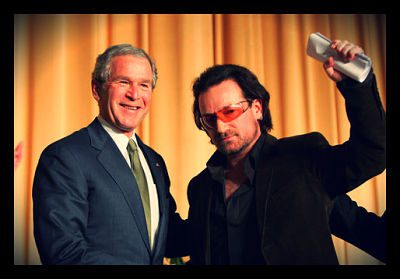
As stated in his 25 April 2013 press conference, George W. Bush may consider Bono “a pal,” but he is not the only one. George H.W. Bush presented the Liberty Medal to the U2 frontman at the National Constitution Center (2007) and Laura Bush joined a meeting with them to discuss AIDS (2005). They have had a decade long relationship revolving around their mutual passion for humanitarian work in Africa.

Bono started hounding politicians in 2002 when he started his non-profit Debt, AIDS, Trade, Africa (DATA). They had a meeting that year resulting in a 5 billion dollar aid package.  Bono also persuaded the former Secretary of the Treasury Paul O’Neill to take a 4-country tour of Africa. This marked an “historic shift in Washington’s stance on aid after years of cuts.”

However, mutual skepticism has marked the their relationship. Bono acknowledged that as he pushed the former president on aid issues, Bush pushed back.  Contentious issues included speed of delivery of the Millennium Challenge money and the Global Fund.

Their friendship, rooted in their shared concern for humanitarian work in Africa, kept Bono going back to Washington.  Twice in 2005 they met in the White House to discuss pro-poor aid. In 2006 Bush invited him to speak at the National Prayer Breakfast. Bono used the opportunity to talk about the ‘Jubilee’ year in respect to the Jubilee Drop in the Debt campaign. The next year former president George H.W. Bush presented the Liberty Medal to Bono. After over a decade of arguments, discussions and commitments to aid, it is not surprising Bush considers him “a pal.”

– Katherine Zobre

Sources: Bush on Bono: ‘We became pals’ , US and Europe boost aid to poorest countries , Bono and O’Neill in Africa , Bono Visits Bush at the White House , Bono Remarks at the National Prayer Breakfast
Photo: Bush and Bono 2006

May 3, 2013
https://borgenproject.org/wp-content/uploads/borgen-project-logo.svg 0 0 Borgen Project https://borgenproject.org/wp-content/uploads/borgen-project-logo.svg Borgen Project2013-05-03 09:00:342024-06-04 02:43:51Bush and Bono: Pals Fighting Poverty
Activism, Advocacy

World Vision’s 30 Hour Famine

30HourFamine09-1
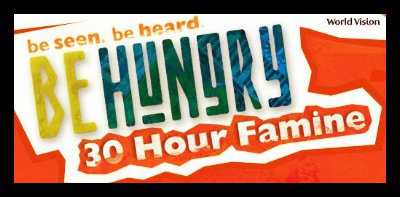
This April 26-27 is the 30 Hour Famine weekend, and thousands of teenagers across America will go hungry to support children across the world as part of World Vision’s fundraiser. World Vision is a leading Christian ministry serving people in nearly 100 countries, and the funds from the famine go to areas of the globe that need the money the most.

QUICK FACTS:

+ about 112,000 teenagers will choose to fast for 30 hours in the pursuit of learning about hunger and making a real-life difference in the lives of hungry children around the world.

+ Just over 3,000 Famine groups will participate.

+ Millions of dollars will be raised. Remember: $1 feeds a child for a day and $30 feeds a child for a month; compounded, $360 feeds a child for a year.

As a result of this weekend alone (not the whole year), approximately:

+ 11,667 otherwise hungry children will be fed for an entire year.

+ Or, 140,000 hungry children will be fed for a month.

Not only does the famine raise money for the poor across the globe, it teaches young adults about how those people live each and every day and raises awareness of global hunger and world poverty. By participating in the famine, teenagers learn how to advocate and make a difference in the lives of others.

– Katie Brockman

Source: World Vision

April 27, 2013
https://borgenproject.org/wp-content/uploads/borgen-project-logo.svg 0 0 Borgen Project https://borgenproject.org/wp-content/uploads/borgen-project-logo.svg Borgen Project2013-04-27 15:32:252020-05-26 07:40:32World Vision’s 30 Hour Famine
Page 55 of 56«‹53545556›

Get Smarter

  • Global Poverty 101
  • Global Poverty… The Good News
  • Global Poverty & U.S. Jobs
  • Global Poverty and National Security
  • Innovative Solutions to Poverty
  • Global Poverty & Aid FAQ’s
Search Search

Take Action

  • Call Congress
  • Email Congress
  • Donate
  • 30 Ways to Help
  • Volunteer Ops
  • Internships
  • Courses & Certificates
  • The Podcast
Borgen Project

“The Borgen Project is an incredible nonprofit organization that is addressing poverty and hunger and working towards ending them.”

-The Huffington Post

Inside The Borgen Project

  • Contact
  • About
  • Financials
  • President
  • Board of Directors
  • Board of Advisors

International Links

  • UK Email Parliament
  • UK Donate
  • Canada Email Parliament

Get Smarter

  • Global Poverty 101
  • Global Poverty… The Good News
  • Global Poverty & U.S. Jobs
  • Global Poverty and National Security
  • Innovative Solutions to Poverty
  • Global Poverty & Aid FAQ’s

Ways to Help

  • Call Congress
  • Email Congress
  • Donate
  • 30 Ways to Help
  • Volunteer Ops
  • Internships
  • Courses & Certificates
  • The Podcast
Scroll to top Scroll to top Scroll to top