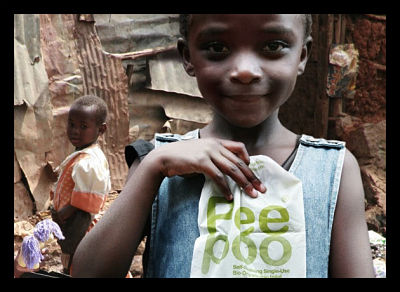
Sadly, 40% of the world’s population lack access to basic latrines.
The lack of sanitation is a major world public health issue. Water contaminated by sewage can propagate lethal epidemic diseases such as cholera which develops in fecal secretions. Today, 2.6 billion people lack access to basic sanitation facilities.
Without toilets, people must resort to relieving themselves in plastic bags, which they throw as far away from their home as they can; a phenomenon known as “flying toilets.” In some areas, flying toilets have become a a public health concern.
In slums especially the scarcity of toilets has become particularly worrisome. Dozens of people share the same toilet, and the poor maintenance and virtually nonexistent hygiene of these places makes people more than reluctant to go. Landlords are also not willing to build more facilities, preferring instead to build more houses and rooms that they can rent to earn an income.
Women and children are the most vulnerable to the lack of hygiene. According to Peepoople, “one child dies every 15 seconds due to contaminated water from human excreta.” Just as bad, the lack of privacy makes women prey to rape and sexual harassment, especially at night when they have to look for sanitation facilities. When adolescent girls have their period, they have to stay home from school because they cannot take care of their hygiene.
Peepoople, an organization aimed at providing millions of people with sanitation facilities in the respect of their dignity, has implemented an innovative solution to curb one of the world’s most serious problems. It has created the PeePoo.
The PeePoo is a bag that “contains five grams of urea, which breaks down waste into ammonia and carbonate,” thereby transforming potentially harmful waste into harmless fertilizer. Biodegradable and designed for the world’s poorest, PeePoo bags only cost $0.03 each.
In the Nairobi slums where Peepoople operates, an incredible micro-economy has emerged after the introduction of the PeePoo bags. For instance, the bags can be used as garden fertilizer, thereby fostering local agriculture and plantation, but they can also be returned to a collection point for a reimbursement of $0.01 per bag.
Seizing the opportunity, some have even made a living off the reimbursement fee. For instance, Mama Lucy, mother of three, told Al Jazeera, “I didn’t have a regular job before the Peepoos were introduced, but I saw an opportunity when people did not want to drop off the bags themselves. Now I do two rounds a day to pick Peepoos from people’s houses. On a good week I earn about a thousand shillings ($11).” Since the introduction of the PeePoo, the number of sexual crimes has also decreased in the Silanga village, according to Mika Mitoko, project manager at Peepoople.
Involving no investment or infrastructure, the PeePoo has proved that easy and cheap solutions can save millions of lives. To learn more about Peepoople, visit their website at: https://www.peepoople.com
– Lauren Yeh
Sources: Peepoople, Al Jazeera

“Nutrition for Growth” and Hunger Alleviation
With last month’s G8 Summit, and the ‘Nutrition for Growth’ summit hosted in London before that, a lot of the focus has been on large amounts of international aid earmarked to combat global hunger and malnutrition.
Small-scale, localized projects play just as large a role as international aid efforts, and possibly more beneficial. The original Green Revolution increased crop yields dramatically, but at no small environmental cost. If this large-scale intervention played its role, multiple small-scale projects could produce the same results.
One such project fighting food insecurity is the Soil, Food, and Healthy Communities (SFHC) program in Malawi. This program began ten years ago with efforts to educate local farmers and diversify their crops. The original aim of the project was to improve the health, food security, and soil fertility of poor households in Northern Malawi. This goal was additionally tied into participatory research, testing legume systems and looking at more sustainable approaches to achieving greater food security.
By introducing a variety of different legume options, as well as agricultural techniques, the quality and quantity of food can both be increased, as well as improving soil quality through organic input. This Ecohealth approach, focusing on the health of the entire system and humans’ interaction with it, can be simultaneously beneficial to the communities’ short-term needs, as well as allowing for longer-term sustainability.
Ten years on from the initiation of the project there have been many encouraging signs of success. The introduction of semi-perennial rotation systems, and the diversification of crops, led in some cases to annual return yields double that of the previous system. In addition to these straightforward agricultural benefits, a further goal of SFHC was to educate the local populace regarding nutrition.
The introduction of diverse legumes into the crop rotation system improves soil quality and yield, and also diversifies the local diet. This additional food production can then directly influence the health of the children of the community. As a result of this project, child malnutrition has been reduced by two-thirds over the past ten years in a hospital catchment area serving about 70,000 people and covering 600-square kilometers. This is largely due to farmers now producing soybeans, groundnuts, and other legumes, and incorporating them into the local diet.
– David Wilson
Sources: The Guardian, Winnipeg Free Press
Importance of Small-Scale Farmers
With a rising population and a high demand on food production, our world is looking for solutions to increase food production. Small-scale farmers play an important role in the dilemma of feeding our world. Currently small-scale farmers produce the majority of food for the developing world.
There are millions of success stories about these farmers reaching out and sustaining whole communities. For example, in Brazil there is a food security policy known as Zero Hunger. In this program the government buys products directly from small-scale farmers and distributes the products to day-care centers, hospitals and community associations.
However, the UN and FAO in a report, Smallholder Integration in Changing Food Markets, highlight the challenges still ahead for small-scale farmers. The report calls attention to the importance of policymakers in the growth of small-scale farmers. The report focuses on the fact that most of these farmers are removed from the market. It calls for policymakers to create greater market integration and more inclusive value chains. The report concludes that by doing these things, these farmers will be more inclined to adopt new technologies to grow productivity.
The report stresses the two main ways to link small-scale farmers to the market are to provide better access to credit and insurance, and to strengthen the links between farmers and buyers. The report discusses the fact that, in many countries, transportation is too costly, infrastructure is inadequate, and the cost of storage is too high. These farmers are unlikely to risk producing a surplus of products if they think that their products would go to waste.
“High levels of price, production risks and uncertainty, and limited access to tools to manage them deter investment in more productive new technologies that would enable smallholders to produce surpluses for sale in markets,” according to the report.
Policymakers must focus on the inclusion of small-scale farmers into the market. They are important to the future of our world and must be supported.
– Catherine Ulrich
Sources: FAO, International Institute for Environment and Development, UN News
Corporate Philanthropy at the Highest Level with Good360
For most people, shopping at a giant retail chain now comes with a high level of expectation. People want their favorite products on the shelves now, in adequate quantities. Rarely does one ever stop to ponder just how the most successful retail and grocery chains move such a large amount of varied product so quickly. The logistical processes involved are so fine-tuned and fast that the systems themselves bear admiration. What if those logistical success strategies worked elsewhere?
Nonprofit organizations the world over sometimes struggle getting provisions to those who need it most for a myriad of reasons; not enough donations, not enough people, slow legal channels. The list could presumably stretch on with no end. One nonprofit group has already solved the problem by employing much the same techniques retailers use to rocket products from the warehouses to the store shelves, and they’re doing it with the help and cooperation of private enterprise.
Good360, formerly Gifts In Kind, began in 1983 by accepting a donation of office supplies worth over $11 million from the company 3M and has never looked back. The nonprofit accepts corporate donations like this from a multitude of businesses who need to clean up their balance sheets by unloading unsold assets and backed up inventory. Transferring such donations to Good360, those companies also build a reputation for corporate philanthropy. Good360 then distributes these goods to a network of charities and other nonprofit groups from their own warehouses. Donations get to where they are most needed even faster. The added bonus is also a boon to the environment because the practice doesn’t involve landfills whatsoever.
Continually highly ranked by Forbes as an efficient charity, Good360 works with many top corporations. Most recently, as of October 2012, they were ranked 29 out of 100 charities by the publication. Good360 depends on $306 million in private support, while generating $311 million in total revenue, giving 99 percent of that to charity. They’re totally dependent on their donors and are 100 percent effective in fundraising.
According to Good360’s website, the firm works only on 1.8 percent of the total value of products donated, which is astounding considering that they’re able to expedite it to charities almost as fast as new products are delivered to stores. The process is so environmentally conscious and efficient that employees from larger, for-profit firms are allowed to learn from Good360.
In the last 14 years they’ve grown exponentially, forging corporate working relationships with well over 40 percent of Fortune 500 companies. They’ve gone to great lengths to increase corporate philanthropy and facilitate international seminars on it. Since 2009, Good360 has taken another technological step forward by joining forces with the American Trucking Association so that trucking organizations can donate transportation to aid shipping in the name of charity. Strategically, the move is brilliant because it strengthens an already strong, logistical network and has forged new working relationships.
In July 2013, Good360 named Chris Blake their new Executive Vice President (EVP). He was the former President of K.I.D.S., Kids in Distressed Situations, another nonprofit. He brings a career of expertise of successful fundraising in the nonprofit sector that meshes perfectly with Good360. Blake was elemental in fostering working relationships between community groups and major companies for K.I.D.S. This new hire increases not only business and operational knowledge but leadership capacity as well.
Good360 has done nothing but grow and improve since its inception. The innovative strides it has made are undeniable. Nothing less than success can be expected of their organization when faced with high demand for products globally. Good360 is a great example of what can be achieved using strong logistics for giving rather than buying and supports economic prosperity for all involved.
– David Smith
Sources: Good360, Forbes Top 100 Charities, Chris Blake Joins Good360
Photo: Photopin
Plan International USA
Plan International USA is a nonprofit organization that got started in 1937 by caring for refugee children of the Spanish Civil War. The organization posits that education is a fundamental right, and they direct their energies toward improving access to a quality education and the proper management and governance of education. Donations go toward schools, furniture, supplies, and the proper training of teachers and parent-teacher associations.
Improving access to education for all is a challenging task, especially in those cultures where one group or gender is held in a higher esteem than another. Some societies are very patriarchal and don’t allow for girls and women to receive the education that males do. Plan International U.S.A. has a very visible link on their website to their campaign “Because I Am A Girl”. One story on this webpage deals with the much publicized international case involving Malala, a young girl who pursued her schooling and was attacked by the Taliban for doing so. ”Because I Am A Girl” highlights Malala Day on July 12 as an occasion to demand that all children, especially girls, get the education they deserve. Malala has become a symbol of oppressed children everywhere who are denied their right to an education.
How important is the education of girls to ending global poverty? Plan International U.S.A. reports that 70% of those 1 billion people living in extreme poverty are female. Schooling raises the standard of living of women and gives girls in the developing world the capacity to fight back against injustice. Denying girls this right is costing the developing world $92 billion in potential income.
Plan International U.S.A. is a dedicated organization that champions what is arguably the cure-all for global poverty, education. With projects aimed at getting girls in the classroom and stories of brave children like Malala, the movement is gaining ground. To make a direct donation to helping women and children, please “Protect A Girl” and visit www.planusa.org.
– David Smith
Sources: Plan International U.S.A, Malala Day, Plan U.S.A.
Photo:
Paul Farmer Fights for Human Right to Health
While many human rights activists address a wide spectrum of issues, Paul Farmer focuses his efforts on an often-overlooked human right – the right to health.
Farmer is a medical anthropologist at Harvard Medical School and the founding director of Partners in Health, an international organization that seeks to address the health problems of the poor. An enthusiastic human rights advocate, Farmer believes that human rights organizations have focused too much on political and civil rights, which cannot be enjoyed when people lack access to basic healthcare and nutrition.
Farmer says that his experience working as a doctor in countries like Haiti and Rwanda revealed to him that ill health is usually “a symptom of poverty and violence and inequality” that can only be remedied by “bringing…many others” into a movement to recognize basic human rights.
Farmer points out that many of his patients “can vote but…can’t get medical care or clean water,” highlighting the discrepancy between the constitutional rights of the world’s poor and the basic human right to health that they are regularly denied. So how, when millions of people die each year due to poverty-induced ill health, can the global community even begin to establish health as a fundamental and inalienable human right?
Farmer says that the key is to “go to people with power and try to get their help.” He acknowledges that Partners in Health and similar aid organizations cannot singlehandedly establish health as a globally-recognized human right, but ordinary people can make a difference in the lives of the world’s poor and sick simply by letting those in power know they care.
While the poverty and illness present in the world may appear overwhelming, Farmer stresses that we must not assume that those in power will not help. In order to change the world, though, we have to ask.
– Katie Bandera
Sources: NPR, NY Times, WHO
Photo: The Daily Beast
Zambia: Poverty and Promising Signs
Known for its stunning natural beauty and variety of wildlife, the country of Zambia draws thousands of global travelers seeking adventure and awe-inspiring views in its world-renowned state parks, along the mighty Zambezi River, and at the famous Victoria Falls, a UNESCO world heritage site. More than half of the country’s 752,000 square kilometers is arable land, and the country is rich in natural resources, especially copper, one of its major exports. Compared to many of its neighboring countries, Zambia has also been somewhat stable politically. Zambia made relatively peaceful transition from British colonial rule in 1964, and the country has been spared the kind of serious civil war that countries like the Democratic Republic of Congo have faced in recent years.
Zambia’s natural beauty and great agricultural capacity are a stark contrast to the economic problems facing the country today, however. According to World Bank figures, an estimated 60% of the country’s 13.8 million people live below the poverty line, with most of those in Zambia’s many rural areas. Life expectancy for the average Zambian is 49 years, in part because of the HIV/AIDS pandemic, which has ravaged the population. Just over 12% of Zambians ages 15-49 are infected with the virus, and UN figures show that about 1 million people were living with the disease in 2011. One-third of the population is without access to clean water, and more than 25% of the country’s schools do not have access to clean water and proper sanitation. The country is reportedly on track to meet Millennium Development Goal #2, but enrollment in primary schools is just under 72%.
Efforts to combat widespread poverty and its attendant health and social effects in Zambia have been comprehensive, involving a coalition of private and public, national and international organizations. Through USAID, the United States recently launched two new health programs aimed at addressing poverty and HIV/AIDS by empowering small farmers with new tools to make their farms viable and profitable. The programs have drawn praise from the Zambian government. Zambia is also making progress toward its Millennium Development Goals, reducing child mortality from 191 per 1,000 births in 1992, to 119 per 1,000 in 2007. Extreme poverty in the country declined from 58% to 51% over the same period, and in 2002 the country eliminated school fees for basic education, taking an important step toward universal primary education. These indicators are promising signs that progress is indeed being made toward relieving the misery of poverty and disease in Zambia. They also suggest, however, that there is much more work to be done.
– Délice Williams
Source: Lonely Planet, UNAIDs, UNICEF, World Bank
Photo: Presentation Primary Terenure
Poverty in Chad
Poverty in Chad? Surprisingly for an oil-producing nation, Chad is one of the poorest countries in the world. After gaining its independence from France, Chad struggled to find its footing. Mismanagement, corruption, conflict and a harsh climate did the country no favors, and Chad has consistently remained one of the poorest countries in Africa.
Over half of Chad’s population lives in poverty; this is partly a result of the harsh geographical conditions. The majority of Chad is covered by desert and for a developing country that depends largely on subsistence farming, this presents a significant challenge. The most successful practice is migratory farming, where herds can move and adapt to changing climate conditions, but even these are severely limited by resources. As well, droughts in the 1970s and 80s aggravated already sub-optimal conditions. Recently, changes in climate have brought lower rainfalls and consistent overuse has led to soil erosion and land degradation. Farmers lack infrastructure, support and resources needed to grow sufficient food.
Geographic isolation, a lack of cultural cohesion and lack of education are all contributors to the problem. Spread out among a huge amount of land, Chad’s citizens are separated by large swaths of land, making it difficult to distribute necessary resources. Most people do not speak either of the country’s official languages (Arabic and French) and 90% of the country is illiterate.
Gender discrimination is also rife in Chad, though women are an essential part of a family’s survival. They are given work outside the home as well as the responsibility of raising a family, tending farms, gathering water, raising children and cooking. Yet they are culturally limited from access to education or training, and marginalized by society. These women are especially vulnerable to the psychological as well as physical effects of poverty.
Chad’s reality is brutal; a large percentage of the population is undernourished and lacks access to education, as well as high levels of food insecurity and infant mortality. Chad is not set to meet the MDGs as a result of poor management and weak planning and implementation.
Chad’s story is not a pretty one, but an important one. It is a reminder of the harsh reality that is daily life in Sub-Saharan Africa, and the amount of work that remains to be done in the region.
– Farahnaz Mohammed
Source: Rural Poverty Portal, World Bank
Photo: Charity in Chad
From Flying Toilets to Peepoo
Sadly, 40% of the world’s population lack access to basic latrines.
The lack of sanitation is a major world public health issue. Water contaminated by sewage can propagate lethal epidemic diseases such as cholera which develops in fecal secretions. Today, 2.6 billion people lack access to basic sanitation facilities.
Without toilets, people must resort to relieving themselves in plastic bags, which they throw as far away from their home as they can; a phenomenon known as “flying toilets.” In some areas, flying toilets have become a a public health concern.
In slums especially the scarcity of toilets has become particularly worrisome. Dozens of people share the same toilet, and the poor maintenance and virtually nonexistent hygiene of these places makes people more than reluctant to go. Landlords are also not willing to build more facilities, preferring instead to build more houses and rooms that they can rent to earn an income.
Women and children are the most vulnerable to the lack of hygiene. According to Peepoople, “one child dies every 15 seconds due to contaminated water from human excreta.” Just as bad, the lack of privacy makes women prey to rape and sexual harassment, especially at night when they have to look for sanitation facilities. When adolescent girls have their period, they have to stay home from school because they cannot take care of their hygiene.
Peepoople, an organization aimed at providing millions of people with sanitation facilities in the respect of their dignity, has implemented an innovative solution to curb one of the world’s most serious problems. It has created the PeePoo.
The PeePoo is a bag that “contains five grams of urea, which breaks down waste into ammonia and carbonate,” thereby transforming potentially harmful waste into harmless fertilizer. Biodegradable and designed for the world’s poorest, PeePoo bags only cost $0.03 each.
In the Nairobi slums where Peepoople operates, an incredible micro-economy has emerged after the introduction of the PeePoo bags. For instance, the bags can be used as garden fertilizer, thereby fostering local agriculture and plantation, but they can also be returned to a collection point for a reimbursement of $0.01 per bag.
Seizing the opportunity, some have even made a living off the reimbursement fee. For instance, Mama Lucy, mother of three, told Al Jazeera, “I didn’t have a regular job before the Peepoos were introduced, but I saw an opportunity when people did not want to drop off the bags themselves. Now I do two rounds a day to pick Peepoos from people’s houses. On a good week I earn about a thousand shillings ($11).” Since the introduction of the PeePoo, the number of sexual crimes has also decreased in the Silanga village, according to Mika Mitoko, project manager at Peepoople.
Involving no investment or infrastructure, the PeePoo has proved that easy and cheap solutions can save millions of lives. To learn more about Peepoople, visit their website at: https://www.peepoople.com
– Lauren Yeh
Sources: Peepoople, Al Jazeera
Oil, Inequality, and Youth: Poverty in Gabon
Gabon, the oil rich Central African country, continues to struggle with widespread poverty. Dependent largely on oil and natural resources including timber and manganese, Gabon’s economy struggles to attain sustainable methods of growth.
With 50% of the GDP reliant on oil sales, the necessity for economic diversity stems from the post-peak levels of oil drilling and the sharp depletion of oil production within the country.
Despite an above average GDP/capita of $17,300 and a status as an upper middle income economy, Gabon continues to face large income inequality. According to the African Development Bank (AFDB), one third of the population lives below the poverty line, with 13.2% living in severe poverty. This conflicts greatly with the label of upper middle income status.
To pinpoint poverty in Gabon, the Multidimensional Poverty Index (MPI) allows us to understand and compare a country’s poverty levels with 3 dimensions: education, health, and standard of living. Conducted by the Oxford Poverty and Human Development Initiative (OPHI), the MPI shows us that 35.4% of the population live in poverty with limited education, nutrition, and a low standard of living.
The universally understood poverty measurements of US $1.25/day, US $2/day, and the National Poverty Line provide a more in depth view of the varying levels of poverty. OPHI found that 4.8% live on less than $1.25/day, 19.6% live on less than $2/day, and 32.7% live below the National Poverty Line.
To further understand the large percent of impoverished Gabonese we must look into the wealth disparity and unemployment. The biggest drawback of an undiversified economy dependent on commodities is limited jobs within the sector. With such a high percent of GDP due to oil drilling, few Gabonese benefit from the sector. This lack of employment in an undiversified economy manifests itself in an unemployment rate of 21%.
Along with unemployment, two other issues factor into Gabon’s development: the large proportion of youth in the country and high urbanization. The AFDB found that 35.6% of the population is under 15, with 60% of that demographic unemployed. They also learned that nearly 86% of the population resides in urban areas, meaning that more than one third of the population lives in the capital city of Libreville.
In spite of these shortcomings, President Bongo Ondimba has begun work on increasing transparency and Gabon’s attractiveness to investors. In April 2010, the country began its attempts to improve the diversity of the economy. To accomplish this the government started to develop the “energy, mining, forest, tourism and agro-industrial potential.” Not forgetting the financial plight of its poorest citizens, the government has also raised the minimum monthly wage and created “solidarity allowance” to benefit very low-income workers.
– Michael Carney
Sources: African Development Bank, CIA World Factbook
Photo: Africa Review
Why Mental Healthcare Is Important to Development
Mental healthcare is important to development. Last month, the World Health Organization adopted the Comprehensive Mental Health Action Plan of 2013-2020 to emphasize the importance of global mental health and to establish goals pertaining to mental healthcare. The Action Plan is the first ever to make mental health its primary concern.
The main objectives of the Action Plan are to “implement strategies for promotion and prevention in mental health”, provide necessary mental health care when needed, and to strengthen research for mental health.
The Action Plan was created due to the fact that much of global health care overlooks mental health problems as a serious concern. The World Health Organization states that “people with mental and psychological disabilities are a vulnerable group as a result of the way they are treated by society”.
Those with mental disabilities are more likely to face physical and sexual victimization, and often times have trouble with school performance and finding employment, leading to a higher risk of living in poverty. On a larger scale, a lack of adequate mental health care for those in need can lead to “reduced social capital” and “hindered economic development”.
In order to reduce the risk of those with mental disabilities living in poverty, the World Health Organization seeks to incorporate adequate mental health support into schools in addition to making opportunities for employment available to those with mental disabilities. While many development efforts focus on ensuring that physical needs are met, the importance of mental health must not be overlooked. When adequate mental health care is available to those in need, the individuals affected, their families, and their communities experience improved development outcomes.
– Jordan Kline
Sources: WHO, Forbes