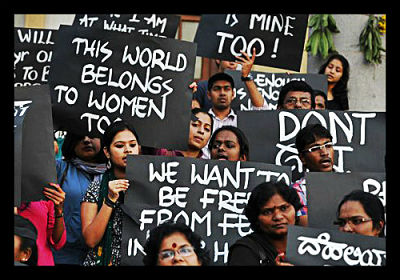
India has two faces. The first is the one we can see in Bollywood movies: beautiful actresses, extravagant costumes and dances, romantic scenarios, love. The second is closer to reality. Women forced into marriage because their parents cannot support them, waves of femicides, sexual harassment – a few examples on a long list. So, between the romanticized image of women and that of women as victims of society, what is it really like to be a woman in India?
Among the G20 nations, a 2012 poll by the Thomson Reuters Foundation ranked India as the worst place to live for women. Why? In a highly religious and strictly stratified society, women have the lowest status, without a doubt.
In traditional Indian society, women are perceived as inferior to men. Mere housewives, they are expected to stay at home, bear children, and take care of household chores. Most women, even nowadays, are forced into marrying a husband that their family chooses. Furthermore, although female literacy rates have increased, only 65.46 percent of women could read and write in 2011 as compared to 82.14 percent of men. This 16.68 percentage-point gap can be attributed to the traditional view that women do not need to go to school.
This patriarchal mindset is still deeply embedded in Indian mentalities. Even before their birth, women are the victims of discrimination due to the hefty dowry the girl’s family must give the husband’s family upon her marriage. Because women cannot inherit from their families, parents have a strong sex-selection bias towards boys to ensure the survival of their descendant line, triggering waves of femicides. Indeed, femicide has been a great plague in India. Research conducted by economists Siwan Anderson and Debraj Ray found that nearly 2 million women are missing in a given year, due to female foeticide and girl killings.
Despite this appalling observation, femicide was only officially recognized as gender-related killing on March 15 of 2013, during the 57th session of the Commission on the Status of Women (CSW). For the first time, governments are urged “to implement or strengthen national legislation in order to punish such killings of women, and girls” according to the United Nations Entity for Gender Equality and the Empowerment of Women (UN Women). For the first time, femicide is seen as a crime in itself, and governments ought to “end impunity by ensuring accountability and the punishment of perpetrators of such crimes and reparation for the victims”.
The CSW resolution arrives in a time of social turmoil after the gang rape and subsequent death of a 23 year-old medical student on a New Delhi bus. The wave of rape protests that occurred in New Delhi after this incident spread across Asia, with demonstrations in Nepal, Sri Lanka, Pakistan and Bangladesh. But these protests did not end sexual harassment in India: in April 2013, a 5 year-old girl in New Delhi was raped and tortured for 40 hours before dying.
But it is really the recent scandal involving an American tourist gang-raped by three men in Northern India that drew more widespread international attention to the issue. In the face of these deplorable incidents, women across India and beyond have been mobilizing for their cause, and the heightened international awareness offers hope that Indian women can look forward to a better future.
– Lauren Yeh
Source: BBC, UN Women, Reuters, Guardian
Photo: JNM Journal

What it’s Really Like to be a Woman in India
India has two faces. The first is the one we can see in Bollywood movies: beautiful actresses, extravagant costumes and dances, romantic scenarios, love. The second is closer to reality. Women forced into marriage because their parents cannot support them, waves of femicides, sexual harassment – a few examples on a long list. So, between the romanticized image of women and that of women as victims of society, what is it really like to be a woman in India?
Among the G20 nations, a 2012 poll by the Thomson Reuters Foundation ranked India as the worst place to live for women. Why? In a highly religious and strictly stratified society, women have the lowest status, without a doubt.
In traditional Indian society, women are perceived as inferior to men. Mere housewives, they are expected to stay at home, bear children, and take care of household chores. Most women, even nowadays, are forced into marrying a husband that their family chooses. Furthermore, although female literacy rates have increased, only 65.46 percent of women could read and write in 2011 as compared to 82.14 percent of men. This 16.68 percentage-point gap can be attributed to the traditional view that women do not need to go to school.
This patriarchal mindset is still deeply embedded in Indian mentalities. Even before their birth, women are the victims of discrimination due to the hefty dowry the girl’s family must give the husband’s family upon her marriage. Because women cannot inherit from their families, parents have a strong sex-selection bias towards boys to ensure the survival of their descendant line, triggering waves of femicides. Indeed, femicide has been a great plague in India. Research conducted by economists Siwan Anderson and Debraj Ray found that nearly 2 million women are missing in a given year, due to female foeticide and girl killings.
Despite this appalling observation, femicide was only officially recognized as gender-related killing on March 15 of 2013, during the 57th session of the Commission on the Status of Women (CSW). For the first time, governments are urged “to implement or strengthen national legislation in order to punish such killings of women, and girls” according to the United Nations Entity for Gender Equality and the Empowerment of Women (UN Women). For the first time, femicide is seen as a crime in itself, and governments ought to “end impunity by ensuring accountability and the punishment of perpetrators of such crimes and reparation for the victims”.
The CSW resolution arrives in a time of social turmoil after the gang rape and subsequent death of a 23 year-old medical student on a New Delhi bus. The wave of rape protests that occurred in New Delhi after this incident spread across Asia, with demonstrations in Nepal, Sri Lanka, Pakistan and Bangladesh. But these protests did not end sexual harassment in India: in April 2013, a 5 year-old girl in New Delhi was raped and tortured for 40 hours before dying.
But it is really the recent scandal involving an American tourist gang-raped by three men in Northern India that drew more widespread international attention to the issue. In the face of these deplorable incidents, women across India and beyond have been mobilizing for their cause, and the heightened international awareness offers hope that Indian women can look forward to a better future.
– Lauren Yeh
Source: BBC, UN Women, Reuters, Guardian
Photo: JNM Journal
Boosting African Economies
In their joint op-ed for the Washington Times, former Congressional representatives Howard Berman and Connie Morella refer to US development efforts, saying, “We’re not just talking altruism. We’re talking sound, smart business.”
Berman, a Democrat, and Morella, a Republican, collaborated the op-ed entitled “A Smart Investment in Africa”, which was published Monday, July 1 in the Washington Times. Their overall message: help the developing world.
The article pointed out how in this globalized age, our security and economy have never been more closely tied with that of the African continent. Over half of US exports go to the developing world. This fact, combined with the vast population of the developing world, makes these countries the biggest potential for growth of American businesses and innovations. Investments in the continent of Africa advance economic and governmental reforms, which give American businesses a better foundation with which to expand into the continent.
The former Congressmen also pointed out that, while Americans are often given an image of Africa as a continent fraught with conflict and despair, African economies are growing at an astounding rate, like much of the developing world. Seven of the most rapidly expanding economies in the world are in Africa. As these economies expand and Africans are lifted out of poverty, American businesses will be able to market their products to the vast amounts of new wealthier consumers.
The article also highlighted how important US investment in Africa is for America’s security interests. Extremist groups, such as Al-Qaeda and its affiliates, are looking for ways to take root in Africa, and countries without the economic capacity to build strong infrastructure or security forces are the most vulnerable to these forces. Investing in African economies gives countries the resources and stability to resist extremist influence.
The security benefits of bolstering African economies are exemplified clearly in The World Bank report entitled “Breaking the Conflict Trap” which argues that an unequal distribution of wealth exacerbates societal tensions and “increases the perception of relative deprivation.” Therefore, reduction of poverty in African countries will reduce conflict in these areas which are critical to US security interests.
The former Representatives pointed out in their op-ed on Monday just how important US aid to Africa is, not just for humanitarian reasons, but for the future of US economic and security interests.
– Martin Drake
Source: Washington Times, World Bank
Zimbabwe Election 2013: A Repeat of 2008?
In recent years, aid to Zimbabwe from the United States has made important strides towards improving life for the people. USAID has supported anti-retroviral treatment, improved access to healthcare, and has even reduced the spread of HIV/AIDs to under 15%. Most recently we have been attempting to transform the country into a democratic nation in order to support growth and success. The people are trying to assist with this change, but the government may be getting in their way.
On June 18th, the Senate Foreign Affairs Committee gathered for a hearing regarding the upcoming elections in Zimbabwe. The 2008 elections were a disaster, flanked with repression and violence across the African country. As a result of that and of U.S intervention and aid, Zimbabwe’s president, Mugabe, signed a new constitution into law that divides the power between him and Prime Minister Tsvangirai and brings about a 2 term, of 5 years each, maximum for each elected president.
The good news is that this means the Zimbabwean people will finally have the chance to shape the government according to their needs, gaining health care and education reforms. The bad news is that the current government may not be so ready to hand over the reigns to the people.
Part of the agreement the U.S reached with Zimbabwe was that the elections had to be held by the end of July. And, while the elections could seriously improve the relationship between our country and theirs, rushing into things could damage any chances Zimbabwe has of actually making progress. Therefore SADC has requested that we give them more time to make sure everything is ready and the elections will be fair.
Acting Assistant Secretary of the Foreign Affairs Committee, Donald Yamamoto, brought forth his arguments before the other panel members. He cited the recent illegal arrests, detentions, and instances of harassment as evidence that efforts are already underway to intimidate voters and sway the election. “Zimbabwe must decide whether it will support a credible electoral process or continue to repress its people and isolate itself from the international community”. This decision does not just decide whether the people stay repressed in poverty, but also whether Zimbabwe becomes involved in trading and business with the rest of the world, including the U.S.
There has also been concern that without enough time, it will be less likely that all the new voters will be registered, inspection of voters’ rolls will take place, and that other needed electoral and democratic reforms will be adhered to. This would make the credibility of the election outcome very questionable and set back the governmental improvements another 5 years.
However, important changes are already underway. For the first time ever, the youth of Zimbabwe are getting together to debate politics and learn about the issues that affect them. If given the chance they could make a noticeable difference in the way things are done and how their country works with the rest of the world.
– Chelsea Evans
Source: Donald Yamamoto, Earl Gast, Dr. Todd J Moss, Reuters
Photo: Zimbabwe Election Watch
Righting the Wrongs of Malnutrition
Think of one child. This child could be your brother, sister, son, or daughter. This person is someone you love and care for dearly. Now imagine watching this child go through the stages of acute malnutrition. As lack of food and nutrients wear on their body, their metabolism begins to slow. Their body slowly eats away at their muscle tissue and their kidneys begin to fail. The suffering of this loved one is something you can’t stop, as there is no food to give them. Their body is just shutting down.
This may sound like a foreign scenario to those able to provide daily meals to their loved ones, but 55 million children in the world today suffer from these serious consequences of malnutrition. These children are susceptible to disease, mental and physical impairments, and possibly death.
For 30 years, Action Against Hunger/ACF International has fought to help these children. An international non-profit organization, ACF has 4,600 health professionals in over 40 countries working to provide nourishment, clean drinking water, and sustainable living conditions to those suffering from malnutrition.
ACF International works to provide both an immediate and long-term impact. Children suffering from malnutrition need assistance now; however, ACF strives to not only get these children healthy but to keep them healthy for good. Accordingly, ACF accepts donations and sends supplies to affected areas, while working to create a long-term presence in international communities through programs and leadership.
The support for this cause remains strong. Sponsor partners, such as Weight Watchers, Pentair, and North American Power, offer unique and relevant ways in which they contribute to eradicating malnutrition. For example, Weight Watchers and Pentair have dedicated over two million dollars each to the cause, while North American Power donates a dollar for every electric bill paid.
With help from these partners and others, Action Against Hunger/ACF International continues to change the world. In 2012, 157,000 children were saved from deadly hunger. Additionally, 550,000 farmers were equipped with the tools necessary to provide their communities with food and economic growth. Progress is being made, but too many children remain hungry.
For more information on how you can become involved with Action Against Hunger and ACF International, visit www.actionagainsthunger.org. Put yourself in their shoes. Make a difference.
– William Norris
Sources: Action against Hunger, World Food Programme
Photo: African Starving Children
Top 5 Countries to Visit in Africa
Though African countries may not be the most traditional tourist destinations for the average Westerner, the World Economic Forum’s Travel and Tourism Competitiveness Report 2013 ranked five African countries in the world’s top twenty-five most welcoming places to travel. This report, which evaluates destinations according to their “attractiveness and competitiveness,” also indicated that several African countries are frequent destinations for business trip extensions. While these measures cannot wholly encompass the subjective factors that draw people to specific tourist destinations, the WEF’s report highlights the burgeoning role of African countries in the global economy and encourages people to travel to Africa for their next trip abroad. Here are the top 5 countries to visit in Africa:
1. Seychelles – Ranked as the top country for travel and tourism competitiveness in Africa, the Republic of Seychelles is a group of 115 islands located off the east coast of Africa. The islands’ scenery is replete with luxury hotels, sandy beaches, and palm trees, vastly different from the diverse climates of continental Africa.
2. Mauritius – Mauritius came in second on the WEF’s list of Africa’s most competitive travel destinations, ranked highly because of its high safety and security ratings and desirable island environment. Located to the east of Madagascar, Mauritius is a popular destination for golf and deep sea fishing and is home to countless resorts and spas.
3. South Africa – South Africa has become an increasingly popular tourist destination due to its historical significance, outdoor activities, and cultural opportunities. Listed as the third most competitive travel destination in Africa by the WEF, South Africa’s visitors embrace the country’s climactic and cultural diversity.
4. Morocco – Ranked third in the world on the WEF’s list of the most welcoming nations for tourists, Morocco is home to many sites of cultural and historical significance. Visitors flock to the country in pursuit of its grand architecture, exciting bazaars and monumental cities such as Casablanca.
5. Rwanda – Placed third on the WEF’s list of the African countries most recommended for business trip extensions, Rwanda is finally moving past the days of its 1994 genocide to become a popular travel destination. The country boasts mountainous scenery, hidden beaches, and extensive rainforests, a prime destination for visitors wishing to experience Africa’s beauty without traveling to its more frequented sites.
– Katie Bandera
Sources: How We Made It In Africa, WEF, Lonely Planet
Photo: Vacation Rental Times
Spotlight: Giving Children Hope
Giving Children Hope (GCHope) is a grassroots organization that strives to do just what its name suggests: focus on the social, economic and health needs of impoverished children around the world. GCHope aims to achieve this through disaster relief, health and community development, and vocational training in developing countries.
President and CEO John Ditty and his wife developed the idea of GCHope in 1993 after deciding to make it their lives’ aims to help the world’s disadvantaged youth, both at home in the United States and internationally. Though the program started by merely delivering medical supplies to regions of developing countries with the least access to health care, the Dittys soon realized that they needed to do more.
As they recognized that children were necessarily a part of families and wider communities, the Dittys expanded GCHope to include community medical clinics and micro-enterprises, immediate disaster relief, and increased family health care coverage in some of the world’s most disadvantaged regions.
GCHope doesn’t take its mission statement lightly, and has been working tirelessly for the last 20 years to make a difference in children’s lives in every corner of the globe. In 2008, GCHope led an initiative to send cholera medicines to Zimbabwe after an outbreak.
One year later, in 2009, the group partnered with Not For Sale to establish clinic in Northern Thailand for children rescued from slavery. In order to raise funds for the latter project, GCHope teamed up with the Not For Sale campaign, International Justice Mission, and Free the Slaves to produce a documentary called Call + Response that supported human rights activism against human trafficking.
In 2010, GCHope was one of the first to respond to the Haiti earthquake and begin collecting donated supplies.
GCHope believes that it can empower “disenfranchised communities” and elevate them out of poverty by instilling hope and leadership capabilities into society’s youngest members. When the children in a community are healthy, well educated, hopeful and stable, the cycle of poverty is more likely to be broken.
If children are truly the hope of the future, organizations like GCHope may be the key to unlocking the children’s potential.
– Alexandra Bruschi
Source: Call and Response, Giving Children Hope, OC Register
Photo: WFP
How Private Academies in India Help Reduce Poverty
Being one of the world’s most populated countries, India’s young workforce (age 25 and younger) is roughly double the population of the entire United States. While hundreds of millions of workers can be seen as an incredible resource, it also presents a pressing dilemma. India currently faces a huge problem of unemployment, which becomes more imminent as the young adult population rises.
In the next nine years, India must train 500 million people. To solve this issue, the Indian government has made practical job training a priority. Training centers such as Gras Learning Academy are becoming more popular as the demand for specific skills increases. Since the education offered at institutions such as Gras is so specific, it has a higher job placement rate. Due to this trend, Gras and other private academies are growing in number all over India.
However, Gras not only offers classes in specialized skills such as cellphone repair and computer networking. Academies like Gras offer classes in basic life skills for students from impoverished areas who may not have had the time or ability to attend secondary school. These basic life skills include the importance of punctuality, speaking professionally with managers, and presenting yourself in a well-kept manner.
In many cases, the needs of struggling economies are overshadowed by prescriptive solutions that are often based in theory. However, private academies in India have addressed poverty very practically by understanding the setbacks of the students, the demands of the workforce, and building a bridge from one to the other.
– Pete Grapentien
Source : The New York Times, The Wall Street Journal
The Thai Government’s Costly Rice Subsidy
For five decades, Thailand was the world’s leading rice exporter. In past two years, however, since the implementation of a costly rice subsidy program, the country has incurred a 4.4 billion loss in rice exports, thereby opening a gap that Vietnamese and Indian exporters have been able to exploit.
At the end of 2011, as elections approached, Thai President Yingluck Shinawatra decided to implement a rice subsidy benefitting four million farmers. By buying their rice at a price 50% higher than the world market price and thus increasing the farmers’ revenue, he ensured himself heightened popularity with the people.
The original idea, according to the Wall Street Journal, was for the plan to “…first function as a welfare handout by replacing private rice dealers with inflated government payments to farmers. Then, in phase two, the world’s top rice exporter would drive up global rice prices by withholding its crops from the market. Once prices rose high enough, Bangkok could recoup the investment by selling off its stockpiles.”
Unsurprisingly, this attempt to manipulate market prices failed as exporters from India and Vietnam rushed in to increase their share of rice exports and boost their own productivity.
In 2012, market prices remained low and Thailand lost its position as leading rice exporter to India, as its exports dropped by 37%.
Mid-June, the government announced a reduction of the rice subsidy from $485 per ton to $388 per ton, though the price still remained higher than the world market price. This 20% price reduction angered peasants, who constitute a majority of the governing party’s traditional electorate.
Monday July 1st, the government decided to reestablish the price of the subsidy to its initial level and reexamine the question in order to placate peasants who withdrew their demonstration threats.
The loss in Thai rice exports due to the subsidy can be evaluated at 35 percent between 2011 and 2013. In 2012 alone, Thai arrived in third position, exporting 6.9 million tons of rice versus 9.5 million for India and 7.8 million for Vietnam. The ill-planned subsidy program has been disastrous for Thailand so far, and promises to deepen government debt if the Thai government does not take action.
In the meantime, the government must quickly find a way to deal with the 17 million tons of Thai rice amassed in stockpiles. With little time left before the excess rice goes bad in one to two years, the government might already have to bring down prices in order to sell its surpluses, virtually guaranteeing that its investments will never be returned.
– Lauren Yeh
Sources: WSJ, Le Monde, Global Voices Online
Photo: Rice Wisdom
Economic and Social Council Focuses on Science
The Economic and Social Council (ECOSOC) kicked off its annual forum at the start of this month, focusing on the importance of science and innovation to achieve development goals. The top UN officials, who were in attendance at the forum, stressed that technology and science are crucial for tackling todays global challenges, from reducing poverty to ensuring sustainable development. Some of the key speakers on the first day of this forum were ECOSOC president, Ambassador Nestor Osorio of Columbia, Secretary-General Ban Ki-moon, and President of the UN General Assembly, Vuk Jeremic.
“The steadily increasing pace of technological innovation makes ours an era of a long profound change…So many fields of human endeavor – medicine, energy, agriculture – have made significant, even drastic, improvements in just a few generations. Yet in the field of development, despite our progress, there are still over one billion people living in extreme poverty. And tonight many, if not most, will go to bed hungry,” said Osorio.
Secretary-General Ban Ki-moon stressed the importance of science and innovation as the Millennium Development Goals (MDGs) come to a close in 2015. While some of the MDGs have already been met, there are several that need extra attention if the international community wishes to achieve them by 2015. “We must intensify out efforts, particularly to tackle the disparities across regions and between social groups…the future we want is within reach. Let us innovate together to achieve it,” stated Ki-moon.
Finally, Vuk Jeremic, President of the UN General Assembly, spoke about the need for a renewed commitment from Member States to face these development challenges together. He urged for a revitalized General Assembly and a renewed ECOSOC to lead the UN in setting the world on a more equitable, prosperous and environmentally sound path.
The ECOSOC forum will last for 26 days, but this assembly on innovation and science will last for four, including several more speeches from world leaders as well as collaboration meetings between several international institutions.
– Catherine Ulrich
Source: UN News, UNOG
Photo: Ventures
The Fight against Schistosomiasis
The Bill and Melinda Gates Foundation contributed $3.4 million to help in the fight against schistosomiasis, a tropical debilitating disease that has infected over 200 million people all over the world. The University of Georgia Research Foundation received the Foundation’s grant and the Director of UGA’s Center for Tropical and Emerging Global Diseases remarked that the project has seen much success in reducing infections as continuous work is put towards eliminating the disease once and for all.
The Center for Tropical and Emerging Global Diseases was established to foster research, education and services related to tropical and emerging infectious diseases and this grant by the Bill and Melinda Gates Foundation will help the Center in its mission particularly as it relates to the fight against schistosomiasis, a disease caused by parasitic worms and second only to malaria as the most devastating parasitic disease.
Schistosomiasis is contracted when a person’s skin comes in contact with water that has been contaminated with the disease. Contamination occurs when cercariae, the infectious form of the parasite, emerges from certain types of freshwater snails.
The fight against schistosomiasis is extremely important in combating one of the most debilitating diseases in the world and thanks to the Bill and Melinda Gates Foundation, $3.4 million will go to that cause.
– Taheera S. Randolph
Source: GPB News, Centers for Disease Control and Prevention, UGA Center for Tropical and Emerging Global Diseases