The Buddhist Tzu Chi Foundation is an international non-profit humanitarian organization with four main tenets: charity, medicine, education, and humanitarian culture. So far, with the help of 10 million volunteers and donors, the Buddhist Tzu Chi Foundation has provided millions of dollars of relief and aid in over 70 countries.
Tzu Chi was among the first organizations to provide relief to families that were victims of the World Trade Center attacks, Hurricanes Sandy and Katrina, and the earthquake in Haiti. Tzu Chi is unique in its approach to disaster relief in that it hands sums of cash directly into the hands of survivors. This is part of Tzu Chi’s philosophy: allowing survivors to use charity money on their own terms.
The Buddhist Tzu Chi Foundation started in 1966 when a group of women began to save two cents from grocery money every day to donate to charity. The organization registered as a non-profit 501(c)(3) in California in 1984, and over the years, it has become an international group of over 10 million volunteers.
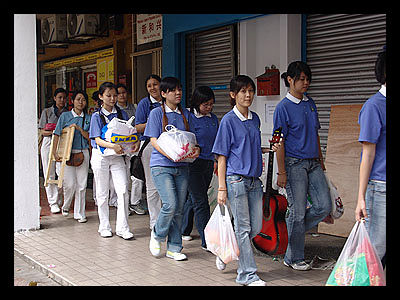
Literally meaning “compassionate relief,” Tzu Chi has expanded its program beyond just charity by building schools and hospitals around the world. With deep roots in Asia, Tzu Chi has become one of the most influential charity organizations in that region. Tzu Chi volunteers are easily recognized by their blue and white uniforms, and have frequently been called “blue angels.”
A factor that distinguishes Tzu Chi from many other Buddhist organizations is that it is first and foremost not evangelical. Volunteers are made to feel at home and are encouraged to practice whatever religion they affiliate with. All members are encouraged to improve their behavior and mindset, regardless of the underlying Buddhist ethics.
Tzu Chi is strictly non-political and non-governmental, and does not discriminate based on race, religion, nationality, gender, or ethnicity. For this, it has come under some scrutiny in the past, as many Taiwanese were upset with Tzu Chi for offering relief to mainland China. That criticism passed when Tzu Chi became one of the most coordinated organizations to provide relief to Taiwan during the 921 earthquake.
The organization has expanded to involve university students worldwide. The Tzu Chi Collegiate Association is a worldwide network that was officially established in Taiwan in 1992. The volunteers are often given opportunities to attend international NGO conferences. Tzu Shao is also a branch of Tzu Chi that allows youth 18 and under to get involved.
Tzu Chi is progressive in the idea that human growth is rooted in charity and giving, not just internal meditation. Not only does Tzu Chi help survivors of disasters and tragedies, but it also helps its volunteers. Many people are involved with the organization to help their communities and also for their own personal development.
– Lindsey Rubinstein
Sources: Tzu Chi, NY Daily News

Immersion: World Learning
Cultures, developed and developing, unite through immersion and connection. Dr. Donald Watt, a Syracuse University Professor, first came upon this idea during the Great Depression. It was his belief that the cultures and the people on Earth would thrive with a better understanding of each other, eradicating preconceived judgments and categorical placement of social status.
Watt knew this goal could only be achieved through cultural integration of young students. That is why he formed World Learning. A non-profit organization, WL focuses on the development of connections between cultures through three types of programs.
1. Education
Offering study abroad programs to high school and college students, WL emphasizes full immersion into foreign cultures. WL offers summer programs that allow students to do field research abroad, while taking in foreign languages and all that the countries have to offer. An example of one of these educational programs is the SIT Study Abroad program. Students enrolled in this program often are assigned a critical issue of a culture, one that they must study to fully understand. They then address the issue through community projects and global service. SIT Study Abroad hosts over 70 programs in Asia, Africa, Latin America and the Middle East.
2. Exchange
WL has developed connections with leaders across the globe, bringing them to the United States to communicate with young students. The insight and experiences of these leaders are beneficial to students in the program.
3. Development
The programs WL have to offer to young students focus on the critical issues our world faces today. These include poverty, government accountability, the spread of disease and the malnutrition of women and children. Once the needs of cultures are identified, WL expects students to immerse themselves and help make a difference through the leadership skills they are taught.
World Learning has made a difference in 60 countries and changed the lives of over 100,000 people. This difference has been due to the engagement of the youth, whose immersion into developing countries has created important lifelong international bonds.
– William Norris
Sources: World Learning, SIT Study Abroad
Photo: Flikr
The Benefits of Volunteering Abroad
Volunteering abroad is a great way to make a difference while also exploring new places. The exposure to other cultures, languages, and ways of life creates mind-opening experiences. Waking up day-to-day in an area of need, one begins to appreciate the gifts of his/her own culture as well as appreciate the benefits of a new culture. The friendships made with other volunteers and community members are an added bonus. Here are just some benefits of volunteering abroad:
Utility Maximization and Altruism:
People, by nature, are utility maximizers who engage in certain behaviors in order to derive happiness and satisfaction. In this case, the certain behavior is volunteering. Volunteering instills a sense of “giving back,” or rather giving ones own resources (time, money, services, etc.) to help those less fortunate. Overseas volunteering is truly meaningful in this area. Leaving one’s comfort zone to venture to another country to help out makes this act of giving even more poignant. According to GoAbroad.com, anyone who decides to volunteer abroad must meet only one important qualification: the urge to make a positive change in the world.
Learn New Languages:
While volunteering abroad, every day is an opportunity to learn the native language. A stroll by a fruit stand is an opportunity to engage the attendant in conversation and learn new vocabulary, even if it is just learning the names of different fruits. Often times English speakers are asked to teach English as a second language which requires relearning grammar rules and usage. What could be so terrible about relearning subject-verb agreement? These better English skills can prove useful in the long run.
Eat Something Different for a Change:
Americans are accustomed to the usual selection of food that is inspected, regulated, processed and enhanced for flavor. Many foreign countries do not face these government expectations with their foods. Volunteers may try fruits, veggies, herbs and meats they never experienced before. Some meals are served fresher and are much cheaper than what most Americans are use to. Some foods are an unexpected treat, and others may be frightening—a fresh fruit with maggots, anyone? Nevertheless, a new menu can yield new favorites, new ways of cooking, and an appreciation for food in its simplest form.
The Cure and Better Manners:
Overseas volunteering is an excellent cure for the “ugly American” syndrome. Volunteers typically receive thorough education about gestures, body language, and conversation to avoid offensiveness. The lessons are a humbling experience and can make a volunteer think twice about how their behavior appears to others in their own culture.
– Scarlet Shelton
Sources: USA Today, GoAbroad.com
WaterAid America
Water sanitation is an issue in development that receives minimal coverage when compared to its impact. Only recently the importance of access to clean water has gained international attention.
A lack of clean water not only makes basic tasks like washing, cooking, and drinking more difficult but also leads to widespread disease. Healthy members of the family are then burdened by taking care of the ill. Livelihoods are often impacted, with women often having to travel long distances to carry water back to their homes, missing out on education or economic opportunities and forcing children to take on responsibility roles in the household.
Established in 1981, WaterAid America works exclusively to provide safe water to at-risk communities globally. It currently works in 27 countries which are among the poorest countries in the world. A country must be on the lower end of the UNDP’s Human Development Index is a criteria for Wateraid to begin work.
The organization works with governments and other international NGOs, receiving funding from the U.S. and U.K. governments to carry out their work. They offer training to foreign departments which lack the resources or background to adequately handle their countries’ crises, thereby creating a sustainable solution rather than a short term intervention.
WaterAid’s impact was documented in Pulitzer Prize winning author Tina Rosenburg’s essay “The Burden of Thirst.” In it, she describes the immense difference made by having access to clean water. Hours previously spent gathering water are instead spent on gathering food or raising animals, diseases plummet and as such, families are no longer forced to care for sick relatives. Girls who previously bore the burden of fetching water are now free to spend their time getting an education.
The problem of unsafe water remains prevalent throughout the world. According to their website, today, 768 million people lack access to clean water and even more, 2.5 billion, lack sanitation.
– Farahnaz Mohammed
Sources: The Burden of Thirst
10 Mil Volunteers Revolutionizing Disaster Relief
The Buddhist Tzu Chi Foundation is an international non-profit humanitarian organization with four main tenets: charity, medicine, education, and humanitarian culture. So far, with the help of 10 million volunteers and donors, the Buddhist Tzu Chi Foundation has provided millions of dollars of relief and aid in over 70 countries.
Tzu Chi was among the first organizations to provide relief to families that were victims of the World Trade Center attacks, Hurricanes Sandy and Katrina, and the earthquake in Haiti. Tzu Chi is unique in its approach to disaster relief in that it hands sums of cash directly into the hands of survivors. This is part of Tzu Chi’s philosophy: allowing survivors to use charity money on their own terms.
The Buddhist Tzu Chi Foundation started in 1966 when a group of women began to save two cents from grocery money every day to donate to charity. The organization registered as a non-profit 501(c)(3) in California in 1984, and over the years, it has become an international group of over 10 million volunteers.
Literally meaning “compassionate relief,” Tzu Chi has expanded its program beyond just charity by building schools and hospitals around the world. With deep roots in Asia, Tzu Chi has become one of the most influential charity organizations in that region. Tzu Chi volunteers are easily recognized by their blue and white uniforms, and have frequently been called “blue angels.”
A factor that distinguishes Tzu Chi from many other Buddhist organizations is that it is first and foremost not evangelical. Volunteers are made to feel at home and are encouraged to practice whatever religion they affiliate with. All members are encouraged to improve their behavior and mindset, regardless of the underlying Buddhist ethics.
Tzu Chi is strictly non-political and non-governmental, and does not discriminate based on race, religion, nationality, gender, or ethnicity. For this, it has come under some scrutiny in the past, as many Taiwanese were upset with Tzu Chi for offering relief to mainland China. That criticism passed when Tzu Chi became one of the most coordinated organizations to provide relief to Taiwan during the 921 earthquake.
The organization has expanded to involve university students worldwide. The Tzu Chi Collegiate Association is a worldwide network that was officially established in Taiwan in 1992. The volunteers are often given opportunities to attend international NGO conferences. Tzu Shao is also a branch of Tzu Chi that allows youth 18 and under to get involved.
Tzu Chi is progressive in the idea that human growth is rooted in charity and giving, not just internal meditation. Not only does Tzu Chi help survivors of disasters and tragedies, but it also helps its volunteers. Many people are involved with the organization to help their communities and also for their own personal development.
– Lindsey Rubinstein
Sources: Tzu Chi, NY Daily News
10 Facts About Operation USA
Operation USA is an international relief agency that focuses on working with grass-roots groups to help alleviate the effects of natural and man-made disasters worldwide. The Los Angeles-based group was a co-recipient of the 1997 Nobel Peace Prize for its work on the “International Campaign to Ban Landmines.”
These are ten important facts about it:
Bonus Fact: Julie Andrews is a founding Board Member, and Rosario Dawson also currently serves on the Board of Directors.
– Lauren Brown
Sources: ICBL, Operation USA
Photo: Food For The Poor
Rising Debt Means Falling Aid
While some economies may be taking the first steps towards recovery, the repercussions of the global economic crisis are still being felt in the majority of countries. And one of the biggest casualties of the continued recession could be progress on the Millennium Development Goals (MDGs). Increased spending over the last few years led to rapid progress on many of the MDGs, however, a recent report entitled “Putting Progress at Risk” by Oxfam International shows that the majority of developing countries are now spending well below the amount required to continue with progress on the various social issues promoted by the MDGs.
While cuts necessitated by the global economic crisis have been made by developing countries – in such areas as agricultural spending, maintenance of water facilities, and wages for teachers and nurse – the problem is exacerbated by the effect the economic crisis has had on developed nations.
The report tracks the spending of 52 developing nations by using data from the Government Spending Watch database. The data shows that these countries have lost a combined $140 billion in revenues during the economic crisis. Unfortunately, at the same time as revenue generation in these countries is declining, international aid is also falling. As a result, countries are being forced to choose between increased borrowing and rising debt, and cutting funding to their own development programs. According to the Government Spending Watch database, only 20% of these countries are meeting targets for agricultural spending, and 40% are reaching the level the World Health Organization recommends for spending on health.
This combination of rising internal debt, and falling external aid, has many developing countries trapped and unable to generate enough revenue to support development, and yet needing that development to happen in order to promote future growth. Developed nations must hold to their initial pledges for aid, otherwise all the progress so far seen could slip away.
– David Wilson
Source: Caledonian Mercury, Oxfam
Obama Pledges $6.5 Billion for Electricity in Africa
According to the International Energy Agency, all developing nations lack adequate access to electricity. This amounts to 1.3 billion people living in the dark worldwide. According to the same source, an investment of $1 trillion USD would be needed to remedy this. Currently, poverty and hunger take center stage. Food is of more use to a starving child than is a night light, but Westerners often take for granted how valuable the power of light can be to a community in poverty.
Not only does electricity make lives easier on a personal level, it helps to mechanize farming operations, which can be a great boost to a company’s agricultural productivity. Natural disasters often become less deadly when people are warned about them ahead of time, which can be accomplished with electric monitoring systems. Socially, populations are less marginalized with improved means of communication and information.
President Barack Obama said during his recent trip to South Africa, “Access to electricity is fundamental to opportunity in this age. It’s the light that children study by, the energy that allows an idea to be transformed into a real business. It’s the lifeline for families to meet their most basic needs, and it’s the connection that’s needed to plug Africa into the grid of the global economy.” President Obama then pledged almost $7 billion USD to help provide electricity for Africa.
The White House stated that The Export-Import Bank will carry most of the financial weight of the program, donating $5 billion, and the U.S. Oversees Private Investment Corporation will provide another $1.5 billion.
The funds will go toward preventing the frequent blackouts that plague the Sub-Saharan part of the continent, as well as helping the 85% percent of people in the region without electricity gain access to it. Kenya, Uganda, Ethiopia, Liberia, Nigeria, Tanzania and Mozambique will be the first countries to benefit from the program as it is developed at preliminary stages.
The investment is a great step toward solving the problem, but in all, Africa alone will need $300 billion to achieve universal electricity by 2030. The Alliance for Rural Electrification, a non-government organization, is another ally in combating this issue. As champions of universal electrification, ARE focuses on renewable energy such as solar, which much of Africa is a strong candidate for. This is especially relevant for areas that are geographically isolated where extending the reach of an existing power grid is not feasible.
– Samantha Mauney
Source: ARE, Scientific American, CNN
Photo: Business Insider
How Africa Can End Hunger by 2025
Africa can end hunger completely by 2025, according to Jose Graniano da Silva, Director-General of the Food and Agriculture Organization of the United Nations. Graniano da Silva bases his prediction on the great progress that has been made in Africa since the establishment of the Millennium Development Goals in 2000.
Since then, eleven countries in Africa have reduced the number of hungry people within their borders by 50%, and several others are on track to do the same by the end of 2015. With the strong momentum that is behind African efforts to combat malnutrition, Graniano da Silva believes that complete elimination of hunger is attainable in the continent by the year 2025.
The Director-General states that the biggest obstacle to eliminating hunger in Africa is accessibility to food. Africa has the second-highest level of economic growth in the world and a multitude of resources throughout the continent, yet 17 of the 20 countries in the world “suffering from prolonged food shortages” are in Africa and “one in four Africans still suffer from chronic hunger.”
The key to reducing hunger, according to Graniano da Silva, is not necessarily by just increasing food production, but rather by making food more available throughout the continent. Increased access to food can be achieved by increasing access to land for growing food and reducing food price volatility.
Other factors that will help contribute to the eradication of hunger in Africa are increasing national budgets on agriculture and providing women with enhanced access to land and credit. Nearly “70% of Africa’s agriculture workforce is female,” making women’s rights and involvement in development essential to reducing hunger.
Jose Graniano da Silva is a former president of Brazil who headed the nation’s Fome Zero program, which successfully lifted 28 million Brazilians out of poverty. The Director-General hopes that similar strategies to the ones that he helped implement in Brazil will help lift millions of Africans out of poverty in the next decade.
– Jordan Kline
Sources: The Guardian, Inter Press Service
Malala Proves Education is Key to Empowerment
Malala Yousafzai is a young education rights campaigner from Pakistan. Malala will soon be celebrating her 16th birthday, a miracle after she was shot by extremists for her outspoken beliefs on education. Malala will celebrate her birthday by traveling to the United Nations where students from more than 80 countries will join her.
Malala and the other young activists will be assembled to call for global education for everyone in the world. She and the other young diplomats believe that education is a right for all – one of the Millennium Development Goals, and a vital component of the path to global citizenship. This belief is well founded in the fact that universal compulsory education represents a future that the world wants. Malala was the first person to sign on to a new worldwide petition calling for urgent action to ensure the right of every child to safely attend school. The petition serves as an initial step in focusing the UN agenda on education.
UN Secretary General Ban Ki-moon supports Malala’s mission to bring education to the world. He states that education is an essential step in a world without poverty, violence, discrimination, and disease. He also recognizes that in order to achieve these objectives, the global society needs to continue pushing forward. The secretary general recognizes that we, as a global society, have made progress on this issue, however, there is much more work to be done. Ban expresses that no child or woman should have to consider going to school as an act of bravery.
Ban states that too many girls around the world are subjected to extremist threats for trying to obtain an education. The benefits of educating women in developing countries have been proven time and time again. Ban explains that when women and girls are educated, a society develops at a more rapid pace than without their education. Additionally, education increases future earnings for women, allowing them to provide their families with additional resources, over time, lifting them out of poverty.
If education is key to empowerment as the path to economic stability and development, why is it so widely contested in many developing countries? The answer lies in fear. If we as a global community continue to fear education for all, we will fail to grow as a global economy. More steps must be taken to ensure each child has access to education.
-Caitlin Zusy
Source: Huffington Post, UN News Center
Photo: Stanford Bookhaven
Developing Countries Become Mobile Phone Consumers
Developing nations have become the mobile phone industry’s biggest new consumer. Some of the poorest countries in Africa have seen a meteoric rise in cell phone use in recent years. Since the invention, cell phones have enabled users to connect across geographic boundaries in ways that were impossible before. Additionally, cell phones are now used in developing for monetary exchanges that have fueled growth.
A vast majority of the population in Africa do not have bank accounts. Instead, their populations are increasingly reliant on “mobile money”, often in the form of pre-paid airtime minutes. Mobile handsets can be acquired at a relatively cheap price and they allow their users to make financial transactions in a way that is independent of inflation or economic stability. Airtime can be transferred between handsets or converted to cash by airtime dealers.
In Botswana, approximately 30% of the population over the age of 16 have a bank account, however nearly 60% have mobile phones. In Cameroon, the difference is even greater, with 7.1% with bank accounts and 36.5% operating mobile phones.
This pattern continues across much of the African continent. The airtime economy offers monetary independence for Africans living on minuscule incomes. Though the cost of entry still prevents the poorest communities from entering the market, handset manufacturers have taken notice of these emerging markets and are developing cheaper, more rugged handsets for poorer communities.
– Andrew Rasner
Source: The Economist, TechCrunch, IST Africa
Photo: Smart Mobile Solutions