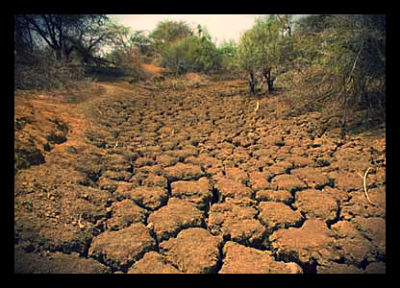
Famine and drought are often considered one and the same. It is easy to think that where there is drought, there is certainly famine or that where there is famine, there must be drought. The truth of the matter is that the difference between a famine and a drought is huge. Famines and droughts are caused by various conditions and factors that sometimes have nothing to do with the other.
Drought may be defined in three ways. That is to say, there are three kinds of drought. Meteorological drought is a reduction in rainfall below a certain level that is scientifically considered to be a drought. This kind of drought may occur in the course of a season, month, or even day. If it rains less than a specific amount, over the specified amount of time, you have meteorological drought.
Hydrological drought may be caused by meteorological drought, but it need not necessarily be so. This kind of drought occurs when a body of water, such as a stream or lake, falls below a certain amount. For example, in a dry year, meteorological drought may lead to hydrological drought in a stream, when the stream runs much lower than it usually does. Likewise, hydrological drought may exist when the source of a stream is blocked or severed.
Agricultural drought occurs when there is a significant reduction in crop yield, such that it may fall to a certain level considered to be a drought. This kind of drought may be caused by meteorological and/or hydrological drought, but may just as easily stem from insufficient access to fertilizer or some other necessary ingredient to produce yield.
Famine, on the other hand, is caused by a decline in availability of and/or access to food often caused by one of the three kinds of drought. Where there is insufficient water to produce a staple crop, for example, or where there is insufficient fertilizer to produce the standard yield for a crop, drought may lead to and certainly cause famine. Yet, it is not necessarily the drought that causes such a famine.
For famine to occur, there must be insufficient availability of or access to food. Though there may be some kind of drought one year, adequate food management of the available crops may effectively prevent famine. This point highlights the importance of access to food. On that note, inadequate management of a drought may lead to famine because families with less purchasing power, say, are unable to gain access to the available foodstuffs.
Though famine often does follow drought, it is not necessarily a cause and effect relationship. Rather the difference between famine and drought lies in the complexity of this relationship and the conditions and factors that surround local circumstances, as well as government and community responses to drought. The difference between famine and drought is therefore dependent on what causes the drought and how communities handle their food supplies.
– Herman Watson
Sources: Preserve Articles, The Borgen Project, World Vision, Edward Carr
Photo: Business Insider

Human Trafficking in Myanmar
Despite recent governmental actions to curb modern day slavery in Myanmar, human trafficking remains a common practice throughout the country.
Human trafficking takes on various forms within Myanmar, including forced labor, the use of child soldiers for the Myanmar government, and sex trafficking and prostitution. The most common countries of trade include Thailand, China, Malaysia, Bangladesh, and Pakistan. China and Thailand stand out as the two countries with the greatest volume of human trafficking with Myanmar, often with people sent to work in fishing villages, mines, and factories or as a prostitute or a bride.
Myanmar has been traced as both a source country for producing modern day slaves and a destination country to receive illegal slaves. Internally, the country has struggled with forced labor and military recruitment of child soldiers. According to 2011 data from the U.S. Department of State, 92 percent of families in Myanmar’s Chin State had at least one family member forced into serving the government without pay. The government recruits thousands of its citizens into forced labor, requiring them to work in infrastructure development, agriculture and, most commonly, the military. While exact numbers are unknown, thousands of these workers and soldiers are reported to be children with the youngest on record being only 11 years. The government forces the Burmese people into these situations with economic and physical threats, often targeting ethnic minorities.
The primary cause of trafficking in Myanmar traces back to the often-criticized military regime government itself. With the government’s blatant abuse of human rights and use of child soldiers, it is only natural for the Burmese people to follow their government’s lead and turn to human trafficking as a means of generating income. Furthermore, the government fails to recognize smaller ethnic minorities as citizens, which leaves them easy targets for traffickers.
Despite these problems, Myanmar officials claim they are committed to fighting this crime. Current governmental plans to address these problems include focusing on victims, building partnerships between government and civil society, and producing results in taking actions against known human traffickers. While the government pledges to increase arrests and prison sentences to address the trafficking problems, widespread government corruption remains an obstacle to progress in putting criminals away.
As of August 1, the United States and Myanmar governments convened to work on a U.S.-Myanmar Trafficking in Persons dialogue to address the issues the country has been facing. While the country faces many challenges in fighting this issue, in particular with regard to government corruption and economic strife, officials remain hopeful that Myanmar is headed in the right direction to curbing the flow of human trafficking within its borders. The test of time will demonstrate how serious the Myanmar government is in creating this change.
– Allison Meade
Sources: Human Trafficking , Republic of the Union of Myanmar , Knoxville Daily Sun
US Foreign Aid to Africa: What We Give and Why
In 2012, the United States provided nearly $12 billion in official development assistance (“ODA”) to African nations. The ODA is allocated to education, health, infrastructure and economic development programs in recipient countries. Currently, the United States allocates foreign aid to 47 African nations and USAID operates 27 missions on the continent.
US Foreign aid to Africa began in the 1960s as many African nations gained independence and the United States sought strategic alliances to counter the influence of the Soviet Union. With the exception of disaster and famine relief, most foreign aid to Africa began to decrease with the collapse of the Soviet Union.
In the 2000s, President Bush more than tripled aid to Africa by establishing programs such as the Child Survival and Health Programs Fund as well as the Global HIV/AIDS Initiative.
Though foreign aid programs are designed to assist recipient nations with development, they also benefit the United States in a number of ways.
First, these programs help build strategic alliances and foster support for democratic transitions. It also stimulates Africa’s growth and development, which provides opportunities for increased trade and direct investment in the continent’s emerging markets.
But for all the benefits, foreign aid to Africa has no shortage of detractors. Many critics point out that much of the money allocated to Africa never reaches the people who most need the assistance. “Eighty percent of U.S. aid to Africa is spent right here in America — on American contractors, American suppliers, and so forth,” said George Ayittey, president of the Free Africa Foundation.
In more corrupt nations, politicians and civic leaders are often charged with misappropriating funds designated for the people. Others critics claim that foreign aid to Africa simply does not work—after 50 years of assistance, Africa still confronts the same issues.
But even critics would have to agree on one crucial point: foreign aid is an integral part of U.S. foreign policy. In Africa, aid programs support a large framework of social and economic assistance for developing nations.
Critics are correct that American companies and corrupt politicians siphon a large portion of foreign aid. But aid to Africa has also done much to improve infrastructure, bolster economic development and improve health care conditions for millions of people on the continent.
– Danial Bonasso
Sources: Foreign Policy Initiative, Washington Post, NPR, One.org
Photo: James Bovard
SoleRebels: Shoes With An Impact
Recently profiled by both CNN and Forbes as an important businesswoman to watch, Bethlehem Tilahun Alemu is quite the success story. While growing up in the small Ethiopian town of Zenabwork, Alemu remembers waiting for a better life to develop for her friends and family, before realizing that she would have to create the reality that she wanted to see. And so, in 2004, she created soleRebels.
SoleRebels is a Fair Trade shoe company that harnesses the artisan skills and recycling habits inherent in Zenabwork’s culture. The company employs locals and pays four to five times the legal minimum wage and over three times the industry average, allowing workers to earn a respectable income and support their families. Workers are paid a straight wage without regard to individual quotas. Most workers live within walking distance of the factory, but transportation is provided for disabled workers who can’t make the trek. Workers and their families are also provided with complete medical coverage, including site visits by board-certified practitioners. Such site visits are especially important considering that competent doctors can be few and far between in Ethiopia.
The company’s original shoe design was based on the traditional selate and barabosso shoes made from recycled tires. In a poignant nod to Ethiopian history, these were the same shoes worn by rebel fighters who opposed colonization by westerners, and who helped make Ethiopia one of only two African countries never to be colonized. This is incredibly consistent with soleRebel’s mission, which is largely based on the need for more African start-up companies that fuel economic growth and independence, rather than NGOs and charity organizations that often do more harm than good.
Currently, their market has expanded considerably. The company now makes numerous different types of shoes, including tooTOOs (similar to TOMs), lace-ups, sandals, slip-ons and coZEEs (similar to UGGs). They even have a line of vegan footwear called b*knd. Their products are sold online and in 30 countries worldwide.
Although their production has increased substantially, almost all products are still made and sourced locally. For example, every piece of fabric used in the making of soleRebel’s shoes is hand-loomed using traditional eucalyptus looms. This process preserves an ancient craft, cuts down on electricity bills, produces absolutely no carbon output and creates beautifully unique fabrics. And the company still uses hand-cut recycled tires for the soles of every shoe, preserving tradition and saving the environment in one fell swoop.
SoleRebels is a great example of poverty fighting done right. This shoe company continues to empower countless numbers of people, who use their talents and preserve their traditions to stake their claim in the world market. Locally and fairly sourced products, combined with beautiful craftsmanship and entrepreneurial know-how, create some great-looking shoes that will leave you feeling even better.
– Katie Fullerton
Sources: soleRebels, Forbes, CNN
Photo: INSP
What is Global Poverty?
What is global poverty? That thing called poverty – how exactly is it defined? What does it mean to lead an impoverished life? Poverty is much more than just statistics about economies, hunger, and homelessness. Poverty is a state of life, affecting all of humanity.
Poverty is most commonly defined by economic standards, based on income levels and access to basic human necessities, such as food, water, and shelter. Poverty is often described with a scale, ranging from extreme to moderate levels. The internationally agreed-upon measurement of extreme poverty currently lies at $1.25 a day, with the next lowest measure of poverty standing at $2 per day. The geographic breakdown of regions with the highest levels of poverty ranging from worst to best include: Sub-Saharan Africa, South Asia, Pacific East Asia, Latin America and the Caribbean, North Africa and the Middle East, and Europe and Central Asia.
Assessing the Impact: What is Global Poverty?
Poverty has many ties to physical health as well, as the world’s poorest countries consistently demonstrate the lowest life expectancies. The majority of these health problems can be traced back to unsafe drinking water and malnutrition, which causes an estimated 8 million people to die every year in addition to 30,000 children’s deaths per day.
Another problem with poverty is the acts of desperation it drives people to. When humans are deprived of basic life necessities, they are forced to take desperate measures in an effort to change their bleak future. Historically, poverty has proven to be the cause of much violence and conflict and continues to be so today. In many situations human trafficking, the use of child soldiers, and prostitution can all be linked to poverty.
In what is perhaps a testament to the subjective definition of poverty, there are mixed results in reducing poverty levels today. According to data from The Economist, nearly one billion people have been lifted out of chronic poverty over the last two decades. While this initially sounds very positive, one must also consider the huge levels of wealth disparity that have shot up in this same time period, as the poorest 20 percent of the world’s population uses a mere 1.3 percent of global resources in contrast to the richest 20% consuming an approximated 86 percent of the world’s resources.
Poverty can be a controversial subject in modern society, as individuals have different understandings of what it means to be poor and what appropriate solutions to poverty should look like. Skeptics criticize the economic definition of poverty because it fails to factor in quality of life. Rather than focusing on pure economic data, most agree that the definition of poverty must also include political and cultural factors and access to opportunities, education, and healthcare. If there’s one thing that can be agreed on, it would be that poverty is a real problem affecting millions of people around the world today, and poverty is a complex issue with multiple layers.
– Allison Meade
Sources: United Nations, World Health Organization, Global Issues, World Bank, ASCD
Agape Family Life House
Agape Family Life House is a foster home and care center for orphans in the city of Langfang, China. The home specializes in medical treatment and care for children with Osteogenesis Imperfecta or brittle bones. The home also supports adoption and placement of children into new homes where they can be loved and cared for properly.
Agape Family Life House was founded by Keith and Cheryl Wyse from the United States. In 2002, the Wyses felt called to move to China to aid handicapped children. The Wyses had already adopted their own daughters from China, Rebekah and Rachelle, twins suffering from OI. So they sold everything they owned and moved to China to pursue their passion. Eventually they would open Agape Family Life House in Langfang which cares for 29 people from age 1.5 to 27. They would also start the Bread of Life Bakery, a bakery that employs some of the oldest girls who were living at the home. The Wyses also dedicated themselves to working with local hospitals and American hospitals to bring surgical procedures and treatments to China. Together with Dr. Wu Guo Hua of the Langfang Orthopedic Hospital, Keith Wyse co-founded the OI Association of China.
Children who suffer from OI have bones that can fracture or break with the slightest bump or injury. As a result, they are often left with severely stunted growth or deformed bones and limbs. Thus the children often grow very slowly and maintain a very youthful appearance despite their actual age. Individuals with OI also often have blue tinged eyes that supplant the usual white sclera of normal eyes.
The children that Agape Fmaily Life House serves are known as “children of glass”. The children of the Agape Family Life House come from all parts of China and varying degrees of poverty. One boy, Joseph, is all the way from the province of Xin Jiang that borders Kazakhstan. Another child Lydia was delivered to Agape Family Life House with a broken arm and a note that read “When she dies, just give this note to the authorities and they will understand that it was not your fault.” Other children have been sent by their orphanages in various provinces to the home to receive better medical treatment.
In each case, children are found or sent to Agape Family Life House because they could not be cared for in their original homes. Other children are simply abandoned by parents who could either not afford to care for a child with OI or for whatever reason, did not want the child. Children who grow up with OI in China face a bleak future if they cannot be treated medically. Furthermore, people with OI in China face the strong possibility of falling into poverty and destitution if they cannot find employment or support.
There are many ways to support Agape Family Life House. Anybody can make individual donations or financially sponsor a child. Donations can also be made to a fund that supports parents interested in adopting any of the children from Agape Family Life House. The home also offers many opportunities to volunteer or intern with the home. Volunteers can interact with children or help around anywhere at the home. Long term or short term arrangements can be made as well. With increasing help from volunteers in the recent years, Agape Family Life House has been able to expand and provide a second chance for many orphans in China.
– Grace Zhao
Sources: Agape Family Life House, CCTV
Photo: International Voice of the Orphan
United Cerebral Palsy
The goal of nonprofit group United Cerebral Palsy is to provide a “life without limits” for people with disabilities. By working with its 100 affiliates, the organization is able to help people all over the world become more independent productive citizens. Founded in 1949 by a group of parents of children with cerebral palsy, United Cerebral Palsy evolved into an organization devoted to anyone with a disability.
United Cerebral Palsy does not focus on how a person acquired a disability; rather, they will reach out to all types of people, whether the disability is due to aging, accident or the person was born with an ailment. Some of the disabilities the group works with are cerebral palsy, Down syndrome, autism spectrum disorders, physical disabilities, and traumatic brain injury (TBI).
This organization is proud to claim affiliation with about 100 groups in its quest to aid the disabled. These affiliates are vital to the cause and provide services such as housing, therapy, assistive technology training, early intervention programs, individual and family support, social and recreation programs, community living, state and local referrals, as well as employment assistance and advocacy. Without the help of its affiliates, United Cerebral Palsy’s outreach would be severely limited.
By focusing on the future, United Cerebral Palsy will impact even more lives. The organization teams up with other groups to develop new technologies and methods for improving the lives of those with disabilities. For example, United Cerebral Palsy is working to ensure that children unable to use their vocal cords can still communicate with innovate new voice technology.
Another resource United Cerebral Palsy provides is just as important as new technology. The group acts as a support group for friends and family of people with disability and offers forums for people to discuss and ask questions about a disability affecting his or her family. United Cerebral Palsy has a branch in each state and affiliates around the world as no one with a disability need go without the independence and wellbeing that he or she deserves.
– Mary Penn
Sources: United Cerebral Palsy, Charity Navigator
Photo: United Cerebral Palsy Cleveland
Access to Clean Water and Sanitation, Water for the World
Congressmen Ted Poe (R-TX) and Earl Blumenauer (D-OR) recently introduced an important piece of legislation that may drastically improve the opportunity for every person in the developing world to access to clean water, toilets, and better hygiene practices.
The Water for the World Act of 2013, introduced by these two congressmen, is a bill that is trying to ensure that the world’s abject poor receive the attention they need from the United States in the attempt to seek improvements in clean water access and hygiene. It is important to note that this act does not seek to create new agencies or programs, but to improve the efficiency of existing programs. The emphasis is not on higher dollar amounts, but more strategic approaches in trying to improve the lives of the world’s poorest people.
Worldwide water sanitation holds important implications for those suffering in precarious conditions, as well as the global economy. The World Bank notes that water sanitation and hygiene programs are a great return on investment: For every $1 spent, $4 is returned in economic productivity, which contributes greatly to the world economy. If people do not have to worry about access to clean water, they can spend more time becoming educated, caring for their families, and contributing to both their economy and the worldwide economy. This would amount to over $220 billion being added to international trade each year.
Improvements in water sanitation, access, and hygiene that the Water for the World Act will try to effect will also significantly reduce transmissions of diseases such as pneumonia. Indirectly, rates of education will improve, as less people worldwide will suffer from malnutrition and diarrheal disease due to dirty water. As literacy rates increase, the rising middle class in developing countries will fight for more transparent and accountable governments. More responsible governance around the world is a key objective of U.S. foreign policy, but it cannot ever be realized if world populations are without access to clean water and sanitation.
Global water, sanitation, and hygiene programs currently constitute less than 1% of the budget of the United States Agency for International Development. Due to the bipartisan leadership of Poe and Blumenauer, their act will place a greater focus on enhancing the capacity of the U.S. government to provide for the world’s poorest, a much needed shift in policy which will stretch this 1% to help more people around the world.
– Rahul Shah
Sources: Huffington Post, WASH Advocates, USAid
Mobility International USA
For the right price, most people can hop on a plane and go anywhere, anytime. College students in particular utilize this privilege and depart for couple months or a year on a study abroad program. A commonly overlooked fact is that for those with disabilities, this may seem like an impossible dream. Organizations like Mobility International USA are here to change that.
One participant in Mobility International USA described how she had wanted to study abroad during college, but was unable to find a program that could accommodate her special circumstances. After almost giving up, she discovered Mobility International and through the organization was connected to several programs that worked with the disabled. Because of Mobility International, she traveled to Peru and then eventually to 21 other countries. Her story is a common one in Mobility International.
Not only does Mobility International work with disabled college students, but also high school, professionals, Peace Corps volunteers and other groups to provide short-term exchanges all over the world. Currently, there are 2,000 people of all ages and backgrounds participating in the program worldwide.
In addition to international exchange programs, Mobility International USA partners with government and non-government disability groups around the world to ensure that people with disabilities have the same human rights as everyone else. This is particularly a concern in developing countries like Ethiopia, Albania, Jordan, Colombia, Uganda, Zambia, and Vietnam. By partnering with disability groups in these countries, Mobility International can work to ensure that the disabled receive the care they deserve.
Since its establishment in 1995, the Bureau of Educational and Cultural Affairs of the U.S. Department of State have sponsored Mobility International USA. This partnership has changed the lives of thousands of people with disabilities. Many, like the girl who was able to visit Peru, now work for the organization. Mobility International USA is an admirable organization dedicated to the pursuit of international experiences and, most importantly, a higher quality of life for the disabled.
– Mary Penn
Sources: Mobility International USA
The Difference Between a Famine and a Drought?
Famine and drought are often considered one and the same. It is easy to think that where there is drought, there is certainly famine or that where there is famine, there must be drought. The truth of the matter is that the difference between a famine and a drought is huge. Famines and droughts are caused by various conditions and factors that sometimes have nothing to do with the other.
Drought may be defined in three ways. That is to say, there are three kinds of drought. Meteorological drought is a reduction in rainfall below a certain level that is scientifically considered to be a drought. This kind of drought may occur in the course of a season, month, or even day. If it rains less than a specific amount, over the specified amount of time, you have meteorological drought.
Hydrological drought may be caused by meteorological drought, but it need not necessarily be so. This kind of drought occurs when a body of water, such as a stream or lake, falls below a certain amount. For example, in a dry year, meteorological drought may lead to hydrological drought in a stream, when the stream runs much lower than it usually does. Likewise, hydrological drought may exist when the source of a stream is blocked or severed.
Agricultural drought occurs when there is a significant reduction in crop yield, such that it may fall to a certain level considered to be a drought. This kind of drought may be caused by meteorological and/or hydrological drought, but may just as easily stem from insufficient access to fertilizer or some other necessary ingredient to produce yield.
Famine, on the other hand, is caused by a decline in availability of and/or access to food often caused by one of the three kinds of drought. Where there is insufficient water to produce a staple crop, for example, or where there is insufficient fertilizer to produce the standard yield for a crop, drought may lead to and certainly cause famine. Yet, it is not necessarily the drought that causes such a famine.
For famine to occur, there must be insufficient availability of or access to food. Though there may be some kind of drought one year, adequate food management of the available crops may effectively prevent famine. This point highlights the importance of access to food. On that note, inadequate management of a drought may lead to famine because families with less purchasing power, say, are unable to gain access to the available foodstuffs.
Though famine often does follow drought, it is not necessarily a cause and effect relationship. Rather the difference between famine and drought lies in the complexity of this relationship and the conditions and factors that surround local circumstances, as well as government and community responses to drought. The difference between famine and drought is therefore dependent on what causes the drought and how communities handle their food supplies.
– Herman Watson
Sources: Preserve Articles, The Borgen Project, World Vision, Edward Carr
Photo: Business Insider
Mini Blood Banks Save Lives in Remote Locations
A basic tenet of medical care – transfusing blood – is often unavailable in the developing world, but a cutting-edge blood transfer system called ProBlood is making live-saving red blood cells available even in the most remote locations.
ProBlood is an innovative system that acts a mini blood bank in a pack, allowing red blood cells and plasma to be separated for immediate use in critical situations where there is no blood centrifuge center available. Every day across the world, situations arise when someone is at risk of dying simply because they do not have access to a blood transfusion. Natural disasters, rescue operations and remote maternity clinics are just a few of the reasons ProBlood’s makers, Hemacon, developed a solution. ProBlood makes it possible for separated blood to be transferred, whereas in the past only whole blood was available. Hemacon designed ProBlood to be an alternative to traditional high g-force blood centrifugation, which allows the blood to be processed with less stress on the red blood cells.
Gravity is all that is needed to get the ProBlood system into gear. The whole blood donation is pulled by gravity through a leukocyte reduction filter, which removes potentially harmful blood-borne diseases and white blood cells. The plasma is then separated from the blood over a hollow fiber separation filter system, leaving the patient with access to plasma with high quality clotting factors. An entire unit of donated blood can be separated in under an hour using ProBlood, which quickly delivers safe red blood cells and plasma to critical patients, without the need for electricity or extensive handling.
ProBlood systems include a donor blood bag, needle, filter and processing component to separate the red blood cells and plasma, allowing them to be immediately administered or temporarily stored in a blood bag. With this system, patients around the world will have rapid access to high quality blood on a consistent basis. Each blood bag can also be stored up to 42 days if refrigerated, furthering increasing the availability of blood.
Hemacon’s mission to create ProBlood stemmed from some staggering statistics: more than one third of all maternity mortalities in developing nations are directly linked to hemorrhaging. Add in the complex logistics of providing safe blood to remote locations, and this statistic became a problem that Hemacon couldn’t ignore. Hemacon stepped in to help these mothers and drastically increase their access to a safe blood supply.
Finding blood donors is a problem in itself, with less than 0.25 percent contributing to blood supplies in the developing world, as compared to 5 percent donating blood in the Western world. By creating the ProBlood separation system, Hemacon has opened up a vital piece of the medical toolkit to the world’s poor. Hemacon is also developing blood separation systems to provide blood specially for pediatric anemia patients and for use in neonatal care. Additionally, patients requiring preplanned surgeries with expected high blood loss can use the ProBlood system for an autologous blood donation, which uses the patient’s own blood to combat blood loss during surgery. This process not only minimizes the risks for patients in surgery, but also allows the autologous blood donation to be collected quickly, safely and easily on site with the ProBlood system.
– Georganne Hassell
Sources: HighBeam Research, Hemacon
Photo: USA Today