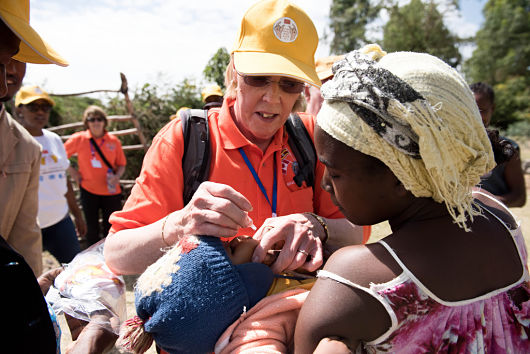
The World Health Organization confirmed that polio in Ethiopia has been eradicated after an assessment team concluded the evaluation process from June 8 to June 12, 2015. This last polio outbreak began almost two years ago in the Horn of Africa, specifically in Ethiopia, Kenya and Somalia.
The assessment team consisted of experts from the Centers for Disease Control, Rotary International, the United States Agency for International Development, the Bill & Melinda Gates Foundation, CORE Group, the United Nations Children Fund, the World Health Organization Headquarters and the World Health Organization Horn of Africa Polio Coordination Office.
The assessment team worked together throughout the outbreak in all three countries to determine that global standards had been met in response to the outbreak and that the transmission of polio had been interrupted. To do this, the team monitored updates from the Federal Ministry of Health on such matters as immunization progress and activities, funding aspects, communication and surveillance.
Polio in Ethiopia: Remaining Polio-Free
The assessment also provided a framework for the efforts still needed to maintain a polio-free status. In order to remain polio-free, Ethiopia needs to update its outbreak and preparedness response plan, strengthen routine immunization and fortify their implementation of acute flaccid paralysis (AFP) surveillance.
AFP is the symptom that indicates that polio could be present. It means that limbs are floppy and lifeless. However, its presence could also be due to other causes. As a result, AFP must be reported in every child less than 15 years of age and tested for poliovirus within 48 hours of onset.
It is expected that there are one to two cases of AFP in every 100,000 children under the age of 5. If there are no reports of AFP in such circumstances, then a region is considered to be “silent.” “Silence” indicates a weakness in the surveillance system, and a failure to end this “silence” could prevent the eradication of polio.
According to WHO, “As long as a single child remains infected […] as many as 200,000 new cases could result every year within 10 years, all over the world.”
Polio is caused by a highly infectious virus, poliovirus, which invades the nervous system. However, 90% of infected people have no symptoms or just very mild symptoms that go unnoticed. In other cases, symptoms could consist of fever, fatigue, headache, vomiting, stiffness in the neck and pain in the limbs. One in 200 infected people become irreversibly paralyzed, usually in the legs. Five to ten percent of those paralyzed die because their breathing muscles become paralyzed.
Across the Horn of Africa, 223 children became paralyzed during the last two years, due to the poliovirus.
Since there is no cure for polio, the polio vaccination is the only protection. In Ethiopia, social mobilizers were successful in their efforts to raise parents’ awareness of the risks of polio and upcoming campaigns to vaccinate children.
It is these connections among informed social mobilizers, healthcare workers and parents within a community that not only leads to vaccination but also builds understanding and commitment to recognizing and reporting AFP to authorities.
Although vaccination and AFP are critical in the eradication of polio, this is not accepted knowledge everywhere. Taliban militants strongly resist vaccination campaigns and are considered responsible for deadly attacks on polio vaccination workers. They “view the campaign as un-Islamic and the health workers are Western spies,” according to The New York Times. Pakistan accounted for 85% of the polio cases reported in 2014.
Ethiopia reported its last case of polio on January 5, 2014. Kenya has also halted the transmission of polio, having reported its last case of polio on July 14, 2013. Somalia has not yet been assessed for eradcation, even though it reported its last case on August 11, 2014. The Somalian government is unable to reach approximately 350,000 children under the age of 5 in order to administer vaccinations, and the assessment team has found gaps in their surveillance efforts.
In spite of these hurdles, the Global Polio Eradication Initiative, launched in 1988 by the World Health Assembly to eradicate polio worldwide, has made enormous progress. Since that time, the number of people infected with the poliovirus has dropped more than 99%. In 2014, only 3 countries remain polio-endemic: Afghanistan, Pakistan and Nigeria.
– Janet Quinn
Sources: Global Polio Eradication Initiative, The New York Times, Outbreak News Today 1, Outbreak News Today 2, WHO
Photo: Flickr

Why This Year’s Flu Epidemic May Be the Worst One Yet
Every winter, the elderly line up at their local drug store and people start walking around cities with face masks—all hoping to avoid getting this year’s strain of the flu. But much like many other diseases, the flu hits people in undeveloped countries, who have minimal access to quality healthcare, harder than it hits those in the United States. This summer, poultry farmers in West Africa are hit particularly bad as the flu epidemic spreads between their livestock.
“[Poultry farming] was our main activity for revenue,” said Naba Guigma, a poultry farmer from Burkina Faso’s Boulkiemde province, a region hit particularly hard by this strain, told IRIN. “Now I have no more poultry. The henhouse is empty.”
Millions of other farmers find themselves in the same situation as Guigma, as the sector has been steadily growing in West Africa since 2005. In Cote d’Ivoire alone, jobs in poultry farming have increased by 70% between 2006 and 2015, according to the U.N.’s Food and Agriculture Organization (FAO). This kind of job growth means that this epidemic does not only affect individual farmers but damages the entire regional economy.
The strain was confirmed to be H5N1, a particularly deadly strain of the bird flu or H1N1 that circled Africa, America and beyond in 2008 and 2009. First identified in January in Nigeria, this poultry flu has since shown up in Cote d’Ivoire, Burkina Faso, Ghana and Niger. Before January, what is commonly known as “bird flu” had not been seen in the region since the epidemic in 2008.
This strain of the disease is particularly dangerous because it can kill the chickens before it is recognized. Guigma initially thought his chickens and guinea fowl were sick with the Newcastle virus, a routine poultry disease. Just two weeks after Guigma first noticed the signs of disease, all of his 120 birds—worth up to $515—died, leaving Guigma without any source of income and with higher prices for poultry in his region.
“At this point, we don’t know very much about these viruses,” said CDC officer Alicia Fry at a press conference with the International Business Times in April. However, given that the virus kills animals in a radius of a contaminated copse and the main way of dealing with exposed animals is killing them on compensating their owners, the future does not look bright for these poultry farmers.
“Nothing about influenza is predictable—including where the next pandemic might emerge and which virus might be responsible,” the United Nations health agency told International Business Times in March. According to the World Health Organization, if this flu is not well-monitored, it could be worse than the 2009 swine flu outbreak that killed over 284,000.
– Eva Lilienfeld
Sources: IB Times 1, IB Times 2, Irin News
Photo: Newshunt
Ryan’s Well Foundation Brings Clean Water to Communities in Uganda
Every day, over 9,000 people living in the Mitoomi-Bushangi districts of Uganda walk many miles to retrieve water that is contaminated with harmful bacteria.
The Ryan’s Well Foundation, a nonprofit dedicated to increasing clean water supply in underdeveloped communities, is working on their project, Protected Springs/Latrines and Handwashing, which will complete a series of projects that are providing clean water, latrines and education to people living in western Uganda. The project is set to establish 25 protected springs, 16 of them for primary schools, build four latrines at a local primary school accompanied with six hand washing stations, and create water committees that will provide training on how to properly wash hands and practice good sanitation. When complete, 8,100 students and teachers will have access to clean water.
In 2014, Ryan’s Well Foundation completed their Uganda: Water and Sanitation project. This project supplied 37 protected springs, prevented diseases by enhancing protection for women and youth through workshops, and increased awareness in schools about washing and hygiene. The project also provided a 25,000 liter rainwater harvesting tank, four latrines and a girls washroom, and training on maintenance and repair for the springs and tank.
With over 500 completed and ongoing projects, Ryan’s Well Foundation has successfully provided over 750,000 people in 16 developing nations. Their projects focus on raising funds to build water and sanitation systems and educating youths about the importance of water conservation and sanitation.
The foundation’s core programs include the Youth in Action Program, Getting Involved Program, and the School Challenge Program, with all three of them narrowing down on educating students in elementary and secondary level schools to practice safe and smart water habits. The organization, located in Kemptville, Ontario, Canada, was started by Ryan Hreljac in 2001.
In 1997, seven-year-old Hreljac recognized the need to provide clean water to children in Africa. With the help of his friends and family, Hreljac fundraised enough money to build a well at the Angolo Primary School in northern Uganda. Since its incarnation, Ryan’s Well Foundation has helped build more than 740 wells and 990 latrines, providing clean water to families who would normally be without.
The Ryan’s Well Foundation has open and completed projects in West Africa, East Africa and Haiti. Their primary targets comprise of Uganda, Kenya, Ghana and Tanzania. Right now they have nine active projects in Northern Togo, Ghana, Western Uganda and Burkina Faso. These projects currently revolve around providing access to clean water in primary and secondary schools.
– Julia N. Hettiger
Sources: Ryan’s Well, Gaiam, My Hero
Photo: Ryan’s Well Foundation
Global Education Emergency Fund Proposed
Education is a fundamental step in bringing people out of poverty. It gives boys and girls the opportunity to seek a higher paying job. It also gives them the chance to become better informed citizens that can make an impact on their country later in life.
The United Nations and other organizations have set about tackling the education issue in the developing world with programs that provide the resources for successful schools. While the programs have been very successful, there are still children without access to education; 58 million, to be exact. That is why on July 6-7 an education summit was held in Oslo, Norway to look at some of the problems that still exist with global education.
One major issue that came up in talks was education amid disasters. The recent earthquake in Nepal and the conflicts in Syria and Yemen demonstrate that wars and natural disasters hinder children going to school. Roughly 65 million children are not in school because of these events. Their absences range from a few months to years. Another issue these recent events highlighted was that education was not included as part of the emergency relief aid, while health, food, and shelter are.
As part of the summit, leaders looked at ways to solve this issue and increase support for educational humanitarian aid. What was proposed was a multimillion Global Education Emergency Fund. The idea behind the plan is to have reserve funds available for building/rebuilding schools, buying books, paying teachers and more in the event that a disaster destroys a school or children become refugees with no access to school.
For the case of medicine, food and shelter, there are already emergency funds set up. In order to fix education issues after disasters, money has to be raised first. This delays the time that reforms can be made and means that children spend more time away from school. The Global Education Emergency Fund would solve this issue. With the fund, education would be addressed as a natural human right. Children would be able to have access to schooling even during strenuous times in their lives. They would be able to continue learning and their development. It would enable them to better themselves and pass through difficult times.
– Katherine Hewitt
Sources: BBC, Gordon And Sarah Brown, Oslo Education Summit
Photo: Oslo Education Summit
Poverty in Russia Has Reached a Breaking Point
Poverty in Russia has been a prevailing issue for years now, but a host of causes has finally brought it to its worst point yet.
According to a recent report by Rosstat, a Russian state statistics service, the amount of people living below the poverty line in Russia hit 22.9 million earlier this year. Russia’s population was roughly 144 million at the end of 2014.
Russia’s poverty crisis has worsened steadily over the past few years due primarily to embargos and resulting inflation. As a result of Russia’s involvement in the Ukraine crisis, many countries embargoed food imports to Moscow. This caused inflation in the country to rise to 16.9%, its highest point in 13 years.
“Unfortunately, predictions are coming true: According to official statistics, the number of poor people has reached 22 million,” Deputy Prime Minister Olga Golodets told a Russian television station.
Additional Western sanctions have caused a steep decline in the price of oil, Russia’s largest export, further damaging the country’s economy and job market. In 2014, the amount of social service agency employees in Russia was cut by 6.5%. Experts are predicting that far more job cuts will follow, affecting 33 different regions of the country over the next few years.
Poverty in Russia is also proving to be immensely damaging to education. According to the Accounts Chamber report, 9,500 towns with populations between 300 and 1,500 had no preschool facilities, and one-third of these towns had no public transportation.
Between this year and 2018, 5.6% of Russia’s preschools are expected to close, as well as 6% of primary and secondary schools, 14.7% of orphanages and 16.1% of vocational schools.
As conditions in Russia continue to worsen, work must continue to be done to improve the quality of life within the country.
– Alexander Jones
Sources: World Socialist Web Site, International Business Times, Moscow Times
Photo: Business Insider
Power to Victims: Human Trafficking
Human trafficking is a major concern especially for young people in underdeveloped and developing nations. However, there have been major efforts to save those taken into modern-day slavery, and victims of such atrocities are now fighting back.
Victims are fighting back with two different approaches: through advocacy programs, and through direct involvement in ending human trafficking and returning others who have fallen victim. These victims range in age, gender and nationalities, whether poor countries in Africa or citizens of the United States. Human trafficking a global issue that affects every nation directly.
The United Nations has founded that 70% of those taken into human trafficking are young women and children. When victims, especially women and children, are able to escape their traffickers, they often find themselves in need of help. For this reason, many shelters and organizations have begun to appear around the world—in order to shelter and protect these traumatized victims, as well as bring their violators to justice.
The Philippines have had several young people taken into human trafficking against their will, and, as the issue is given more attention, victims of the practice are now finding the strength to oppose their captors. Many of these victims are women and children, stolen from shelters—as many of them were already fleeing unsafe living circumstances.
There are shelters throughout the Philippines that are specifically established to house people who have fled their human trafficking captors, assist them in reintegrating into society and also give the legal assistance needed to take down their traffickers.
Human trafficking is also being combated by nonprofit organizations that are emerging all over the globe. A number of organizations have been created to spread awareness of the issue in an effort to end the terrible practice.
One group that was created for such a purpose is Polaris, a nonprofit organization that works with survivors of human trafficking and governments of different countries to apprehend human traffickers and bring back captives who have been taken against their will. One of the biggest efforts in ending the phenomena is through advocacy and spreading awareness of the issue, as is the case for many security concerns throughout the world.
– Alexandrea Jacinto
Sources: CNN, The Polaris Project, The United Nations Office of Drugs and Crime
Photo: FBI
Empact Northwest: Rapid Ready Response When Disaster Strikes
On April 25, a massive earthquake of magnitude 7.8 rocked the tiny country of Nepal. Widespread devastation resulted and the aftermath left hundreds of people entombed in concrete graves. As the international relief effort mobilized, smaller teams of volunteers responded from all over the world using money from their own pockets. One of these teams was Empact Northwest.
Empact Northwest, a nonprofit volunteer organization, hails from Kitsap County, Washington. They specialize in dispatching technical rescue operations locally, regionally, nationally and internationally to communities in need. The group’s motto is “Empathy in action” and on April 27, empathy turned into action when they deployed as Disaster Team 1 to Nepal.
The epicenter of the earthquake that struck Nepal was located in the Lamjung District northwest of Katmandu, a part of Gandaki Zone and one of the seventy-five districts of Nepal, a landlocked country in South Asia. The district, with Besisahar as its headquarters, covers an area of 1,692 squared kilometeres and has a population of 167,724, as of 2011. Lamjung mainly consists of agricultural villages.
After establishing an operation base in Katmandu, Disaster Team 1 became USA-11 by the United Nations Disaster Assistance Center (UNDAC) and were then assigned to the village of Lanmang. The team drove and hiked over rough terrain and demolished roads before they reached the village, where they provided rescue operations and conveyed vital assessment information to the UNDAC. Later, USA-11 partnered with a rescue group from Burnaby, British Columbia in the town of Barabise, conducting K-9 search and rescue tactics.
Empact Northwest is certainly not a newcomer to the international aid scene. The organization is only about five years old, but since its formation, inspired by work done after an earthquake in Haiti, it has been involved in numerous life-saving missions around the world. Empact Northwest offers technical rope and urban search and rescue as well as emergency medical services to disaster-stricken communities. Not only providing rescue, they also offer preventative education to at-risk populations.
In addition to the recent Nepal disaster, since 2010 Empact Northwest has responded to situations in Haiti, Pakistan, Japan, Sierra Leone and the Philippines, providing relief and rescue in catastrophes ranging from earthquakes to tsunamis. It also provides medical relief, logistics and educational mission projects.
Between catastrophes, Empact Northwest is not sitting around idly. The organization is working to provide emergency medical technician training to hundreds of people in Haiti in an attempt to help Haitians sustain a skilled medical work force.
There seems to be no shortage of tragedies in the world, but it is thanks to organizations like Empact Northwest that people are able to cope with these hardships as best they can. In just five short years, Empact Northwest has made an incredible contribution to the globe’s developing countries by saving lives in communities where poverty and hardship are made painfully worse by natural disasters.
– Jason Zimmerman
Sources: Empact Northwest, UNOCHA, CBS
Photo: Empact Northwest
US and Brazil Work Together for Food Security in Mozambique
Obama recently announced that $2 million would be dedicated to an expansion of the partnership between USAID, through Feed the Future, and the Brazilian Cooperation Agency. The money will be used to help Mozambique increase food security with creative agricultural production strategies.
Around 54.7% of Mozambique’s population lives below the national poverty line. The country also struggles with high rates of chronic malnutrition.
With these additional American and Brazilian funds and support systems, Mozambique is in a position to reduce poverty. It has one of the highest rates of economic growth in Africa and exports a large amount of food in the region.
Feed the Future and the Brazilian Cooperation Agency have started initiatives to connect school food programs with local agricultural production. Agricultural research and technology to support local farmers can help address the malnutrition in the region and the broader prevalence of poverty by supporting local farmers.
In the fiscal year of 2013, 47,700 hectares of land were sustained with improved technologies, 575,000 people were trained in child health and nutrition, and 63,800 producers have used new agricultural skills developed by Feed the Future projects
There are several key strategies to increase Mozambique’s food security. One is to increase farmers’ access to agricultural inputs, finance services and unique partnerships. In Mozambique, the central focus is support of critical value chains. For example, sesame, soybean and banana are important crops for nutritional and economic reasons.
Moving forward, there is a push to increase equitable growth in agriculture, support the government’s investment plan and promote local agriculture and nutrition efforts.
– Iliana Lang
Sources: Feed the Future, USAID 1, USAID 2
Photo: Feed The Future
6 Cosmetic, Clothing or Accessory Brands Working for Good Causes
There are plenty of brands around the world that have philanthropic purposes or that have created programs and products that use certain designs in order to participate in charitable programs.
Clothing brands and cosmetic brands have also provided opportunities for many people to participate in charitable programs, while spreading awareness of causes that matter around the world.
Using fashion, jewelry or cosmetic products such as makeup or skin lotions, these brands convert their products into donations or awareness. In other words, their customer will not only be buying their fashion or beauty product, but they will also be contributing to a good cause.
1) LUSH
LUSH is a handmade cosmetic brand that works with organic ingredients to create fresh cosmetic products. This brand uses little or no preservatives in its products and uses vegetarian ingredients.
This brand believes in protecting humans, animals and the planet, showing that they are committed to create their products as natural and as ecologically-friendly as possible.
LUSH is also devoted to work as a campaigner brand that supports animal rights, environment protection and many humanitarian causes, using activism and charitable giving. The brand has a product called “Charity Pot,” which is a hand and body lotion that, whenever is purchased, 100% of the price goes to humanitarian causes in the country or around the world.
2) Satya Jewelry
Satya is a jewelry brand that created modern jewelry pieces with a meaning. The Satya Foundation, along with its jewelry, supports different children groups and charities around the world.
The brand’s foundation is partnered with different organizations, orphanages and projects. Some of the brand’s partners are Commit 2 Change, Charity: Water, and the Manjushree Orphanage, among others. These projects and organizations have different purposes, but each one is dedicated to a worthy humanitarian cause.
3) FEED
“Creating good products that help feed the world” is the phrase that this brand uses as their slogan. This brand creates bags, accessories and clothing out of natural fabrics and artisan-made materials that help with a donation to provide meals around the world to people in need.
The brand has forged partnerships with many other brands, such as Target, Disney, Tory Burch, Godiva, TOMS and many others.
4) Lemlem
Lemlem is a brand that sells women’s and kids apparel, accessories and home items. Founded by model Liya Kebede, this brand empowers and partners with local artisans in the creation of their products.
The brand’s motto, “Made in Ethiopia,” proves that there are different ways and destinations for clothing and accessory production.
5) Warby Parker
This brand sells designer eye wear at an affordable price, and at the same time donates to a humanitarian cause.
They believe that everyone has the right to see, so every time a person buys a pair of Warby Parker glasses, the brand makes donations to their nonprofit partners that cover the donation of glasses to people in need.
Their primary partner, VisionSpring, trains men and women in developing countries to give eye exams and sell glasses to very affordable prices, while also spreading awareness.
The brand believes that selling the glasses at a very affordable price helps these low-income communities to earn a living through their improved vision.
6) Same Sky
This is a jewelry brand that offers products for both men and women. They provide job opportunities to women who are struggling and living in extreme poverty.
The brand has the vision to provide a second chance to these women struggling to make a living. They offer the employment, fair pay, training and education that these women need in order to empower themselves and live self-sustaining lives.
– Diana Fernanda Leon
Sources: LUSH, Satya Jewelry, Feed Projects, LemLem, Warby Parker, Same Sky
Photo: NorthPark Center
Polio in Ethiopia Eradicated
The World Health Organization confirmed that polio in Ethiopia has been eradicated after an assessment team concluded the evaluation process from June 8 to June 12, 2015. This last polio outbreak began almost two years ago in the Horn of Africa, specifically in Ethiopia, Kenya and Somalia.
The assessment team consisted of experts from the Centers for Disease Control, Rotary International, the United States Agency for International Development, the Bill & Melinda Gates Foundation, CORE Group, the United Nations Children Fund, the World Health Organization Headquarters and the World Health Organization Horn of Africa Polio Coordination Office.
The assessment team worked together throughout the outbreak in all three countries to determine that global standards had been met in response to the outbreak and that the transmission of polio had been interrupted. To do this, the team monitored updates from the Federal Ministry of Health on such matters as immunization progress and activities, funding aspects, communication and surveillance.
Polio in Ethiopia: Remaining Polio-Free
The assessment also provided a framework for the efforts still needed to maintain a polio-free status. In order to remain polio-free, Ethiopia needs to update its outbreak and preparedness response plan, strengthen routine immunization and fortify their implementation of acute flaccid paralysis (AFP) surveillance.
AFP is the symptom that indicates that polio could be present. It means that limbs are floppy and lifeless. However, its presence could also be due to other causes. As a result, AFP must be reported in every child less than 15 years of age and tested for poliovirus within 48 hours of onset.
It is expected that there are one to two cases of AFP in every 100,000 children under the age of 5. If there are no reports of AFP in such circumstances, then a region is considered to be “silent.” “Silence” indicates a weakness in the surveillance system, and a failure to end this “silence” could prevent the eradication of polio.
According to WHO, “As long as a single child remains infected […] as many as 200,000 new cases could result every year within 10 years, all over the world.”
Polio is caused by a highly infectious virus, poliovirus, which invades the nervous system. However, 90% of infected people have no symptoms or just very mild symptoms that go unnoticed. In other cases, symptoms could consist of fever, fatigue, headache, vomiting, stiffness in the neck and pain in the limbs. One in 200 infected people become irreversibly paralyzed, usually in the legs. Five to ten percent of those paralyzed die because their breathing muscles become paralyzed.
Across the Horn of Africa, 223 children became paralyzed during the last two years, due to the poliovirus.
Since there is no cure for polio, the polio vaccination is the only protection. In Ethiopia, social mobilizers were successful in their efforts to raise parents’ awareness of the risks of polio and upcoming campaigns to vaccinate children.
It is these connections among informed social mobilizers, healthcare workers and parents within a community that not only leads to vaccination but also builds understanding and commitment to recognizing and reporting AFP to authorities.
Although vaccination and AFP are critical in the eradication of polio, this is not accepted knowledge everywhere. Taliban militants strongly resist vaccination campaigns and are considered responsible for deadly attacks on polio vaccination workers. They “view the campaign as un-Islamic and the health workers are Western spies,” according to The New York Times. Pakistan accounted for 85% of the polio cases reported in 2014.
Ethiopia reported its last case of polio on January 5, 2014. Kenya has also halted the transmission of polio, having reported its last case of polio on July 14, 2013. Somalia has not yet been assessed for eradcation, even though it reported its last case on August 11, 2014. The Somalian government is unable to reach approximately 350,000 children under the age of 5 in order to administer vaccinations, and the assessment team has found gaps in their surveillance efforts.
In spite of these hurdles, the Global Polio Eradication Initiative, launched in 1988 by the World Health Assembly to eradicate polio worldwide, has made enormous progress. Since that time, the number of people infected with the poliovirus has dropped more than 99%. In 2014, only 3 countries remain polio-endemic: Afghanistan, Pakistan and Nigeria.
– Janet Quinn
Sources: Global Polio Eradication Initiative, The New York Times, Outbreak News Today 1, Outbreak News Today 2, WHO
Photo: Flickr
CPAP Machine to Save Lives of Newborns
The neonatal continuous positive airway pressure machine, or CPAP, can be used to save the lives of newborns in developing countries who struggle to breathe after birth. PATH named the neonatal bubble CPAP machine a top breakthrough innovation of 2015 that can help save women and children.
The CPAP machine is used for newborns with breathing difficulties, a leading cause of death in premature babies. The machine contains three main parts: the mask that fits over the nose (or nose and mouth) with straps to keep it in place, the tube that connects to the machine’s motor and the motor that blows air into the tube.
It works using a positive pressure system to help a newborn experiencing respiratory distress syndrome (RDS). RDS is more common in newborns because they have not yet produced enough surfactant, a liquid that coats the lungs to help the baby breathe in air. Without enough surfactant, the infant’s lungs collapse.
The problem is that the neonatal CPAP machine costs up to $6,000, a price tag far too high for most developing countries. Because of this, a group of Rice University faculty, students, clinicians and public and private sector partners dedicated to health technology initiatives sprung into action.
Partnering with Queen Elizabeth Central Hospital, Baylor College of Medicine and 3rd Stone Design, this group, called Rice 360°, created the bubble CPAP to treat infants with RDS in the developing world. Using an aquarium pump to deliver air and a water bottle to relieve pressure, the machine costs as low as $800 instead of $6,000.
With this more reasonable price range and help from the Saving Lives at Birth grant, Rice 360° and its partners are looking to implement the device where it is needed, starting in Malawi, Zambia, Tanzania and South Africa. In areas where premature babies have a low chance of survival, the bubble CPAP machine will change the odds and decrease infant mortality.
– Hannah Resnick
Sources: NIH 1, NIH 2, PATH, Rice 360°
Photo: Tracheostomy