“Every minute of every day, a woman dies somewhere as a result of pregnancy or childbirth,” says Thomas Burke, chief of Massachusetts General Hospital’s Division of Global Health and Human Rights.
Ketamine, an inexpensive anesthetic, is a solution to the global crisis of maternal death due to pregnancy, enabling women to undergo C-sections rather than facing death or serious injury.
Each day, 1,400 women die from causes relating to pregnancy. Pregnancy is the second largest killer of women, behind only HIV/AIDS. And for each woman that dies from pregnancy, 50 to 100 are disabled or suffer from disease. Pregnancy related death affects around 15 to 20 million women every year.
A major cause of death and injury during pregnancy is obstructed labor and a lack of availability of a cesarean section. When labor is obstructed and no C-section is available, women frequently die, suffer from postpartum hemorrhage (which can also cause death), or suffer from fistula (where the bladder and rectum walls erode and are permanently connected to the vagina).
Many clinics and hospitals in developing countries lack the ability to perform C-sections because no anesthesia or anesthesiologists are present, which are necessary for this intensive surgery. This lack of anesthesia services presents a global problem, as anesthesia can potentially save countless lives of women.
Massachusetts General Hospital is addressing this crisis. They created an innovative way to provide anesthesia services to remote, extremely impoverished regions. Their initiative is called The Every Second Matters for Mothers and Babies—Ketamine for Painful Procedures and Emergency Cesarean Section (ESM-Ketamine). Ketamine is an extremely inexpensive anesthetic; it has been used without any formal procedure around the world for over 40 years, and has a near perfect safety record even with little equipment.
C-sections are the most common worldwide operation. One study of 49 countries estimates that if there was an increase in C-sections (by 2.8 million), 59,100 cases of obstetric fistula and 16,800 maternal deaths would be prevented.
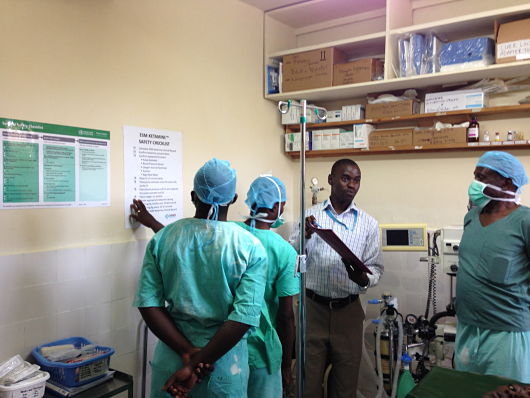
The ESM-Ketamine initiative’s goal is to train clinicians that have no background in anesthesia. The Ketamine initiative offers four days of training for mid-level and above healthcare providers for C-sections and emergency surgeries, using Ketamine as an anesthetic, when no professional anesthetist is available.
Most anesthesia training programs require around four years of training, which is simply not feasible in these developing communities, nor an immediate solution to a crisis that is happening now.
The World Health Organization estimates that 10-15% of births require a C-section. Kenya Demographic Health Survey recently reported that C-section rates in many parts of Kenya are lower than one percent of births. A 2011 Kenya Ministry of Health study also found that only 18 anesthetists exist in the Nyanza region, which has a population of 5.8 million.
Since May 29, 2015, ESM-Ketamine initiative has trained healthcare providers in various hospitals across Kenya, resulting in 231 safe, life-improving surgeries. The program’s initial success demonstrates the powerful potential that Ketamine has for making previously impossible surgeries accessible to women in developing nations, women that provide deeply-rooted social and economic stability to their communities.
When a mother dies or is disabled, her entire community is impacted, and quality of life diminishe—child death rate increases, child education decreases, and both families and communities become more economically unstable.
The maternal mortality rate (MMR), or the ratio of the number of women that die per 10,000 births, was 11.7 in the United States in 2005. In 2014, there are still places on earth where one in six women die from pregnancy related causes; in South Sudan, Afghanistan, and Sierra Leone, the MMR is as high as 2,054.8.
The ESM-Ketamine program provides an inexpensive solution that allows women to undergo cesarean sections, rather than dying or becoming seriously disabled. Healthy women enable a healthy, stable community.
– Margaret Anderson
Sources: Massachusetts General Hospital, World Journal of Surgery, Harvard H Policy Review
Photo: Massachusetts General Hospital

UNICEF’s Celebrity Goodwill Ambassadors
What do Selena Gomez, Sarah Jessica Parker and David Beckham have in common? They are all Celebrity Goodwill Ambassadors for UNICEF.
Founded in 1946 by the United Nations and made a permanent organization of the United Nations in 1953, the United Nations Children’s Fund, or UNICEF, works to ensure the rights of children. According to the Declaration of the Rights of the Child, children have rights to education, protection, health care, shelter and good nutrition. In the poorest regions of the world, children may be denied these rights because of a lack of access to resources, goods and services.
UNICEF has celebrity ambassadors and supporters in countries around the globe. The ambassadors help to raise awareness of global children’s needs, advocate to world leaders for children’s rights and set an example as globally aware citizens. There are three types of Goodwill Ambassadors and Advocates: international, regional and national. These advocates raise awareness internationally, regionally or nationally, with respect to their position.
The Celebrity Goodwill Ambassador program began in 1954 with its first ambassador, the famous entertainer on the screen and on Broadway, Danny Kaye. Following Kaye were other notable performers, actors, singers, athletes and celebrities. One such actor was Audrey Hepburn, who became a Goodwill Ambassador in 1989. In her time as an ambassador, Hepburn traveled to Turkey, Venezuela, Sudan and many other places, advocating for the rights of children.
Currently, there are over 20 international ambassadors, some of which include:
-Katy Perry: She was appointed to Goodwill Ambassador in 2013. Prior to this appointment, Perry had already visited Madagascar with UNICEF, and UNICEF used her song “Roar” in a public service announcement to help inspire girls.
-Liam Neeson: He became a Goodwilll Ambassador in 2011. Famous for his acting on Broadway and in feature films, such as Taken, which discusses trafficking in children and sexual exploitation, Neeson uses his fame to raise awareness of UNICEF’s causes, such as HIV and AIDS programs in Africa.
-David Beckham: Famous for his soccer skills on Manchester United, he used his interest in sports when he became a UNICEF Goodwill Ambassador in 2005, focusing on UNICEF’s Sports Development program. Since then, he traveled with UNICEF to places including Sierra Leone and the Philippines. In 2015, he started 7:The David Beckham UNICEF Fund, which furthers UNICEF’s mission to protect children’s rights.
These celebrities are making a lasting change in the fight for children’s rights and programs dealing with the results of poverty. With new advocates and ambassadors every year, it seems UNICEF will be able to positively change the lives of children for another 62 years and counting.
– Rachelle Kredentser
Sources: UNICEF 1, UNICEF 2, Look to the Stars 1, Look to the Stars 2, UNICEF 3, UNICEF 4, UNICEF 5, UNICEF 6, IMBD
Photo: Daily News
Ketamine Enables Life-Saving C-sections for Women in Developing Regions
“Every minute of every day, a woman dies somewhere as a result of pregnancy or childbirth,” says Thomas Burke, chief of Massachusetts General Hospital’s Division of Global Health and Human Rights.
Ketamine, an inexpensive anesthetic, is a solution to the global crisis of maternal death due to pregnancy, enabling women to undergo C-sections rather than facing death or serious injury.
Each day, 1,400 women die from causes relating to pregnancy. Pregnancy is the second largest killer of women, behind only HIV/AIDS. And for each woman that dies from pregnancy, 50 to 100 are disabled or suffer from disease. Pregnancy related death affects around 15 to 20 million women every year.
A major cause of death and injury during pregnancy is obstructed labor and a lack of availability of a cesarean section. When labor is obstructed and no C-section is available, women frequently die, suffer from postpartum hemorrhage (which can also cause death), or suffer from fistula (where the bladder and rectum walls erode and are permanently connected to the vagina).
Many clinics and hospitals in developing countries lack the ability to perform C-sections because no anesthesia or anesthesiologists are present, which are necessary for this intensive surgery. This lack of anesthesia services presents a global problem, as anesthesia can potentially save countless lives of women.
Massachusetts General Hospital is addressing this crisis. They created an innovative way to provide anesthesia services to remote, extremely impoverished regions. Their initiative is called The Every Second Matters for Mothers and Babies—Ketamine for Painful Procedures and Emergency Cesarean Section (ESM-Ketamine). Ketamine is an extremely inexpensive anesthetic; it has been used without any formal procedure around the world for over 40 years, and has a near perfect safety record even with little equipment.
C-sections are the most common worldwide operation. One study of 49 countries estimates that if there was an increase in C-sections (by 2.8 million), 59,100 cases of obstetric fistula and 16,800 maternal deaths would be prevented.
The ESM-Ketamine initiative’s goal is to train clinicians that have no background in anesthesia. The Ketamine initiative offers four days of training for mid-level and above healthcare providers for C-sections and emergency surgeries, using Ketamine as an anesthetic, when no professional anesthetist is available.
Most anesthesia training programs require around four years of training, which is simply not feasible in these developing communities, nor an immediate solution to a crisis that is happening now.
The World Health Organization estimates that 10-15% of births require a C-section. Kenya Demographic Health Survey recently reported that C-section rates in many parts of Kenya are lower than one percent of births. A 2011 Kenya Ministry of Health study also found that only 18 anesthetists exist in the Nyanza region, which has a population of 5.8 million.
Since May 29, 2015, ESM-Ketamine initiative has trained healthcare providers in various hospitals across Kenya, resulting in 231 safe, life-improving surgeries. The program’s initial success demonstrates the powerful potential that Ketamine has for making previously impossible surgeries accessible to women in developing nations, women that provide deeply-rooted social and economic stability to their communities.
When a mother dies or is disabled, her entire community is impacted, and quality of life diminishe—child death rate increases, child education decreases, and both families and communities become more economically unstable.
The maternal mortality rate (MMR), or the ratio of the number of women that die per 10,000 births, was 11.7 in the United States in 2005. In 2014, there are still places on earth where one in six women die from pregnancy related causes; in South Sudan, Afghanistan, and Sierra Leone, the MMR is as high as 2,054.8.
The ESM-Ketamine program provides an inexpensive solution that allows women to undergo cesarean sections, rather than dying or becoming seriously disabled. Healthy women enable a healthy, stable community.
– Margaret Anderson
Sources: Massachusetts General Hospital, World Journal of Surgery, Harvard H Policy Review
Photo: Massachusetts General Hospital
Temporary Protected Status Designated to Nepal
Secretary of Homeland Security Jeh Johnson designated Temporary Protected Status to Nepal on June 24, 2015.
Temporary Protected Status is granted by the Secretary of Homeland Security when nationals of a country are unable to return to their country safely, or when a country cannot adequately handle nationals returning to their country. The Secretary of Homeland Security may grant Temporary Protected Status to a country that is experiencing a civil war, a country that has experienced an environmental disaster, or a country that is in other extraordinary and temporary situations.
In this case, Nepal experienced a 7.8 magnitude earthquake on April 25, 2015. Nepal ranks among the poorer countries in the world and has a GDP of about $19 billion and a population of 27.8 million. The earthquake has caused 1 million people to fall below the poverty line and has worsened existing poverty in Nepal.
More than 8,000 people died following the earthquake, and thousands were left homeless and without proper medical care. There are several temporary camps across the country, but many are without sufficient food and water. In addition, children and families have to worry about the threat of human trafficking, which has been made worse by the earthquake.
It is for these reasons that Temporary Protected Status to Nepal was designated. Nepalese nationals are allowed to apply and reside in the United States and possibly receive an Employment Authorization Document (EAD). Nepalese nationals in the United States could also have the ability to travel and be protected from deportation. The Temporary Protected Status will last for 18 months and could possibly be extended further.
The ability of the Secretary of Homeland Security to designate a country for Temporary Protected Status is a way for countries to cooperate globally during or after a disastrous event. The United States can assist Nepalese nationals living within its borders and can also help Nepal by allowing Nepalese nationals to stay in the United States.
Nepal is working to improve conditions within the country with the help of humanitarian aid from other countries. Until then, Nepalese nationals can stay and work in the United States in order to remain safe following this crisis.
– Ella Cady
Sources: BBC, United States Senate Committee on Foreign Relations, The Guardian, Huffington Post, Immigration Impact, Times of India, USCIS
Photo: The Guardian
Education for Children with Disabilities in Ethiopia
One in seven Ethiopians has a disability. In Ethiopia, disability is generally considered to be a curse, so families as well as communities discriminate against people with disabilities. In the past, only 0.7 percent of disabled people in Ethiopia have had access to an education. This situation has been changing as education for the disabled in Ethiopia is becoming more and more inclusive.
The 2011 World Report on Disability states that attitudes toward disabilities have been shifting “from a medical understanding towards a social understanding.” Today, inclusive education is no longer an amenity but the target approach to education in both developed and developing countries.
The United Nations Educational, Scientific and Cultural Organization’s 2009 Guidelines on Inclusion in Education state: “Inclusive education is essential to achieve social equity and is a constituent element of lifelong learning.” This means that inclusive education is not a marginal issue but is a necessary component of a quality education for all learners and the development of inclusive societies.
Inclusive education means that marginalized and mainstream children are schooled together unless that approach does not provide an education of equal quality. Some services, such as physical rehabilitation or learning Braille and sign language, can still be provided outside the mainstream classroom when necessary. Marginalized children are not just children with disabilities but have been excluded due to gender, HIV and AIDS, ethnicity, language, religion, economic status and social standing.
Inclusive education is a challenge in both developed and developing countries. It requires changes in a community’s attitude, educational system and finances. It is also strongly linked to the Education for All goals and the Millennium Development Goals. In order to achieve these goals, attention must not only be paid to ensuring that all children attend school, but that they are also provided a quality education. Children who are excluded are not receiving an education of good quality.
The Ethiopian government recognizes the significant role of education in reducing poverty and sustaining economic growth. It is committed to accomplishing the EFA goals and the MDGs. In 1994, the government established an education and training policy with an overall goal of including all citizens in active participation in the community and society. Aligned with the Ethiopian constitution, the policy promotes inclusive education.
In 2009, UNESCO noted that Ethiopia had made considerable progress in reaching the EFA goals but also noted a gap in the ability to provide access to all children. It noted these specific barriers to realizing inclusive education: lack of knowledge about diversity, inadequate preparation of teachers and educational leaders, poor teaching methods, inflexible curriculum, inappropriate learning equipment, insufficient needs identification and inadequate assessment procedures. These gaps resulted in obliging students with special needs to adapt to the schools instead of adapting schools to the needs of the students.
These gaps also pointed out the need to adjust community attitudes, educational services and financial priorities in order to succeed at inclusion. In 2005, Rehabilitation and Prevention Initiative Against Disability, an organization that works to improve the quality of life for people with disabilities, began providing services in Ethiopia that address these three needs. RAPID provides community based services that focus on changing negative community attitudes and supporting children and youth with disabilities to participate as equal members of the community and contribute to the economy.
RAPIDs programs operate on four essential principles in order to realize effective inclusion of children and youth with disabilities:
1. Provide comprehensive physical rehabilitation to serve the poorest children and youth
2. Create programs and projects that help schools to ensure inclusion
3. Lead awareness raising activities that help communities learn about the causes and effects of disability and advocate for government implementation of existing policies regarding disability issues
4. Develop opportunities for youth with disabilities and their families to enter mainstream sources of employment
Since its inception in Ethiopia, RAPID has made progress on many fronts. These are some of the highlights as of 2013:
The community based rehabilitation programs have reached 450,000 people in four cities in the Arsi Zone of the Oromia Region.
The government funds a bus that transports people to rehabilitation services.
In 2009, all parents who were given a loan and training to earn a sustainable income and support their children to go to school reported earning a better income.
In these ways, schools in the Arsi Zone of the Oromia area of Ethiopia are adapting to the needs of the children and youth with disabilities. Ethiopia is on its way to removing the barriers that prevent people with disabilities from obtaining the common services of not only education but also healthcare, employment, transportation and information.
– Janet Quinn
Sources: CBM, Inclusive Education in Action, WHO, IBE
Photo: USAID
Solving the Conflict Diamonds Crisis
“‘Diamonds are forever,’ it is often said. But lives are not. We must spare people the ordeal of war, mutilations and death for the sake of conflict diamonds,” once insisted Martin Chungong Ayafor, Chairman of the Sierra Leone Panel of Experts. Although the world has come a long way since the development of various campaigns against blood diamonds, the most prominent being the Kimberley Process Certification Scheme (KPCS), the current measures in place are not effective enough and must be modified, as expressed by Global Witness.
Conflict diamonds are diamonds that originate from areas controlled by rebel forces opposing legitimate governments. These rebels use diamond profits to fund their military actions, keeping them in power. The struggles to keep a hold of these diamonds often involve torture and murder, and can lead to forced labor of civilians. Conflict diamonds have been most prominent in the Ivory Coast of Africa, but have also been apparent in other areas.
Currently, the United Nations and various humans rights groups are working to keep conflict diamonds from entering the worldwide diamond trade. In 2003, they adopted the KPCS, which requires certification of the legitimacy of the mining, production, selling and exportation of the diamonds from every nation. The KPCS also encourages customers to insist upon documentation of the legitimacy of their purchases.
While 71 countries and over 99% of the worldwide diamond trade are covered by the KPCS, the scheme does not involve a treaty. Rather, governments involved must pass national legislation promising not to trade diamonds with any country outside of the KPCS and accept any shipments sent without proper certification. Although moderately effective in a few select areas, there are still countries that the conflict diamond crisis continues to tear apart. The KPCS fails to put a halt to diamond conflicts throughout the world mainly because of its poor decision-making process and weak internal controls on its participants.
The KPCS decision-making process requires consensus. Because of this, just one participating country can block the rest of the countries from moving forward in solving the crisis. This inability to reach consensus causes the lack of management over important issues and lowest common denominator decisions. Consequently, countries are never suspended or expelled, even when clearly violating the basic policies of the scheme. As shown in The Independent, despite evidence of Venezuela’s diamonds being smuggled, Guinea’s 500% increase in diamond production each year and Lebanon’s exportation rate being higher than its importation rate, no action has been taken against any of these countries.
While participants in the KPCS are required to have a system of internal controls, each participant is allowed to decide how to actually keep conflict diamonds from entering world trade. As demonstrated by VERIFOR, the weakness of the internal controls systems of countries such as Armenia, Zimbabwe, and Brazil have highly contributed to the failure of the KPCS in stopping diamond conflict. In studies conducted in Armenia, Global Witness found that the country, which has no internal source of diamonds, allows conflict diamonds to enter world trade because of a governmental lack of oversight in cutting and polishing centers. Rough diamonds can easily be smuggled into factories and no longer fall under KPCS control once they are polished in the centers.
While Armenia’s legislation acts in accordance with the KPCS, there is a lack of internal controls systems in the country when it comes to the KPCS, easily allowing smuggling in and out of the polishing and cutting factories. The Gemstone and Jewelry Department (GJD), Armenia’s Kimberley Process Authority, does not have policies to verify the figures or the movements of polished diamonds, for Armenian tax officials disclose this information. The GJD performs physical inspections of some cutting and polishing companies, but it informs the companies of these visits prior to the actual inspections. This gives the factories the opportunities to prepare for these visits, with ample time to hide or get rid of any diamonds that could stimulate concern among the GJD officials.
This has propelled theories that Armenia has provided diamonds to Nagorno-Karabakh, which is not covered by the KPCS. If this is true, Armenia is violating KPCS standards. Similar situations have occurred in other countries. In order to control situations like these, the KPCS must require a strict system of internal controls in which the government must oversee the values and movements of diamonds in polishing and cutters centers. Companies that cut and polish diamonds must also become more involved in the KPCS.
In order to make the changes necessary to make the KPCS more effective, it is essential to establish a central body of knowledge in each KPCS participant’s government. These central bodies must oversee the movement of rough and polished diamonds and compare these numbers with the diamonds originally mined and imported in the country. Stricter definitions and amendments must also be added to the actual KPCS core document; the main goal of the KPCS to preserve human rights must be expressed clearly.
There has been success in the blocking of conflict diamonds from entering world trade since the implementation of the KPCS. Consumers are currently more conscience of the issue and often think about this while purchasing diamonds, as many major jewelry companies offer documentation of the legitimacy of the diamonds. There has also been success involving monitoring and the peer review mechanism of the KPCS. Despite the minor successes of the scheme, the KPCS evidently still has a long way to go regarding its reforms and policies.
– Arin Kerstein
Sources: Global Policy 1, Global Policy 2, Global Witness, Institute for Human Rights and Business, The Independent, United Nations
Photo: Kaia Joyas
A Strange Look Into Turkey’s Mad Honey
It’s a substance that would raise an eyebrow or two for its potentially deathly effects, but for some natives in Turkey, poisonous honey is a treat worth “dying for.”
Dating back to 401 B.C., Greek philosopher Socrates’ pupil Xenophon detailed his fascination with and discovery of a honeycomb that had inflicted the jittering in soldiers’ legs and a “fit of madness” among those who had consumed a large amount of the substance.
The pain-causing honey would be known as “mad honey,” and upon further discoveries, in 67 B.C., it proved useful as a lethal weapon for the Persians’ fight against Roman treachery, when opposing forces mistakenly “gobbled it up” and fell into an extreme state of hysteria.
Centuries later, the Black Sea would serve as an abundant harvesting zone for the honey, initiating trade with European regions in the 1700s for infusing the toxin with alcoholic beverages for high risk-taking drinkers. Since the exportation, mad honey has found its way into outside countries like Japan, Germany and Switzerland.
It wouldn’t be brought into the public eye until two centuries later: the toxic-coated honey made its rounds at public health clinics throughout the mid- to late 1980s, when 11 patients were admitted for poisoning pertaining to the intake of mad honey.
Determined by health analysts, the poisonous substance is typically found in the eastern Black Sea region of Turkey, where nearby northern Turkey-bred bees roam rhododendron flower beds retaining grayanotoxin, the offsetting poison trigger thriving within the nectar of mad honey. Although in earlier studies it was always noted for its hazardous aftereffects, the alleged benefits of consuming mad honey include treating diabetes and improving sexual performance.
The benefits have since then ignited forms of debate by fellow travelers and “honey experts,” who proclaim that such allegations are only marketed as “belief” tools to contribute to further purchases of the substance.
Every now and then, the product will be requested by a large number of consumers, especially adventurous travelers visiting Turkey.
In 2011, British publication The Guardian warned readers that no more than one teaspoon of mad honey should be consumed at a time, as it will immediately trigger an irregular heartbeat (yet “rarely” cause fatal damage).
Although the news source reported that one would have to track down rare, hard-to-find carriers if one wished to try the toxic delight, mad honey has been serviced via online purchase at prices over USD$160.
Though it is remotely legal upon purchase in Turkey, and may be viewed to some degree as a “responsible” intake substance, some are wary of the potential consequences it could have on the misinformed.
In a 2012 public health study conducted by lead researcher Suze A. Jansen, if cattle are to ingest the mad honey, they will be prone to an assortment of neurological side effects; their response is more hazardous than that of humans.
Unearthed, Jansen found that cattle were more susceptible to lethal aftereffects if they consumed large quantities of mad honey. Among humans, it is rare for there to be a case where more than a drop is ingested.
As research continues to develop, analysts are currently placing the proposed claims of increased sexual performance into clear perspective. They are also determining whether or not mad honey should be pulled off the shelves of selected Turkish stores, and if doing so will lead to the end of underground purchases from online vendors.
– Jeff Varner
Sources: NCBI, The Guardian, NCBI, Modern Farmer, SFGate
Photo: Deep Roots At Home
The Unprecedented Greek Brain Drain
With the Greek economy in the throes of crisis, and its exit from the EU imminent, employment prospects for educated Greek professionals seem bleak. Questions over their homeland’s future have caused a mass exodus among many educated Greeks. The emigration of Greece’s most talented professionals has earned an informal name in the media; they are called ‘Grexit’s.
In fact, the modern western world has never before experienced a brain drain on this scale; Emigration levels have increased by 300% from before the crisis hit at the onset of the Great Recession. This diaspora exceeds 200,000.
Of those that have emigrated, educated professionals represent a sweeping majority, with up to 180,000 possessing a university degree. Over 10% of Greek professionals currently work and reside abroad.
After looking at the figures, it is not hard to understand why so many young and talented Greeks have left their homeland. The employment rate for those under 24 stands at an abysmal 50%, and between 2008 and 2013 Greece lost nearly 1 million jobs—over half of which belonged to young people. Considering that Greece’s total population stands at around 11 million, this represents a substantial decline in employment opportunities.
Those that have escaped the inhospitable economic climate have found better job prospects in professional fields abroad. Destinations in Europe are the most popular, with countries like Germany and the UK accepting more than half of Greece’s emigrants.
Germany in particular has become a receptacle for many aspiring Greek doctors, as its well-funded healthcare system has a large demand for personnel. So far, 35,000 Greek doctors have traveled to Germany where their pay is substantially better. Ironically, Greece actually possesses a surplus of medical professionals and has more neurosurgeons than even Germany, the largest country in Europe by population. This fact highlights an important, yet tragic, facet of the Greek Brain Drain; Greece possesses a disproportionally large number of high achieving and highly educated people, many of whom have already left.
Three percent of the world’s most prominent scientists hail from Greece. While that figure may seem measly, Greece’s population represents only .2 percent of the global population. Despite all of Greece’s scientific heft, 85% of these globally recognized scientists conduct their research and reside outside of their home country.
For Greece, this represents a devastating loss of investment. Funds spent on education, from both government programs and from family’s pockets, has essentially gone to waste; those who have enjoyed a Greek education and then chose to work abroad are not innovating at home. With so many talented professionals leaving, it will become more challenging for Greece to pull itself out of its depression.
Greek professionals are not alone, as 46% of Greeks have entertained the idea of emigrating from their home country. With this attitude settling upon many, the problem has only compounded. According to the managing director of Endeavor Greece, Haris Makryniotis, “there is a sense of paralysis, and it’s gotten worse since the elections in December.”
Greek banks have also mirrored this mindset and have stopped giving out loans. According to a report by CNBC, this “means that if you are running a business, there is no debt financing available for working capital right now. And if you are an entrepreneur looking for start-up capital, investors are not untying their purse strings.” Effectively the Greek economy is at a standstill.
There are no quick solutions to a crisis such as this. In order for Greece to prosper, its people, including its reluctant expatriates, must look towards the future. Many hope to return once the economy is back on its feet. Hopefully, at the end of their odyssey abroad, they will find themselves back home once again.
– Andrew Logan
Sources: CNBC, The Economist, The Guardian, NPR
Photo: CNBC
US State Department Country Reports on Human Rights Practices
On June 24, the US State Department released the Country Reports on Human Rights. The Country Reports on Human Rights are mandated by Congress in the Foreign Assistance Act of 1961 and the Trade Act of 1974. These acts describe the performance of governments that receive U.S. foreign assistance and of all United Nations member states. The performance of a government is determined by how much a country conforms to the Universal Declaration of Human Rights that outline civil, political, individual and worker rights.
The Department of State prepares these reports using information from U.S. embassies, foreign government officials, nongovernmental organizations and published reports. U.S. diplomatic missions prepare the initial drafts of the individual country reports. The Bureau of Democracy, Human Rights, and Labor (DRL) and other Department of State offices work to document, evaluate and edit the reports.
In 2014, there were a few trends in regard to human rights abuses. While many governments repressed and harmed citizens, many non-state actors also committed horrible human rights atrocities. As observed before, there is a correlation between corruption, human rights abuses and repressive governance.
Many countries had many human rights abuses. The President of Syria, Bashar Asad, continues to attack innocent civilians in an ongoing civil war between the government and citizens who oppose the government’s leadership. ISIL emerged partly because of a non-inclusive government in Iraq. In the Middle East and Africa, ISIL has both killed people and sold girls into slavery. In Nigeria, Boko Haram attacked school children and captured young girls. Countries such as China, Egypt, Eritrea, Ethiopia, Iran, Russia and Saudi Arabia do not allow open media markets and imprison journalists.
Even though many countries still do not recognize certain human rights, or disregard human rights altogether, many countries have given more rights to citizens than ever. In Afghanistan, millions elected a new President. Similarly, India had one of the largest parliamentary elections in history in 2014. Indonesia elected a leader who challenged traditional centers of power. In addition, Tunisia held its first democratic election in 2014.
These reports, along with other reports on human rights from other countries, will help educate the public about international human rights. These reports will allow citizens to learn more about human rights abuses, but they can also help people learn about human rights successes. Education is a vital step to help foster human rights internationally.
– Ella Cady
Sources: Council on Foreign Relations, U.S. Department of State
Photo: Flickr
40% of African American Children Living in Poverty
For the first time since the United States began keeping Census records, the number of African American children in poverty has surpassed that of white children. As of 2013, there were reportedly 4.2 million African American children living below the poverty line versus 4.1 million white children. What makes this statistic even more alarming is the fact that white children outnumber African American children under the age of 18 by three to one.
According to an article by USA Today published on July 16 of this year, “The poverty rates for Hispanic, white and Asian children improved as the United States emerged from an economic recession, but for African-American children, little changed. Poverty is defined as living in a household with an annual income below $23,624 for a family of four.” African American children have suffered more than any other demographic in the United States over the past few decades.
Location is largely to blame for the disparity among African American children. Poor black neighborhoods have remained in poverty for decades without any real sign of improvement. The poverty numbers are highly concentrated in these primarily urban, black areas. Detroit has emerged as a hot-spot for African American children.
In the Michigan city, roughly 60 percent of these children are in poverty, significantly higher than anywhere else in the area. An excerpt from CBS reporting on the matter says, “In Detroit, the jobs have left, the good schools have left, there is poor transportation, high insurance rates, and difficulty getting reasonably good paying jobs.” African American children in poverty suffer as a direct result of their environment.
This trend will continue to increase and spread rapidly across the country if real change does not come soon. More African American children are continually falling behind because of a lack of proper education and social reform. The numbers will continue to grow until the government begins to take this situation seriously.
– Diego Catala
Sources: USA Today, CBS Global
Photo: Flickr
Why You Should Vote for a Candidate With Foreign Policy Experience
I expect that you, like most Americans, are beginning to ponder who you’re going to vote for in the upcoming presidential election. If this is the case, then you might also be causally conversing about or considering the factors most important to your decision. Let me draw your attention to one of the most significant aspects of the presidency, foreign policy.
For a President to be successful in foreign policy it is fairly likely that they will need to have foreign policy experience. When you hear the words foreign policy your mind might initially jump to the conflict in Ukraine and the threats from ISIS. The less considered aspect of foreign policy is foreign aid. If a president does not have a good deal of foreign policy experience, as we saw with President Barrack Obama, it is likely that this president may neglect foreign aid and focus only on military conflicts. This is a problem because foreign aid is integral to the United States’ economics and national security.
Foreign aid has been neglected in foreign policy and viewed as “charity” rather than as a strategy for a long time. During the Obama administration, this neglect grew. According to ForeignPolicy.com USAID, the United States’ aid organization, has had about a 16 percent drop in funding since 2009.
Before Obama was elected many concerns were raised, as described by an article in Time magazine, about Obama’s lack of experience in the foreign policy arena. The article stated that perhaps his international experience would prove to be enough.
It appears that this was not the case.
“Obama’s critics see a president adrift, lacking firm convictions or a strategy for dealing with the world,” says an article by Elias Groll on ForeignPolicy.com. Others such as Dr. Colluci on U.S. News and World Report even go as far as to describe Obama’s administration as a “foreign policy vacuum.” While perhaps this is a little extreme, it is fair to say that Obama did in fact have little experience in foreign policy and that is reflected in his actions abroad as a president.
Obama has focused too much on military conflicts and strategy and has allowed aid funding to decline significantly. Perhaps if he had had more experience he would have learned an important lesson before becoming president: that the global security that he has been working toward could be better sought through stabilizing countries economically and through building infrastructure.
Foreign aid can both spread democracy, as has been the United States’ goal since the Cold War, and fight terrorism. Perhaps Washington should return to foreign aid as a strategy, rather than continuing to use the military to maintain its sphere of influence.
The Marshall Plan could arguably be listed as one of the United States’ greatest foreign policy successes. This move gave the United States the influence it sought, stabilized countries after World War II, and spread democracy.
In addition, while poverty does not necessarily cause terrorism, reducing global poverty will reduce the human resources of terrorist organizations. Not only that, but reducing global poverty will also prevent at-risk populations from being recruited by these organizations in the future.
The next President should be someone who has had enough experience to realize the importance of foreign aid for these reasons. The president should have had enough military and aid experience to know the value of each, and enough foreign policy experience to know that the military is not the most vital part of our national security.
Even if this president does not know the importance of aid to United States’ foreign policy, I hope that at the very least they will realize that increasing U.S. foreign aid will provide a new job market for United States citizens.
– Clare Holtzman
Sources: The Borgen Project, Clingendael, Foreign Policy 1, Foreign Policy 2, Time, U.S. News & World Report